Huadong Medicine Submits NDA for Novel Oral GLP-1 Agonist HDM1002 (Conveglipron) for Weight Management

Huadong Medicine
Large Comprehensive Pharmaceutical Product Developer
November 2, 2026: According to information from the official website of the Center for Drug Evaluation (CDE) under the National Medical Products Administration, the marketing application for Huadong Medicine’s Class 1 innovative drug, carvedilol tromethamine tablets, has been accepted.
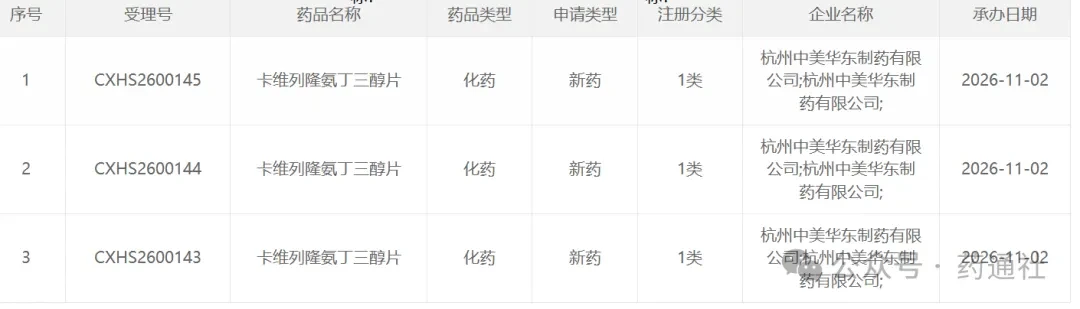
On September 27, Huadong Medicine announced that its self-developed Class 1 innovative drug, HDM1002 tablets (Conveglipron), had achieved positive top-line results in the Phase III clinical study (HDM1002-301) in China for weight management in overweight or obese populations.
According to the company’s disclosure, both the 200 mg and 400 mg dose groups of HDM1002 tablets achieved all primary and key secondary endpoints at Week 44. At Week 44, the mean body weight reductions from baseline were 9.2% and 10.7% in the two treatment groups, respectively, compared with 1.5% in the placebo group. By Week 52, the mean weight loss in the two treatment groups further increased to 10.7% and 12.2%, respectively, while the placebo group showed a 1.2% reduction, with no obvious weight-loss plateau observed to date.
HDM1002-301 is a multicenter, randomized, double-blind, placebo-controlled Phase III study that enrolled 857 adult patients with obesity or overweight and at least one weight-related comorbidity. Participants were randomized in a 2:2:1 ratio to receive HDM1002 tablets 200 mg, 400 mg, or placebo for a treatment period of 52 weeks.
In terms of weight loss target achievement, at Week 52, the proportions of patients with weight reduction ≥5% were 74.6% and 79.6% in the 200 mg and 400 mg groups, respectively; those with weight reduction ≥10% were 46.7% and 53.9%, respectively; and those with weight reduction ≥15% were 21.1% and 29.1%, respectively, all of which were higher than those in the placebo group.
In addition to weight loss, changes in body composition and metabolic parameters were also observed with HDM1002. DEXA analysis at Week 44 showed that the percentage of total fat mass decreased by 7.0% and 8.3% from baseline in the 200 mg and 400 mg groups, respectively; the percentage of visceral fat mass decreased by 13.3% and 14.4%, respectively; and the percentage of total lean body mass increased by 4.6% and 5.6%, respectively.
In subjects with comorbid fatty liver, hepatic fat content at Week 44 decreased by a median of 47.8% and 51.6%, respectively, compared to baseline, versus a 6.4% decrease in the placebo group. Meanwhile, improvements were also observed in multiple parameters, including ALT, AST, waist circumference, fasting blood glucose, HbA1c, blood pressure, and triglycerides.
In terms of safety, the overall safety profile of HDM1002 was consistent with the known characteristics of GLP-1 receptor agonists. The most common adverse events were nausea, vomiting, and diarrhea, which were mostly mild to moderate in severity and occurred primarily during the dose escalation period. The rates of treatment discontinuation due to adverse events were 1.5%, 2.0%, and 0.6% in the 200 mg, 400 mg, and placebo groups, respectively.
HDM1002 is an oral small-molecule GLP-1 receptor agonist. Huadong Medicine has completed the pre-NDA consultation for the weight management indication of this product and is about to formally submit its marketing application in China.
Currently, the GLP-1 market in China is still dominated by injectables, with no oral small-molecule GLP-1 products yet approved for marketing. Globally, Eli Lilly’s oral small-molecule GLP-1 receptor agonist, orforglipron, has already received marketing approval. As oral formulations advance into late-stage clinical trials, competition in the GLP-1 market is beginning to extend from traditional injectable formulations to oral small-molecule drugs.
For Huadong Medicine, HDM1002 is one of the key innovative candidates in its metabolic disease pipeline. In addition to this product, the company also has HDM1005 and DR10624 in late-stage clinical development.
Among them, HDM1005 is a long-acting dual-target peptide agonist of GLP-1R/GIPR. The interim analysis of the primary endpoint at 40 weeks for its Phase III clinical study in China for weight management indications has been completed, and the company expects to submit a Pre-NDA communication application in the fourth quarter of 2026; DR10624 is a triple-target candidate drug targeting FGF21R/GCGR/GLP-1R, which has currently advanced to Phase III clinical trials.
From obtaining Phase III data for a single oral GLP-1 product to advancing multiple innovative metabolic drugs into late-stage clinical development, Huadong Medicine’s GLP-1 pipeline has formed a portfolio of products with diverse formulations, targets, and indications. As HDM1002 enters the marketing application stage, the company’s metabolic business will also enter a critical phase of transitioning from clinical research and development to commercialization.