Johnson & Johnson Discloses Early Clinical Feedback and R&D Plans for OTTAVA Surgical Robot

Johnson & Johnson
Medical Device R&D and Manufacturer

On November 2, 2026, Rocco De Bernardis, Global President of Johnson & Johnson’s Soft Tissue Robotics and Digital Surgery business, revealed in a recent interview thatEarly Clinical Application Feedback and Subsequent R&D Plan for the OTTAVA Laparoscopic Surgical RobotThe company’s inaugural clinical study enrolled 30 patients and completed a 30-day follow-up. Among the six operating rooms where the system was utilized, five had not previously been equipped with surgical robots, and the smallest operating room measured only approximately 22.6 square meters.
Johnson & Johnson also disclosed feedback from 20 survey respondents regarding product usage. Among them, 100% believed that OTTAVA could facilitate robotic surgery in operating rooms with limited space, 95% considered the system’s compact footprint conducive to improving operating room workflow efficiency, and 90% felt it enhanced visibility, collaboration, and communication within the operating room. These data are derived from early, small-sample usage surveys, reflecting respondent evaluations rather than clinically or operationally validated outcomes from controlled studies.
OTTAVA Received U.S. FDA De Novo Marketing Authorization on July 22, 2026, covering 10 types of general surgical procedures. Johnson & Johnson is currently advancing initial commercialization to select U.S. customers, while conducting a new round of clinical studies on inguinal hernia surgery, and plans to expand into specialties such as urology and gynecology.
#Initial Disclosure of Operating Room Usage Feedback
OTTAVA’s first clinical study enrolled 30 patients, with a 30-day postoperative observation period. Johnson & Johnson stated that the study met its prespecified safety and performance endpoints, serving as key clinical evidence for its FDA marketing authorization in July 2026.
This interview newly discloses information regarding the operating room space and its actual usage.
The six operating rooms participating in the clinical study were distributed across multiple medical institutions, five of which had not previously performed robotic surgeries, primarily due to spatial constraints. The smallest operating room measured only 243 square feet, equivalent to approximately 22.6 square meters.
During the integration of surgical robots into hospitals, operating room area, equipment placement, and circulation space for medical staff are critical factors influencing installation and usage. Existing laparoscopic robotic systems may adopt a centrally suspended robotic arm structure or be arranged as multiple independent robotic arm carts surrounding the operating table. In addition to the footprint of the equipment itself, hospitals must also account for space requirements for anesthesia machines, instrument tables, imaging equipment, and the operational workspace of healthcare personnel.
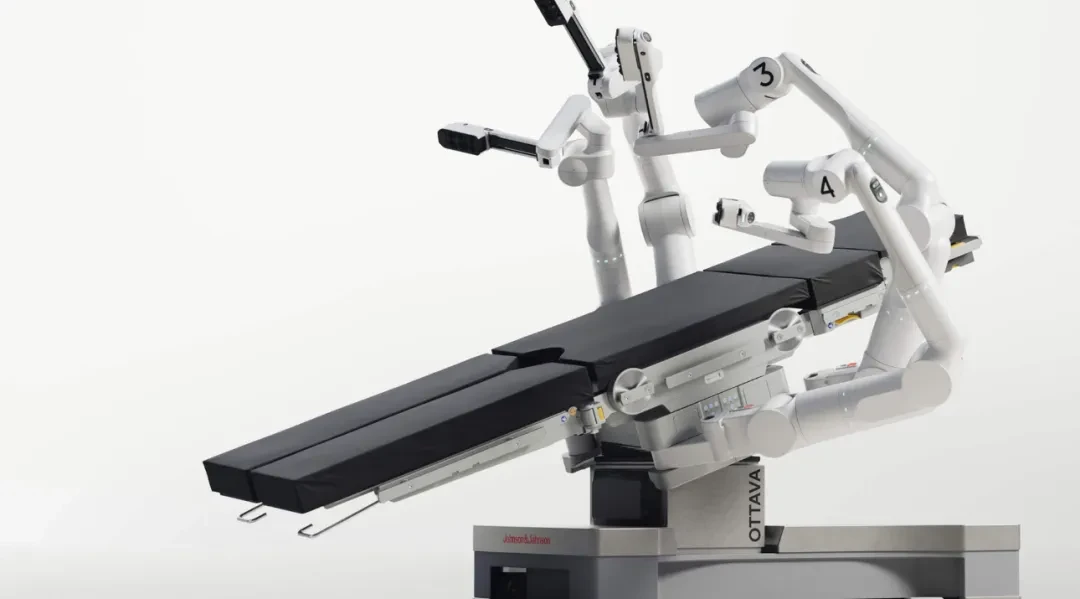
OTTAVA adopts an integrated operating table structure, with its four robotic arms directly mounted on the operating table, thereby reducing the space requirements for independent robotic arm carts or large overhead suspension systems.
According to the technical data released by Johnson & Johnson in July 2026,OTTAVA’s system footprint is approximately 30%–50% smaller than that of traditional suspended and cart-based robotic systems.. This figure is based on the company’s assessment methodology for existing market systems as of September 2025.
#Automatic Positioning, Synchronous Movement of Table and Arm
OTTAVA’s product design centers on operating room space, equipment preparation, patient positioning, and surgical data management.
During the equipment preparation phase, the system features preset robotic arm positions tailored to different surgical procedures. Once the surgical team selects the appropriate procedure, the robotic arms automatically move to the designated initial positions, thereby eliminating the need for manual adjustment of each individual arm. Johnson & Johnson states that the system employs an integrated design, obviating the need for separate calibration or registration steps traditionally required.
Another major feature isTwin Motion (Synchronous Movement of Bed and Arm)。
During laparoscopic surgery, surgeons often need to adjust the patient's position, such as by tilting the operating table, to utilize gravity in shifting tissue positions and thereby create better anatomical exposure for surgical maneuvers.
OTTAVA’s robotic arms can move in synchronization with the operating table, maintaining their relative positional relationships during patient repositioning. This feature is designed to minimize the need for repeated instrument withdrawal, disconnection, and re-docking of the robotic arms during position adjustments, thereby supporting multi-quadrant surgical procedures.
The system is also equipped with specially designed robotic surgical instruments, including:
2-in-1 Needle Holder: Designed for suturing procedures to minimize the risk of accidental suture cutting.
Monopolar Curved Scissors: Used for tissue cutting and dissection.
Other Robotic Surgical Instruments: Supports grasping, dissection, suturing, and other maneuvers for approved general surgical procedures.
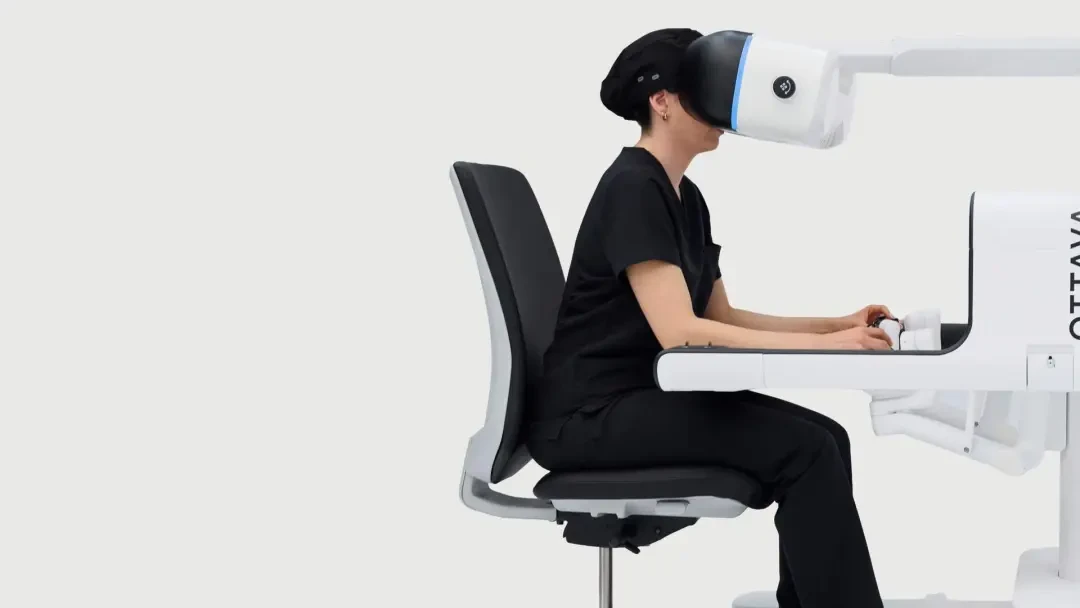
The surgeon console features a seated operation design, equipped with a head-mounted display and dual-hand controllers, and supports the saving of personalized operational settings.
In terms of digitalization, OTTAVA connects with Johnson & Johnson’s Polyphonic Digital Surgery Platform. This platform integrates surgical video, device data, education and training, and data analytics capabilities, providing surgical teams with tools for surgical data management and learning.
Johnson & Johnson has identified automation and AI as key directions for future development. Currently disclosed features, such as automated patient positioning and synchronized movement of the table and robotic arms, are primarily designed to support surgical preparation and workflow operations, with surgical procedures remaining under the control of surgeons.
#10 surgical procedures approved; second clinical study initiated
In July 2026, OTTAVA received FDA De Novo marketing authorization for use in a variety of general surgical procedures, including: Roux-en-Y gastric bypass, gastrectomy, cholecystectomy, splenectomy, sleeve gastrectomy, small bowel resection, appendectomy, lysis of abdominal adhesions, fundoplication, and hiatal hernia repair.
These procedures provide an initial scope of application for OTTAVA’s entry into the U.S. general surgery market.
In an interview on November 2, Rocco De Bernardis confirmed that Johnson & Johnson has launched the second clinical study in the United States, targetingInguinal Hernia SurgeryFurther evaluation will be conducted. The company has also identified urology and gynecology as future directions for indication expansion.
Currently, expanded indications for inguinal hernia, urology, and gynecology are not included in the aforementioned initial FDA authorization. Subsequent market entry remains contingent upon clinical studies, regulatory submissions, and approval outcomes.
Johnson & Johnson also plans to drive the entry of OTTAVA into the European and Asian markets, but did not disclose specific approval timelines or commercial installation arrangements for these regions in this interview.
#From the Surgical Robot Itself to Operating Room Operations
OTTAVA has currently adopted an initial commercialization strategy targeting select U.S. customers. Johnson & Johnson has incorporated some physician feedback gathered from the first clinical study into the commercial version, but has not yet disclosed the actual number of units sold, the number of hospitals with installed systems, equipment pricing, or the cumulative volume of commercial procedures performed.
For hospitals, investment in robotics involves not only equipment procurement but also operating room retrofitting, medical staff training, surgical instruments, consumables, equipment maintenance, and the daily case volume capacity of the operating rooms.
Johnson & Johnson’s product solutions cover multiple aspects of this workflow: reducing space requirements through an integrated bed-arm structure, optimizing operational workflows via automatic positioning and synchronized bed-arm movement, managing surgery-related data through the Polyphonic platform, and providing complementary training and equipment services.
Johnson & Johnson also provides multi-tiered maintenance solutions for OTTAVA, including remote fault diagnosis, spare parts supply, and comprehensive support for the surgical table and uninterruptible power supply (UPS) system.
#MedRobot Insights
OTTAVA’s current primary commercialization challenges include: converting approved procedures into a stable surgical volume, continuously expanding clinical indications, and validating whether its spatial and workflow design can deliver quantifiable operational benefits to hospitals.
Thirty clinical studies and twenty user feedback reports have provided early reference points. As initial commercialization advances in the United States, metrics such as surgical preparation time, operating room turnover efficiency, equipment utilization rates, and long-term usage costs will provide further evidence to assess the actual competitiveness of OTTAVA.
Well-Known Surgical Robot System Manufacturers and Upstream/Downstream Enterprises
Comprehensive▌Micro-invasive Robot | Tuodao Medical | Intuitive Fosun | Weigao
Endoscope▌Edge Medical | Sizherui Intelligent Medical | ConoStent
Orthopedics▌Rosenbot | Yuanhua Intelligence | Changmugu | Xinjunte| Stryker
Vascular Intervention▌Aibo Hechuang | Vimai Medical
Puncture Robot▌True Health | WeiDe Precision
Gastrointestinal Endoscopy Robot▌Robo Medical
Surgical Robot Instruments▌Good Physician| Golden Raindrops