Home Crinetics Pharmaceuticals Announces FDA Approval of Palsonify (paltusotine), the First Oral SST2 Agonist for Acromegaly

Crinetics Pharmaceuticals Announces FDA Approval of Palsonify (paltusotine), the First Oral SST2 Agonist for Acromegaly

Sep 26, 2025 12:48 CST Updated 12:48
Ipsen

Biopharmaceutical Manufacturer

图片
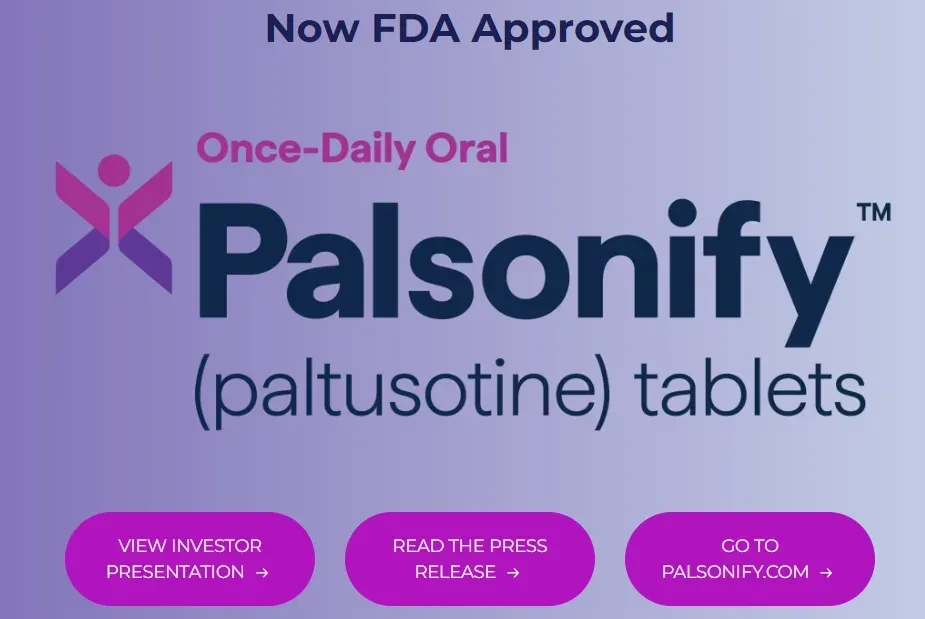
Recently (September 25), Crinetics announced that the FDA has approved the novel non-peptide SST2 (somatostatin receptor type 2) agonist paltusotine (brand name: Palsonify) as the first oral medication for acromegaly to be launched.
Image
Affected by this, on September 25, Crinetics applied to Nasdaq for a T1 trading halt. The suspension was due to the pending release of significant news that could impact the stock price, and the stock would remain halted until the news was disclosed.Previously, we reported that the company was initiated by Baker Brothers, one of BeiGene's major shareholders, in Q2.
Image
The market for acromegaly has long been dominated by Ipsen and Novartis. As the first new mechanism oral drug, the approval of paltusotine this time will signify a major shift in the existing treatment landscape.
Advantages of Paltusotine over Other Therapies
Acromegaly is caused by the growth of a tumor in the pituitary gland, which in turn leads to excessive secretion of growth hormone (GH) by the liver, producing insulin-like growth factor-1 (IGF-1). Excessive GH and IGF-1 promote overgrowth of bones and soft tissues throughout the body.
In children, this leads to gigantism; in adults, it causes acromegaly, with abnormal growth and cardiomyopathy occurring in soft tissues such as the face and heart, along with liver enlargement and proliferation of the skin and cartilage.
The common standard treatment is surgery on the pituitary, but it is often difficult to completely remove all tumor tissues, relying purely on luck. The current first-line treatment drugs are mainly somatostatin analogs (SSA), such as Octreotide and Lanreotide (Somatuline), which occupy over 65% of the market share. Lanreotide is more clinically favored due to its extended dosing cycle of up to 28 days.
Even with once-a-month injections, it still causes significant inconvenience to patients. The administration of Somatuline is relatively complex, creating various inconveniences for patients. Since launching the microsphere injection formulation of this product in 1995, Ipsen has continuously worked on improving the delivery device and method to optimize the patient experience.
As the first once-daily oral SST2 non-peptide agonist, Paltusotine can significantly improve patient compliance, making it especially suitable for groups with poor adherence to injections.
CrineticsThe company submitted a new drug application in December 2024, based on data from two Phase III clinical trials — PATHFNDR-1 and PATHFNDR-2.
PATHFNDR-1The target population is patients with a history of injection treatment. Results published in 2023 showed that 83% of patients taking the drug reached the upper limit of normal IGF-1 levels, compared to only 4% of those taking the placebo.
PATHFNDR-2 TrialThe target population is patients who have not previously received injectable treatments.Results from the PATHFNDR-2 trial, published in 2024, showed that 56% of patients taking Palsonify reached normal IGF-1 levels, compared to only 5% in the placebo group.
The Company's Future Plans
Crinetics is currently well-funded, with a total of $1.2 billion in cash, equivalents, and investments, which is sufficient to support the company’s growth through 2029. The company anticipates that paltusotine will be approved for marketing in the EU in the first half of 2026.
In addition to the recently approved acromegaly, the company also has plans to expand paltusotine into neuroendocrine tumors (NET). Since the SST2 receptor is highly expressed in NET, paltusotine may control tumor progression by inhibiting hormone secretion.
In fact, many radiopharmaceuticals (and their tracers) currently under development are also targeting SST2, and future developments can be anticipated.
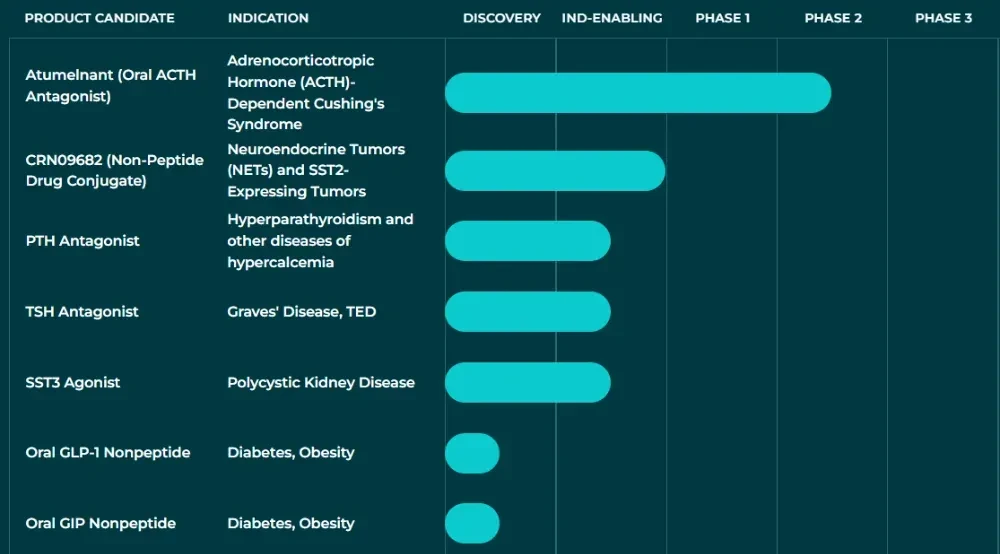
Beyond paltusotine, the company has also developed multiple endocrine-related pipelines, all of which are researched and developed around the company's GPCR (G protein-coupled receptor) drug development platform.
For example, Atumelnant, the world's first small-molecule ACTH receptor antagonist to enter clinical development, can inhibit excessive cortisol secretion by blocking the adrenocorticotropic hormone (ACTH) signaling pathway. Its indications are classic congenital adrenal hyperplasia (CAH) and Cushing's syndrome. The current main treatments for these two diseases have poor compliance and many side effects, leaving a significant market gap.
Image
Reference Source:
https://crinetics.com/news-events/?filter=events


Image
·
·
·
Image
·
·
·

·
·