

Another Chinese BCI Company Starts Pre-IPO Tutoring: Who Will Be the World's First BCI Stock?

StairMed
Developer of Implantable Brain-Computer Interface Technology
Neuracle
Developer and Manufacturer of Brain-Computer Interface Systems and Related Equipment
Arfysica Innovation
Brain-Computer Interface Technology Researcher

BrainCo
Non-invasive brain-computer interface technology solution provider

NeuroXess
Invasive Brain-Computer Interface Developer
One day earlier, Shanghai StairMed Technology Co., Ltd. filed a pre-IPO tutoring registration with the Shanghai bureau of the China Securities Regulatory Commission (CSRC), with Huatai United Securities as its tutoring institution. It is understood that the two sides signed the tutoring agreement on October 30.
The news spread quickly through the industry. StairMed is the fourth Chinese brain-computer interface (BCI) company to head for the capital markets this year. A star project in the primary market, the company focuses on fully invasive BCI. In March 2026, StairMed secured a RMB 500 million strategic financing round led by Alibaba, seen as the first joint bet by Alibaba and Tencent in the BCI field. As of September this year, the company had raised RMB 2.6 billion in total, with shareholders also including industrial capital such as Tencent, Geely and CATL, making it the company with the highest cumulative financing among domestic peers.
Beyond that, StairMed's more striking results are on the product side. To date, StairMed has completed long-term implantation of fully invasive BCIs in 42 patients, with subjects accumulating more than 5,000 days in the body and more than 10,000 hours of brain-control use; the number of implants exceeds the 27 cases publicly reported for Neuralink. Meanwhile, WRS 01, the company's core 256-channel minimally invasive implantable system, was the first fully invasive product to enter the NMPA's Special Review Procedure for Innovative Medical Devices, and in August this year completed enrollment of all subjects in its multicenter registrational clinical trial.
China's BCI IPO Contingent Completes Its Battle Formation
Before StairMed, the race for China's first listed BCI stock was already crowded with star projects.
Currently the furthest along is Neuracle. In June 2026, Neuracle filed a STAR Market IPO application that was accepted by the Shanghai Stock Exchange, with CITIC Securities as sponsor and plans to raise RMB 2.5 billion, of which RMB 1.54 billion goes to BCI R&D projects, RMB 410 million to industrialization and RMB 550 million to working capital. Less than two weeks later, Neuracle entered the inquiry stage.
Neuracle's strongest card is the world's first Class III medical device registration certificate for an invasive BCI. In March 2026, Neuracle's self-developed implantable BCI hand motor function compensation system NEO-ONE SCI was approved for marketing, indicated for hand grasp function compensation in patients with quadriplegia caused by cervical spinal cord injury. The registrational clinical trial of NEO-ONE SC was led by Huashan Hospital and Xuanwu Hospital, with 11 hospitals nationwide participating; 32 patients were enrolled and operated on in 78 days, and the grasp response rate at 3 and 6 months after surgery was 100%.
However, a set of figures in the prospectus also reveals an awkward side of BCI at this stage. Data shows that in the first half of 2026, Neuracle generated revenue of RMB 46.344 million, of which EEG acquisition systems contributed RMB 29.7007 million, or 64.56%, while in 2025 that share was even higher at 72.32%. The invasive products that carry real expectations have performed relatively poorly. In the first round of inquiry, Neuracle replied that it had completed procurement platform listings in 27 provinces at a listed price of RMB 475,000 per set, had sold 13 sets since July with 8 implanted at end sites, held orders and letters of intent for more than 70 sets, and recorded a net loss of RMB 65.4797 million in the first half. Clearly, BCI is not yet what is holding up Neuracle's top line.
Arfysica Innovation follows close behind. On September 4, Arfysica Innovation filed its tutoring registration with the Shanghai bureau of the CSRC, likewise aiming for the STAR Market. Founded in 2015, Arfysica Innovation takes the non-invasive route; founder Wang Wei holds a PhD in biomedical engineering from the University of Southampton and previously served as a global core expert at Siemens Healthineers. Arfysica Innovation has completed successive B+ and C rounds in the hundreds of millions of yuan. Unlike Neuracle, Arfysica Innovation's BCI-plus-exoskeleton rehabilitation system is already in use at institutions such as Changhai Hospital. It is understood that Arfysica Innovation plans to submit its application before the end of the year and hopes to pass the listing review in the first half of next year.
Earlier in the year, BrainCo filed confidentially with the Hong Kong Stock Exchange on January 12, with CICC and UBS as joint sponsors. Before the filing, the company had just completed a Pre-IPO round of about RMB 2 billion at a post-money valuation of more than USD 1.3 billion, the second-largest single financing in the global BCI field after Neuralink, with investors including IDG, Walden International, Lens Technology, Lingyi iTech and Will Semiconductor. BrainCo takes the non-invasive route, with intelligent bionic hands and rehabilitation training systems as its core products; its bionic hand has obtained US FDA clearance, and the company says it is the world's first to bring non-invasive BCI to mass production.
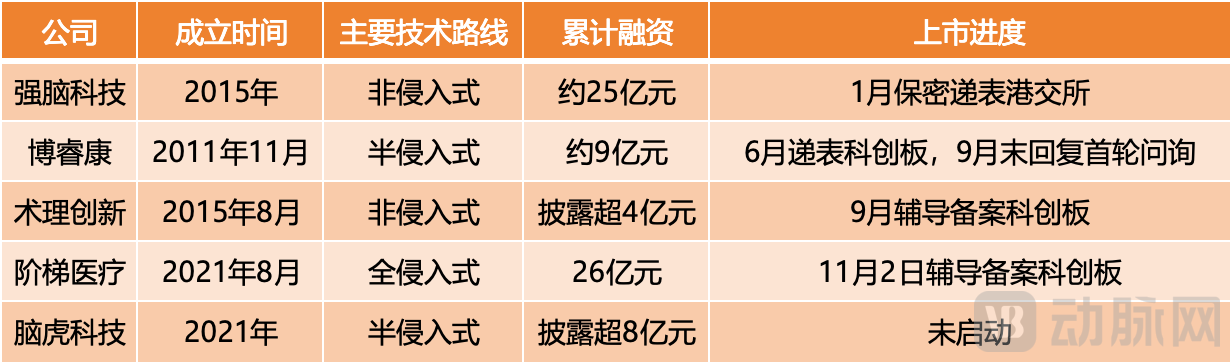
Chinese BCI Companies Rapidly Approaching the Capital Markets. Source: compiled by VCBeat from public information
In addition, NeuroXess is also closing in on the capital markets. In late October, NeuroXess announced the completion of a RMB 700 million Series B jointly led by Guotou Juli, Shenzhen Capital Group and Qinzhi Capital. Its technical route attaches flexible electrodes about 10 microns thick to the surface of the cerebral cortex under the dura, without penetrating the brain parenchyma, making it a semi-invasive approach that does not damage brain tissue, with self-developed 256-channel electrodes. In early July, NeuroXess's fully implanted, fully wireless, fully functional system began a GCP registrational clinical trial at Huashan Hospital, led by Mao Ying's team and joined by nearly 20 top-tier hospitals. NeuroXess is also building a super factory in the Ganjiang New Area of Jiangxi, with a planned area of 14,300 square meters and a target capacity of 10,000 units.
Admittedly, the A-share market still has no listed company with BCI as its core business, yet on the strength of the concept alone, related stocks have already gone through multiple rallies. The value of being the first BCI stock can well be imagined.
China vs. the US: The Most Valuable Player Is the Slowest to Ring the Bell
In a sense, China's BCI industrialization has moved ahead of overseas peers, even though the technology originated in Germany.
On the one hand, Chinese BCI companies are clearly ahead in clinical trial case numbers and enrollment speed. Measured by long-term implants, Neuralink's publicly verifiable figure is 27 cases, the first in January 2024, with participants generating more than 50,000 hours of brain recordings, while StairMed reports 42 cases, already overtaking Neuralink. Synchron, which takes the vascular intervention route, has implanted more than 30 cases; its pivotal trial plans to enroll 100 people and was still recruiting by mid-year, whereas Neuracle completed 32 enrollments and surgeries in 78 days.
On the other hand, Chinese BCI companies are also moving faster toward the capital markets. Overseas, Neuralink, founded by Musk, is the world's most valuable BCI company but has yet to file any documents. Founded in 2016, it was valued at USD 29 billion to USD 42 billion in private secondary transactions as of July 2026. Peers are not heading to exchanges either: Synchron has raised more than USD 570 million and has given a timeline of filing a PMA application by the end of 2027; Precision Neuroscience completed a USD 250 million Series D in September 2026 at a post-money valuation of about USD 1 billion, and likewise has no S-1.
The reason behind this is that China's BCI sector is operating in a more open market environment.
At the capital markets level, even the Shanghai Stock Exchange's STAR Market, the highest bar of all, has actively made things easier for BCI companies. In June 2026, the SSE sought public comment on revisions to the Interim Provisions on the Issuance, Listing, Application and Recommendation of STAR Market Companies, adding four second-level industries under biomedicine in the strategic emerging industries category of Article 5, with BCI first on the list. Subsequently, Neuracle, Arfysica Innovation and StairMed all chose to apply to list on the STAR Market under the fifth set of standards. Over the same period, Hong Kong allowed confidential filings. For BCI companies still in the technology translation stage, confidential filing is undoubtedly highly attractive.
At the regulatory level, China puts approval and payment on the same timeline, whereas the United States leaves them to two separate systems. Invasive products can first enter the Special Review Procedure for Innovative Medical Devices; only four months passed between approval and the first commercial implantation for Neuracle's NEO. In September 2025, the NMPA issued the first industry standard for BCI medical devices; in March 2026, the first invasive product was approved, and the National Healthcare Security Administration completed medical insurance coding within two days. Pricing has also been laid out in advance: the project approval guidelines have established a separate item for BCI, and Hubei subsequently set an implantation fee of RMB 6,552, a removal fee of RMB 3,139 and a non-invasive adaptation fee of RMB 966 per session. In the US, products still have to wait for payers to issue coverage decisions after FDA approval, and no one fills the gap in between.
At the industrial policy level, BCI in China has been written into national plans, the government work report and local revenue targets at the same time, with arrangements at all three levels from ministries to provinces and cities. In 2025, the Ministry of Industry and Information Technology and six other departments issued the Implementation Opinions on Promoting the Innovative Development of the BCI Industry, the first systematic plan for the sector. On March 5, 2026, BCI was written into the government work report for the first time, listed alongside quantum technology, embodied intelligence, 6G and future energy as a future industry the country will focus on cultivating, and the draft outline of the 15th Five-Year Plan includes it in the frontier technology research areas.
Of course, in this financing boom, the shareholder structures Chinese BCI companies have built are also forcing them to grow quickly. Neuralink's shareholders are mainly financial investors who can wait ten years, but the shareholder lists of this Chinese cohort include industrial capital and local state capital: industrial money has strategic considerations, and local guidance funds have assessment cycles, both less able to wait than purely financial investors. Listing here is not just about raising money but about leaving an exit channel for this capital. Put the four layers together, and the gap in pace comes more from the time requirements of capital than from disagreement over technology.
Yet the real watershed in this race is not the day the bell rings, but whether case numbers can be converted into revenue afterwards.
The Real Value of Being the "First Stock" Goes Far Beyond a Name
Right now, these star companies, so hot in the primary market, are once again at the same starting line. The contest among them comes back once more to technology routes and business models themselves. The industry has long been divided on what BCI companies should actually do.
The first is the technology route. From non-invasive to semi-invasive to invasive, companies have now reached the threshold of IPO on all of them. But in practice, advanced and usable are two different things. After all, four routes sit before reviewers with different weights. Ranked from the outside in by the relationship between electrode and brain tissue: the outermost is non-invasive, with electrodes left on the scalp, the route Arfysica Innovation takes; one step in enters the cranial cavity without touching brain tissue, with Neuracle placing electrodes outside the dura and NeuroXess attaching them under the dura, the two separated by a single membrane; the innermost sends electrodes into the brain parenchyma, which is StairMed's tier. Clinical value follows the distance between electrode and neuron: the deeper in, the better the signal; the outermost can only decode coarse movements such as grasping and cursor control, while the innermost enables fine movements and multi-degree-of-freedom control, with the two middle tiers falling in between, epidural placements sparing brain tissue and allowing long-term retention, subdural ones finer but prone to scarring over time as electrodes sit against the cortex, with signal quality declining accordingly.
Commercial value runs the opposite way: the deeper the electrode, the more complex the movements possible, the fewer hospitals and surgeons able to perform the procedure, and the fewer people able to pay. Non-invasive does not enter the operating room, working through rehabilitation departments and outpatient clinics on a per-session basis, with low unit prices but broad reach. Epidural requires neurosurgery, and the unit price can rise to RMB 475,000 per set, but the surgeons and centers able to perform it nationwide are limited, so volume cannot scale. The public market will not price all four; it wants comparable gross margins, installed base and follow-up attrition rates, all of which depend on whether the procedure can be replicated. Wherever the first stock lands is where the industry's frame of reference is set: landing in the invasive tier sets the ceiling of technology, landing in the other two sets the size of the market, and the latter can be checked by calculation while the former cannot.
The second is the business model. Generally speaking, invasive sells surgery while non-invasive sells services: two different businesses. Revenue for invasive equals surgical volume times unit price, constrained at both ends: on the supply side, surgeons must be willing to perform it and hospitals willing to offer it; on the payment side, someone has to pay. Neuracle is the clearest sample right now. Its device costs RMB 475,000 per set and is already listed on procurement platforms in 27 provinces. Since July it has sold 13 sets, with 8 implanted at end sites and another 5 delivered to hospitals but not yet installed in patients. The company itself warns in its prospectus that results would suffer if reimbursement rates fall short of expectations.
By contrast, the non-invasive path is much shorter. BrainCo's bionic hand is already in mass production and has FDA clearance, selling as a standardized product; Arfysica Innovation's BCI-plus-exoskeleton has entered institutions such as Changhai Hospital and is billed as a rehabilitation service, without waiting for an implant registration certificate.
Notably, in the contest for China's first BCI stock, there is an easily overlooked sticking point: valuation. RMB 4 billion is the expected market cap threshold under the STAR Market's fifth set of standards, and all four companies are close to that line, though with differing quality.
Among them, Neuracle reached the line exactly through one financing round: a RMB 300 million Series E completed in November 2025 at a post-money valuation of RMB 4 billion, just enough to qualify. StairMed relies on financing scale: RMB 2.6 billion raised cumulatively as of September, the most among domestic peers, with Tencent, Alibaba, Geely and CATL on its shareholder list; the pricing given by the primary market has itself become the basis for reaching the line. Arfysica Innovation faces the most pressure: with successive B+ and C rounds in the hundreds of millions of yuan, its funding volume is the smallest of the four, and to support an expected market cap of RMB 4 billion it will have to price its offering well above its last primary round.
In practice, whichever company wins the title of first stock will define the BCI industry for a considerable period to come.