

Huawei's First Class III Medical Device: Why the Most Crowded Track?

HUAWEI
A Global Leader in ICT (Information and Communications Technology) Infrastructure and Smart Devices

Sinocare
Rapid Detection of Chronic Disease: Product R&D, Production, and Sales

yuwell
Developer and Manufacturer of Basic Medical Devices

Sibionics
Medical Device R&D and Manufacturing Company

MicroTech Medical
Developer of Medical Device Products for Diabetes Management
A medical device whose retail price has already dropped to around RMB 100 and which requires users to keep buying consumables has just gained a heavyweight player.
On October 30, Huawei's continuous glucose monitoring (CGM) system was approved by China's NMPA. It is Huawei's first approved Class III medical device, and it also means Huawei has formally entered the CGM market.
Over the past few years, Huawei has kept building out its presence in smart wearables and health monitoring, with a number of hardware and software products approved as Class II medical devices. For a CGM market that has already taken on a certain competitive shape, what changes will Huawei's entry bring?
CGM has become one of the fastest-growing segments in medical devices in recent years.
Unlike conventional fingerstick blood glucose meters, CGM relies on a sensor to monitor glucose in interstitial fluid, enabling continuous glucose tracking, showing glucose trends and issuing alerts for the risk of high or low blood glucose. It gives people with diabetes a more complete picture of their glucose data and is convenient to use in long-term glucose management.
Overseas brands such as Abbott and Dexcom have long enjoyed high market recognition. In recent years, as domestic products have kept iterating technically, their cost-performance advantage has become increasingly pronounced, and China's CGM industry has entered a period of rapid growth.
According to public information from the NMPA, more than 30 CGM products have been approved for marketing in China to date.
Among them, local companies such as Sinocare, SIBIONICS, MicroTech Medical and Yuwell have built relatively mature product systems, sales channels and user bases.
Industry growth is directly reflected in corporate revenue, and CGM has become a core growth business for a number of device companies. Take MicroTech Medical, which discloses its CGM performance separately: its CGM revenue topped RMB 400 million in 2025, and the momentum carried into 2026, with first-half revenue alone exceeding RMB 300 million, up 118.7% year on year.
As the market keeps expanding, competition in CGM is also intensifying.
E-commerce platform data shows that when multiple boxes are bought in a single order, the unit price of CGM can fall to around RMB 100. Compared with the several-hundred-yuan pricing of 2021, when CGM was just taking off, prices have fallen sharply. Some companies have begun building AI + CGM ongoing services and glucose monitoring + other monitoring functions to strengthen their products' competitiveness.
It is not hard to see that the market environment Huawei faces in launching CGM this time is quite different from the one it faced with its previous physical medical device, the wrist ambulatory blood pressure recorder.
In 2024, Huawei launched the wrist ambulatory blood pressure recorder. Although the traditional ambulatory blood pressure market already had multiple vendors, Huawei integrated the monitoring function into a smartwatch, creating a new product form and expanding the use scenarios. The carrier of this medical device, the smartwatch, is essentially a consumer electronics product, and blood pressure monitoring is one of its auxiliary functions.
CGM is different. As a standalone medical device that is not integrated into other equipment, it has a stronger medical character. At the same time, competitors already have mature products with extremely similar functions and have established stable channels and user groups. Although the industry still has room to grow, the room to build a significant differentiated advantage has become very limited in the short term.
In September 2026, He Gang, CEO of Huawei Terminal BG, said publicly that Huawei had conducted four years of technical research in the blood glucose testing device field and had come up with a technology solution that could be industrialized. That means Huawei has already carried out technical preparation over a considerable period.
Judging by industry patterns, consumer electronics companies entering Class III active devices rarely build a biosensor production line from scratch. A more likely division of labor is that core algorithms, system design, brand, channels and ecosystem are led by Huawei, while sensor manufacturing or key membrane materials are handed to a specialized medical device team.
However, Huawei has not disclosed any information about the CGM's sensor technology route, core algorithms, supply chain or partners, so it is impossible to accurately assess how high the proprietary technology barrier it has built at the core of CGM really is.
With no further product details disclosed, and judging from the currently public registration information, the scope of application and core functions of Huawei's CGM are at a level similar to mainstream products already on the market.
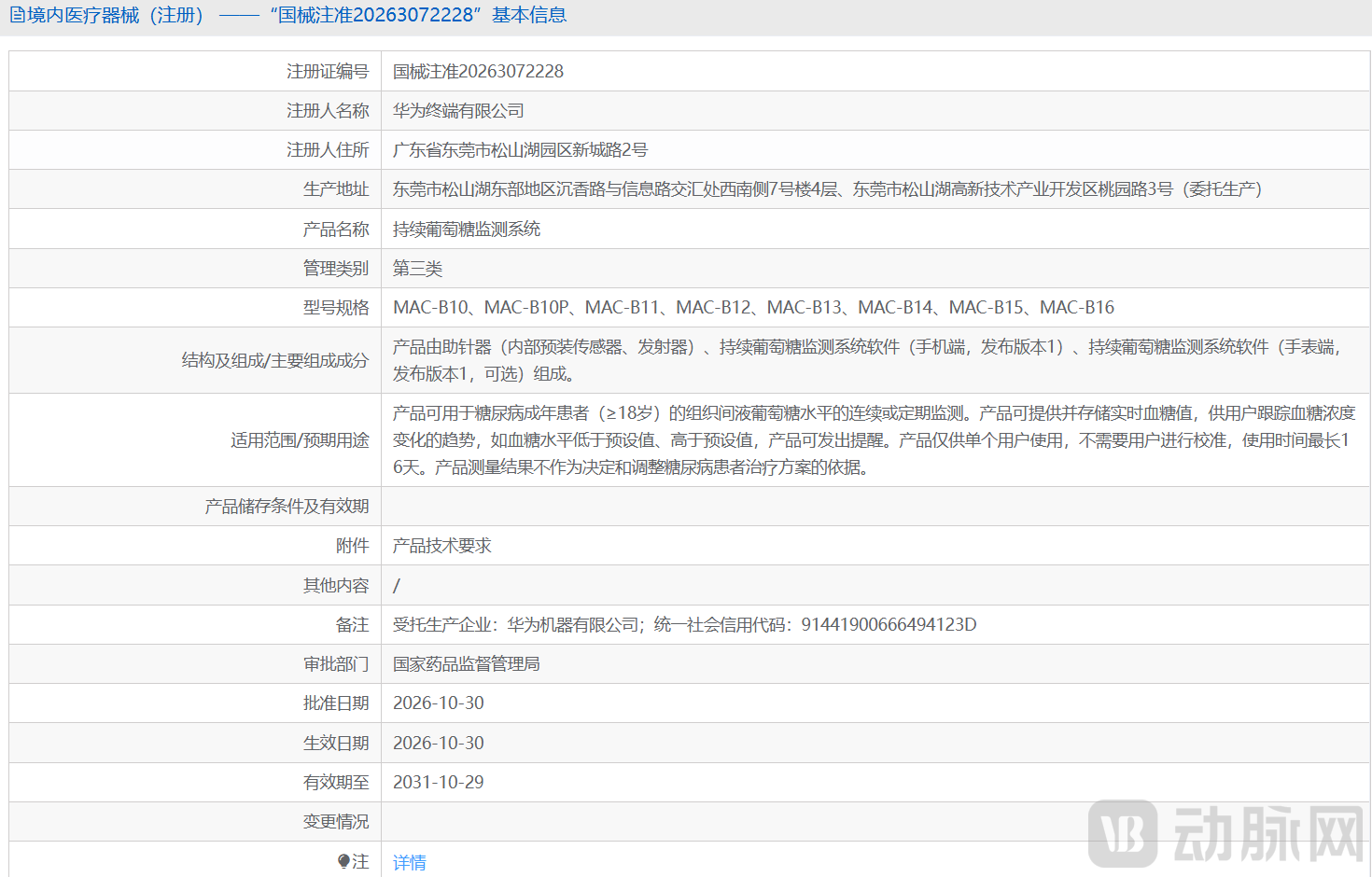
NMPA registration information shows that the approved product targets adult diabetes patients aged 18 and above and is used for continuous or periodic monitoring of interstitial fluid glucose levels. The device can provide and store real-time glucose values for users to track trends in glucose concentration; if glucose levels fall below or rise above preset values, the product can issue a reminder. The product is for single-user use only, requires no user calibration, and has a maximum use time of 16 days.
Continuous monitoring and glucose trend alerts are standard CGM functions. Compared with the 14-day use period common among mainstream domestic products, Huawei's 16-day "endurance" is only a modest improvement, and that alone is not enough to build a significant competitive edge.
From the target population and monitoring functions to the clinical positioning, the currently available public information is not enough to show that Huawei's CGM has a significant advantage or technical highlight compared with competing products.
Against this backdrop, where might Huawei's CGM competitiveness come from?
The first is brand and channels.
Huawei has already accumulated a huge user base in smartphones, smartwatches and sports and health, and its brand awareness among consumers is high. Relying on its existing phone terminals, Vmall, offline stores and the Huawei Health app, Huawei can efficiently reach potential target users.
Another obvious source of competitiveness comes from the health data ecosystem.
For other CGM and health monitoring products, data fragmentation has long been a persistent problem. Even for CGM products from the same manufacturer, different series may require users to switch between different apps, and cross-brand, cross-category health monitoring data is even more scattered.
Huawei smart terminals could previously already integrate various health data such as ambulatory blood pressure, ECG and sleep. They can connect data collected by products under the Huawei umbrella and also support importing data from some third-party devices, including data from third-party CGMs.
Once Huawei has its own CGM, connecting it with the existing data system will let users view data within familiar devices and apps, lowering the threshold for ordinary users and even enabling personalized health management plans based on comprehensive health data.
The business logic of medical devices is entirely different from that of consumer electronics. Even within medical devices, CGM and the ambulatory blood pressure monitoring watch Huawei has already launched differ significantly.
What is special about CGM is that, after the initial purchase, users usually have repeat-purchase needs, either for an all-in-one CGM device or for the sensor of a split-type CGM; in the process, they also need multiple personalized services such as practical guidance on wearing, interpretation of glucose data and patient education.
For companies, brand advantage can drive a user's first purchase, but it does not necessarily drive long-term repeat purchases and sustained use. The market position of a CGM product is ultimately determined by comprehensive strength across multiple dimensions.
Users' daily experience directly affects their willingness to repurchase.
Sensor detection accuracy and data stability, wearing comfort, effective use duration, as well as data transmission between the device and the phone and the ability to issue abnormal alerts, all directly shape users' actual perception.
More critically, beyond the technical specifications of the product, many seemingly trivial experience details can directly affect the user experience. In real-world use, quite a few users run into various practical troubles: sweating and friction cause the adhesive patch to fall off, resulting in consumable waste; long-term application causes skin itching and red rash allergies; the raised body of the sensor creates a foreign-body sensation, which worsens when lying on one's side or exercising; and some products have insufficient waterproof performance, requiring removal during prolonged water contact and interrupting glucose monitoring.
Add to that the reading delay and occasional false alarms inherent in interstitial fluid monitoring, and all of these can affect users' willingness to keep using the product. This requires companies to value users' experience in these fine details while iterating sensor hardware and optimizing algorithms.
Good user retention also cannot be achieved without the support of accompanying professional services. CGM after-sales service is not limited to handling hardware failures; it also requires professional medical staff to provide timely guidance and intervention.
How the sensor is worn, how alert parameters are set, how glucose trends are interpreted, and what to do when abnormal values appear, all require a well-developed service system for support.
Specifically, this includes medical staff assessing and screening the target population and guiding users to wear the device correctly and rotate application sites; interpreting continuous glucose curves, identifying hard-to-notice glucose fluctuations and helping adjust glucose control plans based on monitoring data; and professionally screening alarm information, distinguishing false alarms from real risks of high or low blood glucose, and giving corresponding handling advice.
As hardware monitoring capabilities mature, industry competition will further extend to the contest for the service entry point of diabetes management.
CGM can continuously collect glucose data, but raw data does not automatically translate into clinical value. How to bring massive monitoring data into real diabetes diagnosis and treatment workflows has become a key focus for leading companies.
Many CGM manufacturers are now building data platforms for medical institutions and clinicians: connecting patients' ambulatory glucose data to hospital information systems or internet healthcare platforms to support doctors in remote review, disease follow-up and evaluation of drug efficacy; or connecting device links such as ambulatory glucose monitors and insulin pumps to achieve synergy between monitoring and treatment, exploring ways to connect patients, doctors and medical service institutions on the basis of testing devices and digital platforms.
Therefore, the competitive boundary of CGM companies is still expanding.
For Huawei, smart terminals, the Huawei Health platform and a huge consumer user base can lay the foundation for CGM to reach potential users, and the health service ecosystem also provides room for integrating follow-up services. However, competition in CGM is far more than a contest of terminal advantages. What detail-level innovations does Huawei's new product actually have? And what new changes will it bring to the fiercely competitive CGM industry? The answers will have to wait until the product is officially launched.