

Spanning the RMB 100,000–1,000,000 Price Band: Domestic Ophthalmic Optical Biometers Are Chasing Down Zeiss

Intalight
High-end Ophthalmic Equipment Developer

Moptim
High-end Ophthalmic Medical Device R&D, Production, and Sales

TowardPi
High-end Ophthalmic Medical Device Developer
Domestic ophthalmic optical biometers are gaining strong momentum.
Industry data show that in the first half of 2026, domestic brands already outsold imports. Building on their established edge in the myopia prevention market, domestic makers have accelerated their extension over the past two years into pre-cataract examination, a field with higher technical barriers.
As key equipment in pre-cataract-surgery examination, a biometer's measurements and calculations bear directly on postoperative outcomes. Compared with the myopia prevention setting, where axial length measurement dominates, pre-cataract examination places higher demands on measurement precision, stability under complex ocular conditions and IOL calculation capability.
As self-developed technologies and new products enter hospitals, domestic brands will extend into more complex clinical settings.
Ophthalmic biometry has split into two major settings, myopia prevention and pre-cataract examination, and domestic devices have advanced their market breakthrough along both.
As myopia prevention gained momentum in China in earlier years, axial length measurement became a key indicator for screening, monitoring progression and setting control plans. Demand in optometry for axial length devices kept rising, and biometers aimed at myopia prevention sold well accordingly.
Purchase cost, ease of operation and after-sales service are what optometry practices value most. Though optometry-version biometers from imports such as Zeiss are also popular, domestic devices have a clear cost-performance advantage; domestic brands are understood to have taken most of the optometry segment.
NMPA registration data show that, years ago, more biometer products had been approved in China than imported ones. Yet for a long time domestic devices left a notable gap in clinical settings centered on pre-surgical examination. Many could not deliver sufficient pre-surgical measurement precision, lacked penetration through cataract, and showed only moderate measurement repeatability under complex ocular conditions.
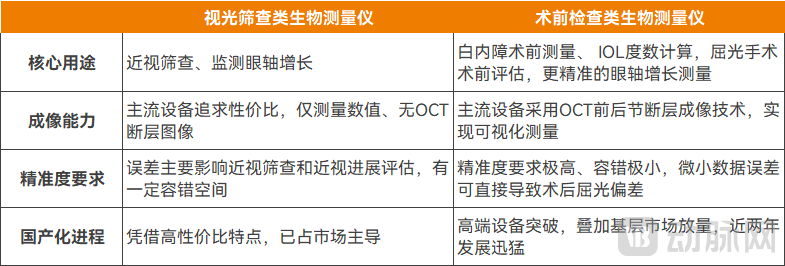 Differences between ophthalmic biometers for the two application settings. Source: company public information, interviews
In recent years, as high-end ophthalmic equipment developed rapidly in China, leading domestic makers gradually completed measurement technology iterations, adding core capabilities such as visualization and new-generation IOL calculation formulas, and better meeting the pre-surgical measurement requirements of cataract surgery.
At the same time, broader clinical use of premium IOLs and a rising number of cataract patients who have had refractive surgery are steadily releasing hospital demand for high-end biometers, opening new market opportunities for domestic brands.
"National strategies such as tiered diagnosis and the building of county-level medical communities continue to land, releasing a large volume of grassroots ophthalmic examination demand, while the pricing and service models of imported equipment struggle to cover lower-tier markets, leaving broad room for domestic brands," said Li Peng, head of technology R&D at MediWorks.
In the past, the clinical biometer market was long dominated by Zeiss's IOLMaster series, which at one point held a 70% to 80% share.
The landscape has shifted markedly over the past two years. In-hospital installations of domestic biometers from TowardPi Medical, Intalight, MediWorks and Suowei Electronic have climbed rapidly.
Domestic price bands have also moved steadily upward. Domestic devices were previously mostly mid- to low-end, with most products priced between RMB 100,000 and RMB 400,000. China Government Procurement Network data show that in the past two years more domestic devices have been priced above RMB 600,000, with some high-end models reaching RMB 800,000 to RMB 1 million, on par with Zeiss's high-end IOLMaster 700.
That means domestic biometers have built a complete product hierarchy and price ladder from mid- to low-end up to high-end.
Rapid volume growth of high-end models, together with continued growth at county-level and grassroots institutions, is lifting the overall market share of domestic devices. Data from Zhongcheng Big Data's MDBIDS medical device tender database show that in the first half of 2026 domestic optical biometer sales overtook imported brands for the first time, with sales value also rising steadily and the gap with imports narrowing year by year.
In the observation of Wang Yingqi, co-founder and CEO of TowardPi Medical, acceptance of domestic biometers among hospitals and industry experts is gradually rising, and domestic brands show strong competitiveness across price bands, from high-end lines to cost-performance models. "Optimistically, domestic products could take market leadership within the next two to four years."
The core reason domestic devices could enter the pre-cataract examination track lies first in breakthroughs at the measurement technology level.
Previously, many domestic biometers mainly used partial coherence interferometry (PCI) technology and lacked whole-eye tomographic imaging, so in pre-cataract examination of complex cases such as dense cataract, high myopia and epiretinal membrane they were prone to interface identification errors that were hard to detect.
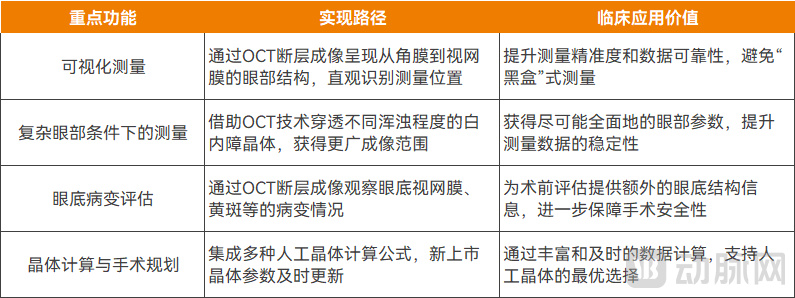 Functional and technical breakthroughs of domestic ophthalmic biometers around cataract measurement. Source: company public information, interviews
As domestic makers accumulated OCT R&D, the technology was applied to biometers, which is also the technical route of Zeiss's IOLMaster 700. OCT can output tomographic images of the eye and offers stronger penetration for conditions such as lens opacity, allowing users to confirm measurement positions directly through visualized ocular structures and ensuring the reliability of measurement data.
Among domestic ophthalmic biometers now on the market, TowardPi Medical's Ziwu and Intalight's Ruyi are based on swept-source OCT, while MediWorks' Columbus, BigVision's Velite C680 series, WRMT's BVB2000 series and Gaush Medical's Gaush Ostar series use spectral-domain OCT. Configurations differ in emphasis, but the shared goal is better measurement quality that matches the standards of pre-cataract clinical examination.
Li Peng, head of technology R&D at MediWorks, analyzes that a maturing technology base has carried leading domestic brands over the hard threshold of clinical usability, with core measurement precision and stability greatly improved, resolving the most fundamental performance shortfall and giving them the ability to penetrate high-end clinical settings.
On top of measurement breakthroughs, some domestic devices keep expanding their functional boundaries to meet the assessment needs of complex corneal morphology.
Basic biometry data suffice for ordinary cataract surgery, but for cataract patients after corneal refractive surgery, for keratoconus patients, or when choosing functional IOLs such as toric or multifocal models, more comprehensive and finer corneal data are required.
In a single acquisition, TowardPi Medical's Ziwu biometer obtains ocular biometric parameters and also quickly captures anterior and posterior corneal topography, corneal aberration, kappa angle, alpha angle, lens tilt and decentration and other data needed for refractive cataract cases, supporting IOL selection for complex refractive patients.
While measuring routine data, Intalight's Ruyi whole-cornea biometer can perform 150,000-point high-density whole-cornea topography and panoramic anterior-segment OCT, offering multi-dimensional corneal analysis of morphology, astigmatism and aberration to support fit assessment and selection strategy for functional IOLs. It provides a complete whole-eye biometric assessment and technical support for next-generation IOL calculation and prediction.
Zhou Ying, marketing manager at Intalight, said that optimal lens selection needs support from more dimensions of ocular parameters. For cataract patients after refractive surgery, corneal conditions are complex and precise power calculation is impossible without complete corneal information; when a biometer can measure and assess complex corneal morphology, additional corneal measurement devices are no longer needed.
Fast software iteration and localized service are another differentiated advantage for domestic makers.
Bao Hongyan, chief medical officer and deputy general manager of TowardPi Medical, noted that biometers are involved in IOL power calculation and that lens parameters are closely tied to biometer data. The development of domestic high-end IOLs has also created favorable conditions for domestic biometers to expand their market.
IOLs iterate quickly, with parameters differing between products, so biometry software must update lens data and optimize calculation logic in step. International makers keep launching new products, and domestic high-end IOLs such as trifocal and EDOF models are also reaching the market in quick succession, raising the bar for device adaptation efficiency.
Domestic devices support rapid software upgrades, entering new lens parameters and adjusting calculation logic, especially for new domestic lenses, helping doctors and patients adopt new products. Adding lens models to imported devices requires software updates from overseas manufacturers, a longer overall cycle.
On localized competitiveness, Li Peng of MediWorks believes domestic makers respond faster in service and configure products more closely to domestic clinical settings, which is also a notable advantage.
Domestic optical biometers have now overtaken imports in sales volume, but there is still room to further reshape the market.
According to industry statistics, Zeiss's ophthalmic biometers still hold nearly 50% market share. On the hospital procurement side, imported brands remain strongly competitive.
To move from today's volume lead to future market leadership, domestic makers need to shift their competitive focus from catching up on single-device performance to building advantages across a complete clinical system.
Zhou Ying, marketing manager at Intalight, acknowledged that measurement and imaging devices are judged by different logic, and that hospitals especially value the long-term stability of measurement equipment. "At this stage, users of domestic devices are mainly those who embrace new technology; once domestic devices build richer and longer-cycle track records, institutions will have stronger procurement incentives."
To build clinical advantage, the first task is sustained technical refinement, tackling common clinical pain points and filling existing clinical gaps.
Postoperative refractive outcomes in cataract surgery are affected by multiple factors, including IOL calculation formulas, individual ocular structure and lens implantation position. Even with pre-surgical examination and calculation as precise as possible, postoperative results remain uncertain, and satisfaction cannot be guaranteed for all patients.
"Biometers still face bottlenecks in precise lens calculation; for short-axial-length patients, for example, predicting effective lens position (ELP) is the core difficulty. ELP estimation accuracy directly determines postoperative refractive outcomes, and existing formulas cannot yet achieve precise prediction in all cases," Zhou Ying of Intalight pointed out as a current pain point in the industry.
He noted that the industry is improving prediction accuracy by iterating formulas and introducing deep learning algorithms, and that domestic high-end device makers need to work with ophthalmic experts at home and abroad, relying on new technologies and algorithms, to tackle the challenge together.
Bao Hongyan, chief medical officer and deputy general manager of TowardPi Medical, believes companies should deepen engineering-medicine collaboration and clinical research with leading hospitals, using that to drive technology iteration and market influence.
In her view, domestic makers can learn from Zeiss by emphasizing academic development, working with leading hospitals to validate new algorithms and novel biomarkers and to keep producing academic output. "Today many domestic companies treat clinical research only as a required step for registration, neglecting the long-term value of collaborative engineering-medicine academic research; that mindset urgently needs to change across the industry. Long-term clinical research is both the basis for continuous technical evolution and an important means of converting technical advantage into market recognition."
Second, domestic makers should build a more complete product ecosystem, creating product synergy across every step of surgery.
"A biometer is not like an OCT; it is not just a contest of hardware specifications. Soft factors such as doctors' usage habits, clinical databases and multi-device connectivity are all key to competition," judged Wang Yingqi, co-founder and CEO of TowardPi Medical.
The development paths of international ophthalmic giants such as Zeiss and Alcon have already proven that strong product ecosystem synergy can build hard-to-replace market advantages. Alcon's Argos biometer, for example, holds a relatively high share overseas, and one of its advantages lies in its ability to link and adapt with the group's extensive IOL consumables.
Cataract surgery spans pre-surgical examination, lens selection and intraoperative procedures; if biometer data can interoperate with other examination devices and surgical navigation systems, data silos break down and doctors gain more complete grounds for surgical planning. Over the long run, biometry data can also serve as a data entry point supporting automated surgical systems such as femtosecond lasers and surgical robots.
VCBeat has learned that domestic companies have begun to lay out in an ecosystem direction: for example, opening data links between biometers and other devices so that examination data complement each other and pre-surgical data work better with surgical equipment; and integrating biometer results with examinations from other devices in a region to promote data exchange between higher- and lower-level hospitals, supporting tiered diagnosis and the flow of quality medical resources to lower tiers.
However, at this stage domestic ophthalmic device companies show a vertically divided landscape: most focus on a single segment, either devices or consumables, either diagnostic instruments or therapeutic products. Almost no company has completed a product ecosystem across the full diagnosis-and-treatment workflow, and building such an ecosystem takes long accumulation. It is foreseeable that once a full-chain ecosystem lands, it will form a deep competitive moat.
Finally, domestic makers need to make high-end ophthalmic technology more accessible.
Tertiary hospitals value the ability to handle complex cases, accumulated clinical evidence and physician trust, while county-level and grassroots institutions care more about purchase cost, operating thresholds, supporting training and after-sales support. For high-end biometry to spread more widely, it must balance cost, ease of use and clinical precision and fit the realities of grassroots care systems.
Li Peng, head of technology R&D at MediWorks, said the ultimate mission of domestic medical devices is not only import substitution itself but also broadening access to high-end ophthalmic technology. For example, full-chain in-house development from optical design, core algorithms and hardware architecture to complete systems, with cost reduction through independently controllable software and hardware, technology reuse and scale production, lets grassroots users afford the technology, while automated and intelligent operation and telemedicine platforms ensure they use it well.
Overall, domestic devices have found a viable path to growing market share. From overtaking imports in volume to building irreplaceable clinical value, future competition in ophthalmic optical measurement is not only a contest of technology but a long accumulation in which technological progress brings quality ophthalmic resources to more patients.