

A Tianjin University Professor's Startup Uses Original Hypersound Technology to Give AI Hands and Feet That Hold Steady

CVGBIO
MEMS Chip + Smart Instrument + Consumables Developer
"AI for Science's bottleneck is not compute or models but the 'dirty data' and non-standardizable manual operations at the wet-lab end."
When talking with founders of AI pharma companies and leading professors, Duan Xuexin, a professor at Tianjin University and founder of CVGBIO, would often hear the phrase "Garbage in, garbage out." This classic expression from computing originally meant that when the input data is flawed, no amount of model sophistication or compute will produce anything but a more polished error, underscoring how much data quality shapes results.
The same logic applies to AI for Science (AI4S). As AI reaches deeper into literature search, data summarization, model reasoning, and drug design, how to obtain high-quality, standardized data that carries full experimental context and is traceable has become a central question in connecting computation with real experiments. From tech giants to biotech companies, from lab cloud platforms to open-source robotic frameworks, experiments are turning into a pipeline that code can call.
On October 16, Google published a technical blog describing its progress on a self-driving wet lab: AI agents propose candidate molecules and schedule experiments, robots carry out the operations, and the readings flow back into the model to adjust the next round of plans. In one study, the team said it had found protein molecules that bind tightly to targets associated with solid tumors.
But Google also drew a line in that blog: this is still a research prototype, the robotic operations were validated mainly with dyes and water, and the wet-lab work in the molecular studies is still done by researchers. The loop can already turn, but it turns "lightly": it can move liquid, but not yet cells.
Cell experiments are especially complex: because cells are living and highly heterogeneous, the same experiment performed by different people, or with different sample handling, can change cell states and results. Without standardized control and complete records, researchers struggle to tell whether a difference comes from the biology itself or from variation in handling, and the comparability and reproducibility of the data suffer.
In the past, much of the data in the literature was collected and recorded by hand, and the process was hard to quantify, record, or reproduce. Models trained on such distorted data naturally produce computational results that struggle to carry over into real experiments, and the drug formulations developed from them struggle to reach real-world use.
Look back at the history of life science tools: at the gene level, PCR and second- and third-generation sequencing became classics long ago; at the protein level, giants such as Beckman spent more than half a century building a system of standardized tools. At the cell level alone, there is still no tool that can manipulate high-concentration, low-volume samples in a programmable, recordable way while keeping cells alive.
This is exactly the problem CVGBIO hopes to solve.
In 2023, Duan Xuexin took the "Hypersound" (GHz acoustic streaming) technology he had cultivated in the lab for nearly a decade toward industrialization and founded Convergency (Tianjin) Biotechnology Co., Ltd. (hereinafter "CVGBIO").
In CVGBIO's vision, sound waves are not just a physical means of manipulating cells but a technological entry point that turns cell experiments from a craft dependent on individual experience into programmable, recordable, repeatable processes: around its high-frequency Hypersound acoustic chips, the company has developed a series of devices for fully automated cell suspension preparation, label-free cell sorting, picoliter droplet dispensing, and live-cell printing. These provide standardized cell-process equipment for life science manufacturing and an execution layer for AI for Science and even virtual cell models, while outputting clean, high-quality data with mechanical annotations (the force parameters, landing position, and volume of every droplet can be matched one-to-one with downstream readings).
Hypersound: A Homegrown, Original Technology, a Programmable Manipulation Force in Water
"Hypersound" is CVGBIO's core technology label and the technical foundation of the company.
This is a class of sound waves at frequencies on the order of gigahertz (GHz): because the frequency is so high, a wave traveling in water is completely absorbed by the fluid within just 6-7 micrometers. The energy does not disappear; it rapidly converts into the kinetic energy of the fluid, forming a directed, focused thrust that can be generated and withdrawn on microsecond timescales and can reach accelerations on the order of 10^6 g in water. What does that mean?
"Think of a bullet fired into water: however fast it travels, viscous drag stops it almost at once. Hypersound does the opposite, turning the resistance of water into usable thrust," Duan Xuexin said. The essence of Hypersound, he noted, is transmitting force through a liquid.
For cell manipulation, CVGBIO does not use a robotic hand to grip cells directly. Instead, it creates a precisely adjustable "micro-scale flow" in the liquid around the cells and, by controlling electrical signals, device structure, and fluid boundaries, lets that force take on tasks such as detaching, sorting, or ejecting cells in droplets. Because nothing touches the cells and the force is transmitted through water, damage from nozzle squeezing and interfacial adhesion is avoided, and proteins on the cell membrane are disturbed far less, opening another technical path for live-cell manipulation.
So how can the strength, direction, and duration of this "micro-scale flow" be controlled precisely? The key lies in a MEMS (microelectromechanical systems) chip smaller than a grain of rice.
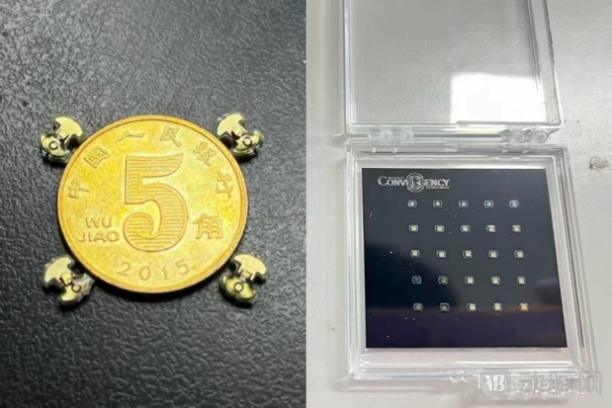
Hypersound MEMS chip
The piezoelectric thin film in the chip vibrates at high frequency when driven by an electrical signal and is further converted into GHz sound waves. Because the input is an electrical signal, the frequency, power, and pulse parameters of the sound wave can all be adjusted in software, making the conversion from electrical signal to sound wave to fluid force controllable, quantifiable, and repeatable. In other words, it is a "programmable force generator": give it a signal and it produces the corresponding force; the parameters and results of every action can be recorded and reproduced.
The chip is only the starting point. The real difficulty is turning a physical capability into a usable tool: the choice of chip structure and materials, fine control of driving parameters, the design of microfluidic modules, software control, and the coupled calibration between these elements and specific biological processes, none of which can be skipped. The underlying device provides the physical capability; the modules and instruments are responsible for putting it into researchers' hands.
CVGBIO's product line has grown along exactly this logic.
HyperDrop Draws Its Blade: Breaking the "Impossible Triangle" in Live-Cell Printing and Becoming AI4S's "Senses, Hands, and Feet"
The same Hypersound chip, placed in different physical structures, "grows" into a different device: set into tissue samples, it performs fully automated dissociation to prepare high-quality single-cell suspensions; built into microchannels, it generates microvortices for label-free cell sorting; mounted over a thin liquid surface, it performs nozzle-free live-cell printing and picoliter dispensing.
Among them, the HyperDrop Hypersound picoliter dispensing and live-cell printing system is CVGBIO's flagship product.
Conventional nozzle-based printing relies on pressure to extrude liquid, and with high-concentration, high-viscosity, or viability-sensitive cell samples it inevitably runs into clogging and shear damage.
HyperDrop instead uses Hypersound drop-on-demand (DOD) technology with no nozzle at any point: rather than being squeezed or sheared, cells are steadily "flicked" out by the kinetic energy that sound waves generate in water, so there is no clogging and no cross-contamination. It handles high-viscosity, high-viability samples, and cell densities can reach 10^8 cells/mL or more, close to the concentration of dense tissue suspensions, making it directly usable in frontier applications such as drug screening models, tumor neoantigen models, and organoids.
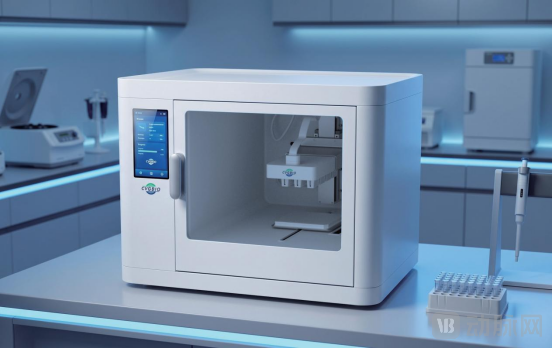
HyperDrop Hypersound picoliter dispensing and live-cell printing system
"Small volume, high cell concentration, no clogging: this was long regarded in the industry as an 'impossible triangle'. HyperDrop achieves all three at once and can also precisely control where each droplet lands in space and time," Duan Xuexin said.
In his view, small droplets are only the baseline; accuracy is the key. Placing each cell precisely into its intended well, and making every subsequent data set correspond to a specific cell, sample, and processing condition, is what makes data traceable and reproducible, the basic skill of high-quality data in the AI era. It also gives HyperDrop three core application directions:
Single-cell omics library preparation: cells are precisely dispensed into library-preparation plates and paired with whole-transcriptome library protocols, so that precious clinical samples yield maximum value across transcriptomic, metabolomic, and proteomic dimensions;
Low-sample drug susceptibility testing: a few milligrams of clinical biopsy sample can yield millions of cells, which are dispensed into hundreds of standard wells for drug screening, reducing the use of animal experiments;
Feeding AIVC (AI virtual cells): combining single-cell omics with drug-screening data produces exactly the "high-quality data with causal structure" that virtual cell models need most. Companies building virtual cells are building AI's "brain"; CVGBIO aims to build its "senses, hands, and feet".
HyperDrop's capabilities are also extending beyond life science.
With high-speed printing across formulation space, it can handle high-throughput material microarray spotting. microRNA detection, for example, requires loading sample arrays at defined positions on electrochemical chips, which conventional methods cannot achieve, and some imported instruments have long lead times and face restrictions on supply to China; HyperDrop offers an alternative.
Further still, it can print high-throughput pure water-based samples onto flexible curved surfaces, dispensing with organic solvent inks and offering a green manufacturing route for quantum-dot light-emitting devices, display panels, and other production scenarios. This is also a concrete step in CVGBIO's move from AI for Medical toward AI for Material.
On the commercial side, CVGBIO's in-house cell suspension preparation instrument has entered volume delivery and sales; engineering units of its live-cell printing and picoliter dispensing equipment have been delivered to research users including the Institute of Biophysics, Chinese Academy of Sciences, and several more units are scheduled for delivery this quarter (Q4 2026). The company has also completed delivery of an overseas order from Italy.
But CVGBIO's ambition goes well beyond that. Duan Xuexin wants CVGBIO to define a new category of cell-process equipment: "When people think of magnetic bead sorting, they think of Miltenyi; when they think of electroporation, Lonza; when they think of flow cytometry, Beckman. I hope that in three years, when people think of label-free, standardized acoustic cell manipulation, they will think of CVGBIO."
Equipment sales are only the starting point of a much larger journey; recurring consumables and experimental services are expected to form a stream of repeat revenue, while the process parameters and experimental data accumulated across different application scenarios will feed back into product iteration and new product development. Seeded by the Hypersound MEMS chip, CVGBIO's business tree will keep branching until a single tree becomes a forest.
If NVIDIA's GPU is the brain of AI, then the Hypersound actuator chips CVGBIO builds are its hands and feet.
In the first half of AI, the contest was over whose brain was bigger: more parameters, more compute, a smarter model. That race has already sorted the field into tiers.
In the second half, the contest is over whose hands and feet are steadier: a model can propose ten thousand possibilities, but can the lab actually make, measure, and record every one of them at a controllable cost?
A brain can be scaled with compute; hands and feet can only be built through real action, one movement at a time. And cells are precisely the hardest part to do "steadily": living, heterogeneous, sensitive to shear, and small in sample size, to the point that the mechanical process of a single operation often cannot even be recorded.
CVGBIO is offering exactly such a pair of hands and feet. How many new discoveries it can ultimately drive and what business ecosystem it can build still have to be answered by the product validation and customer use that follow.