

$110 Million Upfront Payment! Li Ka-shing Sells a New Drug
HUTCHMED
Biopharmaceutical Manufacturer

GSK
Pharmaceutical R&D Manufacturer
Today, HUTCHMED announced that the exclusive development and license agreement with a GlaxoSmithKline (GSK) subsidiary for the innovative anti-cancer candidate drug HMPL-A830 has been completed.
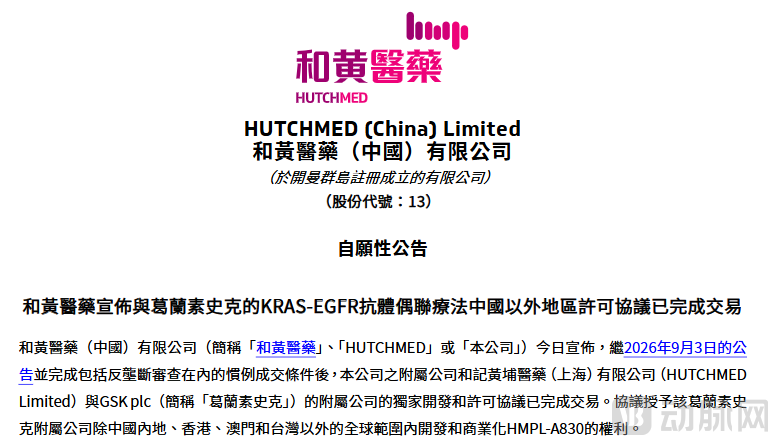
Under the previously announced agreement terms, HUTCHMED will receive an upfront payment of $110 million and is eligible to receive up to $1.185 billion in development, regulatory, and commercial sales milestone payments, as well as tiered royalties based on annual net sales.
The potential total value of this transaction could reach up to $1.295 billion, covering global markets excluding mainland China, Hong Kong, Macau, and Taiwan. HUTCHMED will be responsible for the global Phase I clinical development of HMPL-A830, while GSK will take over subsequent clinical development and commercialization within the licensed territories thereafter.
Notably, HMPL-A830 is not a mature asset that has already entered pivotal clinical trials and is awaiting commercialization. The Phase Ia portion of its global Phase I clinical trial was initiated in September 2026, with plans to conduct the study in patients with unresectable advanced or metastatic solid tumors.
KRAS's Long-Standing Challenge and a Novel Solution
To understand this deal, one must first return to HMPL-A830 itself.
HMPL-A830 is an Antibody-Targeted Therapeutic Conjugate (ATTC) developed by HUTCHMED. Unlike traditional Antibody-Drug Conjugates (ADCs), which typically link antibodies to cytotoxic payloads, HMPL-A830 employs a distinct design: it conjugates a highly selective small-molecule KRAS inhibitor as the payload to an anti-Epidermal Growth Factor Receptor (EGFR) antibody.
This design aims to combine two mechanisms of action: on one hand, leveraging anti-EGFR antibodies to recognize EGFR-expressing tumor cells and deliver KRAS inhibitors to the target area; on the other hand, simultaneously intervening in both EGFR- and KRAS-related signaling pathways.
Behind this approach lie the real-world challenges still facing KRAS-targeted therapies.
KRAS is a key driver gene in various solid tumors, with high mutation rates observed in colorectal cancer, lung adenocarcinoma, and pancreatic ductal adenocarcinoma. In recent years, the development of KRAS-targeted therapies has advanced continuously; however, significant unmet clinical needs remain in this field due to variations in KRAS mutation subtypes and tumor types, as well as resistance mechanisms that emerge during treatment.
Notably, the EGFR signaling pathway is associated with resistance to certain KRAS-targeted therapies. In specific tumors such as colorectal cancer, EGFR-mediated feedback signaling represents a key area of research into the limited efficacy of KRAS inhibitors.
Therefore, the core rationale behind HMPL-A830 is not simply to combine two drugs, but to integrate a KRAS inhibitor with EGFR pathway intervention into a single molecular design by leveraging antibody-mediated targeted delivery.
However, mechanistic plausibility does not equate to established clinical advantage. Clinical studies are needed to determine whether the antibody can achieve effective delivery, whether the conjugate can maintain appropriate pharmacokinetic properties, whether the two mechanisms of action can produce the expected synergistic effects in humans, and whether the overall safety profile is superior to that of existing treatment regimens.
What bets are each side placing?
For multinational pharmaceutical companies, in-licensing does not imply that a candidate drug has already demonstrated commercial value; rather, it represents a phased assessment of a R&D asset based on existing data, technological pathways, and future market potential.
For GSK, the appeal of HMPL-A830 may stem from three aspects.
First, there remains a clear unmet need for R&D in the field of KRAS-associated tumor therapies. Although progress has been made in KRAS-targeted treatments, challenges related to different mutation types, tumor indications, and resistance mechanisms continue to pose complex R&D issues. Candidate drugs offering alternative delivery methods or mechanisms of action present opportunities for further exploration.
Secondly, the problem HMPL-A830 aims to address is not limited to single-target inhibition. It combines antibody-mediated targeted delivery with a small-molecule inhibitor, aiming to simultaneously leverage EGFR recognition and KRAS pathway inhibition. This design provides it with a development positioning distinct from traditional monotherapies or cytotoxic ADCs, forming a basis for GSK's assessment of its differentiation potential.
Third, early-stage licensing preserves flexibility for subsequent R&D adjustments. Under the agreement, HUTCHMED is responsible for global Phase I clinical development, while GSK assumes responsibility for subsequent clinical development and commercialization. This arrangement enables GSK to further evaluate the development pathway and resource allocation for the program as early clinical data accumulate following the licensing deal.
For HUTCHMED, the significance of this transaction lies in the financial returns and the introduction of overseas development resources. The company will receive an upfront payment of $110 million and is eligible for milestone payments of up to $1.185 billion, as well as sales royalties. Meanwhile, HMPL-A830 has become the first candidate drug from its ATTC platform to be licensed to a global partner, providing an external collaboration case for the platform's future development.
HUTCHMED has not withdrawn from R&D as a result. The company remains responsible for global Phase I clinical development and retains the rights to develop and commercialize the product in Greater China. In other words, by licensing GSK to participate in subsequent overseas development, the company has retained its core market rights.
This deal also reflects a trend in the out-licensing of innovative drugs from China: collaborations between multinational pharmaceutical companies and Chinese firms are no longer limited to products nearing market launch; early-stage assets with differentiated mechanisms also have opportunities to secure overseas development partnerships.
Realization Still Depends on Clinical Data
For an early-stage licensing deal, the potential transaction value is not the sole criterion for assessing its worth. As HMPL-A830 is still in Phase I clinical trials, the key determinant of the project's future value lies in whether its technical design can translate into safety and efficacy advantages in humans.
The challenges facing this drug stem not only from the inherent difficulties in the clinical translation of KRAS-targeted therapies but also from the engineering design of the antibody-drug conjugate (ADC). Conjugating a small-molecule KRAS inhibitor as the payload to an anti-EGFR antibody necessitates simultaneously addressing issues related to targeted delivery, payload release, in vivo distribution, and safety. Unlike the cytotoxic payloads commonly used in traditional ADCs, HMPL-A830 employs a targeted small molecule as its payload. However, whether this design can enhance therapeutic efficacy and establish an appropriate therapeutic window remains to be validated by clinical data.
Next, several developments warrant attention. First are the safety, tolerability, and preliminary antitumor activity data from the Phase Ia dose-escalation study of HMPL-A830, which will help determine whether its technical design can translate into actual performance in humans.
Next is whether GSK will further advance the collaboration on another ATTC candidate drug. The right of first negotiation leaves open the possibility for continued cooperation between both parties, but whether to exercise it still depends on subsequent evaluations.
Finally, the progress of other clinical-stage pipelines within HUTCHMED's ATTC platform will influence external perceptions regarding the platform's ability to consistently generate drug candidates.
The key follow-up aspects of this deal extend beyond the clinical results of HMPL-A830 as a single molecule; they also include whether its technological approach can be further validated and whether the collaboration can expand from a single asset to other pipeline candidates.
For HUTCHMED, the completion of the transaction introduces a global development partner for its product; for GSK, securing the license is merely the starting point for subsequent development.