

Exclusive: DeepSurgery Completes Nearly RMB 100 Million in Series B Funding to Accelerate Clinical Development for Multiple Indications and Overseas Expansion of Its Microsurgical Robot

DeepSurgery
Developer of Intelligent Microsurgical Equipment

RCCAPITAL
Financial Advisory Service Agency

Prosperity Investment
A Well-Known Domestic Equity Fund-of-Funds Manager

Chenhui Venture Partners
Frontier Technology Investment Firm

Med-Fine Capital
Venture Capital Firm

CS Capital
Investment Institution in the Fields of Life Sciences and Consumer Healthcare

DIG GROUP
Technology Sector Investment Firms
VCBeat has learned that DeepSurgery, a leading microsurgical robotics company, recently announced the completion of its Series B financing round, raising nearly RMB 100 million. The round was co-led by Med-Fine Capital and China Grand Prosperity, with participation from Chenhui Venture Capital, CS Capital, DIG GROUP, and existing shareholder Wondfo Chuangu. RCCAPITAL continued to serve as DeepSurgery's exclusive financial advisor.
This marks DeepSurgery's third round of financing completed over the past 15 months, fully demonstrating the sustained confidence of professional investment institutions and industrial capital in the microsurgical robotics sector, as well as their high recognition of DeepSurgery's technological prowess and team execution capabilities. Following this round of financing, DeepSurgery will further accelerate clinical trials for multiple indications, product registration, and market expansion both domestically and internationally.

DeepSurgery is a founding member of the Microsurgery Branch of the China Association for Medical Device Industry, dedicated to developing intelligent devices that cover the entire spectrum of microsurgical procedures. Its flagship product, the FUNZAR microsurgical robot, was listed as a major advancement in the field of microsurgery by the Microsurgery Branch of the Chinese Medical Association for two consecutive years (2024 and 2025), and was ranked as the top advancement among the five major breakthroughs in 2025.
FUNZAR is the world's first modular universal microsurgical robot, equipped with dual-arm 16-degree-of-freedom robotic arms, 60× 4K ultra-high-definition 3D digital visual navigation, and submicron-level master-slave control—featuring a positioning error of less than 1 micron and motion scaling from 13 to 130 times.
At the inaugural 2025 Super Microsurgical Vascular Anastomosis "Human-Machine Competition," FUNZAR, as the sole robotic system shortlisted in the robot category, competed alongside the champion surgeon from the manual category and successfully completed end-to-end anastomosis of mouse tail arteries with a diameter of 0.1 mm, demonstrating to the industry the precision limits of domestically produced microsurgical robots.

FUNZAR Competes Alongside Champion Physicians
DeepSurgery adheres to foundational originality, pioneering the proprietary"Multi-Remote Centered Microsurgery (MRCM)" universal microscopic configuration. This technology achieves sub-micron spatial positioning, adaptive force-feedback closed-loop control, and flexible multi-arm robotic integration, elevating surgery from a mere"microscope" to a comprehensive "MicroSystem" through its system-level architecture. The company continues to strategically secure patents in Europe and the United States, along with multiple domestic invention patents, around its core architecture, thereby establishing a moat of proprietary technology.
In 2026, FUNZAR entered the National Special Review Procedure for Innovative Medical Devices (Green Channel), enjoying priority review and accelerated product launch, becoming one of the few domestically produced universal microscope surgical robots to enter this channel.
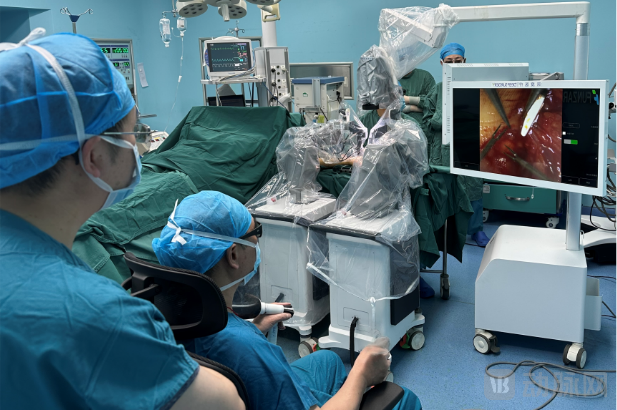
Physician Operates FUNZAR for Microsurgery
Currently, the multi-indication, multicenter registration clinical trials for FUNZAR are being simultaneously conducted at several prestigious institutions, including Beijing Jishuitan Hospital (Capital Medical University), Shanghai Sixth Peopl's Hospital (Shanghai Jiao Tong University School of Medicine), Xiangya Hospital (Central South University), The First Affiliated Hospital of Sun Yat-sen University, Sun Yat-sen Memorial Hospital (Sun Yat-sen University), and Peking University School of Stomatology. Notably, patient enrollment for the first indication is nearing completion, having received high acclaim from senior experts, which fully validates the technology's superiority and robustness.
Notably, in March 2026, FUNZAR was used at the First Affiliated Hospital of Sun Yat-sen University to perform the world's first microsurgical robot-assisted direct bypass surgery for cerebral revascularization in a patient with moyamoya disease. In July 2026, FUNZAR was used to perform the world's first spermatic vein reflux reconstruction and bypass surgery. These milestones represent technological breakthroughs that overseas microsurgical robots have yet to achieve, attracting widespread attention from the domestic and international medical communities.
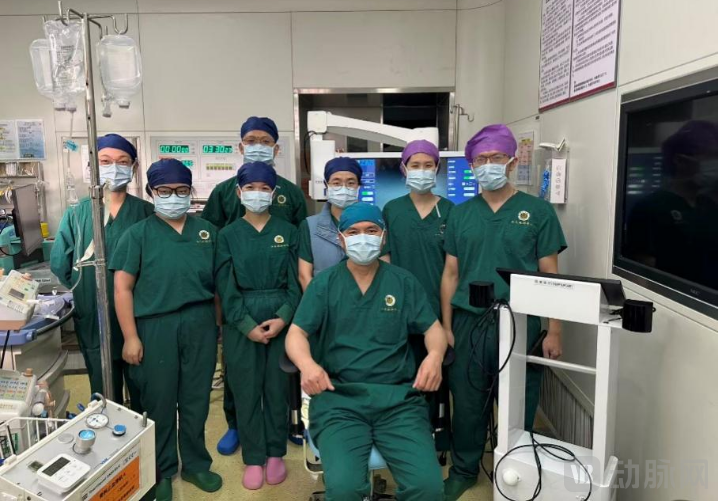
Clinical PI Professor Zhu Qingtang, Vice President of The First Affiliated Hospital of Sun Yat-sen University, poses for a group photo with the clinical team post-surgery
Global microsurgical robotics is in the early stages of commercialization, with an unsettled competitive landscape: Italy's MMI received US FDA clearance for Symani in 2024, making it the first commercially available microsurgical robot approved for market launch worldwide; the Netherlands' MicroSure obtained CE marking for MUSA-3 in 2026.
Currently, no domestically produced microsurgical robots have been approved for market launch in China. However, the gap between domestic and international capabilities in this field is narrow. Domestic products, represented by DeepSurgery's FUNZAR, are rapidly advancing through clinical trials and have even achieved localized leadership in terms of technological originality and procedural coverage. Industry experts believe that it is unlikely for the microsurgical robot sector to replicate the scenario seen with laparoscopic surgical robots, where the da Vinci system maintained a 20-year lead over Chinese counterparts. Instead, it is more probable that Chinese and overseas products will remain broadly synchronized in technological generations, jointly competing in the global market.