

Bill Gates-Backed Surgical Robot Company Files for Bankruptcy, While Chinese Peers Begin to Turn a Profit

Vicarious Surgical
VR Surgical Robot Developer

Longwell Medical
Developer and Manufacturer of Joint Replacement Surgical Robots

MedBot
Surgical Robot Developer
In 2026, Vicarious Surgical, a prominent U.S. surgical robotics company, completed shareholder procedures in July, agreeing to dissolve and liquidate by transferring its assets to creditors. Founded by former Apple employees, the company counted Bill Gates and BD (Becton, Dickinson and Company) among its investors. After 12 years of operation, it never secured FDA approval or entered human clinical trials, remaining far from the operating room.
Founded in 2014, the company was once considered by investors to be the most promising surgical robotics unicorn capable of challenging da Vinci. Leveraging a disruptive design featuring single-port access and VR headset-based control, it raised approximately $300 million (around RMB 2 billion) in cumulative funding. Upon its listing in 2021, its market capitalization briefly exceeded $1.2 billion, and it secured the world's first FDA Breakthrough Device designation for a surgical robot.
Around the same time, China's MedBot issued a positive profit alert, forecasting a net profit of RMB 28 million to RMB 40 million for the first half of the year, compared to a loss of RMB 115 million in the same period last year. Revenue is expected to increase by 200%–230% year-on-year, with gross margin improving by more than 15 percentage points. Although the company delayed the release of its financial results and suspended trading due to related matters, pending the official financial report, this first-ever semi-annual profit forecast since its establishment in 2015 is sufficient to boost industry confidence.
Although the surgical robotics sector remains a blue ocean, its development logic has fundamentally shifted from the early stages. The industry's focus has moved away from questions such as whether the robotic arms are stable, whether the port sizes are smaller, and whether physician training is easy, toward practical considerations: whether hospitals will actually utilize the systems after purchase, the extent of their usage, the potential for recurring revenue from consumables, and the ability to generate sustainable cash flow.
In the first eight months of 2026, financing in China's robotics sector totaled RMB 124.51 billion, approximately twice the full-year amount for 2025. However, the surgical robotics segment tells a different story.
It takes several years for a surgical robot to go from research and development to obtaining regulatory approval. Securing this certification is merely the starting point for commercialization; subsequently, the company must complete clinical validation, successfully participate in hospital tendering and procurement processes, conduct physician training, and ramp up surgical procedure volumes. Only when recurring purchases of consumables are achieved can the business be considered self-sustaining.
Longwell Medical's first total hip arthroplasty robot, TRex-RS, completed its inaugural surgery as early as March 2021 and received regulatory approval in September 2024; just 16 months later, the company reached its end. This case illustrates that obtaining a registration certificate does not resolve order acquisition challenges.
In Surui's STAR Market listing application materials, the company projects that it will reach break-even by 2029. This forecast also reflects, to some extent, the long-cycle characteristics of the industry. Within the same technological pathway, Surui's single-port laparoscopic surgical robot, the SR-ENS-600, has received approval, becoming the first such device approved in China and the second globally. Despite both Eastern and Western companies betting on single-port technology and miniaturization, they have achieved markedly different outcomes.
The R&D, clinical trials, policy alignment, regulatory approval, clinical data accumulation, and hospital procurement budgets for surgical robots all require time to achieve breakthroughs. While capital investment can accelerate a company's R&D progress, the cycle required to cultivate physicians' clinical habits cannot be shortened. Therefore, the commercialization trajectory of surgical robots cannot be analogized to the development paths of other general-purpose robots.
Exiting companies share many common reasons for failure.
For instance, although Longwell Medical obtained its registration certificate, it failed to complete the full commercialization process, as every stage—from post-registration equipment installation and the implementation of clinical pathways to hospital procurement and recurring consumable purchases—required sustained resource investment.
Vicarious Surgical was founded in 2014 and is headquartered in Waltham, Massachusetts, USA. Co-founders Adam Sachs and Sammy Khalifa, both MIT graduates in mechanical engineering and former Apple engineers, teamed up with Barry Greene, a surgeon with extensive experience in laparoscopic surgery.
Specifically regarding the product, they aim to develop a miniature surgical robot that accesses the abdominal cavity through a single incision. The incision is only about 1.5 centimeters in length. By donning a VR headset, physicians can remotely control the robotic arms inside the body using an immersive three-dimensional view, effectively "sending the doctor into the patient's body."
This design is quite aggressive in terms of parameters: the robotic arm has 9 degrees of freedom, whereas the industry leader, da Vinci, has 7; it is equipped with 28 sets of high-precision sensors that can replicate the upper limb movements of doctors from the shoulder and elbow to the wrist. Capital has placed significant bets on this technology; in 2018, the company completed a $16.75 million Series A financing round, with participation from Gates Ventures, affiliated with Bill Gates.
In 2021, Vicarious went public on the New York Stock Exchange through a merger with the SPAC company D8 Holdings, achieving a valuation of approximately $1.1 billion and a market capitalization that once exceeded $1.2 billion. Shareholders included Becton, Dickinson and Company (BD), Innovation Endeavors (founded by former Google CEO Eric Schmidt), AME Cloud Ventures (under Yahoo co-founder Jerry Yang), and Khosla Ventures, among others.
In 2022, its product was selected as one of TIME Magazine's Best Inventions of the Year and became the first surgical robot globally to receive the FDA's Breakthrough Device designation. The company originally planned to pursue the FDA's de novo review pathway with abdominal wall hernia repair as its initial indication, aiming to secure clearance in 2023 and advance commercialization.
Vicarious Surgical's founders hail from Apple, accustomed to a "launch first, iterate later" approach that allows the market to grow alongside the product. This strategy works well in software and consumer electronics. However, the development logic for medical devices is entirely opposite: regulatory approval is merely the starting point; only after conducting small-scale clinical trials can large-scale commercialization proceed.
A Post-Mortem on Vicarious's Failure: The Core Issue Was Technological Radicalism Detached from Industrial RealityTo enable robotic arms to perfectly mimic human hand movements, the company adopted a decoupled drive scheme, causing structural complexity to rise exponentially. Over several years, the company struggled to increase yield rates from single digits in the lab to industrial-level standards suitable for mass production, but ultimately failed to break through this barrier.
If the hurdle of mass production cannot be cleared, the product will remain stuck at the prototype stage. The product design itself has critical flaws: it is equipped with only two robotic arms, whereas many complex surgeries require the coordination of three or four arms. The lack of auxiliary arms to handle tasks such as retraction, irrigation, and suction leaves the system ill-equipped to handle intraoperative emergencies. Although the VR headset concept is impressive, prolonged use by surgeons leads to visual fatigue and dizziness, thereby increasing operational risks during lengthy procedures that can last several hours.
This "launch-first, iterate-later" approach, when applied to medical devices, has resulted in a complete loss of control over the development timeline. Vicarious Surgical had originally planned to obtain FDA clearance in 2023, initiate human clinical trials in 2024, and submit a complete FDA approval package by the end of 2025; all of these key milestones were missed.
Over the past 12 years, it has not obtained any FDA marketing approval, has not entered human clinical trials, and has generated no revenue, relying entirely on financing to sustain operations. In 2024 and 2025, it incurred net losses of $63 million and $50.2 million, respectively. As of March 31, 2026, its cash and short-term investments totaled only approximately $3.7 million, with a single-quarter loss of $7.3 million, bringing cumulative losses to approximately $246.1 million.
In July 2025, the company underwent a leadership change, with healthcare industry veteran Stephen From assuming the role of CEO. He reduced annual expenditures from $50 million to under $20 million and completed laboratory testing of the synthetic abdominal model in May 2026. However, the company has yet to secure buyers or new financing.
In March 2026, the New York Stock Exchange (NYSE) initiated delisting proceedings due to the company's continued failure to meet market capitalization requirements. The company's stock price plummeted by more than 90% from its peak, with its market capitalization shrinking from $1.2 billion to the million-dollar range. In June of the same year, the company submitted a proposal for shareholder voting to approve the transfer of assets to creditors and subsequent dissolution and liquidation. Following the approval of the vote in July, the entire board of directors resigned, the company ceased operations, and handed over the vast majority of its assets to a liquidation firm for disposition.
Vicarious had originally scheduled to freeze its core product design by the end of 2026, yet the company entered dissolution and liquidation proceedings in July 2026.
During the liquidation auction of another surgical robotics company, Wire Science, 17 patents, 72 trademarks, and all fixed assets were put up for bid with a starting price of approximately RMB 1.29 million, of which the starting price for the intellectual property portion was only about RMB 87,000. Once technical assets diverge from clinical pathways, their actual commercial value is not high.
Vicarious collapsed prior to clinical trials, Longwell Medical failed in its operations after obtaining certification, and Wire exited during the commercialization phase. Risks exist at every stage of the sector; their commonality is that cash reserves were exhausted before the business could generate sufficient revenue.
Placing Vicarious Surgical's outcome back into the global market context makes it clearer.
According to data from market research firm The Business Research Company, the global surgical robotics market size grew from $11.15 billion in 2025 to $13.52 billion in 2026, representing a compound annual growth rate (CAGR) of approximately 21.3%. Within this sector, the global market for laparoscopic surgical robots was valued at around $11.8 billion in 2025, with Intuitive Surgical's da Vinci system long holding an approximate 80% market share. The market has not disappeared; rather, the barriers to entry have risen, and Vicarious Surgical fell just short of clearing these heightened thresholds.
Previously, progress in China's domestically produced surgical robots was mostly reported in terms of regulatory approvals, inaugural procedures, and the number of hospitals adopting the technology. In 2026, the industry has begun to benchmark itself using operational metrics such as the number of units won in tenders, overseas orders, recurring consumables sales, and the extent of loss reduction.
Based on the bid data, a total of 27 endoscopic surgical robots were publicly awarded to public hospitals across China in the first half of the year, with 17 units being domestically produced, accounting for 63%. The number of domestic manufacturers participating in the bids increased from five to seven.
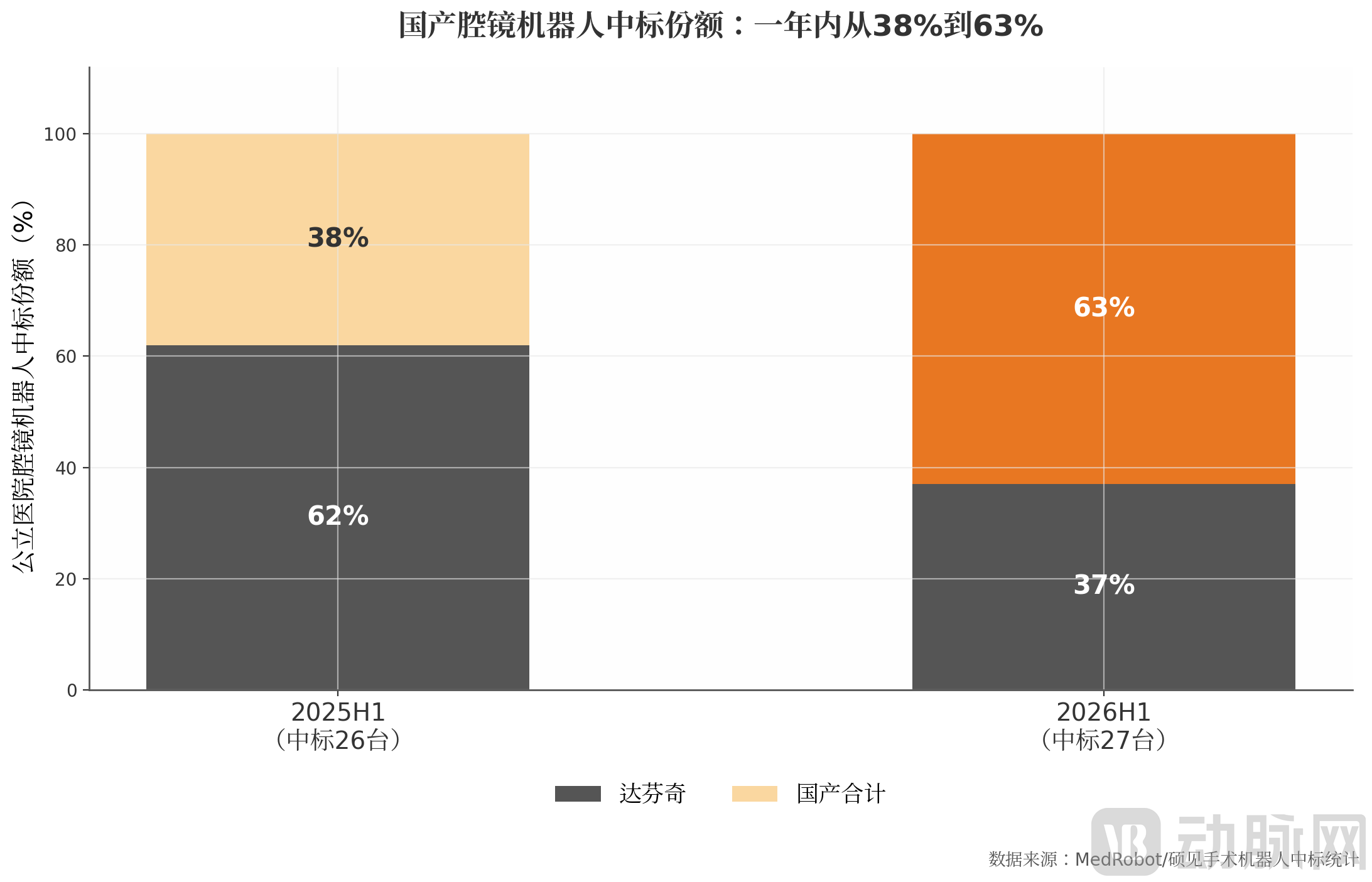
Market Share of Chinese-Made Laparoscopic Robots in Winning Bids, Charted Based on MedRobot Data
Da Vinci's share of tender awards in China fell from approximately 67% in 2023 to around 51% in 2024, dropping below 50% in 2025. In the second quarter of 2026, Intuitive Surgical installed 468 new systems globally, bringing its cumulative installed base to 11,710 units; however, only two units were installed in mainland China and Hong Kong during that quarter.
Changes in market share are influenced by pricing factors. In the first half of the year, the average winning bid price for laparoscopic surgical robots decreased from approximately RMB 17.69 million to around RMB 13.32 million, representing a decline of about 25%. Against this backdrop, the actual number of surgeries performed and the utilization rate of installed systems are key indicators for assessing the clinical acceptance of domestically produced surgical robots.
In terms of overseas expansion, MedBot disclosed in June that its global commercial orders had surpassed 300 units, with the third hundred achieved in just over 120 days. SHURUI won a bid to supply and deliver systems to Spain's Vall d'Hebron University Hospital for €2.42 million in the first half of the year, installed systems on a pay-per-use basis at München Klinik Bogenhausen in Germany, and gained market access through France's UniHA. Jingfeng installed or delivered 49 units overseas in the first half of the year, bringing its cumulative overseas total to 103 units, with overseas revenue accounting for 69.8% of its total.
Past achievements were measured by the number of countries entered. Today, Spanish university hospitals handle procurement directly, Germany employs a pay-per-use model, and France grants access through group purchasing organizations. These diverse payment models indicate that overseas clients are willing to integrate Chinese-made devices into their local hospital procurement and reimbursement systems, further demonstrating the commercialization and implementation capabilities of these products.
Regarding financial data, MedBot's profit forecast awaits confirmation in the official financial report. The company's selling expense ratio decreased from 80.8% in 2024 to 36.9% in 2025. Revenue from standalone repeat purchases of Toumai consumables increased sixfold year-on-year, accounting for approximately 12% of total revenue.
Edge Medical's H1 2026 revenue reached RMB 319 million, a year-on-year increase of 113.8%. The net loss narrowed by 78.4%, and the gross profit margin rose from 62.8% to 64.1%. The reduction in losses was driven by lower R&D expenses, while the revenue growth and improved gross margin signal positive business momentum.
In the orthopedics sector, TINAVI's Tianji system has cumulatively completed 180,000 surgeries, with 49,000 cases in 2025 and 28,000 cases in the first half of 2026. Based on the installed base of orthopedic robots for spine and trauma applications, TINAVI, Medtronic, and Zimmer Biomet collectively account for approximately 98% of the market, with TINAVI alone holding about 87%.
In July 2026, TINAVI announced its plan to acquire controlling interest in Shanghai MedBot Orthopedics, aiming to evolve its business model from pure equipment sales to an integrated approach combining robotics and implants. The global orthopedic market is dominated by joint procedures; the worldwide market for knee and hip implants was valued at approximately $18.4 billion in 2025. In contrast, China's orthopedic robotics sector has been primarily driven by spinal applications. This acquisition targets the larger joint replacement market.
In the capital markets, True Health Medical listed on the Hong Kong Stock Exchange on June 30, and SHURUI's IPO application for the STAR Market was accepted. Amidst the current difficulties in financing, a company's ability to advance its IPO filing or listing demonstrates confidence in its own performance.
The revenue model for surgical robots comprises equipment, consumables, and services. Equipment sales are one-time transactions, while revenue from consumables and services depends on the frequency of hospital use after installation.
Consumables revenue from Intuitive Surgical's da Vinci robotic system accounts for nearly 60% of its total revenue, whereas domestic products contribute only slightly over 10%. This gap is significant. Currently, many domestically produced systems are still in the early stages of installation, with equipment just entering hospitals and their consumables businesses still in the nascent phase.
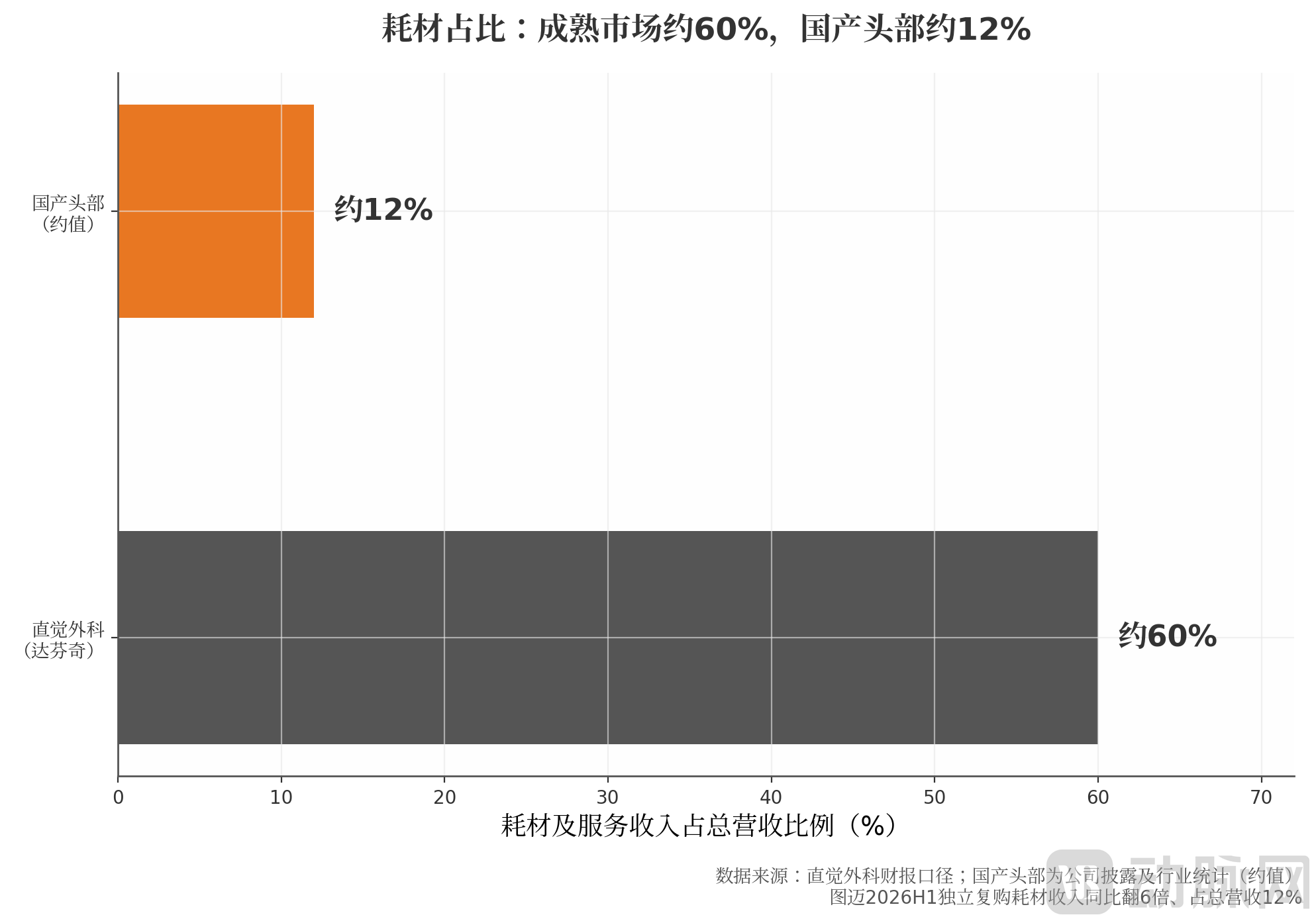
Proportion of Consumables Revenue, Charted Based on Corporate Financial Report Data
Annual surgical volume per unit is the most intuitive metric. The da Vinci Surgical System averages over 400 procedures annually per unit, while Tinavi's flagship series approached nearly 200 procedures in 2025. Although statistical methodologies may vary, the trend is clear. If a single device performs only dozens of procedures per year, it becomes difficult to establish consumables and services as a secondary revenue stream.
China has nearly 2,000 Grade A tertiary hospitals, with a cumulative installed base of approximately 600 to 700 laparoscopic robotic systems. According to calculations by third-party agencies, the penetration rate of robot-assisted laparoscopic surgery in China was about 0.7% in 2024, compared to approximately 21.9% in the United States, indicating significant potential for market growth.
Changes on the payment side are more specific. The project initiation guidelines issued in January clarified the pricing framework for robot-assisted surgeries. When implemented in Hunan Province, detailed rules were provided: procedures classified under precise execution incur an additional charge of 300% of the primary surgery fee, capped at RMB 26,000 per case; remote surgery procedures incur an additional charge of 500%, capped at RMB 37,000. Guangdong Province subsequently followed suit. In September, DRG/DIP 3.0 further clarified the positioning of robot-assisted surgeries within the medical insurance system, allowing hospitals to independently account for the costs associated with robot-assisted medical services.
Centralized procurement is driving equipment prices back to a reasonable range, with procurement evaluation criteria placing greater emphasis on clinical utility, quality, and total lifecycle cost. While low pricing can facilitate market entry into hospitals, long-term retention depends on comprehensive usage value; companies offering genuine clinical value will benefit from this shift.
The industry has shifted from asking "Can we buy it?" to "Is it worth buying?", but price remains a critical hurdle. Once that is cleared, competition centers on utilization rates, consumables, and services. Only when equipment is used sufficiently can one meaningfully assess the quality of revenue.
In the past, the industry was frequently asked when it would become profitable. After 2026, this question has become more specific: How many units can a single device perform annually? What percentage of revenue comes from consumables? Can operating cash flow sustain the business independently? Only companies that can answer these questions are considered capable of moving forward without relying on external financing.
On the other hand, latecomers are also catching up.
Mindra's emerging business revenue in the first half of 2026 reached RMB 3.11 billion, a year-on-year increase of 19.59%. Its surgical robot has entered the registration phase but has not yet been launched. Mindray's strategy is to enter the market leveraging its channel and cost advantages only after regulatory frameworks are finalized and pathways are validated. By taking this step now, Mindray is effectively signaling that its surgical robot has moved beyond the conceptual stage and into a phase focused on delivery capabilities and financial viability.
UIS's uSurg DoctorX received regulatory approval in late July and made its debut of a minimally invasive surgical ecosystem at the Annual Congress of Surgery in September. Platform-focused players in minimally invasive surgery such as United Imaging, specialty-focused companies like Tinavi Medical, and Mindray, leveraging its distribution channels, are now converging on hospital procurement lists. Those who can drive up surgical volumes, sustain consumables usage, and achieve positive cash flow will survive.
It is not yet time for the industry to celebrate. Equipment utilization rates need to ramp up, consumables require repeat purchases, companies must re-prove their full lifecycle value after centralized procurement, and overseas markets must be conquered one by one—all of which demand steady, step-by-step execution from enterprises.
The story of Vicarious Surgical serves as a mirror: cutting-edge innovation must align with genuine clinical needs, and technological advancements must proceed in sync with manufacturing feasibility, regulatory pathways, and commercialization timelines. Merely stacking high-end technologies and relying on capital infusions for survival will ultimately fail to sustain a company through the protracted industrialization cycle. For Chinese companies striving to boost equipment utilization rates, drive recurring revenue from consumables, and achieve positive cash flow, this case offers a crucial benchmark for reflection.