

Medical Device Multinationals Reshuffle China Leadership as the Market's Strategic Weight Rises!

BD
Medical Device R&D Manufacturer, Distributor

Thermo Fisher Scientific
Biotechnology Product Developer

Zimmer Biomet
Medical Device R&D Manufacturer

Fresenius Medical Care
Dialysis treatment services and dialysis product suppliers

Olympus
Precision Machinery and Instrumentation R&D, Production, and Sales

Danaher
Product Design and Manufacturer

GE Healthcare
Digital Solution Provider
On October 9, BD announced that Jeffrey Chen would become Senior Vice President and General Manager of Greater China, while James Deng, who has led BD China for 16 years, plans to retire in mid-2027. Going back further: Thermo Fisher changed its China leadership in August, Zimmer Biomet its Asia-Pacific head in July, Fresenius Medical Care its China head in May, and Olympus its China president in March; in January, Danaher's China Diagnostics Platform and GE HealthCare's China Imaging business handed over in succession.
The essence of this executive shake-up is not a simple changing of the guard, but something that comes with organizational restructuring, the reallocation of business resources, and a profound reshaping of how multinationals position core markets such as China strategically.
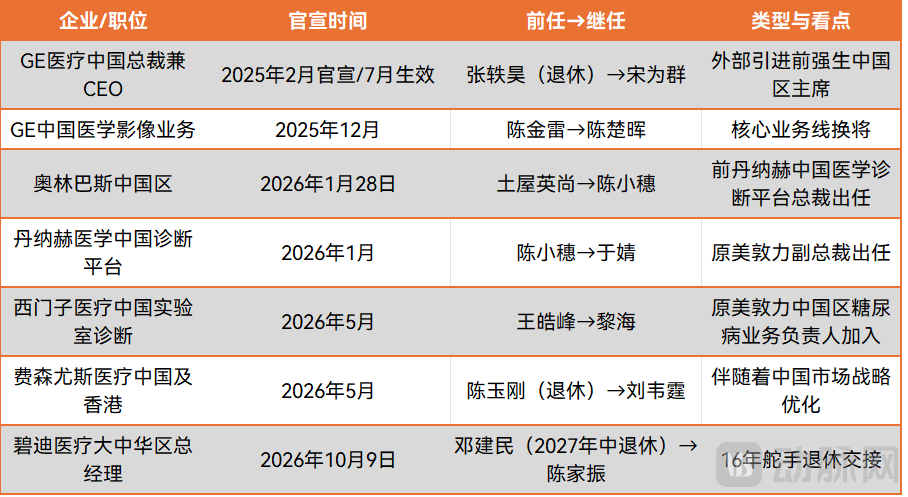
Amid this strategic adjustment among global medical device MNCs, several have refined their strategies in the China market.
On March 2, 2026, Chen Xiaosui, formerly president of Danaher's China Diagnostics Platform, formally took office as president of Olympus China. The appointment marked China's elevation into an independent global strategic region, the first time the head of China has reported directly to the global CEO, and the first time both core business units and functional departments report to the China president — achieving "end-to-end" coordination and accountability across the entire chain for the China market.
This gives the China region greater autonomy and more flexibility in responding to changes in the Chinese market. China accounts for about 9% to 10% of Olympus's total revenue. Olympus said at an earlier earnings briefing that revenue in FY27 Q1 (April to June 2026) fell about 3% year on year, weaker than North America, Europe, and the rest of Asia-Pacific. In China, the business was mainly affected by earlier quality rectification, product recalls, and the suspension of shipments for some products, leaving its recovery lagging other core markets.
A recovery pace behind other core markets shows that advancing at a single global rhythm no longer applies, so Olympus has pushed decision-making down to the end closest to the local market. This restructuring, which gives the China region greater autonomy, means Olympus will go to considerable lengths to revive the China market.
Beyond Olympus, GE HealthCare has also given the China market a distinctive place in its strategic architecture. In its restructuring, GE HealthCare created a new "Global Markets" region, grouping all overseas markets other than China under one commercial leadership structure for centralized management, so as to improve global operating efficiency and resource coordination. That China alone remains outside this structure shows precisely that its strategic status is no longer that of an ordinary regional market.
GE HealthCare CEO Peter Arduini said that under the leadership of the new China president, Song Weiqun, GE HealthCare China has optimized its product portfolio, focused on its clinical value proposition, actively responded to volume-based procurement (VBP) policy, and set up a dedicated provincial government affairs team to ensure strategic alignment in tendering and bidding.
On performance, GE HealthCare's China revenue in Q2 2026 was USD 582 million, up 3.4% year on year and a further improvement on Q1; revenue in China for the first half was USD 1.149 billion, down 0.6%. Management still expects China revenue to fall in 2026, and the single-quarter recovery has yet to change its cautious full-year outlook.
Fresenius Medical Care has likewise refined its strategy in the China market, drawing on a product portfolio better suited to local needs, accelerating the commercialization of local innovations, and pursuing a more focused market strategy, to support long-term development in China and consolidate its market position.
Strengthening its China leadership team was an important part of that optimization: in May 2026, for example, Fresenius Medical Care appointed Rex Liu as general manager of its China region. Rex Liu has more than 16 years of experience in the healthcare industry, having worked at leading medical device companies including Abbott, B. Braun, Boston Scientific, and Medtronic, and brings extensive senior management experience.
China accounts for about 6% to 7% of revenue in Fresenius Medical Care's Care Enablement segment. The company believes the China market has long-term growth potential, driven by a rising prevalence of chronic kidney disease, the expansion of dialysis services, and growing demand for advanced treatment technologies. This strategic optimization is intended to better adapt to changes in the Chinese market.
The rise in the China region's strategic status shows that multinational medical device companies' strategy toward China is undergoing a profound evolution: from the early model of "broad-brush product importing" toward a refined strategy of deep localization, compliance with policy, and optimized product line configuration.
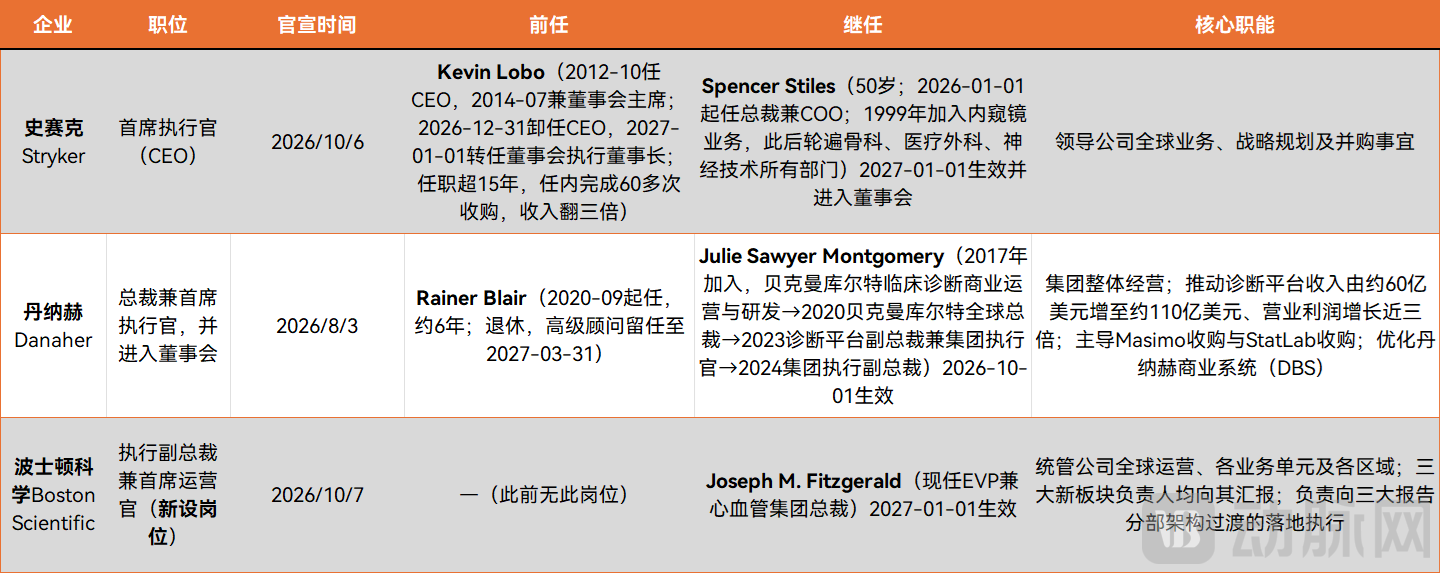
Senior Management Changes at Global Medical Device Multinationals
Organizational restructuring at global medical device companies is cascading from the top down. Placing the 2026 moves of several giants side by side reveals three choices pointing in the same direction: replacing capital operators with business operators, dismantling the generic regional management template, and concentrating resources on a few high-value businesses.
First, the executives taking over at several medical device MNCs are all business operators who grew up on the front line. In October 2026, Stryker announced that Spencer Stiles, who has served as president and chief operating officer since the start of this year, will become CEO. Stiles, 50, started in the endoscopy business in 1999 and has since held leadership roles in almost every business unit, spanning orthopedics, MedSurg, and neurotechnology; he took office as president and COO on January 1, 2026, and will take over as CEO and join the board a year later. This means the board values how deeply the successor knows the business, and expects him to unlock greater organic growth.
Danaher, too, chose an internal executive with a track record of successful integration. On August 3, Danaher's board appointed Julie Sawyer Montgomery as president and CEO, effective October 1; Rainer Blair is retiring and will serve as senior advisor until March 31, 2027.
Montgomery is strong both in M&A and in driving commercial growth. She joined Beckman Coulter's clinical diagnostics business in 2017, starting in commercial operations and R&D; was promoted to global president of Beckman Coulter in 2020; became vice president of the Diagnostics Platform and a group executive in 2023; and rose to executive vice president of the group in 2024. The company disclosed that she drove Diagnostics Platform revenue from about USD 6 billion in 2017 to about USD 11 billion, with operating profit nearly tripling. She led Danaher's roughly USD 9.9 billion acquisition of Masimo in 2026, whose pulse oximeters, medical-grade smartwatches, and remote patient monitoring systems were folded into Danaher's digital health platform.
Second, the generic regional management model is being dismantled in favor of differentiated configurations. Boston Scientific, for example, announced on October 7, 2026, that Joseph M. Fitzgerald, currently president of its Cardiovascular Group, will become executive vice president and chief operating officer (COO) from January 1, 2027 — a position that did not exist before.
At the same time, Boston Scientific's business structure will shift from two segments, Cardiovascular and MedSurg, to three reportable segments: the former cardiovascular business will be split along product lines into Interventional Therapies and Rhythm Solutions, while MedSurg will largely keep its existing framework. The heads of all three segments will report to Fitzgerald.
GE HealthCare's "Global Markets" region bundles together "all overseas markets other than China" — geography becomes a residual item, and China is the only region kept on a direct channel of its own.
For medical device MNCs, a new organizational structure means faster decisions, more precise resource allocation, and better enablement of business lines.
Third, resources are concentrating in core businesses: segments with weak growth are being merged, and businesses with uncertain prospects face reassessment.
GE HealthCare made two bold moves on its business portfolio: consolidation and reassessment. On April 30, it fully merged the previously separate Imaging business (45% of quarterly revenue) and Advanced Visualization Solutions (AVS, 26%) into an "Advanced Imaging Solutions" (AIS) super-segment with annual revenue of USD 14.6 billion. AIS products include MRI, CT, X-ray, molecular imaging, and ultrasound equipment, together with AI-driven software subscriptions and imaging value-added services, with hardware and software run by the same segment.
More notable is how GE HealthCare is handling another business. On its second-quarter earnings call on July 29, management announced a comprehensive review of strategic options for Patient Care Solutions (PCS), with continued ownership, a sale, and other value-enhancing transactions all under consideration. The business spans four product lines — patient monitoring, diagnostic cardiology, maternal and infant care, and anesthesia — and accounts for about 15% of the company's full-year revenue, with annual revenue of about USD 3 billion, yet it has declined for three consecutive years from 2023 to 2025, organic revenue fell 13.5% in Q2 2026, and segment EBIT is negative.
From CEO to COO, and on to segment consolidation and the reassessment of peripheral businesses, the moves at these companies center on two things: the generic template for regional management is being taken apart and reconfigured, and resources are concentrating in core businesses.
Putting these changes together, three consistent strategic orientations emerge.
First, talent selection: homegrown doers at the helm of core segments, with outside hires precisely filling the gaps. In the succession of top management (CEO, COO, and so on), giants such as Boston Scientific, Danaher, and GE HealthCare show a highly consistent strategic conviction — all prefer to promote from within veterans with strong records in pillar businesses or high-growth segments. This "internal promotion" mechanism ensures continuity of core strategy and deep insight into the main business. In sharp contrast, outside appointments cluster in functions the company does not yet have. BD, for example, appointed Arthur Hu as chief information and digital officer in September; his combined background at Lenovo and McKinsey is precisely what the company needed. "Homegrown promotion for core businesses, external hiring for capability gaps" — this dual-track talent profile reflects a clear logic: MNCs shore up the base while precisely filling seats in new arenas.
Second, governance goals: breaking "big-company disease", with centralization of power and flattening aimed at agile decision-making. The core demand behind this round of personnel and structural changes is to shorten decision chains and build a "lean, efficient, and agile" governance system, to counter global market volatility and increasingly tight cost-control pressure.
Third, strategic direction: reshaping the top-level digital design, with intelligence and precision medicine as the second growth curve.
At the intersection of AI and the global precision medicine wave, this round of executive appointments generally carries a strong "digital transformation" imprint, with the new leaders or core executives tasked with accelerating technology convergence and the deployment of digitalization.
These dense personnel changes are not isolated coincidences, but a profound reflection of the restructuring of growth models across the global medical device industry, mounting localization pressure, and the cross-sector convergence of technology. Resources are being redistributed, flowing to the projects that are worth the most.