

150 Million, 8 Years, 0 Products: The Project of a Top Scientist's IP Has Come to an End
KingMed Diagnostics
Third-Party Medical Testing and Pathological Diagnosis Service Provider
Eight years ago, at the unveiling ceremony, Dennis Lo's team and executives from KingMed Diagnostics stood side by side in front of the plaque for the "KingMed Future Non-Invasive Prenatal Testing Technology Center," with experts from the Society for Maternal-Fetal Medicine (SMFM) in the United States and the Chinese Birth Defects Monitoring Center seated in the audience.
In December 2018, the industry described it as "the only collaborative platform in mainland China for the 'father of NIPT,'" with an investment of RMB 150 million and each party holding a 50% equity stake, aiming directly at the untapped market for high-end non-invasive prenatal testing (NIPT).
The joint venture met its end with a brief revocation notice in the Hong Kong Gazette and a termination statement citing "no further need for continued existence."
According to the announcement released by KingMed Diagnostics on October 12, 2026, DRA COMPANY LIMITED (hereinafter referred to as "DRA") was formally dissolved on October 9. From a high-profile launch to a quiet liquidation, this highly anticipated benchmark collaboration for industry-academia-research integration in the Greater Bay Area has completed its entire lifecycle.
The biopharmaceutical investment community has long exhibited a strong penchant for top-tier academic intellectual property (IP), with the market often assuming that major scientific breakthroughs inherently carry commercial certainty. The conclusion of the DRA project offers a case study worthy of close examination for industry capital: The success of scientific research achievements does not equate to commercial success; the premium brought by academic IP often masks the huge gap on the path to industrialization.
The narrative surrounding this investment in 2018 was nearly impeccable given the industrial landscape of that year.
Leveraging the foundational patent portfolio of Professor Dennis Lo's team in the field of NIPT, DRA is positioned to develop high-end non-invasive prenatal testing products based on CNV-seq technology.
To facilitate the undertaking of mainland China operations, a two-tier entity structure was adopted for the transaction: KingMed Diagnostics transferred its 100% equity interest in its wholly-owned subsidiary, Guangdong KingMed Future Biotechnology Co., Ltd., to DRA for an amount equivalent to RMB 10 million in Hong Kong dollars.
Upon completion of the transfer and closing, KingMed Future will be wholly owned by DRA and will be exclusively responsible for the research and development, manufacturing, and sales of high-end non-invasive prenatal testing (NIPT) in mainland China; DRA will hold the relevant patent licenses, with plans to cover the high-end prenatal markets in China and Southeast Asia.
At that time, the optimistic assumptions of capital were built on a set of interlinked growth logics.
Demand is underpinned by three key expectations: the two-child era has spurred a sustained demographic dividend in births, the penetration rate of basic NIPT continues to rise, and high-end CNV-seq is poised to become the second growth curve for the genetic testing industry.
On the supply side, there are also two trump cards: first, the academic prestige of Dennis Lo, with the market believing that his foundational patent portfolio and technical authority in the field of NIPT will facilitate smoother clinical translation and regulatory approval of the product; second, the distribution network of KingMed Diagnostics, which held a 34.1% share of the third-party medical diagnostics services market in 2018, ranking first in the industry.
In the imagination of capital, KingMed Diagnostics' channel network penetrating into county-level regions means that once its high-end CNV-seq product under the DRA brand is approved for market launch, it can be rapidly distributed to thousands of partnered medical institutions, bypassing the lengthy cycle traditional IVD companies face in building distribution channels from scratch.
Thus, the strategic combination of "top-tier scientists + leading distribution channels" has taken shape: Professor Dennis L's team addresses technological supply, while KingMed Diagnostics ensures market reach. Together, they can theoretically compress the time lag between product approval and scaled commercialization. Moreover, once the reagents are successfully commercialized, their gross margin will be significantly higher than that of traditional independent clinical laboratory (ICL) testing services.
Technological leadership, established distribution channels, growing demand, and substantial gross margins—in the industrial context of 2018, the investment thesis for this deal was virtually flawless.
The market has another key benchmark: Dennis Lo's team previously founded Cirina, which was acquired by GRAIL in 2017. This successful exit led the industry to widely believe that this technology possesses the capability for commercialization, and it was also the core reason why the DRA project garnered such high expectations at the time.
Several years later, the underlying assumptions supporting this investment gradually unraveled, project advancement continued to face obstacles, and this was reflected in the financial statements as business contraction and asset impairment.
Changes first emerged on the demand side. During the project initiation phase, the industry widely anticipated the continuation of the demographic dividend from childbirth. However, as the number of births in China continued to decline subsequently, the conventional NIPT sector became embroiled in intense price wars.
CNV-seq is inherently a niche, self-pay test with higher pricing and limited clinical indications; it also requires accompanying genetic counseling services, resulting in a real-world market size far below initial estimates.
Related-party transaction data provides a clear view of business fluctuations. According to the related-party transaction notes disclosed in KingMed Diagnostics' annual report, the amounts for goods purchased from KingMed Future were as follows: RMB 3.968 million in 2021, RMB 22.6241 million in 2022, RMB 2.3725 million in 2023, nil in 2024, and RMB 7,800 in 2025.
Business volume peaked in 2022, then rapidly contracted, falling to nearly zero within two years.
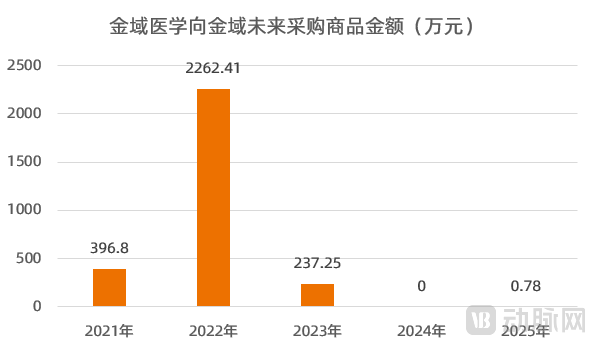
Value of Goods Purchased by KingMed Diagnostics from KingMed Future, 2021–2025 (Source: Compiled by VCBeat)
On the product front, the sector has run into the prolonged cycles brought about by stringent IVD regulations. For high-end CNV-seq reagents, the registration pathway is lengthy, the threshold for clinical evidence continues to rise, productization timelines are repeatedly delayed, and capital's expected milestones keep falling short.
In its response to the Shanghai Stock Exchange's inquiry letter regarding its 2024 annual report, KingMed Diagnostics explicitly stated that, due to the complexity of the technology, the approval process for diagnostic test kits in China has been slow, and its high-end CNV-seq products have not yet received regulatory approval.
Furthermore, at the corporate governance level, the scientific team places greater emphasis on technical rigor and scientific boundaries, whereas KingMed Diagnostics, as the industry partner, requires commercializable products that are implementable and have clear profit expectations.
During the market downturn, divergences between the two parties regarding investment pacing and project priorities were continuously amplified, resulting in slow project progress. KingMed Diagnostics has continued to recognize impairment losses on this long-term equity investment.
According to the inquiry letter from the Shanghai Stock Exchange and relevant financial report disclosures, as of the end of 2024, KingMed Diagnostics' carrying amount of its long-term equity investment in DRA was approximately RMB 97 million, with an estimated recoverable amount of approximately RMB 24 million. Consequently, an impairment provision of approximately RMB 73 million was recognized for the year 2024.
Compounded by multiple variables, DRA is gradually sliding into the so-called "valley of death" in industrialization within the biopharmaceutical sector.
Across the entire biopharmaceutical industry, the liquidation of DRA is not an isolated case but a predicament commonly faced by numerous projects aimed at translating scientific research achievements into commercial applications. Every project transitioning from the laboratory to the market must navigate the same narrow and protracted pathway, with only a minority ultimately succeeding.
DRA is not a startup founded by individual professors in the traditional sense, but rather a joint venture between an industry leader and an academic team; nevertheless, it still exposes the common contradictions inherent in the commercialization of star scientific research IPs.
By integrating the widely recognized "Valley of Death" pattern in scientist-led startups within the biopharmaceutical sector, one can better understand the underlying logic behind the failure of such industry-academia-research collaboration projects.
The so-called "Valley of Death" in industrialization refers to the vast chasm between the completion of papers and patents for basic research achievements and the development of compliant, scalable, commercially viable products with payment value.
A significant number of projects fail not due to technical flaws, but because they are stalled by the combined pressures of funding, regulation, clinical validation, and market demand, halting their progress at the stage of transitioning from the laboratory to the clinical market.
Statistical data indicates that the failure rate of entrepreneurial ventures launched by university professors in the United States is as high as 96%–97%; relevant domestic statistics also show that the success rate for such ventures among Chinese university professors remains within the 2%–3% range. A large number of scientific research projects falter in this "valley of death."
Several Common Root Causes of Professors' Failed Entrepreneurial Ventures
First is the difference in underlying mindset. Scientists are naturally obsessed with technological breakthroughs and pursue technical excellence. This tendency often leads them to overlook real-world clinical needs and lack a commercialization mindset. The balance between product cost, pricing, and clinical benefits is rarely a priority for them. Consequently, bridging the gap from laboratory to market becomes a significant challenge.
In the DRA case, the team validated the detection capability of CNV-seq at the technical level; however, during the project initiation phase, there was insufficient estimation of implementation constraints, such as the out-of-pocket market and supporting genetic counseling services.
The second issue is role misalignment. As a long-standing chief scientist, the professor excels in experimental design and data interpretation; however, when required to assume CEO responsibilities—such as supply chain management, marketing promotion, legal negotiations, and team performance evaluation—they often struggle to adapt. Under the DRA model, Professor Dennis Lo's team provides patents and scientific guidance, while corporate operations, regulatory registration, and commercialization are handled by industry partners. This arrangement also reflects the widespread challenge that research teams are generally not adept at commercial operations.
Investors have another core concern regarding professor-led startups. A professor's primary responsibilities remain teaching, research, and administrative duties at the university, meaning their entrepreneurial endeavors are merely a part-time commitment. During critical periods such as fundraising negotiations, major clinical milestones, and key decision-making phases, they may not be able to devote their full attention. Any absence on their part would directly impact the project's momentum.
Today, many industrial investors have established clear screening criteria: they do not invest in professors who have not left their full-time positions at universities. The essence of this approach is to mitigate the risk of project stagnation caused by the founder's absence at critical junctures.
In the DRA project, core scientists bear heavy administrative and research responsibilities at The Chinese University of Hong Kong. Their absence from key decision-making milestones due to academic and administrative commitments may compromise decision-making efficiency.
However, under the DRA model, corporate operations, registration, and commercialization are inherently borne by industry partners, with the scientist team's role limited to providing patents and scientific guidance. Therefore, this concern primarily manifests in the efficiency of decision-making at critical milestones, rather than in day-to-day operations.
DRA is bolstered by the IP of star scientists and further enhanced by the channel resources of China's leading independent clinical laboratories (ICLs). In its early stages, the project nearly possessed all the elements favored by capital investors.
However, eight years of implementation have proven one thing: when evaluating such projects, investors need to proactively strip away the halo surrounding star scientists. They must let go of romanticized notions about academic narratives and return to the most fundamental, hard-core realities of industrial commercialization.
Among these, the regulatory pathway, technological maturity, and market and reimbursement logic are the three core dimensions determining the success or failure of a project.
The regulatory pathway determines whether a project can secure market approval. In heavily regulated sectors such as prenatal genetic testing, the policy window often dictates a project's fate even before market size does.
After years of pilot programs and standardization, basic NIPT has established a relatively mature implementation framework, whereas the company's self-developed high-end CNV-seq product failed to complete the registration process. Even with impressive laboratory data, ambiguous product approval pathways and continuously evolving clinical evidence requirements inevitably prolong project timelines, steadily draining financial resources and testing the patience of all stakeholders.
The Predicament of DRA: Uncertainty in the Registration Cycle as a Pervasive ConstraintAmidst the predicament faced by DRA, uncertainty surrounding the registration cycle serves as a constraint throughout the entire process. During the prolonged waiting period, the external market environment continues to deteriorate, steadily diluting the project's investment value.
Technical maturity requires distinguishing between laboratory-level technical feasibility and stable data capable of supporting product registration and scaled-up manufacturing.
Results from academic papers and small-sample research data can only demonstrate the feasibility of the underlying technical principles; they do not guarantee direct translation into standardized in vitro diagnostic (IVD) products. Many scientist-led projects tend to stall at the research validation stage, lacking a robust chain of clinical evidence derived from large-scale, multicenter studies that comply with regulatory registration requirements. Consequently, these projects struggle to deliver stable, reproducible results suitable for mass-produced testing.
The DRA team is capable of completing the technical validation of CNV-seq; however, transitioning from research samples to standardized commercial products requires extensive clinical work that complies with regulatory requirements. The difficulty of this step is often obscured by the academic spotlight.
Market and payment logic ultimately determine whether a product can generate sustainable revenue after its launch. This is the most direct lesson from the DRA project.
During the project initiation phase, the industry anticipated that high-end prenatal testing would become a growth sector based on fertility trends at the time. However, the declining birth rate and price wars in basic NIPT directly compressed the addressable market for paid services.
CNV-seq is an out-of-pocket expense item with a higher price tag, and it requires accompanying genetic counseling. Both physicians' willingness to recommend and patients' willingness to pay constitute practical barriers.
Detaching from real-world payment scenarios and relying solely on technological advancement to extrapolate market potential is a common pitfall for many scientist-led projects.
Of course, the liquidation of DRA should not lead to a denial of the value of the Star Scientist Project. Research and development capabilities, product capabilities, and commercialization capabilities are three entirely independent systems. The academic halo can reduce the difficulty of early-stage fundraising, but it cannot help projects navigate the hurdle of industrialization.