

From 600 Million Annual Health Checkups to Trillion-Yuan Proactive Health: Topsky's Transformation and Second Growth Curve

TOPSKY
Medical Information Provider
Zhang Lei, 35, has just received this year's health checkup report: high blood lipids, mild fatty liver, excess weight — almost identical to last year's. The report advised "a light diet and more exercise", and he did not much care. Next year, in all likelihood, the same indicators will come back; with slightly worse luck, there may be one more entry: "high blood pressure".
This story repeats itself every day.
Industry data shows that China's health checkup industry handles roughly 490 million to 630 million checkup visits a year, yet the follow-up rate after a positive finding remains low. For most checkup institutions, the service ends the moment the report is printed — abnormal indicators like Zhang Lei's tend to be locked in a drawer along with the report.
Behind the "checkup only, no management" dilemma, policy, industry and capital are joining forces to break through. But the more critical question is: why now?
The most fundamental driver is pressure on medical insurance payments. China has more than 300 million chronic disease patients, and chronic disease spending accounts for over 70% of total medical insurance expenditure; the "treating existing illness" model is no longer financially sustainable. Moving the health management front line forward to reduce the onset of chronic disease at the source is not only a public health issue but a rigid demand on the payer side.
Policy signals are being released at a rapid clip. From "Healthy China 2030" to the 15th Five-Year Plan, which explicitly calls for a leap from "treatment-centred" to "health-centred", while "proactive health and technological responses to population ageing" has been listed as a National Key R&D Program. The payer side is loosening in step: some regions are exploring bringing health management into medical insurance payments, and the integration of commercial insurance with health management is tightening.
What needs to be "clarified" and added here is this: why is it a "trillion-yuan track"? According to the 2026 China Sub-health Industry Research Report released by LeadLeo Research Institute, China's sub-health industry market alone grew from RMB 620 billion in 2021 to RMB 850 billion in 2025 and is expected to reach RMB 1.466 trillion by 2030. Add health management for the "already ill" population, such as chronic disease patients, and this is unquestionably a huge market worth more than a trillion yuan.
Li Dianzhao, Chairman of Topsky, believes: "Whether it is DRG/DIP reform on the hospital side or reforms within insurers themselves, both need proactive health to control costs and lower expenses across the entire service chain."
Against this backdrop, at its mid-year strategy meeting Topsky stated explicitly: "Actively respond to the country's programmatic call for 'proactive health' and, by combining it with lifestyle medicine, comprehensively reshape the company's commercial value." Li stressed, "As the entry point to health management, a health checkup's value should not stop at the delivery of a report."
Proactive health is not a slogan. To truly take hold, it still needs an operable medical methodology. And the answer Topsky found is lifestyle medicine.
In Topsky's strategic map, AI and lifestyle medicine form the technology and methodology layer, proactive health is the strategy layer, and hospitals, enterprises, insurance and eldercare are the deployment scenario layer. Together, the three point to Topsky's transformation from a checkup informatisation provider to a proactive health service provider.
Against the broader trend of proactive health, to better understand Topsky's strategic transformation one must first sort out the three growth ceilings of the traditional checkup industry.
The first ceiling is the service boundary of "checkup only, no management". In the checkup industry, "checkup only, no management" has long been an open secret. Topsky summed up four reasons why public hospitals "want to manage but cannot": first, no billing items — public hospitals lack billed services for post-checkup health management, so physicians lack incentive; second, insufficient manpower — post-checkup follow-up requires substantial staffing for report interpretation, plan design and tracking, and hospitals find it extremely hard to free up extra hands; third, liability risk — with checkups alone, risk concentrates on missed or wrong findings, whereas stepping into post-checkup management may instead introduce new risks; fourth, limited data — a checkup dataset alone is not enough to support comprehensive health management; data from at-home health monitoring is also needed to carry it out effectively.
The situation at private institutions is no more encouraging. Although some hospitals that do conduct health management are strong, their capacity for serious medical services is limited, which leaves consumer trust insufficient; most checkup institutions, meanwhile, remain stuck in the shallow "checkup plus phone follow-up" model, which can hardly change users' health outcomes.
The second ceiling is the single revenue model. Traditional checkups are essentially a one-off transaction — users pay once a year, and the relationship ends when the service concludes. Without the means to reach users continuously, a one-time checkup user cannot be converted into a long-term health management customer, and customer lifetime value is locked to the unit price of a single transaction. For investors, that means low revenue predictability, low repurchase rates and a constrained valuation logic.
The third ceiling is the cost bottleneck of personalised delivery. "Using checkup reports for chronic disease intervention and sub-health management is something the industry has talked about for more than 20 years without ever landing it," Li points out. The core bottleneck is that health management must be highly personalised, yet until now companies could at best produce a "template" — the same plan for everyone, young or old, male or female, giving one programme the moment diabetes is mentioned, with insufficient effectiveness. And having health managers tailor a plan for each person is simply impossible on cost.
And Topsky happens to stand in the best position to break these ceilings. As a leading checkup digitalisation service platform in China, Topsky is a top player in online checkup booking and in the checkup software subsegment, serving more than 5,000 public medical institutions nationwide, covering over 100 million people and having accumulated more than 90 million structured checkup records. These data are both an asset and a reminder — behind every abnormal indicator lies a health risk that has not been effectively managed, and also commercial value that has yet to be tapped.
With the three ceilings stacked together, the traditional checkup business has limited room to grow. A new growth curve must be sought "after the checkup".
Lifestyle medicine is a clinical discipline with a rigorous academic definition. Using evidence-based interventions such as nutrition, exercise, sleep, stress management, social connection, and smoking and alcohol cessation, it delays or reverses the formation and progression of health risks.
"In plain terms, you can understand lifestyle medicine as healthcare delivered outside hospital settings," Li notes. Its service settings are the home, the community and the workplace, with services delivered mainly online, targeting four scenarios: post-discharge rehabilitation, chronic disease management, sub-health intervention and at-home eldercare.
Lifestyle medicine and health checkups have a natural point of connection. The abnormal indicators found in checkups — high blood lipids, borderline blood sugar, fatty liver, excess weight, prehypertension — mostly require no medication, but do require intervention. These people are precisely the target population for lifestyle medicine.
Yet lifestyle medicine has been talked about in China for years without ever achieving scaled deployment. The core bottleneck is that lifestyle medicine is at its essence about "behaviour change", and behaviour change requires three things: a personalised plan; long-term companionship with dynamic adjustment; and a multidisciplinary team (physicians, dietitians, exercise rehabilitation specialists and psychologists). Together, these three push per-capita service costs extremely high and beyond the reach of scale.
But this track is not without commercial validation. Before its transformation, Topsky conducted systematic market research. Li noticed that, according to incomplete statistics, certain private health management institutions focused on subsegments such as TCM nodule intervention, weight loss and qi-and-blood conditioning have annual revenues in the hundreds of millions to several billion yuan, validating the commercial feasibility of non-pharmaceutical health management. "These success stories tell us that this track will certainly produce a successful model."
So what qualifies Topsky to do this? The answer: the integration of AI capabilities with human service capabilities.
AI's change to lifestyle medicine shows first and foremost in generating personalised plans tailored to each individual.
"What generative large models do best is provide different intervention plans based on each person's health parameters," Li says.
Topsky's self-developed "Woodpecker" large model is a vertical large model focused on personalised lifestyle management, providing technical support for scenarios including personalised lifestyle management, information integration, service assistance and ongoing companionship. Drawing on long-accumulated structured checkup data, checkup informatisation capabilities, business systems and a professional service team, the Woodpecker large model is helping Topsky extend a one-time service into ongoing companionship and upgrade standardised processes into personalised delivery for each individual. It is also the core technology engine behind a series of the company's innovative products.
Its core advantages are reflected in four areas:
First, training on high-quality multimodal data. The model is trained on more than 90 million health records spanning multiple dimensions, including checkups, consultations and health interventions, with industry-leading data quality.
Second, dynamic assessment and adaptive optimisation. It receives real-time feedback on user behaviour and health indicators, dynamically assesses intervention effects and automatically optimises subsequent personalised lifestyle management plans.
Third, deep scenario-specific fine-tuning. It is deeply fine-tuned for specific scenarios such as lifestyle intervention and everyday health education, so the management plans it delivers are more professional and more actionable.
Fourth, multimodal interaction capabilities. It supports multiple interaction modes including text, voice and images (report recognition), giving users in different scenarios a more natural and convenient experience.

"Woodpecker" large model
In practice, the Woodpecker large model's workflow is as follows: once a user enters the service, they first connect with a health butler and a physician to complete the establishment of a health record and data collection (normalising structured and unstructured data); the model then assists the physician in stratifying and grading the user and attributing risk; on that basis it helps the physician generate personalised intervention plans across the six pillars of lifestyle medicine; and the final plan undergoes manual review by a human physician — "it cannot simply be whatever the AI produces," Li stresses. Beyond plan generation, the AI health coach also provides 24/7 interaction covering daily diet logging, exercise reminders, sleep feedback, emotional support and more.
At present, on the hospital side, AI applications already cover the entire process from pre-checkup to post-checkup: AI-powered smart package recommendations before the checkup, quality control and year-on-year report comparison during it, and report interpretation afterwards. The two most used and best received scenarios are AI pre-checkup smart recommendations and AI smart final review.
"The logic by which our AI smart final review issues reports is exactly the same as a physician's, with several-fold efficiency gains and significantly better quality. AI can go further, prompting physicians on whether to switch to better wording," Li says. "For physicians it delivers an intelligent assistance effect, so acceptance is extremely high."
Under a human-machine collaboration model, AI handles scaled personalised plan generation and daily interaction, while human experts can focus on complex cases, final plan review and building user trust. This division of labour lets lifestyle medicine, for the first time, have the potential to be delivered at scale.
From an investment perspective, the Woodpecker large model's value lies not only in the technology itself but in the dual moat it builds: one is a data moat — 90 million structured checkup records are a scarce asset for training vertical large models, and latecomers will struggle to accumulate a dataset of comparable scale and quality in a short time; the other is a compliance moat — the Woodpecker large model has already completed the filing for generative AI services, giving it a first-mover compliance advantage.
The value of AI is becoming more prominent still. Last October, the "Smart Health Management Platform for Geriatric Multimorbidity" jointly proposed by Topsky and Peking University People's Hospital was approved by the National Institute of Hospital Administration, NHC, becoming a core part of the National Key R&D Program project "Building a Continuous Service Model for Older Adults with Multiple Coexisting Diseases and Its Regional Demonstration Application", which aims to resolve the conflicts between single-disease guidelines and geriatric multimorbidity scenarios. Now, with the Woodpecker large model having completed its filing, it will play a greater role in AI assistance going forward.
Technology answers whether something can be done; business must answer who pays.
In Topsky's revenue structure, 2B business accounts for about 68% and forms the foundation, while 2C business accounts for about 32% and is the growth engine. Topsky is now building an H-B-C full-chain closed-loop AI health service platform to provide more precise and efficient solutions for different parties —
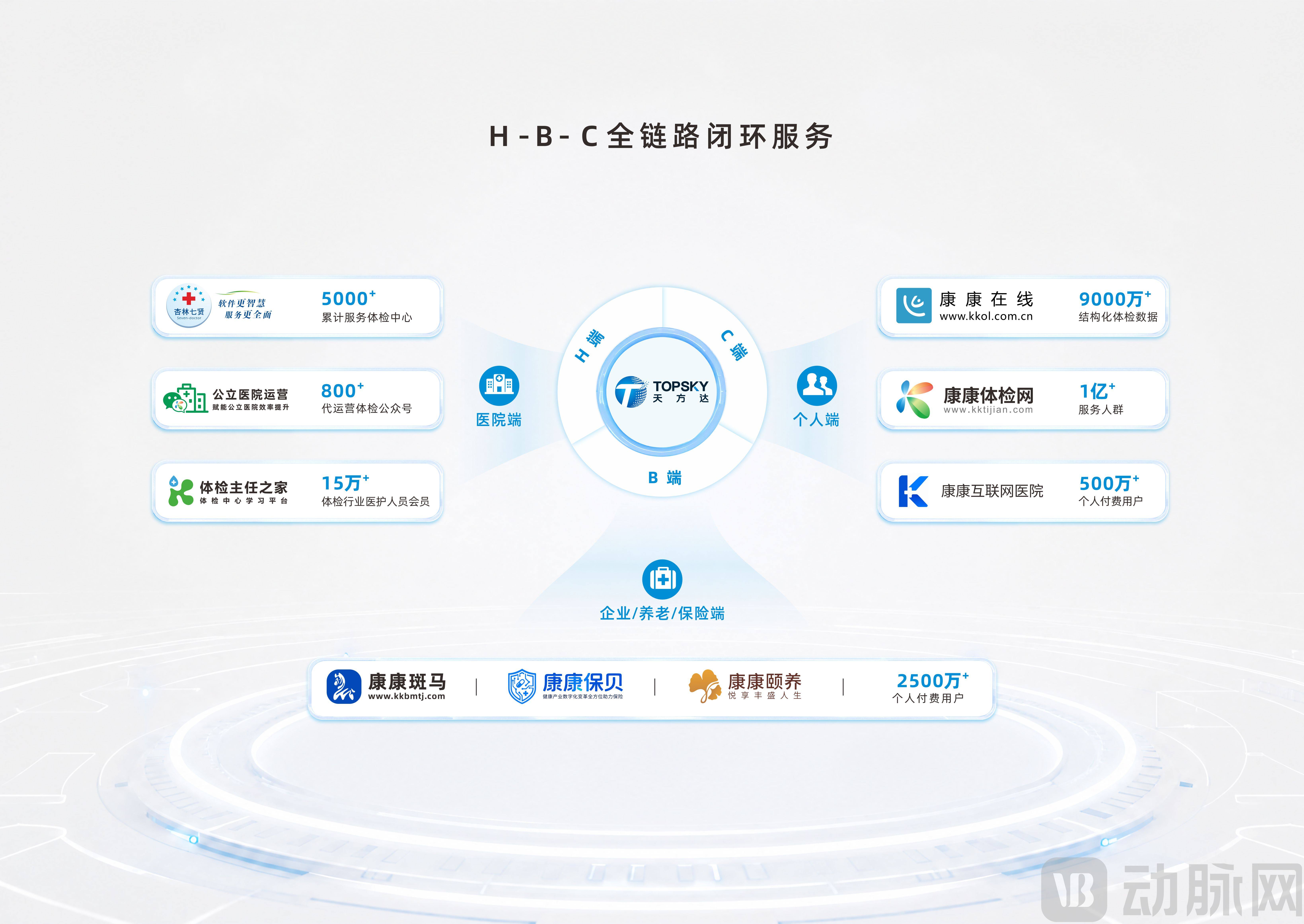 H-B-C full-chain closed-loop services
For the H side (hospitals), Topsky provides AI-empowerment solutions to help hospitals further improve efficiency and extend their service boundaries; for the B side (enterprises, insurers and eldercare institutions), it provides one-stop health management solutions to reduce the health risks of employees or members; and for the C side, it provides AI-driven personalised proactive health management to help users build healthy lifestyle habits. Data shows that in 2025 Topsky added more than 400 new clients, with revenue growth of 48.9% and a core client repurchase rate above 95%.
Taking C-side services as an example, Topsky is moving users from one-off checkup transactions to annual membership services. For investors, the significance of this shift is that moving from one-off transaction revenue to recurring revenue will fundamentally change revenue predictability and the valuation logic. Under a prepayment model, cash flow comes earlier and is steadier, giving the company a more solid financial foundation for continued R&D investment and market expansion.
It is understood that among Topsky's health management services, products such as personalised customisation and post-checkup report interpretation are relatively mature and already live, while the deeper annual-fee membership service is still in a commercial validation phase and is being fine-tuned with clients.
Still, for proactive health services to keep generating value, Topsky must solve two core challenges —
The first challenge is closing the loop between monitoring and intervention. A checkup happens once a year, leaving the other 360-plus days of data blank; without real-time data input, AI intervention becomes guesswork. Topsky's solution is the "Orange Cat Akang" series of AI smart hardware — an AI pet robot positioned as "a warm AI companion for at-home health monitoring and eldercare". Topsky has already formed a strategic partnership with Yinling Times and is working to bring "Orange Cat Akang Smart Companion" to market. Topsky expects the deep integration of the "Orange Cat Akang" AI smart monitoring hardware with an Agent to extend low-frequency checkups into high-frequency at-home health monitoring, fully connect the in-hospital and out-of-hospital data loop, and sharply raise customer lifetime value (LTV) and its data asset moat.
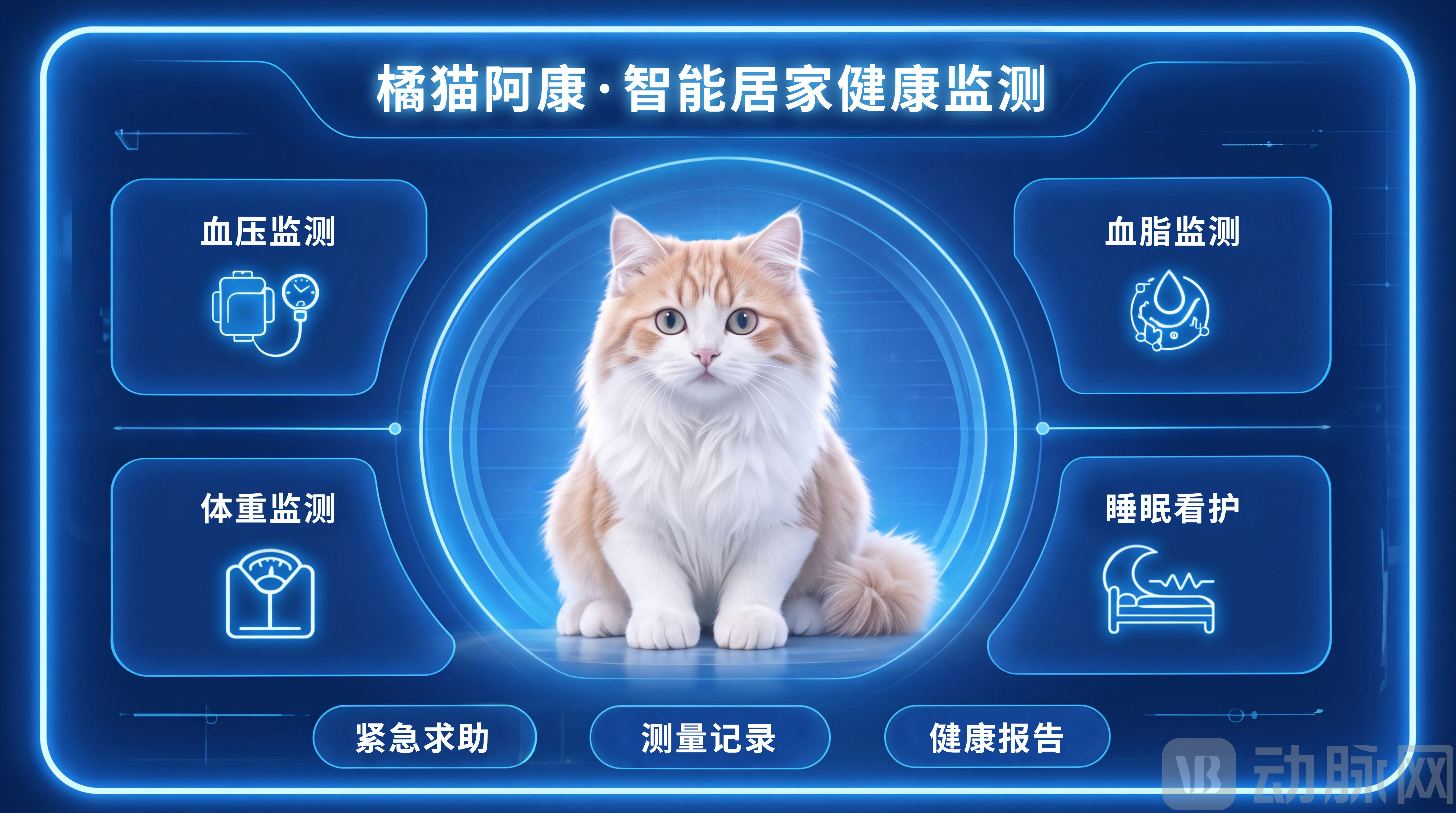
The "Orange Cat Akang" series of AI smart hardware
The second challenge is the efficient flow and application of data. To this end, Topsky built an H-B-C three-way data hub that, through One ID (unified user identity), One Profile (unified health profile) and One Brain (unified AI decision-making brain), lets data flow and appreciate in value across the hospital side, the enterprise side and the individual side. Li explains the process using group checkups as an example: after an enterprise purchases group checkup services, and based on the data connection between the H side and hospitals, Topsky can efficiently generate for it an annual plan covering multiple hospitals, multiple age groups and multiple packages; once the enterprise's package is set, it syncs automatically to hospitals, and C-side users can choose a hospital and time through the booking portal, add AI-personalised items and purchase services for family members; after the checkup is completed, and with authorisation obtained, the results are fed back to the individual and the enterprise through the platform; it also supports complex functions such as group-wide final review analysis for enterprises.
"More users, more data, a more accurate model, better service, even more users" — that is the data flywheel Topsky hopes to form. But Li also stresses: "Only compliant, high-quality data can be used to form a data flywheel. The key is not just whether the underlying model is powerful enough, but how data is applied in real scenarios and how data quality keeps iterating."
Seen against the broader landscape of the checkup industry, Topsky's transformation holds a distinctive position.
"We started from health checkups, the 'intersection of medicine and health' — connecting forward to hospitals and backward to enterprises and individuals," Li notes. Topsky's core advantage is the relationship with public hospitals cultivated over nearly 30 years — more than 5,000 partner medical institutions nationwide. That is the result of capital plus time, not something that can be built quickly by burning money alone.
On the competitive landscape, Li has a clear-eyed judgement. In his view, some internet healthcare platforms are still in the traffic and drug-selling business rather than the service business, while some private checkup chains still face the double constraints of consumer trust and the ability to integrate medical resources.
The challenges of transformation are real. Li admits that Topsky will further integrate AI technology to serve users better and improve user stickiness. Despite the challenges, its direction is clear. This company, which started out in checkup informatisation, is trying to answer an industry question — is the ultimate value of a health checkup to discover disease, or to stop it from happening?
In Li's view, "AI plus lifestyle medicine gives proactive health, for the first time, the conditions to be scalable, verifiable and profitable." Topsky's transformation is not an endpoint; it is more like a microcosm of the industry's migration from the "disease-detection business" to the "health business".
But whether the transformation succeeds depends on having a verifiable execution path. Based on its business foundation and strategic positioning, Topsky has laid out a three-to-five-year roadmap: 2026–2027 to consolidate the foundation, expanding AI penetration in hospital scenarios, advancing C-side membership, completing mass production of Orange Cat Akang hardware and validating the "hardware plus service subscription" model; 2027–2028 to complete scaled replication, getting the H-B-C data hub running, landing proactive health services at scale on the B side and beginning to see the data flywheel effect; and 2028–2030 to build out the ecosystem, with proactive health becoming a core revenue pillar, exploring compliant value-added data services and constructing a health management ecosystem covering hospitals, enterprises, insurance, eldercare and individuals.
The core logic of all three phases is consistent: starting from 90 million checkup records, using the Woodpecker large model as the engine and the H-B-C full chain as the channel, to ultimately achieve a value leap from a "one-off checkup transaction" to "lifelong health management services".
Asked how he hopes users will refer to Topsky in ten years, Li answers: "I hope we are referred to as a 'health butler'. When users entrust their health needs to us, whether it is lifestyle medicine services outside hospital settings or assistance with serious medical services, we can meet them all in one stop."
It is worth noting that VCBeat has previously reported separately on Topsky's positioning in areas such as the "checkup–management–care" closed loop in the silver economy, B-side corporate health management scenarios, and hospital-side integrated full-process services covering pre-hospital patient acquisition, in-hospital efficiency and post-hospital value-added services. In future, these scenarios will further coalesce around the "proactive health" strategy to form Topsky's complete strategic map.
Let us return to the story at the beginning. If there were a solution that could keep tracking his indicator changes after the checkup and dynamically adjust diet and exercise advice, Zhang Lei's report next year might look very different. And that is precisely the question Topsky's transformation sets out to answer.
More than 90 million dormant checkup reports are waiting to be awakened. And what awakens them is not only technology, but a trillion-yuan proactive health market that is opening up.