

CNY 1.5M Annual Salaries: Brain‑Computer Interface Sector Wages Fierce Talent Battle

Active Intelligence Technologies
Developer of Invasive Brain-Computer Interface Technologies
wiraxon
Brain-Computer Interface Developer and Manufacturer

Gestala
Ultrasound Brain-Computer Interface Technology Developer

StairMed
Developer of Implantable Brain-Computer Interface Technology
The Brain-Computer Interface Sector Sees Surging Hype, as a Talent War Heats Up.
Since 2026, brain-computer interface (BCI) roles spanning algorithms, hardware, and product commercialization have consistently appeared on high-salary recruitment lists. Some companies are seeking key technical talent globally, offering annual salaries of RMB 1 million; compensation for positions related to implantable BCIs has even surged to RMB 1.5 million.
Capital, industry, and research forces are converging en masse, significantly accelerating the industrialization of brain-computer interfaces (BCIs), as if entering a frenzied "gold rush" phase. Yet behind the million-yuan annual salaries, some questions still warrant calm exploration: What kind of talent are companies vying for? Which capabilities determine the market value of brain-computer interface (BCI) professionals?
Brain-Computer Interfaces Enter a Period of Rapid Development: Driven by Factors Such as Diversification of Technological Products and Significant Capital Investment, Corporate Demand for Talent Has Surged, Igniting a Fierce Competition for Top Professionals.
The growing diversification of brain-computer interface (BCI) technologies and product roadmaps has directly driven an increase in job demand.
Within the industry, invasive and non-invasive technological approaches coexist, with a continuously expanding array of electrode solutions and hardware forms. Concurrently, technologies for sensing and modulating optical, electrical, magnetic, ultrasonic, and chemical signals are advancing in parallel. Implantable devices are focused on high-density neural recording, brain intent recognition, and neural stimulation research and development, while non-implantable products are increasingly being deployed in scenarios such as medical rehabilitation, assistive control, and consumer electronics. The diversity of R&D tasks necessitates that companies staff professionals with expertise in these respective fields.
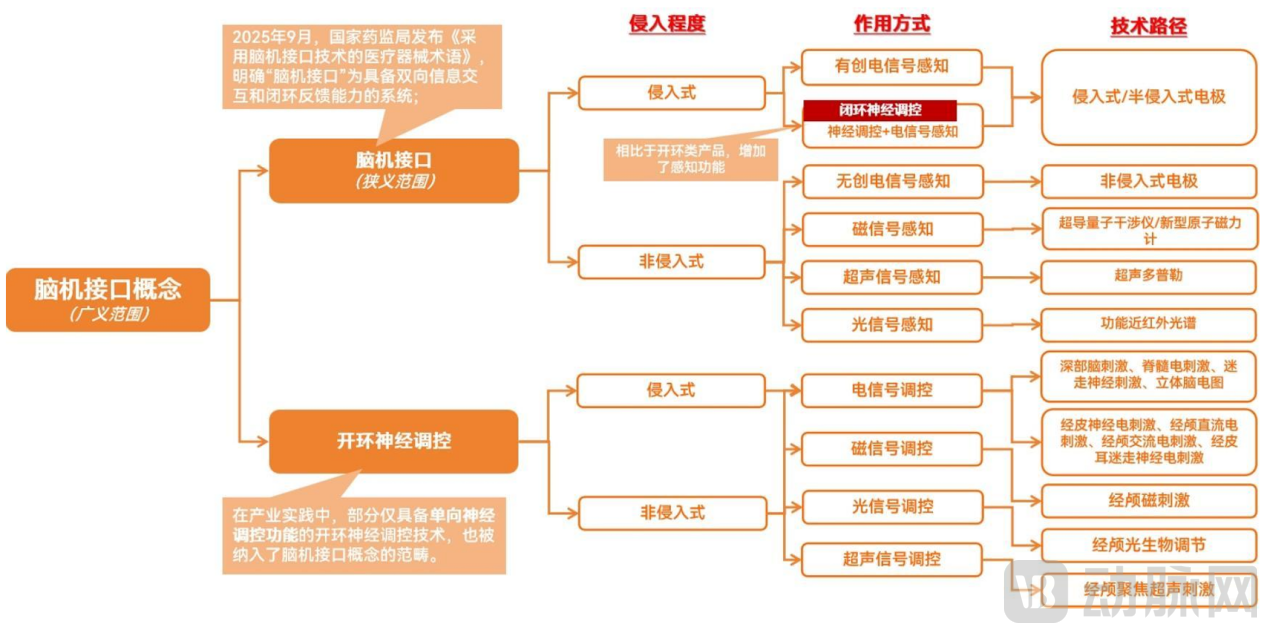 Diverse Technological Pathways of Brain-Computer Interfaces, Image Source: VBInsight's "2026 Report on Early Commercialization Exploration of Brain-Computer Interfaces"
The influx of capital enthusiasm has accelerated corporate expansion, driving up the scale of talent demand.
In the first half of 2026, China's brain-computer interface (BCI) sector witnessed dozens of financing rounds, with total funding reaching billions of yuan and frequent large-scale deals exceeding RMB 300 million. With ample funding in hand, expanding the team has become one of the company's top priorities.
For instance, Active Intelligence completed a RMB 330 million angel financing round, allocating the funds primarily to team expansion, clinical trials, and hardware infrastructure development. Wiraxon secured RMB 300 million in its angel series financing, simultaneously advancing clinical trials and global expansion while aggressively recruiting interdisciplinary talent specializing in brain-spine interfaces. Gestala has currently assembled a team of 45 top-tier scientists and engineers from around the world, with the continued accumulation of high-caliber talent remaining a key priority for the future.
The industry scale continues to grow, further amplifying the demand for talent, with high salaries becoming a prominent feature of recruitment in the sector.
The Beijing Directory for Human Resource Development in New Quality Productive Forces (2026 Edition), released by the Beijing Municipal Human Resources and Social Security Bureau, indicates that the reference annual salary range for brain-computer interface positions is RMB 180,000–470,000, with a human resource development rating of "full-level" five stars (the higher the star rating, the greater the human resource development value).
Higher salaries have emerged in specific job postings. Public recruitment information reveals that an implantable brain-computer interface company is offering annual packages of up to RMB 1.5 million for FPGA experts and PhDs in automation control, while positions for neural signal decoding experts and PhDs in neuroscience command annual salaries of up to RMB 1 million.
Annual salaries of one million yuan are not isolated cases. During the spring recruitment season of 2026, some brain-computer interface (BCI) enterprises in the Greater Bay Area were already recruiting talent globally with annual compensation packages reaching one million yuan. According to data from nationwide searches conducted by Bailie Talent Technology in the first half of 2026, the median annual salary offered by employers for Neural Signal Algorithm Engineers reached RMB 820,000. For core candidates with more than three papers published in NeurIPS or the Journal of Neural Engineering, top-tier companies offered packages exceeding RMB 1.2 million. Data from the BOSS Zhipin platform also showed that recruitment salaries for positions such as Head of BCI Chip Development, BCI Pre-research System Engineer, and Head of Multimodal Algorithms exceeded one million yuan at certain companies.
The statistical methodologies and sample scopes of these data differ, so they cannot be directly used as the average salary level for the entire industry. Nevertheless, it is not difficult to see that Diversification of technological products, coupled with capital infusion, has jointly driven an increase in hiring scale within the brain-computer interface (BCI) industry, highlighting a prominent landscape where funding is abundant and talent acquisition is fiercely competitive.
As the industry advances, the demand for talent in brain-computer interfaces (BCI) continues to evolve, and the criteria for evaluating scarce interdisciplinary professionals have become more specific.
In the early stages of the industry, the primary task for companies was to validate technical feasibility. The focus was on verifying technological pathways, debugging algorithms, and developing prototype units. During this phase, recruitment efforts prioritized research talent in neuroscience, EEG signal processing, algorithm development, and prototype R&D.
As a cohort of companies initiates clinical trials, product registration filings, and engineering-scale mass production, As the industry enters a new phase, companies still require human resources to support stable product operation, complete clinical validation, and implement large-scale production. Talent demand has expanded from a few R&D positions to a full suite of industrialization roles.
Taking Gestala as an example, the company's primary focus in its early stages was to validate the scientific hypotheses and technical roadmap, with a talent structure skewed toward neuroscience, ultrasound, algorithms, and prototype R&D.
With the launch of its global headquarters and super factory in Chengdu, the company has entered a new phase characterized by parallel engineering-scale manufacturing and clinical translation. Consequently, its talent needs are expanding to encompass systems engineering, reliability validation, product development, quality systems, regulatory affairs, clinical trials, manufacturing, and supply chain management.
StairMed's talent strategy also reflects a similar trend. The company's implantable wireless brain-computer interface (BCI) system has entered the “Green Channel” for innovative medical devices, becoming the first fully invasive BCI product in China to gain access to this expedited review pathway.
Currently, StairMed is conducting a concentrated recruitment drive focused on algorithms, hardware, device fabrication processes, electronics, and clinical engineering to support the R&D of its implantable brain-computer interface products, the advancement of clinical projects, and technological iterations. The next phase of talent development will extend to strengthening capabilities in system integration and product commercialization.
Brain-computer interfaces (BCIs) are inherently characterized by significant interdisciplinary features. Amid shifting talent demand trends, the value of multidisciplinary professionals has become increasingly prominent; however, severe market supply shortages persist—a reality widely acknowledged across the industry.
"Brain-computer interface is a field with extremely high technical barriers, spanning materials science, chip design, algorithms, neuroscience, and clinical medicine. It requires the integration of multidisciplinary knowledge to drive the consolidation and implementation of different technological modules, thereby establishing a complete business platform," said Yang Zhiwen, Founding Partner of Nuoyu Capital.
Relevant executives at StairMed also noted that the team requires not only specialists with deep expertise in a single domain, but also interdisciplinary talent capable of bridging neuroscience, engineering R&D, and clinical needs.
Peng Lei, Founder and CEO of Gestala, lamented when discussing the pain points of recruitment. Recruitment for standard, standardized roles is moderately challenging; the most difficult positions to fill are those for composite leaders who possess two to three complementary skill sets. "For instance, professionals who possess both an understanding of neuroscience issues and the ability to translate multimodal brain data into algorithmic and product capabilities are limited in number globally, making identification, communication, and mutual validation more time-consuming."
"Composite talents" are often mentioned by industry insiders, but this concept remains relatively abstract. The scarcity of such talent is not merely due to their broader knowledge base. Brain-computer interface (BCI) technology is currently in a phase of rapid evolution in technical pathways and continuous change in product forms, making it difficult for companies to define core roles using fixed professional labels.
What qualities should such talent possess? Who can command a high salary? Today, companies employ more multidimensional criteria for evaluation.
According to relevant executives at StairMed, ideal composite talents should possess the ability to oversee the entire R&D chain: "We place particular emphasis on whether practitioners can address genuine clinical needs, drive synergy across various stages, and transform technological breakthroughs into safe, reliable, and practical products step by step."
From the perspective of compensation distribution, to whom are companies willing to offer more competitive returns? In Peng Lei's view, it is typically those who can bridge multiple disciplines and take accountability for final outcomes. Such individuals are largely capable of mitigating key technical risks, shortening translation cycles, and building organizational capabilities. "Therefore, compensation is determined not only by job title but also by the scarcity of talent, the complexity of assigned tasks, and whether one possesses end-to-end experience spanning from research to product development or from clinical trials to regulatory approval. As the industry evolves, competition among enterprises for top-tier scientists, system architects, and core leaders in clinical translation will continue to intensify."
Based on common industry perspectives, talent competition in the brain-computer interface (BCI) sector is becoming increasingly differentiated. While basic R&D roles are expanding alongside industrial growth, scarce high-end talent is increasingly concentrated in positions responsible for tackling key technological challenges, system integration, and clinical translation. Higher compensation is predominantly directed toward these critical roles that directly influence product development cycles and the pace of commercialization.
As in other industries, talent mobility is also the norm in the brain-computer interface (BCI) sector. It has become common for companies to poach employees from one another and for executives to switch jobs, taking their teams with them. Yang Zhiwen observed that companies mastering core technologies such as electrodes and neural stimulation have become a major source of talent for numerous emerging startup teams.
This model primarily involves the internal circulation of existing mature talent, making it difficult to fundamentally expand the overall talent supply in the industry. Brain-Computer Interface Talent Is Scarce; Companies Must Proactively Broaden Their Talent Acquisition Channels.
The first viable approach to sourcing external talent is to look toward adjacent industries and identify practitioners with the capability for cross-industry transition.
Peng Lei noted that the industry is no longer recruiting exclusively from within the traditional brain-computer interface (BCI) circle. "Professionals from fields such as precision medical devices, ultrasound imaging, semiconductor sensors, robotics, artificial intelligence, neuroscience, and clinical medicine all possess the potential to transition into the BCI sector."
If cross-industry talent acquisition is a crucial means of expanding professional skill teams, then targeted global searches are the key pathway to securing top-tier elite talent.
For top-tier talent, companies cannot rely on job descriptions to screen candidates; instead, they focus on tackling key technological challenges and achieving core business objectives by seeking elite professionals capable of independently defining problems and leading teams to achieve breakthroughs from zero to one.
The founding team's connections, the network of scientific advisors, collaborations on international research projects, and partnerships with upstream and downstream industry players are all critical channels for accessing top-tier talent. Leveraging this global, targeted recruitment strategy, Gestala has successfully onboarded senior overseas experts, including the former Clinical Lead at Neuralink and the Head of R&D and Regulatory Affairs at Nano Retina, a visual brain-computer interface company. Meanwhile, the company has established an external Scientific Advisory Board (SAB), which now includes Professor Feng Jianfeng, Dean of the Institute of Science and Technology for Brain-Inspired Intelligence at Fudan University; Professor Trevor Robbins, an internationally renowned cognitive and behavioral neuroscientist; and Professor Helen S. Mayberg, a prominent American neurologist.
While successfully recruiting external talent can yield rapid business results, the recruitment cycle and outcomes are uncertain; therefore, it is particularly important for enterprises to independently cultivate their own reserve talent.
Capital enthusiasm can accelerate team expansion, but it cannot immediately shorten the talent development cycle. Peng Lei believes that competition among enterprises will ultimately revolve around technological direction, research culture, clinical resources, and long-term growth potential, rather than just short-term compensation.
However, the feasibility of internal training varies significantly across different types of talent. In Yang Zhiwen's view, engineering professionals are relatively well-suited to grow through corporate projects. Once technical leads establish the overall framework and break down complex tasks for implementation, entry-level professionals can accumulate experience through hands-on project practice.
However, it is difficult to rapidly cultivate talent in brain science, neuroscience, and clinical medicine solely through internal corporate projects. Medical professionals must undergo a comprehensive training pathway encompassing undergraduate, master's, and doctoral studies, as well as standardized residency training, followed by extensive clinical practice. The career development cycle for specialized roles such as neurosurgeons is particularly protracted; such expertise cannot be mass-produced merely through short-term corporate investment.
It is precisely for this reason that companies are proactively partnering with universities and research institutions to streamline talent development through industry-academia-research collaboration.
For example, Gestala has established the NeoLAB Open Research Platform, positioned as a vehicle to integrate basic science, technological R&D, and the cultivation of young talent. The company also plans to launch the Gestala Global Scholars Program to support young scholars focusing on ultrasound neuromodulation, functional ultrasound imaging, neural decoding, NeuroAI, and sonogenetics. By leveraging NeoLAB as its corporate interface, the company aims to connect universities, hospitals, research institutions, and industry teams, thereby forming an open network for talent development.
In summary, the talent challenge in the brain-computer interface (BCI) sector is evolving from a corporate recruitment issue into a broader industry-wide talent ecosystem problem, requiring collaborative efforts from all stakeholders across the industry.
Yang Zhiwen also cautioned that the industry needs to overcome impetuousness. Because Decoding brain signals is inherently fraught with challenges. While motor-related signals are relatively controllable, the interpretation of internal brain activities such as emotions and thoughts faces extremely high technical barriers; some laboratory findings were established under experimental conditions involving small animals with thin skulls or artificially removed bone flaps, leaving a substantial gap to clinical translation.
"These bottlenecks are difficult for individual scientists or small teams to overcome alone; they heavily rely on continuous breakthroughs in basic research and require long-term collaborative efforts among enterprises, universities, and research institutes, potentially spanning three to ten years. Moreover, brain-computer interfaces have extremely high standards for product safety and ethical constraints; the industry needs to abandon a short-sighted mindset and cultivate more patience and depth."
The talent gap and technological barriers are intertwined. Only by breaking down institutional barriers, pooling efforts across the industry, and building a talent cultivation and supply ecosystem aligned with the development patterns of interdisciplinary fields can brain-computer interfaces truly unleash their immense potential.