

Chinese-Origin iPSC-Derived Cell Therapy XS411 for Parkinson’s Disease Showcased at International MDS Congress with Promising Clinical Data

XsellSmart
Stem Cell Therapy New Drug Developer

October 10, 2026
eMedClub News
October 2026,International Congress of Parkinson's Disease and Movement Disorders(MDS)Held in Seoul, South Korea, the congress is globally recognized as one of the most prestigious and influential international academic conferences in the field of Parkinson’s disease and movement disorders.Feng Tao’s Team, Beijing Tiantan Hospital, Capital Medical UniversityInvited to deliver the opening presentation for the “Parkinson's Disease: Clinical Trial, Pharmacology, and Medical Management” session.Results of the Phase I Clinical Study of XsellSmart’s Proprietary Universal XS411 Cell Injection for the Treatment of Parkinson’s Disease, as well as the progress of its multicenter, randomized, parallel-controlled, blinded-assessment Phase II clinical trials across China, has garnered extensive attention from international peers.
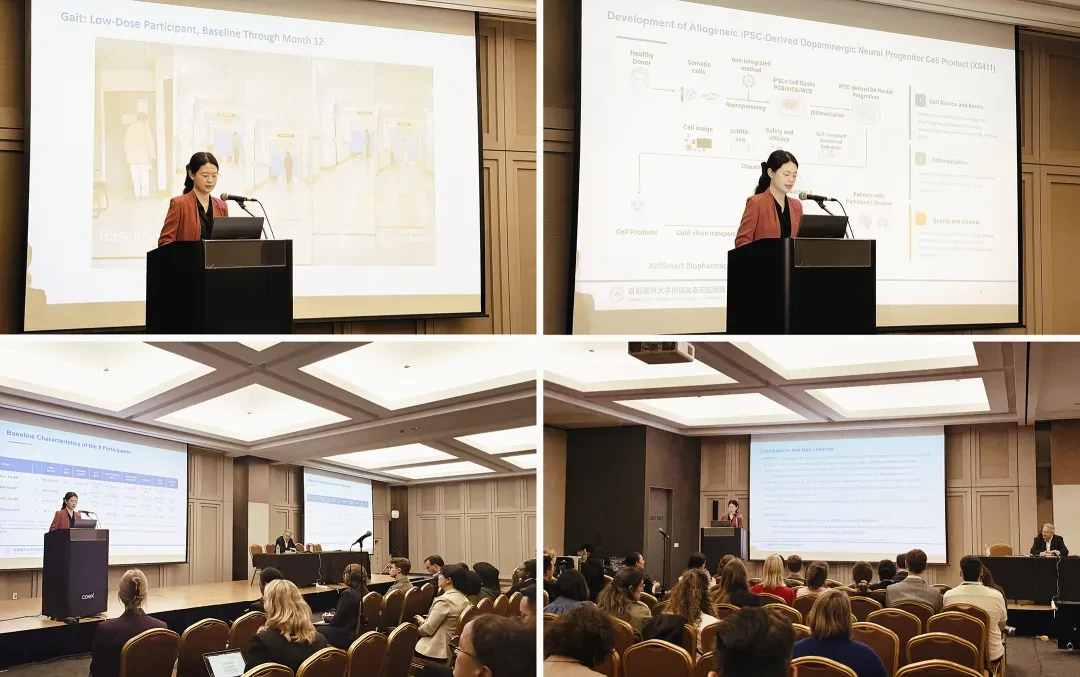
Dr. Su Dongning, representing the research team of Beijing Tiantan Hospital, Capital Medical University, National Center for Neurological Disorders, delivered a report.
Preliminary Clinical Evaluation ResultsIt is demonstrated that XS411 injection, a novel universal iPSC-derived dopaminergic neural precursor cell therapy developed by XsellSmart, does not require HLA matching. When combined with standardized immunosuppressive therapy, XS411 cells can survive, engraft, and differentiate into dopaminergic neurons in the putamen of Parkinson’s disease patients, thereby establishing dopamine synthesis and metabolic capacity. This leads to significant improvement in Parkinson’s disease symptoms while maintaining a favorable safety profile.
Phase I Study: Sustained Improvements in Motor Function, Quality of Daily Life, and Molecular Imaging Metrics
The Phase I study reported herein employed a single-arm, open-label, 3+3 dose-escalation design and enrolled a total of nine patients with moderate-to-advanced Parkinson’s disease. The mean disease duration was approximately 10 years. All patients exhibited wearing-off phenomena, with Hoehn–Yahr stages of 3 to 4 during the off period. Despite receiving existing treatments, their symptoms remained inadequately controlled, resulting in significant impairment of daily functioning and quality of life.
After undergoing standardized examinations and assessments, patients who met the relevant standards of the National Medical Products Administration (NMPA) received bilateral posterior putamen XS411 stem cell transplantation. With continuous follow-up, to date, all subjectsAll met the primary safety and tolerability endpoints: No dose-limiting toxicities, serious adverse events, or adverse events attributable to XS411 were observed; serial MRI scans revealed no abnormal cell overgrowth or tumor formation, and no graft-induced dyskinesia was observed.
To date, all nine subjects in the Phase I study have demonstrated significant improvement, with the magnitude of improvement exceeding the minimal clinically important difference (MCID) reported in published literature.(MCID)Threshold, indicating that improvement in motor symptoms is clinically significant.
Regarding motor function, the mean improvement in the off-state MDS-UPDRS Part III score at 6 months post-transplantation exceeded 30 points compared to baseline in nine subjects. Efficacy continued to improve through the 12-month follow-up. During the follow-up period, the magnitude of improvement in the higher-dose group showed a trend toward superiority over the lower-dose group.
For patients with more severe disease progression who have long been troubled by motor fluctuations, patient diaries revealed changes that more closely reflect daily life. Six months post-transplantation, the average daily duration of good "on" time—defined as "on" time without severe dyskinesia—increased by more than 5 hours in nine subjects; at the 12-month follow-up, the magnitude of therapeutic improvement continued to expand. The higher-dose group showed a trend toward greater improvement compared to the lower-dose group.
The patient self-reported PDQ-39 quality of life assessment also demonstrated a consistent trend of improvement, corroborating the physician-assessed improvements in motor function and the symptom changes recorded in patient diaries, suggesting that changes in motor function correspond with the patients’ perceived improvements in quality of life.
Considering that both physician-rated assessments and patient-reported outcomes in open-label studies may be influenced by subjective factors, Professor Feng Tao and his research team from Beijing Tiantan Hospital, Capital Medical University (National Center for Neurological Disorders), further employed ¹⁸F-DOPA PET molecular imaging—an internationally recognized objective marker reflecting dopamine synthetic metabolism—as an objective endpoint in this Phase I study.
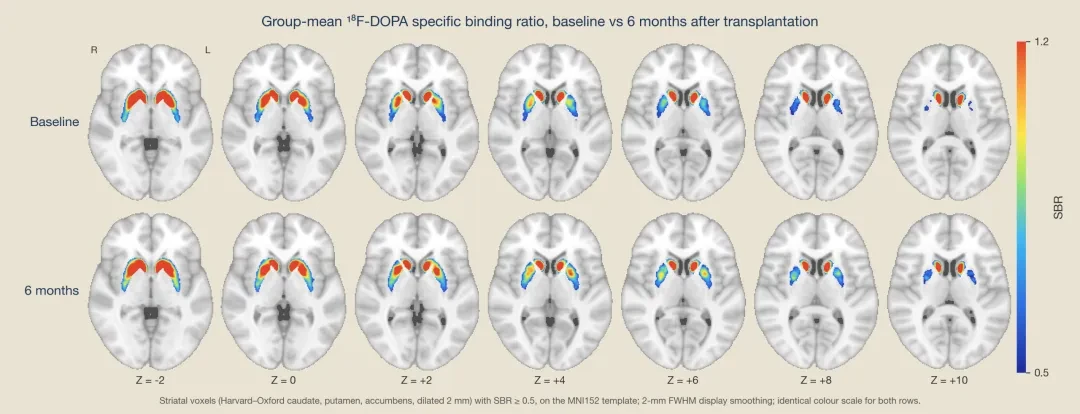
International Gold Standard ¹⁸F-DOPA PET Molecular Imaging Objective Metrics (Phase I Clinical Trial Data for Registration): Following treatment with the novel cellular therapy XS411, increased tracer uptake was observed in the cell transplantation region, demonstrating a specific enhancement of intracerebral dopamine synthetic metabolism.
¹⁸F-DOPA PET scan showed that the putamen of post-transplant subjects(XS411 Stem Cell Transplantation Injection Site)The specific binding ratio of the ¹⁸F-DOPA tracer increased compared to baseline, with areas of signal enhancement corresponding to the needle tracks of cell transplantation. This indicates that after stem cell implantation, the cells have survived, engrafted, and differentiated in the transplantation area, establishing dopaminergic synthetic metabolic function. They have replaced the diseased dopaminergic neurons with healthy, functional ones, thereby becoming a new source of dopamine.
Phase II Study: Enrollment completed; the world’s first stem cell therapy study for PD adopting a PROBE blinded assessment design
Phase II Clinical Trial of XS411, a Universal Cell Injection, for the Treatment of Primary Parkinson's DiseaseLed by Beijing Tiantan Hospital, National Center for Neurological Disorders, with Professor Feng Tao serving as the lead investigator, this multicenter study was jointly conducted in collaboration with multiple authoritative clinical centers in the field of Parkinson’s disease across China, including Peking Union Medical College Hospital, the Second Affiliated Hospital of Soochow University, and Jiangsu Province People’s Hospital, as participating sites.
The study adopted a prospective, randomized, open-label, blinded-endpoint evaluation (PROBE) design. Randomization, parallel control, and blinded endpoint assessment help reduce bias, providing a more reliable basis for evaluating efficacy and supporting subsequent confirmatory studies. The blinded endpoint assessment used in the Phase II study ensures that independent review results are not influenced by subjective factors, thereby more accurately reflecting the true changes in disease status.
This study isThe First International Stem Cell Therapy Study for Parkinson’s Disease Using a PROBE Design, laying a solid foundation for the pivotal Phase III registration study and providing more robust scientific evidence for the clinical translation of this innovative therapy. Currently, the study hasSuccessfully completed enrollment of all 30 subjects and entered the follow-up phase.。
XS411: A Universal Cell Therapy Strategy Without HLA Matching for the Development of Novel Drugs Targeting a Broad Population of Parkinson’s Disease Patients
The Four International Studies Published to Date on the Treatment of Parkinson’s Disease with Pluripotent Stem Cell-Derived Dopaminergic Neural Progenitor Cells Represent a Significant Breakthrough in the Field of Parkinson’s Disease Therapy(Nature 2025;Nature 2025;Cell 2025;Nature Medicine 2026)Among them, three studies utilized embryonic stem cell-derived cells, facing ethical issues that hinder widespread application; only one study conducted by Kyoto University in Japan employed induced pluripotent stem cell-derived cells for the treatment of Parkinson’s disease, which has currently received conditional approval for market launch. Kyoto University adopted an HLA haplotype homozygous “super donor” strategy, but this technical approach faces bottlenecks related to technology, cost, and regulatory oversight in China, Europe, and North America.
XsellSmart’s independently developed universal XS411 cell injection, which does not require HLA matching, has successfully demonstrated the safety and remarkable efficacy of cell replacement therapy under standardized immunosuppressive management. The significance of this study lies in the potential for allogeneic iPSC-derived dopaminergic neural precursor cells to become a universal product, offering more Parkinson’s disease patients the opportunity to benefit from stem cell therapy.
XS411 Cell Injection Incorporates Patient Accessibility into the Starting Point of R&D: It does not require donor-recipient HLA matching as a prerequisite for treatment, does not establish individualized autologous cell preparation processes for each patient, and does not rely on building a large matched cell bank covering diverse HLA types as a precondition for clinical application. A unified cell source, manufacturing process, and quality control system create conditions for centralized production, batch management, and multi-center clinical supply.
For neural cell therapies requiring stringent quality control and refined clinical procedures, the feasibility of a universal strategy depends on reproducible product manufacturing and the continuous accumulation of clinical evidence. XS411 has advanced this strategy through a complete Phase I dose-escalation study and a multicenter, randomized Phase II study, thereby making the development pathway for scalable application more concrete.
In 2026, the XS411-related project received support from the National Science and Technology Major Project on “Innovative Drug Development.” Led by XsellSmart, the project was jointly undertaken by national-level institutions including Tongji University, the National Institutes for Food and Drug Control, Beijing Tiantan Hospital, and Peking Union Medical College Hospital. The project kick-off meeting was held in June in Beijing. Collaborative efforts involving corporate R&D, basic research, drug testing, and clinical research capabilities provided synergistic support for overcoming key technical challenges and facilitating clinical translation of universal neural cell-based novel therapeutics.
In July, XS411 was granted Fast Track designation by the U.S. FDA(Fast Track Designation)Following the approval of clinical trial applications in both China and the United States, this status provides significant support for the product’s international development, facilitates enhanced communication with the FDA regarding development plans and study designs, and enables the utilization of mechanisms such as rolling review when applicable conditions are met.
Support from the National Science and Technology Major Project facilitates alignment with U.S. regulatory development pathways, enabling XS411 to continuously refine its international market-oriented development framework based on its clinical progress in China. For an original cell therapy targeting broad patient accessibility, the concurrent establishment of clinical evidence, pharmaceutical quality, and cross-regional registration capabilities is key to building long-term competitiveness.
End-to-End R&D and Manufacturing Capabilities Build a Foundation for Sustained Growth
The competitiveness of cell-based therapies spans the entire process from cell sourcing to clinical application. XsellSmart has established an integrated R&D system for XS411, covering iPSC reprogramming, directed differentiation, product characterization, quality control, and preclinical safety evaluation, which is applied to the manufacturing of clinical-grade cell products. Analytical approaches such as single-cell transcriptomics, combined with systematic safety assessments, collectively support product characterization and quality studies.
This capability is currently being validated through multi-center clinical practice. The completion of enrollment for 30 cases in the Phase II study signifies that product development has entered a stage imposing higher demands on clinical supply, research collaboration, and standardized follow-up. The continuous accumulation of experience in manufacturing processes, quality control, and clinical execution also lays the foundation for subsequent expansion of study scale and preparation for industrialization.
The presentation at the International MDS Congress has brought the clinical progress of XS411 into the spotlight of the international Parkinson’s disease research community. The non-HLA matched product strategy, ongoing follow-up from the 9-patient dose-escalation study, the 30-patient multicenter randomized Phase II trial, along with the foundation for regulatory development in China and the United States and support from the National Science and Technology Major Project, collectively constitute the competitiveness of leading Chinese pharmaceutical companies, represented by XsellSmart, in the field of iPSC-derived neural cell therapy.

Click “Share”、“Like"and"Watching”Charge me up a bit~