

Enhancing Data Value from the Source: A Multimodal Data Foundation Opens a Second Growth Curve for Imaging AI

Rimag
Third-Party Chain Medical Imaging Service Provider

Diagens
Medical Imaging AI and High-End Medical Equipment Developer

Tempus
Precision Medical Technology Researcher
Subtle Medical
Medical Imaging Software Developer
How far can the value of a single medical imaging examination extend? For diagnosis, it is the basis for assessing a condition; for follow-up, it is a reference for comparing disease changes; for clinical research and medical AI, it may become the input for observing treatment efficacy and validating models.
However, the high heterogeneity of medical imaging data limits the continuous release of the value of a single examination.
For the same type of examination, different hospitals and different technologists using different equipment and sequence parameters may produce different slice thickness, resolution, noise, and contrast. Even after images enter the PACS (picture archiving and communication system) or the imaging cloud, these differences still increase the difficulty of longitudinal follow-up, multicenter research, and AI development.
To break down these barriers and fully unlock the value of imaging data, some medical AI companies are building a new "data foundation" on top of their existing products and data systems. Focusing on the processing steps before acquisition and archiving, they optimize quality and standardize data organization, turning scattered, heterogeneous images into a data foundation that is easier to compare and reuse.
In this process, point-solution AI keeps addressing specific clinical tasks, platforms connect workflows and multimodal information, foundation models expand cross-task capabilities, and the data foundation supports the continuous generation and use of data. Working in concert, these capabilities extend AI value along the clinical workflow.
The scope of medical imaging AI's empowerment thus leaps from classification, segmentation, and assisted diagnosis to the generation, organization, and continuous use of imaging data.
There is no single path on the market for building such foundation capabilities.
In China, Rimag leverages its third-party imaging service network to connect imaging centers, solutions, and cloud services with medical institutions and patients, providing scenarios for data accumulation, model validation, and large-scale application; Diagens, meanwhile, has built products around clinical tasks such as chromosome karyotype analysis and is developing the iMedImage medical imaging foundation model.
Overseas, Tempus, building on its existing clinical testing and data platform business, has successively integrated Arterys' radiology AI capabilities and Paige's digital pathology products, data, and foundation model assets. Combined with molecular, pathological, and clinical information, these clinical entry points further expand precision medicine, pharmaceutical R&D, and life science services.
Subtle Medical, an AI company that recently earned a place on TIME's "World's Top HealthTech Companies 2026" list (overseas trade name: Subtle Medical Inc.), instead places its focus on the source of imaging data generation, integrating its existing product capabilities in acquisition optimization, enhancement, and quality control into a multimodal imaging data foundation.
In Subtle Medical's overall design, the multimodal imaging data foundation is a layer of AI-driven data production and quality management capability that connects imaging devices with PACS, imaging clouds, and hospital data centers.
Through cross-modal and cross-device capability combinations, the foundation moves scan optimization, quality enhancement, automated quality control, standardization, information completion, and synthesis upstream to the acquisition and adjacent processing steps. With First Time Right as its goal, it seeks to obtain, as far as possible during the first examination, data that meets clinical purposes and can be used for subsequent computation and reuse.
A paper by the team of Dr. Gong Enhao, founder of Subtle Medical, published in the journal Applied Radiology under the title "Beyond Reconstruction: The Next Frontiers in AI Imaging Acquisition," discusses the direction of AI expanding from image reconstruction toward intelligent acquisition. Combining this research with clinical workflows, the value of governing imaging data at the source can be understood from three aspects.
First, it provides a quality basis for the mutual recognition of examinations across regions. Cross-device and cross-hospital quality evaluation and standardization improve image comparability and, on the premise of meeting clinical requirements and mutual recognition rules, help reduce avoidable repeat examinations.
Second, it supports hospitals in building high-quality data resources. Governed multicenter, multimodal images can be linked with test and clinical information in the HIS (hospital information system), EMR (electronic medical record), LIS (laboratory information system), and PACS, serving longitudinal follow-up, group-level quality control, clinical trial enrollment, and AI model training. The incremental value hospitals gain comes from improvements in quality, efficiency, and data utilization capability.
Finally, continuously accumulated high-quality images can be used for opportunistic screening, disease risk prediction, multimodal AI, and foundation model research. Going further, by linking with pathology, genomics, and proteomics, multimodal data alignment can be optimized, and a single examination may generate value beyond its original purpose, supporting patient stratification, efficacy evaluation, and pharmaceutical R&D.
Clinical networks connect real-world scenarios, foundation models expand cross-task capabilities, multimodal platforms organize different types of information, and acquisition-side data foundations improve data quality. Each path has its own emphasis, and each also provides a basis for the others' applications.
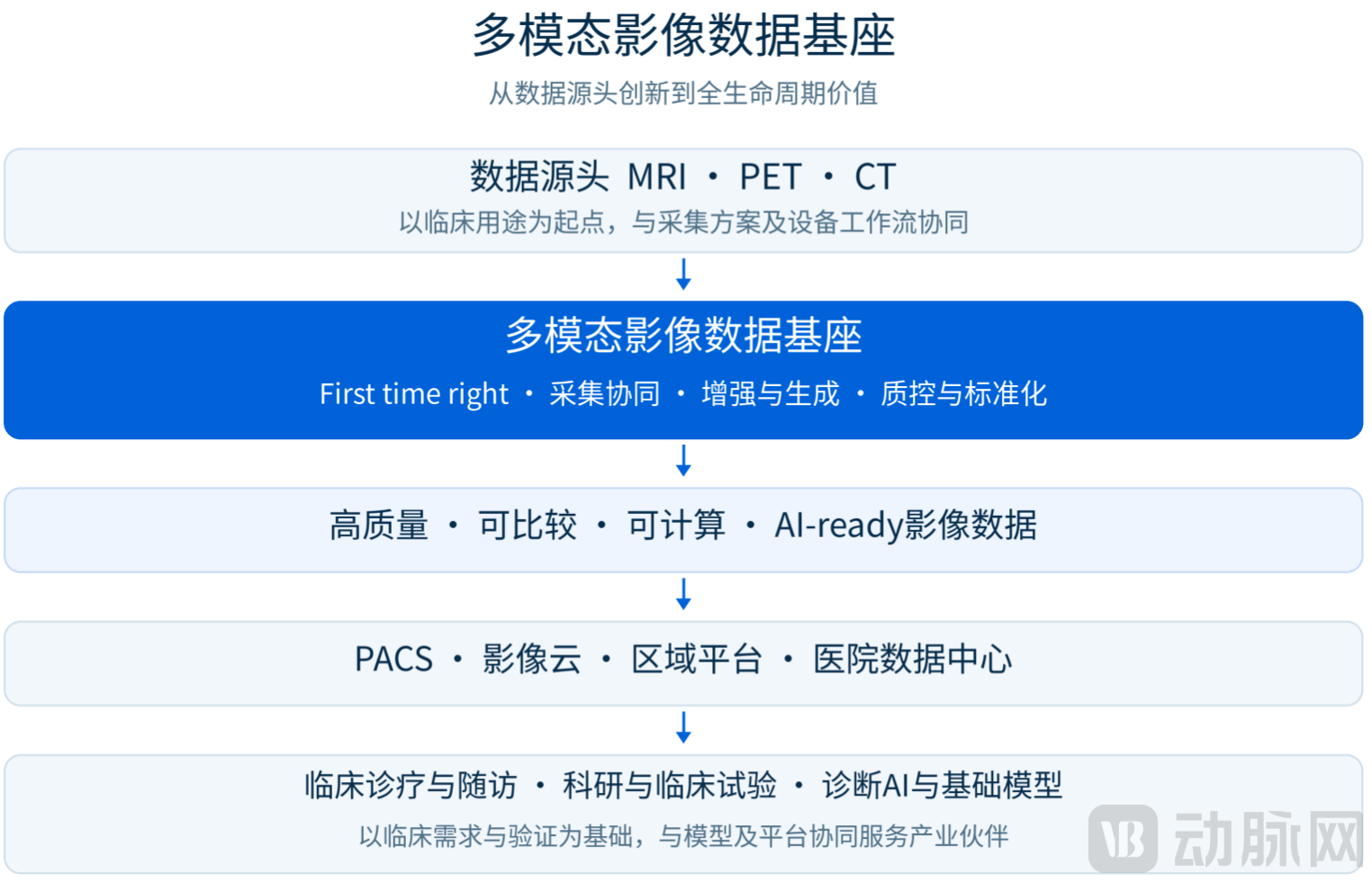
The specific pathways through which the multimodal imaging data foundation acts on intelligent acquisition
From concept to implementation, realizing a multimodal imaging data foundation requires a combination of imaging AI, radiology, and global productization capabilities.
Subtle Medical has built a product portfolio covering various imaging examinations. SupMR serves MRI acceleration and enhancement; SupPET/ECT improves low-count PET and SPECT nuclear medicine images and supports low-dose or accelerated scanning under validated protocols; SupCT supports CT denoising, quality improvement, and scan protocol optimization, and can further empower advanced applications such as coronary CT FFR; SupQC connects quality evaluation to routine management. Combined with the latest generative AI capabilities such as SupSYNTH and SupBoost, the products continue to expand along acquisition optimization, information utilization, and quality management.
Among them, SupBoost is a representative product in the portfolio, demonstrating how AI can use multimodal information to further unlock the value of data acquisition.
Specifically, this technology strengthens the contrast-enhancement information actually acquired in MRI, improving lesion visibility without increasing the dose of gadolinium-based contrast agents. Exploration of applications involving even lower contrast agent doses will need to advance in conjunction with corresponding research and product validation.
A multicenter, multi-reader study recently published in the Journal of Magnetic Resonance Imaging showed that after SupBoost processing, the lesion visualization score rose from 3.16 to 3.73 and the overall image quality score rose from 3.07 to 3.55. Together with Bracco, the technology has been developed into the AiMIFY product, which has obtained U.S. FDA clearance and European CE MDR certification and has entered clinical and commercial application.
Another multicenter study, published in the American Journal of Neuroradiology (AJNR), evaluated how SupSYNTH synthesizes spine STIR (short tau inversion recovery) sequence data from existing T1 and T2 images: the synthesized images scored higher on image quality and demonstrated diagnostic equivalence to STIR sequences from conventional long scans in the diagnostic tasks assessed in the study.
From the image quality and efficiency optimization of SupMR, SupPET, and SupCT, to the cross-contrast synthesis of SupSYNTH and the true enhancement-information optimization of SupBoost, and further to quality management technologies such as SupQC, these products together improve the utilization efficiency of medical imaging data acquisition and lay the foundation for the continuous use of multimodal data.
Behind these products are founder Dr. Gong Enhao's long-term research accumulation in medical imaging and AI technology, co-founder Professor Greg Zaharchuk's clinical radiology and neuroimaging background at Stanford University School of Medicine, and the industrialization experience of the global management team. Together, these capabilities support paired data acquisition, independent validation, cross-device adaptation, and long-term deployment.

Dr. Gong Enhao, founder of Subtle Medical, led his team to an NVIDIA AI award; he and co-founder Professor Zaharchuk received the award from Jensen Huang and others
Once medical AI enters clinical practice, whether it can continuously integrate into workflows, deliver clinical value and returns recognized by customers, and generate payment is a major commercialization test it must overcome.
For Subtle Medical, thanks to the commercial support of its existing business, the data foundation rests on a dual basis of demand and delivery.
According to the company, its business model includes AI SaaS subscriptions and sales of AI image post-processing hardware systems. Continuous subscriptions connect software services with routine examinations, requiring the company to deliver quality, efficiency, and operational value over the long term. Per the company's latest disclosures, its products have entered more than 1,500 hospitals and imaging centers worldwide, obtained 11 FDA clearances cumulatively, accumulated more than 50 clinical validation papers, and generated annual recurring revenue (ARR) of about USD 20 million. Deployment, clinical evidence, regulatory clearances, and continuous payment together form the basis of the first growth curve.
On this basis, Subtle Medical continues to expand its acquisition-side capabilities, which can be summarized in three directions — Acquire Less, Acquire Smarter, and Acquire Anywhere — exploring new growth space around acquisition cost, examination paradigms, and application scenarios respectively.
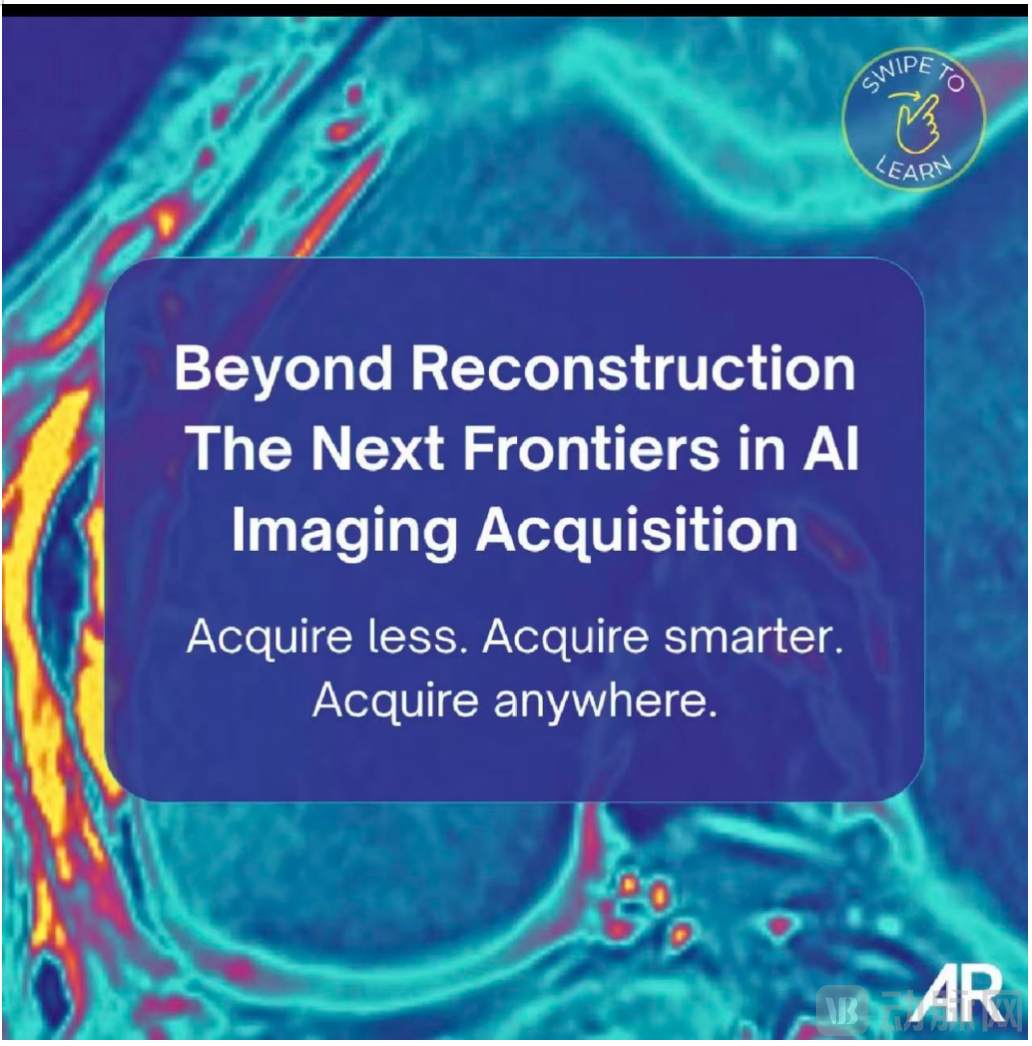
Acquire Less contributes the most fundamental clinical value: faster scans, dose reduction under validated protocols, and fewer additional acquisitions, balancing quality and efficiency. Combined with automated quality control and workflow support, it can also identify problems earlier, reduce rework, and lessen high-quality examinations' dependence on staff experience.
Acquire Smarter further combines generative AI with imaging physics. SupSYNTH synthesizes specific MRI contrasts from existing sequences, SupBoost strengthens lesion enhancement information, and SupQC identifies quality issues; together with standardization and data alignment capabilities, they explore more reasonable and efficient sequence combinations to obtain high-quality, multi-contrast results, and combine DLR (deep learning reconstruction) and super-resolution methods to optimize the use of imaging information.
On this basis, multimodal applications can further link imaging, laboratory testing, pathology, genomics, proteomics, and clinical records. Through accurate association of patients, samples, and time points, combined with multimodal AI for data alignment and joint analysis, AI can support patient stratification, efficacy prediction, and study enrollment, and can also supplement medical IT platforms with high-quality images and quality records.
Acquire Anywhere opens up empowered scenarios. Targeting full-spectrum coverage from ultra-low-field portable devices to ultra-high-field, high-end equipment, it adapts enhancement, reconstruction, and standardization capabilities to different conditions.
In the ultra-low-field direction, bedside examinations can be explored, combining structural imaging with multimodal neural signals such as EEG to provide a multimodal research basis for brain-computer interfaces (BCIs), neurointervention, and neuromodulation; the ultra-high-field MRI and photon-counting CT directions focus on fine structural visualization and information utilization. Different device types and new uses advance progressively according to research, validation, and registration progress.
These three directions connect to new examination paradigms and application scenarios: using existing clinical products as the entry point, they plug data foundation capabilities into continuous services, allowing the product portfolio to expand with customer needs.
As a result, Subtle Medical is expected to extend from single-device imaging software to device and medical information system integration, medical group quality management, and multimodal research services, driving imaging quality improvement across the entire process of examination, follow-up, intervention, and research.
The multimodal imaging data foundation can supplement "test data + clinical data + AI algorithms" with high-quality images and processing capabilities and, by coordinating with hospital information systems, support the continuous use of data along the care pathway.
For hospitals and imaging groups, this means extending from single-image processing to continuous quality management; for device and medical IT companies, it means integrable acquisition optimization, image processing, and quality control capabilities; for pharmaceutical companies, CROs (contract research organizations), and AI teams, it means more reliable multicenter imaging input and task validation support. Deployment connects demand, the product portfolio and integrations expand applications, and continuous service and feedback further support improvement — forming the growth cycle of the second growth curve.
This direction ultimately points to the continuous use of data from every examination. Dr. Gong Enhao said, "In the past, we used AI to optimize medical imaging; in the future, we hope to use AI to redefine high-quality medical data, so that the data from every acquisition can maximize its clinical value and full-lifecycle value."
The "15th Five-Year Plan for Pharmaceutical Industry Development" calls for strengthening original innovation, deepening AI-enabled upgrading, and advancing digital and intelligent transformation. Source-level innovation in imaging data echoes this direction: it moves quality optimization upstream to the data generation stage, advances independent innovation in underlying technologies and full-chain applications, and improves the utilization efficiency of existing equipment so that more regions can access high-quality imaging services.
Subtle Medical has therefore partnered with several medical IT companies worldwide. For medical IT vendors advancing smart hospital, medical large model, and data intelligence strategies, Subtle Medical's multimodal imaging data foundation and related AI applications, located upstream in the data flow, can fill the gap in imaging data quality and efficiency improvement and further support AI's empowerment of downstream clinical, research, and industrial applications.
Building on existing clinical demand, a continuously paid business, and global deployment, and further connecting upstream and downstream players in equipment, testing, and medical IT, Subtle Medical's second growth curve will depend on whether these capabilities can translate into clinical benefits and full-lifecycle service value that customers continuously perceive.