

Over $3 Billion Pours In! Physical AI Is Shattering the Ceiling of AI Drug Discovery

VECVERSE
Cloud-Based AI Solutions Provider

OXTIUM
AI+Life Science Technology Developer
Phyraxis AI
Experimental Equipment Developer
Recently, the term “physics” has appeared with increasing frequency in the narrative discourse of AI4S and the pharmaceutical industry.
Especially over the past six months, startups spanning the upstream, midstream, and downstream segments of the AI for Science (AI4S) industry have been vying to highlight their exploration of the physical world in their fundraising pitches. In August 2026, Transfyr secured $25 million in seed funding immediately upon its establishment, with the phrase "Physical AI Platform for Science" featured prominently in the headline of the financing announcement. In China, VECVERSE completed its Pre-A financing round in September, similarly emphasizing in its press release headline its use of Physical AI to build self-driving laboratories. Meanwhile, OXTIUM Sciences, which closed a nearly RMB 100 million Series A round in June, boldly stated in its news headline that it aims to reshape the paradigm of life sciences research through Physical AI.
Although there is no consensus in the industry on what exactly constitutes "physical AI" in the pharmaceutical sector, it seems that embracing the "physical" aspect holds the key to unlocking the gateway to the real world.
AI4S at the Forefront: A Surge in Physics
Physical AI, originally a buzzword from the tech world, has frequently appeared alongside embodied intelligence and world models in this new wave of artificial intelligence. In the technology sector, Physical AI generally refers to AI systems integrated with the physical world, such as autonomous driving. At the Consumer Electronics Show (CES) earlier this year, Jensen Huang described Physical AI as the next wave of AI.
Compared to embodied intelligence and world models, Physical AI offers a broader conceptual scope and greater room for imagination, thereby rapidly gaining high recognition from the capital, academic, and industrial sectors. Today, the wave of Physical AI is sweeping into the realm of life sciences, further expanding its conceptual boundaries.
"Indeed, the term 'Physical AI' is also a novel concept for industry peers," Li Su, Founder and CEO of VECVERSE, told VCBeat. "Based on our experience, Physical AI refers to systems capable of genuinely perceiving the real-world environment and controlling devices previously operated by humans to execute tasks. In a laboratory setting, this can be interpreted as enabling AI to participate in experiments through instruments or robots." Li pointed out that the key value of Physical AI in life science laboratories lies in environmental perception and decision-making. According to incomplete statistics from VCBeat, over the past year or more, life science companies labeled as "Physical AI" have intensively secured financing, including significant early-stage funding rounds.
Two companies in this round have drawn significant attention: one is based in New York, and the other in Shenzhen. In late 2025, Medra, an AI robotics startup headquartered in New York, completed a $52 million Series A financing round. Combined with its previous $11 million seed round, the company's total funding has reached $63 million. Medra was founded by Michelle Lee, a Chinese-American scientist who graduated from Stanford University and spent many years conducting research on foundational models for robotics at the Stanford AI Lab. Before leaving to start her own venture in 2022, Michelle Lee also interned at Elon Musk's SpaceX. Medra is dedicated to developing physical AI scientists for drug discovery. Michelle Lee summarizes this work as a two-tier synergy: Scientific AI generates hypotheses, while Physical AI operates the instruments.
Six months later, Shenzhen-based OXTIUM completed a Series A financing round of nearly RMB 100 million, led by GTJA Investment. Previously, in 2025, OXTIUM secured several rounds of funding from HongShan Seed Fund, CDF Capital, and Nanshan SEI Investment. Co-founded and led by CEO Jin Yongcheng and three other University of Oxford alumni, the team has published more than 60 papers in top-tier journals such as Nature. Upon announcing the Series A round, OXTIUM Sciences explicitly stated that the funds would first be used to deepen the underlying architecture of Physical AI.
Furthermore, several companies established earlier have also regained investor favor by riding the wave of Physical AI. In May 2025, Suzhou Divamics completed an A-round financing worth tens of millions of yuan, led by YuanBio Venture Capital. Zheng Zheng, the founder, previously stated that Divamics's technological approach involves the deep integration of AI with physical simulations, utilizing molecular dynamics to calculate the dynamic interactions between drug molecules and their targets. In March 2026, Hangzhou C12.ai secured a new round of financing amounting to RMB 50 million, led by Yonghua Investment. This came three and a half years after its previous funding round. Chen Zhigang, founder of C12.ai and the first Chief Digital Officer of WuXi AppTec, did not explicitly use the term "Physical AI," but instead emphasized that HeTan Intelligence aims to build a general-purpose, software-defined robotic scientist.
In August of the same year, Hangzhou VECVERSE, founded in 2018, completed its Pre-A financing round. Li Su, founder and CEO of VECVERSE, holds a Ph.D. in engineering robotics from the Technical University of Munich. The company's slogan is "Physical AI for Science." The following month, NUTSHELL, established in 2013, announced the closing of its C1 financing round, amounting to tens of millions of US dollars. In its press release, NUTSHELL emphasized its dual-drive strategy combining AI and physics to identify implicit allosteric sites that traditional force fields fail to capture.
Notably, investment firms have shown great enthusiasm for very early-stage projects at the intersection of physical AI and life sciences. In April 2026, Transfyr closed a $25 million seed round (approximately RMB 168 million), positioning itself directly as a research-observable physical AI platform. In China, DeepCell completed a seed financing round of nearly RMB 100 million in August 2026, proposing an "AI + physics" approach that encodes molecular physical mechanisms as model constraints. The following month, Shanghai Phyraxis AI, just one month after its establishment, secured several million RMB in its first round of strategic investment. Branding itself as Phyraxis AI, the company explicitly positions itself as a provider of physics-based artificial intelligence for scientific research. Wang Tong, founder of Phyraxis AI, discussed embodied intelligence in the context of the company's business, noting that embodied intelligence in the life sciences must go beyond mere demonstrations of robots performing single actions.
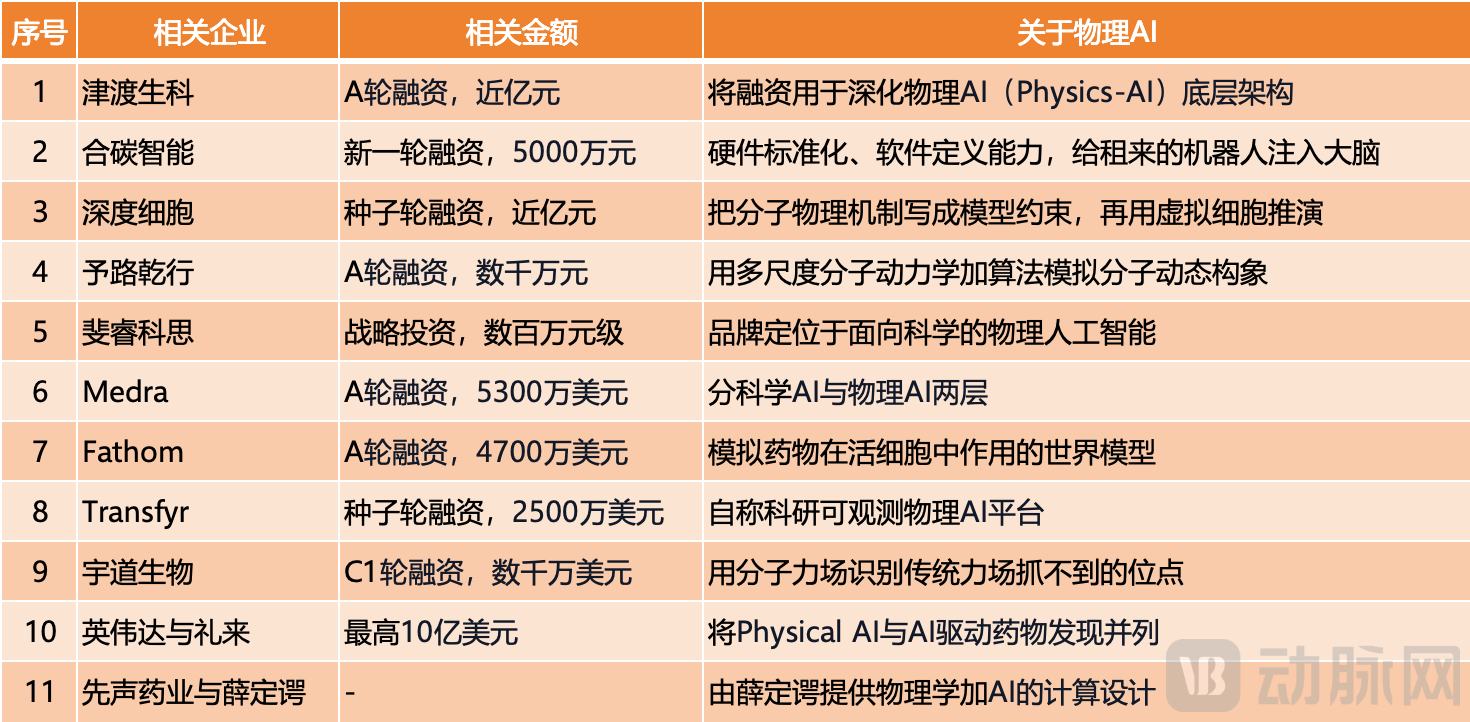
On the other front, pharmaceutical giants have demonstrated unprecedented enthusiasm in proactively embracing Physical AI. In January 2026, NVIDIA and Eli Lilly announced a partnership to establish a joint AI innovation laboratory in the San Francisco Bay Area. This collaboration integrates NVIDIA's BioNeMo platform into Lilly's R&D workflows, with a projected investment of up to $1 billion over five years to cover associated costs for talent, infrastructure, and computing power. In the press release announcing this initiative, "Physical AI" and "AI-driven drug discovery" were positioned side by side, while a roster of ecosystem partners—including Thermo Fisher Scientific, Amgen, Roche, and Multiply Labs—was prominently featured. Additionally, in August 2026, Simcere Pharmaceutical Group reached a global agreement with Schrödinger for drug discovery and development. Under this partnership, Simcere will lead preclinical and clinical stages, while Schrödinger will provide its computational design capabilities combining physics-based modeling with AI. Earlier still, large language model pioneer Anthropic collaborated with HHMI Janelia to open-source the Model Hardware Standard (MHS), aiming to enable unified discovery and control of microscopes, liquid handlers, and robotic arms, thereby significantly lowering the barriers for AI adoption in laboratory settings.
To date, more than $3 billion has flowed in directly or indirectly, underscoring the intense interest in AI for Science (AI4S).
What Should Physics AI4S Do?
At its core, Physical AI transcends computational models to integrate with the real world. The real-world domain that Physical AI4S engages with is the laboratory, which is undergoing profound transformations amid the AI wave.
As large biological models continue to evolve, AI-driven design outputs have become sufficiently abundant, while validation and data feedback remain extremely scarce, thereby sparking substantial demand for wet-lab experiments. With the design side generating molecules daily, the validation stage serves as the sole bottleneck. "This makes real-world experimental data, especially data from failed experiments, critically important," an industry practitioner told VCBeat. Overall, current physical AI4S approaches, which vary in technical style, can be broadly categorized into two types: companies that treat physics as a physical space, building robots and selling experimental throughput and evidence chains, such as Medra and OXTIUM; and companies that treat physics as knowledge, developing models and promoting a "compute-first, test-second" paradigm, such as DeepCell and Divamics. Both types of physical AI4S companies focus heavily on experimentation: the former aims to improve experimental efficiency, while the latter seeks to reduce the need for experiments.
Companies that treat physics as their foundational framework primarily address the challenge of laboratory intelligence. This approach is akin to embodied AI in the life sciences sector, leading to an earlier adoption of the concept of Physical AI. Although the smart laboratory is not a novel concept, the majority of operations in current laboratories remain manual. Apart from automation in certain isolated steps, the process from setting objectives to generating results still requires researchers to engage in repetitive trial and error, which is cumbersome and lacks intelligence. "For Physical AI for Science (AI4S), the true bottleneck lies in the loss of experimental expertise," pointed out the aforementioned industry practitioner. "It is essential to transform the intuition and tricks accumulated by senior researchers through years of hands-on experience into reproducible and traceable data." Consequently, many Physical AI4S companies have proposed the ultimate solution of creating "AI Physicists."
Specifically, the deployment models of Physical AI in laboratories can be divided into two categories. The first is building proprietary laboratories; for instance, in April 2026, Medra inaugurated ML001 in San Francisco, touted as the world's largest laboratory, covering approximately 3,530 square meters and operating hundreds of robots around the clock. The second model is asset-light, involving the integration of AI algorithms or robotics into existing laboratories, where the majority of Physical AI for Science (AI4S) enterprises are currently focused.
For instance, VECVERSE has built the "VLA Operon" physical multi-agent cluster using vision-language-action (VLA) models, transforming equipment such as pipetting and purification systems from isolated execution terminals into intelligent agents with perception, decision-making, and collaborative capabilities. Coupled with modular workstations that can be intelligently assembled in a Lego-like manner, this approach shifts experiments from manual operations to self-driven processes. "With the integration of AI, we hope the system will not only analyze the results of the current batch but also help us determine which conditions to prioritize for the next batch, thereby assisting researchers in exploring prerequisite conditions," explained Li Su.
For example, C12.ai deployed its robots in the laboratory of BeOne's Guangzhou Bio-Island Innovation Center to perform drug molecule purification. During a 50-day trial run, C12.ai's Talos system processed 15 real drug molecules, each involving over 200 consecutive operational steps, for a cumulative total of more than 3,000 physical operations, successfully purifying 14 of them. In another case, YongSheng Intelligence conducted four sets of more comprehensive wet-lab experiments in collaboration with the Shanghai Artificial Intelligence Laboratory. All wells in the 96-well plates showed bacterial growth after inoculation and culture; PCR amplification yielded the expected bands for all 24 colonies; two plasmids were constructed via molecular cloning, and sequencing confirmed 15 mutants; and PCA-based assembly identified 93 positive clones out of 96 candidates.
Phyraxis AI and OXTIUM adopt a more asset-light model. The former incorporates an execution evidence ledger as a platform module to record commands, status, visual evidence, operational outcomes, and anomaly information; the latter focuses on full lifecycle tracking of experimental samples, with work orders specifying details down to liquid volume, temperature gradients, and time windows.
Companies that treat physics as knowledge attempt to construct microscopic world models, incorporating molecular force fields, conformational dynamics, quantum chemistry, and other elements into these models. They perform computational calculations first, then submit the results to laboratories for experimental validation.
DeepCell's approach transforms molecular physical mechanisms into learnable and verifiable model constraints, rather than simply layering physical rules on top of existing models. Yudao Bio has compiled a database of protein conformations collected over more than a decade, using it to train a molecular force field specifically tailored to conformational changes. This force field is designed to identify implicit allosteric sites that traditional force fields fail to capture, with its flagship pipeline being the p53 Y220C reactivator. Fathom combines quantum chemistry with AI to simulate protein dynamics at atomic resolution, aiming to build a world model that simulates drug actions within living cells. Divamics employs multi-scale molecular dynamics simulations, focusing its efforts on protein degraders, GPCRs, and nucleic acid therapeutics.
The strategy employed by such companies to reduce experimental demands is to shift the locus of trial-and-error. By embedding physical laws into models, a portion of the trial-and-error process can be conducted computationally, thereby minimizing the need for experiments aimed at falsification. Aqemia, headquartered in France, even claims that synthetic data generated through physics-based algorithms can replace experimental data, effectively moving the entire trial-and-error process into the computational realm. Of course, most such attempts are still in their early stages and remain far from either falsification or verification.
When AI Drug Discovery Hits a Real Bottleneck
Among the diverse application scenarios of AI for Science (AI4S), pharmaceutical development is the most mature and holds the greatest potential. The current predicament facing AI-driven drug discovery has undoubtedly served as a significant catalyst behind the surging popularity of physics-based AI4S.
As AI-driven drug development finally advances candidates into Phase III clinical trials, the tangible value AI brings to the traditional pharmaceutical industry is increasingly being scrutinized. Data from multiple sources indicate that although AI has improved the efficiency of new drug screening, the failure rate of AI-selected molecules in subsequent clinical trials is even higher than that of molecules identified through traditional processes. In other words, progress in AI-driven drug discovery is concentrated in computationally tractable areas, with accuracy and speed improving annually, yet it has not fundamentally altered the high-risk, long-cycle nature of new drug development. Consequently, the growth potential for such AI-driven drug development may be limited. Over the past few years, investment in AI within the pharmaceutical industry has continued to increase, and the number of molecules entering development pipelines has risen year by year, but very few have successfully progressed to late-stage development.
The location of the bottleneck can be clearly elucidated from the perspective of model capabilities. The official CASP16 assessment revealed that AlphaFold 3 achieved an average LDDT-PLI score of 0.80 in predicting protein-ligand conformations, significantly outperforming all participating groups. However, the same assessment deemed its affinity predictions entirely unreliable, with a maximum Kendall τ correlation coefficient of only 0.42 against experimental data. While the model can predict how molecules bind, it cannot determine the strength of that binding. In other words, the key to breaking through the AI drug discovery bottleneck no longer lies in large language models. As Michelle Lee, founder of Medra, stated, in the current landscape of AI-driven drug development, software capabilities have far outpaced hardware advancements.
Models learn the statistical patterns of historical samples, but in the process of new drug development, the benefits derived from deeply mining these statistical patterns are quite limited. "In life science laboratories, it is perfectly normal for experiments not to always proceed as expected," points out Li Su. "Therefore, we need to equip experimental systems with the ability to autonomously detect anomalies." This is akin to the significant difference in the autonomous driving field between maintaining a constant speed on a specific road and achieving full self-driving capability in any spatial environment.
Yet real-world data is precisely what AI-driven pharmaceutical companies lack the most. As drug development progresses closer to the clinical stage, available data becomes increasingly scarce. A vast amount of failed experimental data remains siloed within companies, while only successful cases are visible externally, easily leading to survivorship bias. This creates a structural mismatch: the data most critical for model training is exactly the data least likely to be shared externally. For pharmaceutical companies, the capabilities of external AI tools can be purchased, but their proprietary data is not shared. However, a viable training dataset must incorporate both successful and failed experimental results to establish a closed loop, thereby enabling reliable predictions for unknown R&D challenges—thus forming a paradox.
Amid the predicament of AI-driven drug discovery, experimental demand has surged abruptly. The limit of AI-driven drug discovery is no longer defined by the boundaries of algorithms and computing power, but by those of the physical world.
Admittedly, the current hype around "Physical AI" does carry an element of trend-chasing. However, the direction of effort is correct. After all, the focus of the surge in Physical AI for Science (AI4S) is no longer merely on making models smarter; it is beginning to engage directly with laboratory benches and data. If AI-driven initiatives can make experiments reproducible, well-documented, and capable of feeding back into subsequent rounds of production capacity, then Physical AI4S capabilities will become the most critical strategic differentiator in AI-enabled drug discovery.