

Over $250 Million! Shanghai-Based Company Sells European Rights to a Drug-Medical Device Product

Asieris
Innovative Drug Developer

Theramex
Developer of Women's Health Products
On the evening of October 7, Asieris (688176.SH) disclosed a licensing announcement.
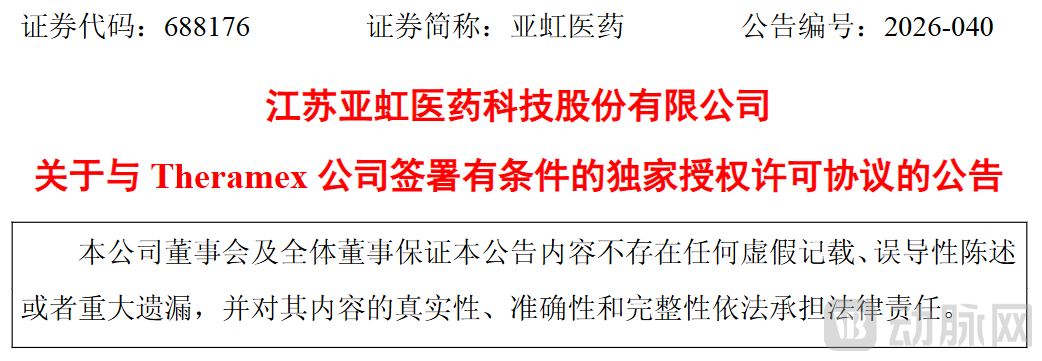
The Company entered into an Exclusive License Agreement with Theramex HQ UK Limited, a London-headquartered specialty pharmaceutical company focused on women's health, granting the latter exclusive rights to APL-1702 (brand name: CEVIRA®) in European countries as well as Australia, New Zealand, and Turkey. Asieris retains the rights for all other regions worldwide.
According to the announcement, Asieris will receive a $15 million upfront payment, an $11 million near-term regulatory milestone payment, as well as subsequent commercialization milestones and tiered sales royalties, with the total transaction value exceeding $250 million.
However, the upfront payment is not due immediately upon signing; rather, it is subject to four precedent conditions: execution of the supply agreement, successful audit of the CEVIRA® manufacturing facility, alignment and consistency with the upstream licensing agreement, and obtaining clarification and confirmation from the European Commission regarding the clinical value assessment of the device.
An "Ointment + Light" Combination Attempts to Bypass the Scalpel
To understand the value of APL-1702, one must first recognize that it seeks to transform the traditional treatment pathway for cervical precancerous lesions, which typically follows a "detect-and-resect" approach.
For high-grade squamous intraepithelial lesions (HSIL), excision or ablation remains the primary treatment modality. Among these, large loop excision of the transformation zone (LLETZ, also known as LEEP) involves excising the lesioned tissue followed by histopathological examination to confirm the extent of the disease.
For patients who still desire fertility, this treatment approach requires a balance between lesion clearance and preservation of cervical tissue. The American Society for Colposcopy and Cervical Pathology (ASCCP) guidelines also allow some patients with cervical intraepithelial neoplasia grade 2 (CIN2) to opt for observation, in order to reduce the potential impact on fertility from unnecessary treatment.
APL-1702 offers an alternative approach: instead of directly excising tissue, it utilizes photodynamic therapy (PDT) for localized clearance of lesions.
Its core is not merely "treating diseases with light," but rather a combination of pharmaceuticals and medical devices. After the patient topically applies hexyl aminolevulinate hydrochloride ointment to the affected area, the photosensitizer acts within the lesion tissue; subsequently, the matching cervical photodynamic therapy lamp delivers light at specific wavelengths to activate the photosensitizer, generating cytotoxic reactive oxygen species that destroy the target lesion tissue.
Therefore, CEVIRA is not merely a substitution of medication; rather, it integrates the drug, light source, and therapeutic procedure into a comprehensive treatment regimen. Asieris Pharmaceuticals disclosed that the product consists of hexyl aminolevulinate hydrochloride ointment and a disposable cervical photodynamic therapy lamp. The treatment does not require excision of cervical tissue, and each light exposure session lasts less than 10 minutes. The FDA also classifies "photosensitizing drug + activating light source" as a typical combination product.
Whether this approach is viable will ultimately depend on validation through clinical data.
In an international, multicenter Phase III clinical trial, CEVIRA demonstrated significantly superior efficacy to placebo in both response rate and histopathological downstaging rate.
Among patients with CIN2 within the spectrum of high-grade squamous intraepithelial lesions (HSIL), the response rate was 49.6% in the treatment group versus 22.6% in the placebo group (P=0.0003). Six months after the initial treatment, 57.5% of patients in the treatment group exhibited histopathological regression to normal tissue or low-grade squamous intraepithelial lesions (LSIL) of the cervix, compared with 30.6% in the placebo group (P=0.0009). These findings indicate that nearly 60% of patients could avoid surgical excision with only one to two treatments. The relevant study results were published in Med in December 2025.
This also means that what Theramex has taken over this time is no longer a photodynamic technology confined to the laboratory stage, but rather a drug-device combination product that has completed international Phase III clinical trials, received approval in China, and is currently entering the European regulatory system.
Two Ownership Changes Within Seven Years
The complementarity of this transaction can only be fully understood within the context of APL-1702’s chain of title.
This product was not independently developed from scratch by Asieris. The Norwegian company Photocure completed its Phase I and Phase II clinical trials and licensed the global development and commercialization rights to Asieris in 2019. Asieris initiated the global Phase III trial in November 2020 and achieved the primary endpoint in September 2023.
Asieris Pharmaceuticals subsequently achieved a critical milestone: in February 2026, the European Medicines Agency (EMA) accepted its Marketing Authorization Application (MAA) for the treatment of high-grade squamous intraepithelial lesions (HSIL) of the cervix; in March 2026, China’s National Medical Products Administration (NMPA) issued the Drug Registration Certificate, approving it for the treatment of patients aged 18 years and older with histologically confirmed cervical intraepithelial neoplasia grade 2 (CIN2).
In other words, Asieris Pharmaceuticals spent seven years advancing a Phase II asset to the regulatory submission stage in China, the United States, and Europe, and then handed over this region to more specialized players before commercialization kicked off in Europe.
The buyer's strategic fit is equally clear. Theramex's portfolio spans five key areas: contraception, fertility, menopause management, osteoporosis, and uterine health, with a business network covering more than 50 countries through a combination of direct operations and strategic partnerships. The treatment of cervical lesions falls squarely within its "uterine health" segment, enabling direct leveraging of its existing gynecological distribution channels.
This is not the first time Theramex has expanded its footprint in women's health through licensing deals. In March 2023, it secured exclusive commercialization rights for abaloparatide (Eladynos), a bone-forming agent, from Radius Health in the European Economic Area, the United Kingdom, Australia, and Brazil. The drug was subsequently recommended by the UK's National Institute for Health and Care Excellence (NICE) in August 2024 for postmenopausal women with osteoporosis at very high fracture risk. In December 2024, the two parties further extended their collaboration to include Mexico, Canada, Israel, South Africa, and Russia. In July 2025, the drug received another recommendation, this time from the Scottish Medicines Consortium (SMC).
From hormone replacement therapy to bone health and cervical lesions, Theramex is systematically building a product portfolio for the "full life cycle of women," with this transaction representing just one piece of the puzzle.
Combination Drug-Device Products Going Global: Regulatory Hurdles May Be the Bottleneck
What truly deserves attention behind this deal is that regulatory considerations themselves become part of the transaction when combination drug-device products go global.
For traditional innovative drugs, overseas license-out activities primarily revolve around clinical data, regulatory approval progress, and commercialization prospects; whereas for combination products like CEVIRA, which integrate both pharmaceuticals and medical devices, it is also necessary to address compliance and evaluation issues related to the device component.
In particular, the light source of CEVIRA is not a mere auxiliary device but a critical component that activates the drug and completes the therapy. Whether the drug and device can be integrated as a complete treatment regimen for entry into the target market directly determines the product's commercial viability.
This point is already reflected in the current agreement: clarification and confirmation by the European Commission of matters related to the clinical value of the CEVIRA device is one of the prerequisites for the payment of the $15 million upfront fee.
In other words, the parties did not defer the resolution of regulatory risks until just before product launch; instead, they directly incorporated them into the transaction terms.
This also indicates that for drug-device combination products, "obtaining marketing authorization for the drug" does not equate to completion of commercialization readiness; device evaluation may likewise serve as a critical milestone affecting deal closure.
By not divesting the global rights in a single transaction, Asieris has preserved additional strategic flexibility. Under the agreement, Theramex obtains exclusive rights for Europe, Australia, New Zealand, and Turkey, while Asieris retains rights to all other regions, including the United States market.
Previously, Asieris Pharmaceuticals had reached an agreement with the U.S. Food and Drug Administration (FDA) on the design of a standalone Phase III trial to support the market launch of CEVIRA, and the U.S. market remains in further development stages.
Thus, this transaction is more akin to a regionalized division of commercialization responsibilities: markets that have already entered the registration and commercialization phases and require local women’s health channels are handed over to Theramex; regions that still require further investment and development remain with Asieris Pharmaceuticals.
Returning to CEVIRA itself, the combination of drug and device is merely the first step. Next, it must still clear three major hurdles: overseas regulatory approval, clinical adoption, and commercialization.
Combining a drug with a light source is not difficult; the real challenge lies in ensuring physicians' willingness to adopt it, regulators' acceptance, and a responsive supply chain. The transfer of APL-1702 to Theramex represents merely one baton handoff in the long-distance race toward commercializing this drug-device combination.