

Exclusive: Led by Shenzhen Capital Group, OptoSeeker Closes Pre-A Round with Multiple Institutions Doubling Down Again

Optoseeker Biotechnology
Developer of Cell Screening Functional Characterization Platform

Nanshan SEI Investment
Industrial Investment Institutions

LINGYI CAPITAL
Venture Capital Firms

SCGC
Investment Institutions in Innovative Fields
VCBeat has learned that Optoseeker Biotechnology (Shenzhen) Co., Ltd. (hereinafter "OptoSeeker") has recently closed a Pre-A funding round of more than RMB 50 million. The round was led by Shenzhen Capital Group, with Guangdong Traditional Chinese Medicine Health Equity Investment Fund Partnership Enterprise (Limited Partnership), Nanshan SEI Investment, and LINGYI CAPITAL participating.
The proceeds will be used mainly for core product R&D and engineering, validation of key application scenarios, and further exploration of an AI-driven technical service model. OptoSeeker will continue to deepen its product and application footprint in antibody discovery, cell line development, and cell and gene therapy, and explore new technical service capabilities built around single-cell functional data.
Dr. Xie Hainan, co-founder and CEO of OptoSeeker, said: "I am very grateful to Shenzhen Capital Group, Guangdong TCM Health Equity Investment Fund, Nanshan SEI Investment, and LINGYI CAPITAL for their trust in and support of OptoSeeker, and especially to LINGYI CAPITAL and the Nanshan District investment system for their continued follow-on investment across multiple earlier rounds. Life sciences are entering a new, AI-driven phase, and high-quality cell functional data will become critical infrastructure in that process. OptoSeeker will keep investing in the R&D and engineering of its instruments, while actively exploring a data-driven technical service model, so as to give the industry a complete capability spanning from experiments to data."
Notably, this round also reflects the continued recognition of OptoSeeker's long-term development by multiple institutions. Since its founding in 2023, OptoSeeker has completed three funding rounds.
Among them, LINGYI CAPITAL has invested in all three rounds, taking part from the earliest stage and remaining the company's most consistent capital partner; the Nanshan District of Shenzhen has supported it for two consecutive rounds, first through Nanshan Venture Capital and then through Nanshan SEI Investment, reflecting local industrial capital's firm confidence in homegrown hard-tech companies; Innoangel Fund also continued to add investment in the company's first and second rounds (leading both).
Continuous investment is not inertia; it is a decision by institutions to commit again after re-examining the team, technology roadmap, and business progress at each new stage of development. This sustained recognition is the most direct vote of confidence from external capital in OptoSeeker.
Founded in 2023 and headquartered in Nanshan, Shenzhen, OptoSeeker is one of the few companies worldwide — and a domestic leader — to independently master core optoelectronic tweezers (OET) manipulation technology. The company has completed the leap from a proof-of-principle prototype to a mass-production instrument, achieving fully independent R&D and manufacturing of hardware, software, and consumables, and has built a multidisciplinary R&D team spanning optics, mechanics, electronics, automation, microfluidics, chips, software engineering, biological applications, and bioinformatics.
Around foundational technologies such as optoelectronic tweezers (OET), digital microfluidics (DMF), and digital micromirror device (DMD)-based structured light projection, OptoSeeker has built several product lines:
The OptoBot® series targets high-throughput single-cell manipulation and functional screening, integrating optoelectronic tweezers, microfluidics, microscopic imaging, and software control into a single system, and supporting cell loading, isolation, on-chip culture, functional detection, candidate ranking, and targeted retrieval. The system can run experiments simultaneously across thousands to tens of thousands of microwells, delivering a complete closed loop from "seeing a signal" to "tracking a cell, exporting the cell, and resolving its sequence."
The OptoNeuroBot® structured light projection system can precisely control the position, shape, timing, and intensity of illumination within the microscope field of view, serving experiments such as optogenetics, light curing, and micropatterning.
The DropletBot® digital microfluidics platform uses electrical signals to manipulate discrete droplets on a chip, turning movement, mixing, and reactions into programmable operations.
The OptoGrow® stage-top live cell incubator system provides temperature, gas, and humidity control for long-duration microscopic observation of cells.
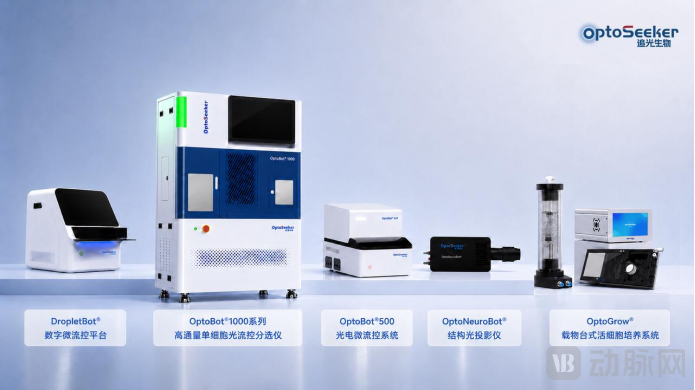
OptoSeeker Product Matrix
At present, several of the company's products have been delivered to multiple customers, with installation, commissioning, application validation, and iterative optimization continuing around real experimental and R&D scenarios. Backed by stable platform performance, system integration capability, lean manufacturing capability, and timely application support, the products have won customer recognition in scenarios such as single-cell manipulation, structured light projection, and digital microfluidics, further validating OptoSeeker's complete capability from core technology to product engineering to customer deployment.
While building out its instruments, OptoSeeker is also actively exploring an AI-based technical service direction — providing AI-driven biological R&D teams with cell functional validation services that span from experiment design to data delivery. Today, AI for Science is reshaping the research paradigm of the life sciences, but the development of AI biology models faces a key bottleneck: high-quality, single-cell-level long-term functional data is extremely scarce. Protein structure prediction and genomic analysis have already accumulated large-scale public datasets, yet the dynamic functional data of living cells — time-series fluorescence changes, secretion dynamics, morphological evolution, stimulus responses — remains scattered across various laboratory records, making standardized collection and large-scale accumulation difficult.
OptoSeeker's instrument systems, especially the OptoBot® series, have the ability to generate this scarce data for AI models. The system simultaneously tracks the multi-dimensional functional performance of single cells in thousands of independent microwells; each cell is traceable throughout the entire process from entering the chip to being exported and retrieved, and the data naturally carries timestamps, spatial coordinates, and cell identity labels. This structured, high-temporal-resolution live-cell functional data can form the raw material needed to train the next generation of AI biology models.
In terms of industrial collaboration, OptoSeeker has reached strategic partnerships with MGI and BioMap. OptoSeeker and BioMap partnered in July 2025 to combine the single-cell functional data generated by the OptoBot® series with BioMap's life science foundation model, exploring an AI for Science closed loop of "data generation—model prediction—experimental validation"; in August of the same year, OptoSeeker and MGI reached a strategic partnership to jointly build an autonomous, controllable antibody discovery platform covering "screening—sequencing—data analysis." The three-party collaboration further connects single-cell functional screening, sequencing, and AI analysis, providing an industrial synergy foundation for OptoSeeker to expand its "instruments + data + AI" technical service model.