

$2.7 Billion Investment in Innovative Companies: Which Sectors Did Medtronic Target?

Medtronic
Chronic Disease Medical Device and Therapy Developer

Cornerstone Robotics
Innovative Surgical Robot Developer
PwC's latest data shows that in the first half of 2026, the total value of global healthcare technology M&A reached $36.5 billion, with both the number of deals and the transaction volume exceeding those of the same period in 2025.
Medical giants are aggressively acquiring assets, with Medtronic emerging as the most active buyer. In the first three quarters of 2026, the world's largest medical device company spent a total of approximately $2.7 billion on outbound investments and mergers and acquisitions. On September 1, it officially announced two transactions on the same day: a strategic investment of approximately $700 million in the Chinese surgical robotics company Cornerstone Robotics, and a strategic investment in Pi-Cardia, an Israeli company specializing in TAVR leaflet enhancement. In the first half of the year, it completed three acquisitions—CathWorks, Scientia Vascular, and SPR Therapeutics—led the $100 million Series D financing round for the Chinese company Pulnovo Medical, and invested in two ICE companies, Beluga Medical and CARDIOACC, on the same day, June 3.
Ample cash reserves have fueled Medtronic's acquisition spree. In the fiscal year ended April 24, 2026, Medtronic reported revenue of $36.4 billion, marking its strongest annual growth in a decade; the company held $9.2 billion in cash on hand and generated $5.4 billion in net free cash flow for the year.
At the 2026 J.P. Morgan Healthcare Conference, Medtronic announced that it would take the initiative through strategic M&A, targeting high-growth, near-commercialization bolt-on acquisitions. In line with this strategy, Medtronic intensified its external investments and mergers and acquisitions in 2026, acquiring innovative medical technologies. Where Medtronic allocates its capital serves as a roadmap for future growth in the medical device industry.
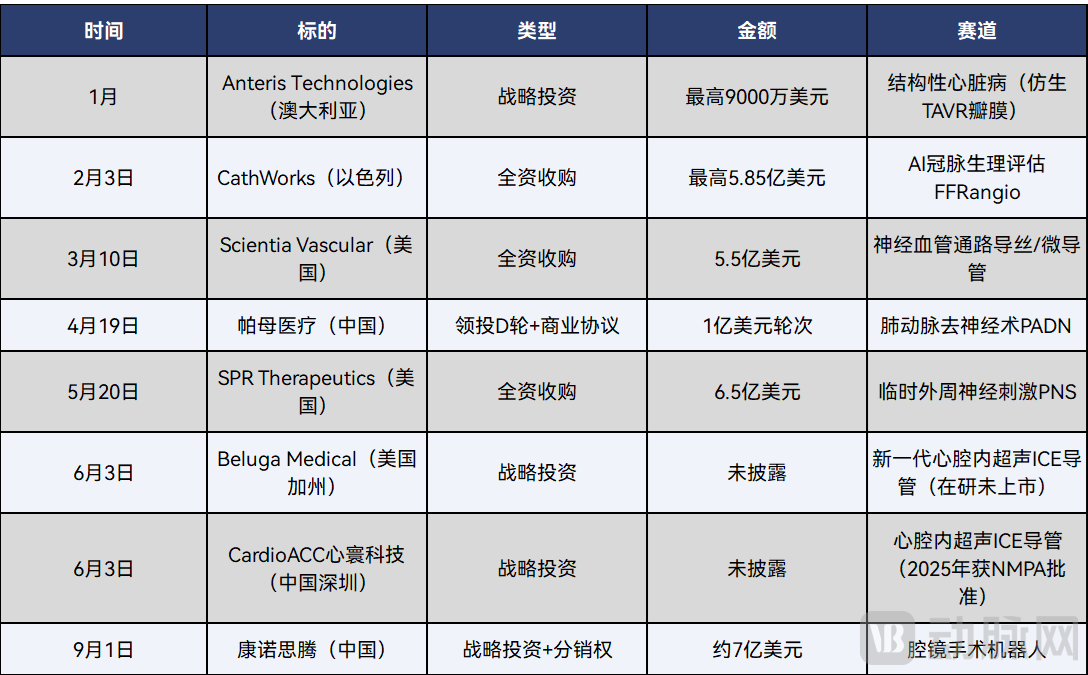
Compared with other global medical device giants, Medtronic has shifted its investment strategy in the medical technology sector from defensive to offensive. In 2026, small-scale investments and mergers and acquisitions have occurred frequently, spanning multiple stages from early research and development to near-commercialization, thereby rapidly integrating innovative products into its robust commercialization channels.
Medtronic's acquisition strategy targets innovative companies whose products have largely secured regulatory approvals and undergone clinical validation, with entry timed to coincide with the clear emergence of strong commercial potential. For instance, CathWorks' FFRangio system has demonstrated robust commercialization capabilities and high clinical acceptance in the United States, Japan, and Europe in recent years, prompting Medtronic to exercise its acquisition option early in April 2026 and complete a full acquisition of the company for a total consideration of up to $585 million.
The second major characteristic of Medtronic's investment and M&A activities is the high degree of complementarity between the targets and its existing business. Target acquisitions often address weaknesses in existing business lines, create synergies with current products, and become key drivers of business growth. In the field of neurointervention, acquisitions have been used to fill gaps in micro-guidewire access solutions; in coronary intervention, acquisitions have supplemented intraoperative decision-support software; and in structural heart disease, investments in biomimetic TAVR technologies have enhanced competitiveness.
Medtronic Previously Revealed M&A Direction at the JPM Conference: Cardiology and Neuroscience Are Key Areas for Medtronic to Strengthen. Recent Investments Have Also Centered Around These Two Directions.
In the neurointerventional field, Medtronic acquired Scientia Vascular for $550 million this year, targeting Stryker's stronghold and enhancing the competitiveness of its neurointerventional solutions. Medtronic has strong flagship therapeutic products in neurointervention (such as the Solitaire thrombectomy stent, flow diverter stents, and coils), but has long lacked top-tier access tools (guidewires and catheters); meanwhile, the neurointerventional guidewire market has been dominated by Stryker. Through the acquisition of Scientia Vascular, Medtronic has secured a competitive guidewire product.
Scientia Vascular's core strength lies in its micro-guidewires manufactured using proprietary micro-structured laser engraving technology, which enables 1:1 torque transmission. The company also pioneered large-diameter guidewires suitable for intracranial access. In surgeries for complex ischemic stroke (large vessel occlusion), physicians require bulky aspiration catheters to remove cerebral thrombi; however, the market previously lacked thick guidewires specifically designed for intracranial use that could directly accommodate these catheters. Scientia was the first to introduce the Aristotle Colossus (a 0.035-inch large-diameter guidewire), which remains the only 0.035-inch large-diameter guidewire currently approved by the FDA for use in intracranial vessels. This innovation allows physicians to bypass the intermediate steps of exchanging multiple thin guidewires, enabling them to deliver large-diameter thrombus aspiration catheters directly to the cerebral thrombus in a single step.
In the field of cardiac ablation, Medtronic has strengthened its electrophysiology ecosystem through two investments in intracardiac echocardiography (ICE) technologies on June 3. On the same day, Medtronic invested in two ICE companies: Beluga Medical, based in California, and CARDIOACC, based in Shenzhen, with a clear plan to integrate ICE into its Affera mapping and ablation system. Beluga Medical is developing next-generation ICE products that have not yet been launched, betting on advanced imaging technology. CARDIOACC's ICE catheter received approval from China's National Medical Products Administration in 2025, allowing for rapid integration into Medtronic's commercial portfolio, while its 4D ICE product remains under development. By investing in both technological potential and commercial certainty, Medtronic has added greater depth to its strategic positioning around its primary growth engine.
Structural heart disease is also a key focus area for Medtronic, which has invested in two companies: Pi-Cardia and Anteris Technologies. Headquartered in Australia, Anteris Technologies is the global pioneer of the first-of-its-kind "3D single-piece molded" biomimetic leaflet technology. In January this year, Medtronic announced a strategic investment of up to $90 million in the company. Anteris's approach involves directly reshaping a single piece of bovine pericardial tissue into a three-dimensional structure that conforms to the anatomy of the native human aortic valve, using high-precision 3D molding. The working area of the leaflets is completely free of sutures. This design differs from traditionally sutured prosthetic valves, enabling more uniform stress distribution during leaflet opening and closing.
Pi-Cardia offers a leaflet modification solution. After TAVR, many patients require a second valve replacement due to valve degeneration. However, during the second replacement, the leaflets of the original old valve are "pushed aside and outward" by the new valve, potentially obstructing the coronary artery openings. Pi-Cardia’s ShortCut™ allows physicians to longitudinally split the potentially obstructive old leaflets from the center before implanting the new valve, by advancing the device through the vasculature into the heart. This provides a safe, easy-to-learn, and reproducible leaflet modification method that effectively preserves coronary access and facilitates future transcatheter valve procedures. ShortCut™ is the first leaflet modification technology approved by the FDA worldwide. Medtronic secured exclusive global commercial distribution rights through a strategic investment of up to $80 million, while retaining the option to acquire the company for no more than $210 million upon achieving certain milestones.
Medtronic has secured a first-mover advantage in next-generation transformative technologies within the valve sector through these two investments, thereby enriching its product portfolio in the field of structural heart disease.
In its investments in interventional cardiology, Medtronic targets the window of opportunity for generational shifts in diagnostic and therapeutic modalities. In the realm of coronary physiological assessment, Fractional Flow Reserve (FFR) serves as the functional gold standard for determining whether coronary lesions cause ischemia. However, traditional methods require pressure wires and adenosine-induced hyperemia, resulting in complex procedures and low clinical penetration. CathWorks’ FFRangio from Israel leverages AI and computational fluid dynamics to directly derive lesion-level functional scores from routine coronary angiography images, eliminating the need for additional devices or medications. Competitors include Philips' X1-FFR, acquired through SpectraWAVE, and HeartFlow's CT-FFR. Financial reports provide validation data: in Q1, the coronary and renal denervation businesses grew by 13%, with CathWorks alone contributing nearly 3 percentage points.
In the field of pulmonary hypertension, Medtronic has invested in a Chinese company with original technology: Pulnovo Medical. In the denervation space, Medtronic's proprietary product is the Symplicity renal denervation system, with management describing renal denervation (RDN) as one of the most attractive long-term opportunities in medical technology. Pulnovo Medical's Pulmonary Artery Denervation (PADN) applies the same mechanism to pulmonary hypertension—a field dominated by pharmacological therapies and largely devoid of device-based solutions. Medtronic led a $100 million investment round, coupled with a commercial agreement, to secure a potential new product category.
Surgical robotics is also a high-growth, high-potential sector that Medtronic views favorably. Over the past decade, the global volume of robot-assisted surgery (RAS) procedures has grown at an average annual rate of approximately 16%, yet penetration rates remain in the single digits, with only about 1% in emerging markets. In terms of competitive landscape, Intuitive Surgical's da Vinci system dominates the laparoscopic robotic market. Although Medtronic's Hugo system received European approval in 2020, its progress has been sluggish, and it has yet to break into the U.S. market.
Hugo itself is also accelerating. During the FY27 Q1 earnings call, management projected that the cumulative number of Hugo-assisted procedures would exceed 50,000 within the current fiscal year, with procedure volume growth surpassing twice the market rate. The company also plans to expand Hugo's indications in the U.S. market to include general surgery and gynecology. Centered around Hugo, Medtronic is building a comprehensive surgical ecosystem: its intraoperative AI collaboration platform, Touch Surgery, has already been deployed in over 1,500 operating rooms globally, and the August launch of Touch Surgery Aide brought 300 times greater computing power into the operating room, forming a platform-based product portfolio alongside visualization, navigation, and energy devices.
The transaction with Cornerstone Robotics precisely fills the gaps not covered by Hugo. Cornerstone Robotics's Sentire® laparoscopic surgical robot features an integrated architecture, whereas Hugo™ is Medtronic's self-developed modular system with a distributed architecture (separate surgeon console, patient-side cart, and vision cart). Integrated and distributed architectures each excel in different indications, with the da Vinci system being the representative of the integrated architecture. Sentire serves as a "strong complement" to the Hugo platform. Through this dual-platform strategy of "Hugo as the core and Sentire as the extension," Medtronic can offer more flexible options to customers across diverse clinical scenarios, procedural requirements, and economic models.
Pain management falls under the neuroscience segment. With a $650 million acquisition, Medtronic has replaced a stagnating legacy business with a new growth engine. The value of SPR Therapeutics must be viewed in the context of Medtronic's situation: As the pioneer of the spinal cord stimulation (SCS) market, Medtronic has long held the top position in implantable neurostimulation. However, this market is losing momentum, with the neuromodulation segment recording only a 3% growth in FY27 Q1.
SPR's Pace system offers an alternative approach. It delivers temporary peripheral nerve stimulation (tPNS): implanted at the bedside postoperatively, stimulated for approximately 60 days, and then removed, leaving no permanent device behind. The commercial value of this design lies precisely in its "temporary" nature: patients are spared the decision threshold associated with permanent implants, physicians can initiate analgesia immediately after surgery, and the product shifts from being a "device for treating chronic pain" to becoming "part of a perioperative analgesia regimen."
Medtronic is targeting the incremental market of tens of millions of patients in postoperative pain management and opioid alternatives. For Medtronic, this also means that its existing sales force and hospital customer base now have a new high-turnover product to offer. In its financial reports, management positioned the peripheral nerve stimulation market, where SPR operates, as growing at over 20%, explicitly stating that the acquisition "strengthens our overall pain portfolio."
Medtronic's Three Strategic Moves in China in 2026: A Separate AnalysisIn April, Medtronic led a $100 million Series D financing round for Pulnovo Medical and signed a commercial agreement. In June, it made a strategic investment in Shenzhen CARDIOACC (amount undisclosed). In September, it strategically invested approximately $700 million in Cornerstone Robotics and secured distribution rights for its robotic products in certain approved markets outside the United States.
Changes on the supply side form the foundation. After a decade of accumulating engineering dividends and accelerating registration and approval processes, innovation in China's medical device industry has entered a harvest phase. In its mid-2026 Healthcare M&A Report, PwC pointed out that regulatory reforms in China have shortened the approval cycle for innovative medical products and reduced development costs, while the large patient population supports faster clinical trial enrollment and generates larger datasets. For giants like Medtronic, which possess established platforms but face lengthy internal R&D cycles, Chinese assets effectively outsource R&D time and costs.
Demand-side realities also impose constraints. Amid global cost-containment efforts and pricing pressures, growth must be aligned with a more optimized cost structure. Chinese companies with proven product capabilities and valuations still at depressed levels offer multinationals more cost-effective options to fill strategic gaps.
Closing the distribution loop is the final piece. With decades of operations in China, Medtronic has established robust clinical influence and manufacturing capabilities. Its distribution rights model enables Medtronic to leverage its global network to market innovative Chinese products: robotic systems are sold to overseas markets through Medtronic's channels, pulmonary hypertension products are secured via commercial agreements, and CARDIOACC's ICE catheters are promoted across mainland China using Medtronic's clinical distribution network. For Chinese companies, this represents a strategy of leveraging established platforms to expand globally; for Medtronic, it sustains internal growth curves by integrating external R&D.
While some multinational medical device companies are scaling back their local investments in China, Medtronic has elevated China from a sales market to a source of innovation. This shift itself warrants continued industry attention.
Returning to the question in the title: Which sectors did Medtronic invest in during 2026? Across nine transactions, its capital never strayed from its core business landscape—surgical robotics, cardiac ablation, structural heart disease, coronary physiology, neurovascular access, denervation, and pain management—not a single penny was allocated to hyped concepts unrelated to its main business. As the most active acquirer in the medical device industry, it is also one of the most conservative. The giant no longer buys stories; it only buys proven products.