

Neuralink Leverages 50,000 Hours of Neural Data and AI Models to Eliminate Recalibration in Brain-Computer Interfaces

Neuralink
Brain-Computer Interface System Developer

On October 1, Neuralink announced a major technological update: the cumulative usage time of its implanted devices by participants has exceeded 50,000 hours, thereby accumulating one of the largest datasets of intracortical neural activity to date. The company leveraged this data to pretrain a foundation model for brain-computer interfaces. Preliminary achievements include setting new records for cursor control, observing a phenomenon known as “cursor teleportation,” and establishing a clear pathway for developing an application programming interface (API) for the motor cortex.
Let’s now take a closer look at these preliminary advances:
01
Calibration: A “Sisyphean” Burden
The reason why brain-computer interfaces give people a sense of sci-fi wonder yet remain elusive is mainly because this technologyLong-term presence in research laboratoriesIn China, its application relies on bulky hardware and specialized researchers, remaining far from consumer-grade products.
Witnessing users move cursors with their thoughts for the first time feels like stepping into a science fiction scene. However, while this control method is astonishing, the actual user experience still has shortcomings. Some of these user experience (UX) issues stem from the system’s reliance on “decoders”—a class of machine learning models trained to translate neural activity into intended actions. Decoders vary from user to user, and all users must undergo calibration before using the device. During calibration, users complete a series of structured tasks to generate a training dataset. The accuracy of the resulting model directly impacts the user experience.
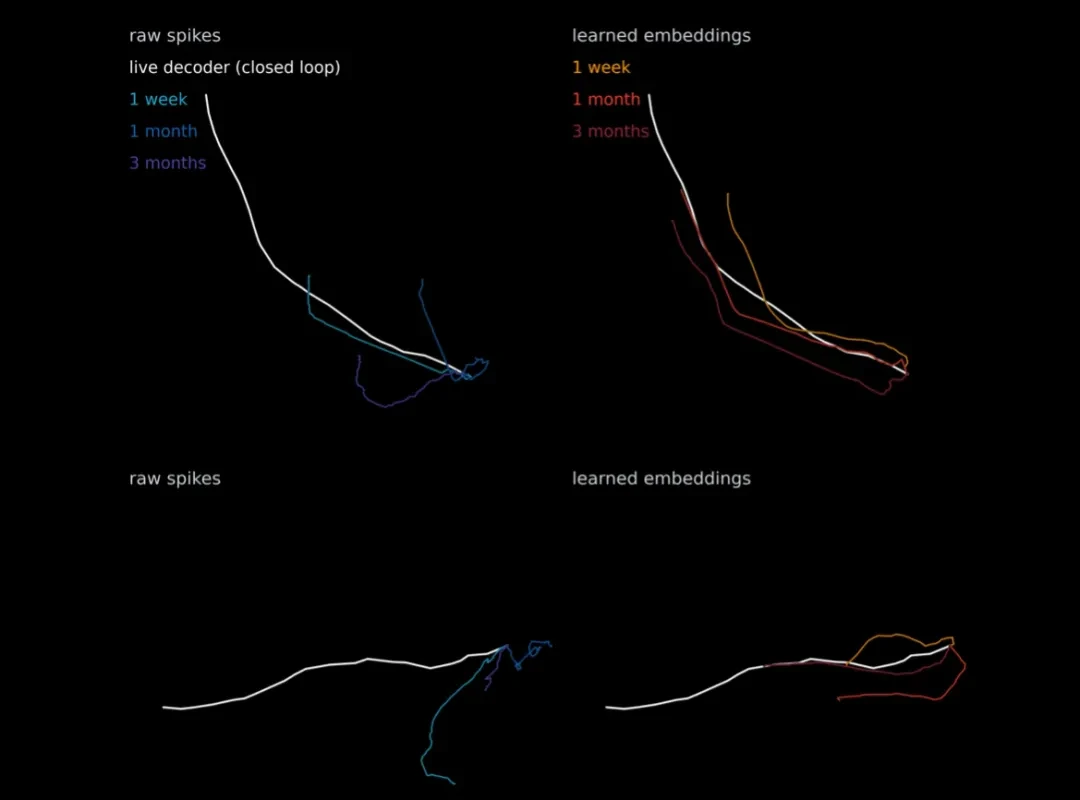
Figure 1. Comparison of spike-based and embedding-based decoders by replaying cursor movement trajectories across different usage durations.
The initial calibration is the most time-consuming, but this is only the beginning. Neural data is highly non-stationary, and even the best decoders experience performance degradation over time. As control capability wanes and labeled data becomes obsolete, users must recalibrate to restore previous performance levels. This traps users in a “Sisyphean” cycle: they are forced to repeatedly perform the same tasks to use the BCI, only for previously generated results to be ultimately discarded. According to Neuralink, users spend an average of 55 minutes per week on calibration merely to maintain control capability.
Each specific function, such as typing or playing games, also requires a dedicated decoder. The more feature-rich and powerful the device, the higher the time cost invested by the user. Calibrating each decoder to its optimal state may consume most of a morning. Although the system is effective, it requires users to continually reacquire control capabilities they had previously mastered. In the two years since the initiation of clinical trials, participants have generated over 50,000 hours of unlabeled, free-form neural data. The first participant alone recorded more than 9,000 hours of data, equivalent to 22.4 billion neuronal spikes. Previously, these data were largely untapped. Neuralink was once constrained by limited data volume, relying primarily on supervised learning techniques; now, however, it has accumulated large-scale datasets sufficient for pretraining.
02
Model Design
Neuralink aims to build a general-purpose neural foundation model that is robust to signal drift. To this end, the research team first pre-trained participant-specific neural encoders using thousands of hours of each participant’s own neural recordings. These encoders transform noisy, drift-prone spike data into stable embeddings suitable for decoding. The model design is based on the following five key assumptions:
Neural activity is best modeled using dynamical systems.It is widely believed that neural population activity represents a state that continuously evolves according to learned rules. This makes the Mamba architecture a more suitable inductive bias. Meanwhile, Mamba meets the team’s requirement for constant low-latency inference, further supporting this choice.
Treat pulse events as Tokens.Inspired by POYO, each recording channel possesses a learnable embedding, such that corresponding events are perceived by the model only when the channel emits spikes. The Perceiver-based input layer can naturally handle variable numbers of active signals. This architecture also facilitates model training on data from multiple users.
Cross-channel structures are available for utilization.When designing training objectives, the team employed reverse engineering based on practical application requirements and data characteristics: the deployed decoder must strictly adhere to causality, as users’ future intentions beyond a specific time window are unknowable, while spike data exhibits high autocorrelation. Based on these considerations, the team adopted a “spatially masked auto-Poisson regression” approach, feeding data from half of the channels into the model and requiring it to predict activity in the other half, thereby prompting the model to reconstruct the underlying neural population state from partial representations.
The intent exists within a stable subspace.This perspective has been explored in previous studies and aligns with intuition. The results from Neuralink’s pre-trained models appear to provide further support. As shown in the figure, information related to specific dates is not prominent in the intermediate layers but re-emerges in the final output.
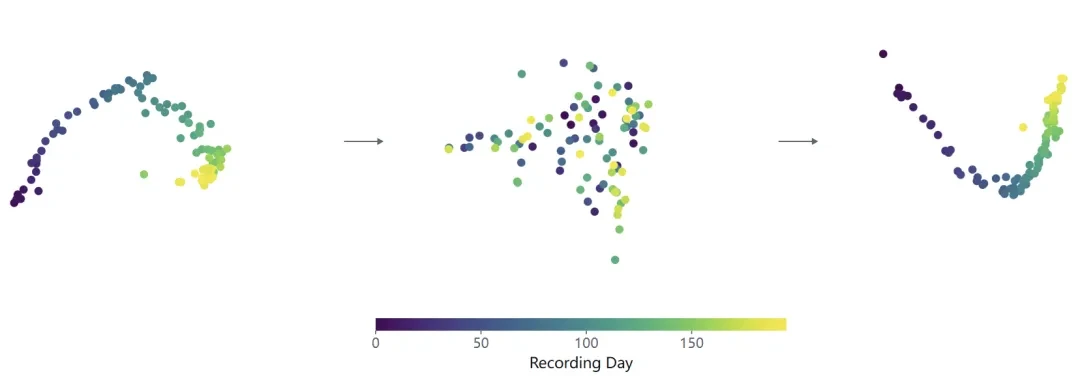
Figure 2. Projection of the daily average embedding vectors onto the first two principal components, color-coded by recording age.
A single neural encoder can handle multiple tasks.Human hands can perform various activities, such as writing, playing musical instruments, and driving vehicles, without the need for additional “external components.” The Neuralink implantable device, Link, records signals from the “hand knob” area of the motor cortex; therefore, the team believes that the device should also possess adaptive capabilities similar to those of the brain and hands.
03
User Experience and Performance Go-Live
Improvement of User Experience
Following the introduction of this feature, users’ decoders demonstrated higher accuracy and extended operational lifespan. The team evaluated control performance using “bits per second” (BPS). This metric reflects the maximum information transfer rate during cursor use, comprehensively accounting for both speed and precision. Neuralink regards it as the most objective benchmark available for assessing decoder quality. The median BPS of the Neuralink system is approximately 10.
Breaking Through Performance Limits
By leveraging large volumes of unlabeled intracortical neural data for pretraining, Neuralink was able to develop decoders that outperform those trained solely on limited labeled datasets. Thanks to these decoders, six participants achieved new personal bests. Three of them surpassed the previous record of 10.39 bits per second (BPS), with one reaching 11.32 BPS. According to Neuralink, this performance sets a new record in the field of brain-computer interfaces (BCI).
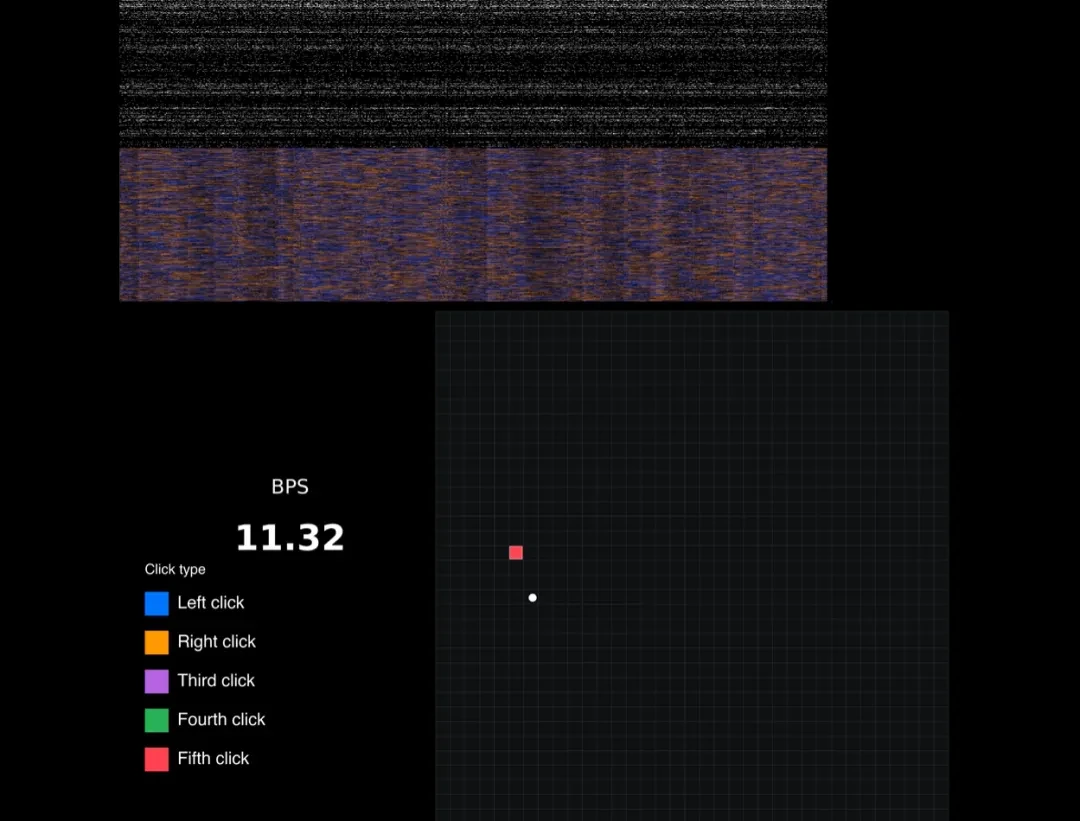
Figure 3. Raster plot of neural spikes, embedding vectors, and gameplay footage from P15’s record-setting match.
User feedback indicates that the cursor responds more sensitively, with smoother and more stable movement, enabling both precise selection and high-speed operation. Improvements in control performance have rendered software corrections such as smoothing and low-velocity suppression unnecessary.
“Better than previous models. Smoother, more precise in direction, and feels effortless. It glides smoothly toward where I want it to go without requiring strenuous pushing.”— P9
The decoding performance for click actions has also improved, as reflected in both raw metrics and the actual user experience. Decoded probability confidence levels are higher and rise more rapidly, making different types of clicks easier to distinguish. Users encounter fewer misclicks, a type of error that is often particularly frustrating. These improvements are critical to achieving 11 bits per second (BPS). Previously, the team relied on post-processing to reduce errors, often at the cost of increased latency. By eliminating this trade-off, click actions have become more decisive and precise.
“[Sense of control] is indeed better. [Click experience] is more suitable for gaming, fast and responsive. By slightly lowering the sensitivity, I can easily reach 11 BPS.” — P15, shortly before reaching 11 BPS
03
Service Life and Data Efficiency
Equally important is how long the decoder can maintain its performance without recalibration. With older systems, users typically spent 10 minutes calibrating before use each day. Some extended the interval between calibrations to several days, trading off some performance for time savings, but few decoders could remain stable over longer periods. Pre-training significantly extends the operational lifespan of the decoder. Even users accustomed to recalibrating at the slightest decline in performance can go more than a week without recalibration.
One user maintained a performance level of 10 bits per second (BPS) using the same decoder for five consecutive days. Some decoders retained robust performance over a usage period exceeding three weeks; in one study participant’s case, the decoder remained controllable after a year and a half. Neuralink believes these preliminary results herald the prospect of decoders with non-degrading performance, marking further progress toward “plug-and-play” brain-computer interfaces (BCIs).
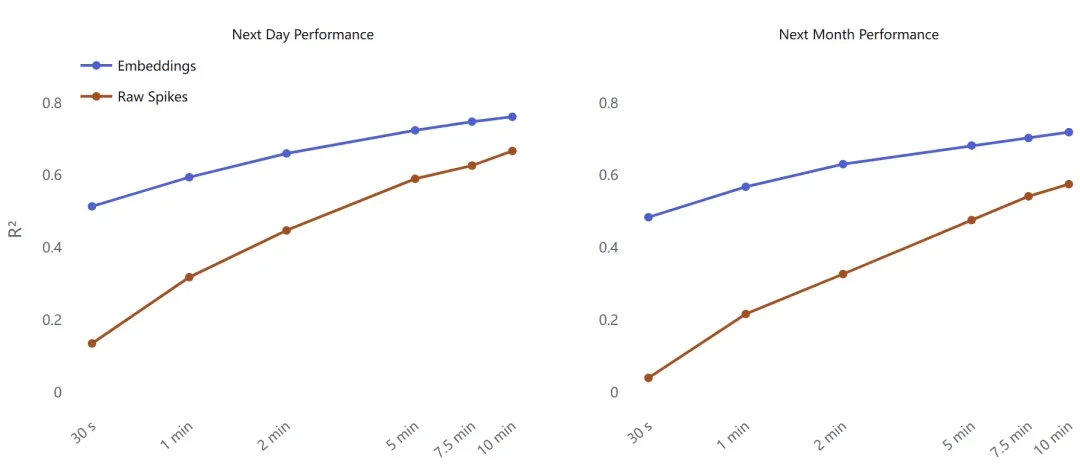
Figure 4. Relationship between decoder performance and dataset size.
In addition to the reduced calibration frequency, the team also found that the time required for users to regain optimal performance through calibration was shortened. For some users, the calibration burden decreased from 10 minutes per day to 10 minutes per week. As shown in Figure 4, the information contained in 30 seconds of labeled embeddings data is equivalent to that of approximately 3.5 minutes of raw spikes data, and the model can effectively generalize to data collected one month later.
The improvement in lifespan is also evident in Neuralink’s robotic arm control simulations. In this scenario, users are required to simultaneously control complex movements across seven or more dimensions. Decoders for such tasks typically degrade faster than those for cursor control: a high-performing decoder may become unusable within as little as six days, forcing users to devote additional time to recalibration. In contrast, decoders trained on learned embeddings remain controllable after one week, allowing users to skip the initial calibration phase.
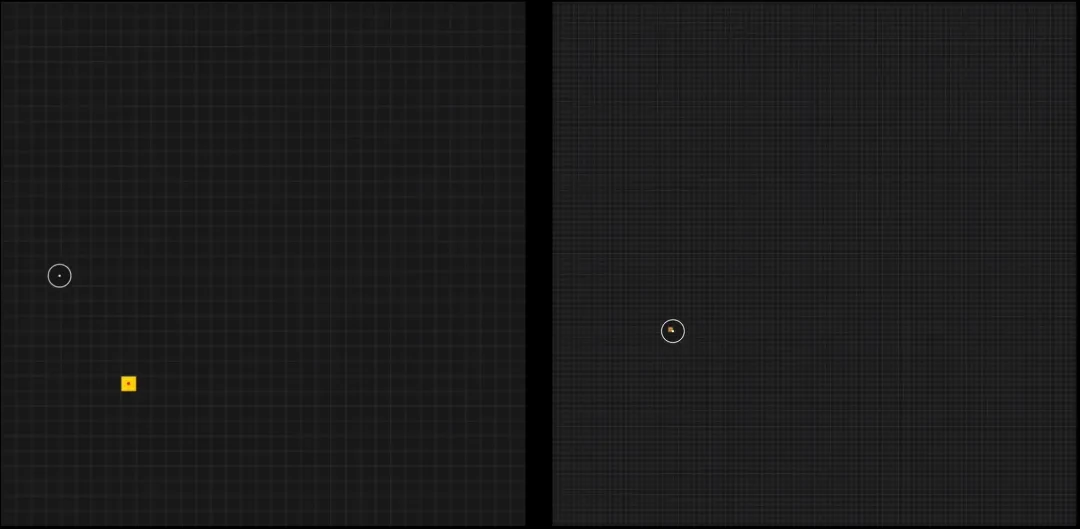
Figure 5(Left Figure). An example of effective control achieved based on calibration data from 20 months ago, without any post-processing. Figure 6(Right figure (). P9 demonstrates precise control capabilities on a 100×100 grid.
04
What is Cursor Teleportation?
The information encoded by the motor cortex extends far beyond muscle activation signals and velocity intentions. Previous studies have explored improving BCI systems by decoding position, error signals, and preparatory intentions. Neuralink is currently investigating the decoding of screen coordinates for cursors and targets based solely on neural activity. Figure 7 presents some preliminary results, with predictions derived from a stateless linear model fitted exclusively to embedded data.
These implants also enable the team to explore interaction modalities that go beyond the capabilities of mouse control. While a mouse can only register movement and clicks, neural signals may reveal when a user is about to act or when they realize they have made an error. What functionalities can be achieved with brain-designed interfaces? One possibility is cursor teleportation: predicting the user’s intended destination and moving the cursor directly there in a single step.
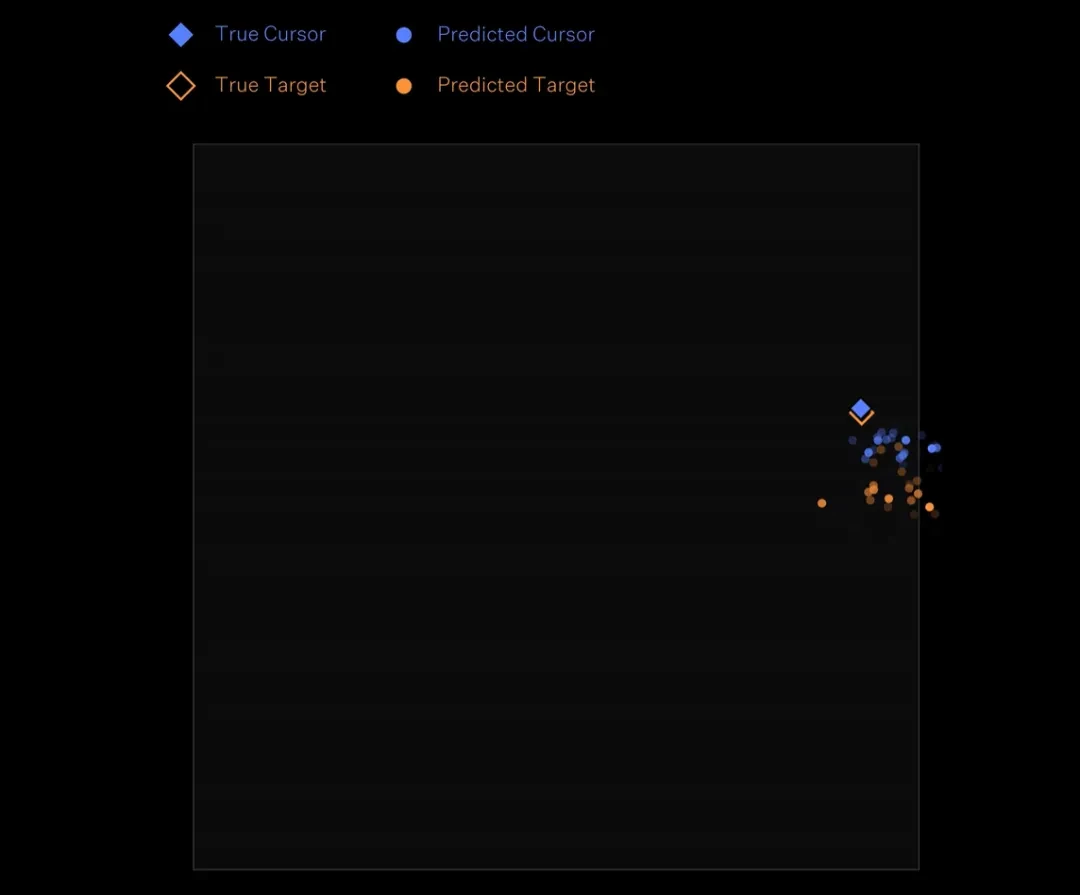
Figure 7. Instantaneous position prediction for held-out data.

Figure 8. 10 BPS control driven by the predicted target position.
Figure 8 illustrates the practical application of this concept. Although it is not yet possible to predict user intent with pixel-level precision, the system significantly reduces cursor movement time and achieves an information transfer rate exceeding 10 bits per second (BPS) in preliminary tests. Neuralink aims to provide a new computer interaction experience as the technology continues to be refined.
05
Future Directions
Pooling Multi-User Data (Pooling Brains).All practical application results presented here were derived from models pre-trained on data from a single participant. As a next step, the team plans to aggregate data from multiple participants to test whether the performance of the shared foundation model improves with increased data scale. Currently, multi-user models have not yielded improvements in real-time (online) application performance, with their decoders showing no superiority over single-user models. However, the team has observed successful model transfer across different participants.
In one experiment, a model trained exclusively on data from participant P9 was successfully transferred to participant P2, with 99% of its weights remaining completely frozen during the transfer process. This model outperformed the original decoder for P2. Other studies, such as POYO3 and NDT25, have also demonstrated that aggregating multi-user data can enhance offline performance, further supporting the feasibility of such models. Successful multi-user models are expected to provide new users with a higher starting point, streamline the onboarding process, and leverage each participant’s data to improve the control experience for all users.
One-shot calibration.Can users perform calibration only once? Recent research findings from Neuralink provide a basis for the team’s progress toward this goal. Maintaining performance for one week is already a positive development; extending this to a year or longer requires the decoder to adaptively adjust to changes in neural signals. The ability to achieve effective control even after 20 months of calibration indicates that useful information can be retained over the long term. The current challenge is to achieve reliable, continuous decoding, thereby reducing the time users spend maintaining BCI devices and allowing them to devote more time to actual usage.
Zero-Shot CalibrationCan users achieve control capabilities comparable to those of able-bodied individuals without any calibration? If the model possesses universality, meaning it is applicable to all people, it becomes possible to realize a “plug-and-play” control experience. Neuralink’s goal is for the device to accurately respond to the user’s intentions upon waking after surgery.
API for the Motor Cortex.People use the same hands to type, play games, and pick up a glass of water. Could a single decoder manage all these actions? Neuralink envisions employing a shared decoder for all intended hand movements—essentially an API for the motor cortex. Users would need to calibrate only once, enabling seamless use across different applications, while developers could build on this unified interface. This approach would lower the barrier to developing applications for Link and pave the way for a rich ecosystem of BCI applications.

Brain-Computer Interface Community is the first brain-computer interface (BCI) industry service provider in China.Service Platform, Pioneer and Leader of New Media for Brain-Computer Interfaces in China。ChiefTo provide the following services to enterprises, research teams, investment institutions, and practitioners:
Publicity and Reporting:Report on corporate updates, technology insights, and product introductions through articles with images, short videos, and live streams to enhance exposure and industry influence.。
Resource Matching:Match resources such as capital, supply chains, clinical institutions, and channel partners based on needs, facilitate genuine connections, and promote collaboration.
Translation of Achievements:Assist the technical team in identifying industry partners, investors, and implementation scenarios to facilitate the translation of technology into products.
Event Planning and Execution:Undertake the planning and execution of online and offline roadshows, salons, forums, and other events.
Other Customization Requirements:Including personalized services such as customized reporting, market research, and recruitment support.
Cooperation Negotiations,Please contact WeChat: ZuoLeiLeiya
(Note: Name-Organization-Collaboration)
Submission | Become a Creator,Please contact WeChat: RoseBCI

?Star and Pin to Top?
Stay Ahead of Every Breakthrough in Brain-Computer Interface Technology

One-click Triple Action: “Share,” “Like,” and “Wow”
Feel free to chat in the comments section.