

Sirius Therapeutics Files for HKEX IPO: Backed by Nearly $900M CRISPR Deal and Promising siRNA Pipeline
Sirius Therapeutics
Oligonucleotide Drug Developer
CRISPR Therapeutics
Gene Editing Drug Developer
On September 2 this year, Novartis and Arrowhead reached a BD deal worth $200 million upfront and up to $2 billion in potential milestone payments for the siRNA therapy ARO-SNCA. The next day, Novartis struck another BD deal with Boho Pharmaceutical for four siRNA drugs worth over $5.2 billion. These two consecutive BD deals, totaling more than $7 billion, sent a strong signal to the market and drew investors' attention to the increasingly prominent small nucleic acid field.
In fact, as early as May this year, CRISPR Therapeutics, a global gene-editing giant, spent $895 million (approximately RMB 6.5 billion) to reach a significant collaboration with Sirius Therapeutics, an innovative pharmaceutical company in China, to jointly advance the development of siRNA innovative therapies. This marks the third BD overseas deal in China’s small nucleic acid field. Due to this prior BD track record, Sirius Therapeutics' Hong Kong IPO has garnered significant attention.
Intelligency APP learned that on September 28, Sirius Therapeutics officially submitted its prospectus to the Hong Kong Stock Exchange, with Goldman Sachs, Haitong International, and HSBC as its joint sponsors.
siRNA Therapy Track Has Become the Next "Hot Potato"
According to the Frost & Sullivan report, the global siRNA therapy market size reached 2.4 billion USD in 2024 and is expected to grow to 50.3 billion USD by 2040, with a compound annual growth rate (CAGR) of 20.9%. Among them, there are 22 approved products on the market (including delisted products), including 7 siRNA drugs, 13 ASO drugs, and 2 aptamers. Meanwhile, there are over 1,200 small nucleic acid new drugs under research globally.
Driven by breakthroughs in innovative technologies and strong sales performance this year, the small nucleic acid sector has garnered widespread attention from investors. In addition to Novartis' significant entry with an investment of over $70 billion mentioned above, the stock prices of U.S.-listed small nucleic acid concept stocks Alnylam, Ionis, and Avidity have risen to varying degrees since the beginning of the year. Among them, Alnylam's stock price surged by a maximum of 105.78% this year due to the better-than-expected sales performance of its RNAi therapy Amvuttra, with its market value surpassing $60 billion.
Compared with overseas markets, the development of small nucleic acid drugs in China started relatively late. Currently, there are only three imported new drugs on the market: Nusinersen and Tofersen, co-developed by Biogen and Ionis, and Inclisiran, co-developed by Novartis and Alnylam.
But on the other hand, the R&D pipeline for domestically produced small nucleic acid new drugs is rapidly expanding, second only to the United States. Currently, there are already more than 300 new drugs under research, with nearly 70 entering clinical stages. This year, financing activities in the small nucleic acid drug sector have also been frequent, with multiple companies receiving new funding support.
For example, in April this year, Xuanjing Bio secured Pre-A funding; in May, Haobo Medicine raised US$50 million through a B+ round of financing; in the same month, Sirius Therapeutics obtained nearly US$50 million in B2 round financing; in August, HaiChang Bio raised nearly 500 million yuan in a C round; also in August, Ribo Bio raised over 200 million yuan through private equity financing, etc.
According to incomplete statistics, since the beginning of this year, 8 small nucleic acid enterprises in China have received financing. Among them, Haobo Medicine, Sirius Therapeutics, and Ribo Biotech have all completed financing of over 200 million yuan.
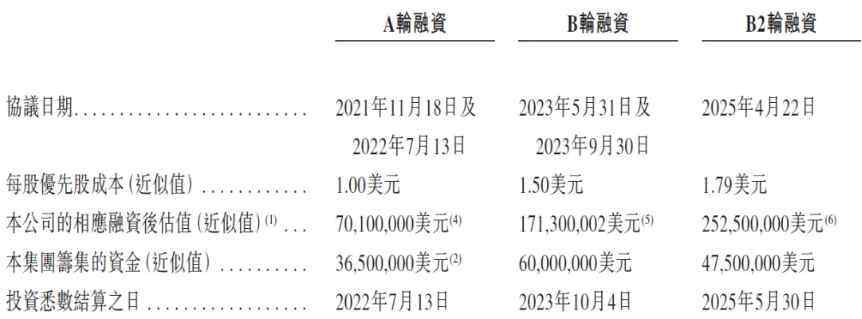
According to the Zhitong Finance APP, Sirius Therapeutics, which has filed for an IPO in Hong Kong, has undergone three rounds of financing since its establishment. After completing a US$47.5 million Series B2 financing in May this year, its post-money valuation has reached US$253 million.
Behind the Nearly $900 Million Blockbuster BD
In May this year, the nearly $900 million BD deal between Sirius Therapeutics and CRISPR Therapeutics is worth investors' attention not only because it is the third BD overseas deal in China's small nucleic acid field, but also because it is one of the few deals featuring a "high transaction amount, co-development, and co-commercialization" model.
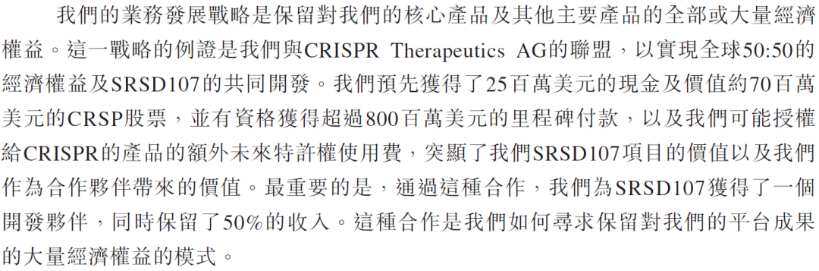
According to the company's prospectus, Sirius Therapeutics' FXI siRNA and CRISPR Therapeutics have adopted a 50:50 co-development model. As a result, Sirius Therapeutics received $25 million in cash, $70 million in equity, and $800 million in milestone payments from CRISPR Therapeutics. This is all due to Sirius Therapeutics' core R&D pipeline with FIC/BIC potential.
According to the Zhitong Finance APP, since its establishment, Sirius Therapeutics has been committed to maximizing the clinical and commercial value of siRNA therapies.
Currently, the company has established a rich and differentiated competitive product pipeline, with a core product — FXI siRNA (SRSD107) for treating coagulation disorders — and two key products: Lp(a) siRNA (SRSD216) and INHBE siRNA (SRSD384), used for treating cardiometabolic diseases and obesity, respectively.
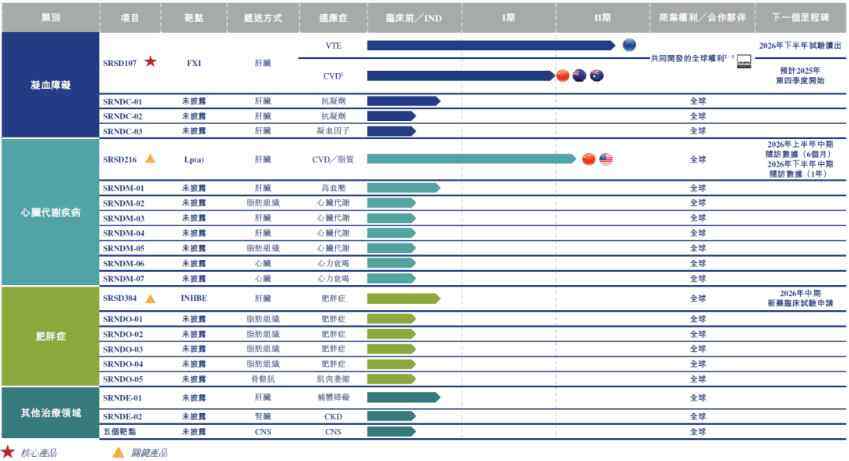
Among them, the most notable one, which is co-developed with CRISPR Therapeutics, is Sirius Therapeutics' core product, SRSD107.
SRSD107, as the company's core product, is a potential first-in-class siRNA drug targeting coagulation factor XI. From the mechanism of action, SRSD107, a double-stranded small interfering RNA (siRNA) drug with independent intellectual property rights developed by Sirius Therapeutics, targets coagulation factor XI (FXI), which is expected to significantly reduce the risk of bleeding while lowering the incidence of thrombotic events. Its potent and long-lasting effect, along with favorable safety, positions SRSD107 as a potential FIC/BIC next-generation safer anticoagulant drug.
At the same time, its potential indications are extensive, covering atrial fibrillation, venous thromboembolism (VTE), cancer-related thrombosis, end-stage renal disease patients undergoing hemodialysis, and major orthopedic surgery populations whose treatment options are limited due to bleeding risks.
Previous clinical results showed that FXI siRNA administration could achieve sustained suppression of FXI for up to 6 months, demonstrating promising FIC/BIC potential, which became the key factor in attracting interest from MNCs. The product is currently undergoing a Phase II multicenter clinical trial in Europe, with plans to initiate another Phase II trial in China as well as in Australia/New Zealand.
It is worth mentioning that for a long time, the standard treatment for antithrombotic therapy has been based on "xabans," with the veteran anticoagulant apixaban achieving annual sales of over 20 billion US dollars in 2024. However, the potential risk of bleeding has always been a pain point for this therapy. Supported by strong clinical data, the siRNA therapy SRSD107 is expected to gain significant commercial market space.
In addition to its core products, another key product in Sirius Therapeutics' pipeline, Lp(a) siRNA, is currently in Phase II clinical trials. Data from the Phase I clinical trial showed that 300mg and 600mg dose groups achieved over 95% inhibition 43 days after administration, with sustained inhibition lasting at least 12 weeks. Follow-up is still ongoing, with the potential for dosing once every six months or even once a year. Supported by strong clinical data and high patient compliance, its commercial prospects are also highly promising.
Financially, although the company's net losses reached RMB 309 million and RMB 342 million in 2023 and 2024 respectively, with the cash flow support from BD transactions, the company has turned a profit in the first half of this year, achieving a net profit of RMB 34.461 million. Moreover, the cash and cash equivalents for the period increased to RMB 618 million, which is sufficient to meet the company's R&D investment needs for nearly three years. Additionally, the company is expected to receive an $800 million milestone payment from CRISPR Therapeutics, ensuring a stable cash flow and high growth certainty. Therefore, against the backdrop of a continuing bull market for innovative drugs in Hong Kong stocks, the company is worth investors' attention.