

2 Days, 2 Deals, $2 Billion-Level BD
SciBrunch
Small Molecule Antitumor Drug Developer
Akeso
Innovative Antibody Drug Developer

AstraZeneca
Biopharmaceutical Manufacturer

MSD
Pharmaceutical R&D and Manufacturer
In the final days of September, two billion-dollar deals were successively closed in the global oncology pharmaceutical sector, with Chinese innovative drug assets once again becoming core targets for the pipeline strategies of global giants.
On the evening of September 28 (Beijing Time), Shanghai-based biotech company SciBrunch Therapeutics entered into a collaboration with multinational pharmaceutical giant MSD. The core asset of this partnership is SPR2015, a preclinical-stage, orally bioavailable KRAS G12D (ON) inhibitor independently developed by SciBrunch.
Under the agreement, MSD secures exclusive global rights to develop, manufacture, and commercialize the molecule. SciBrunch will receive a $400 million upfront payment, along with milestone payments tied to multi-indication development and commercialization milestones, bringing the total potential value of the deal to up to $2.13 billion.
On the morning of September 29 (Beijing Time), AstraZeneca announced a $2 billion strategic equity investment in Summit, the holder of overseas rights to Akeso's first-in-class PD-1/VEGF bispecific antibody, Ivonescimab.
The core clinical focus of this deal is the joint clinical research on ivonescimab in combination with AstraZeneca's CLDN18.2 ADC drug, sonesitatug vedotin (sone-ve), for various gastrointestinal tumors, led by AstraZeneca. The two parties simultaneously signed a memorandum of understanding, aiming to further expand the collaboration to explore combination therapies involving ivonescimab and multiple ADCs and other anti-tumor drugs in AstraZeneca's portfolio. Throughout the collaboration, each party will retain the development and commercialization rights to their respective drugs and jointly bear the R&D costs.
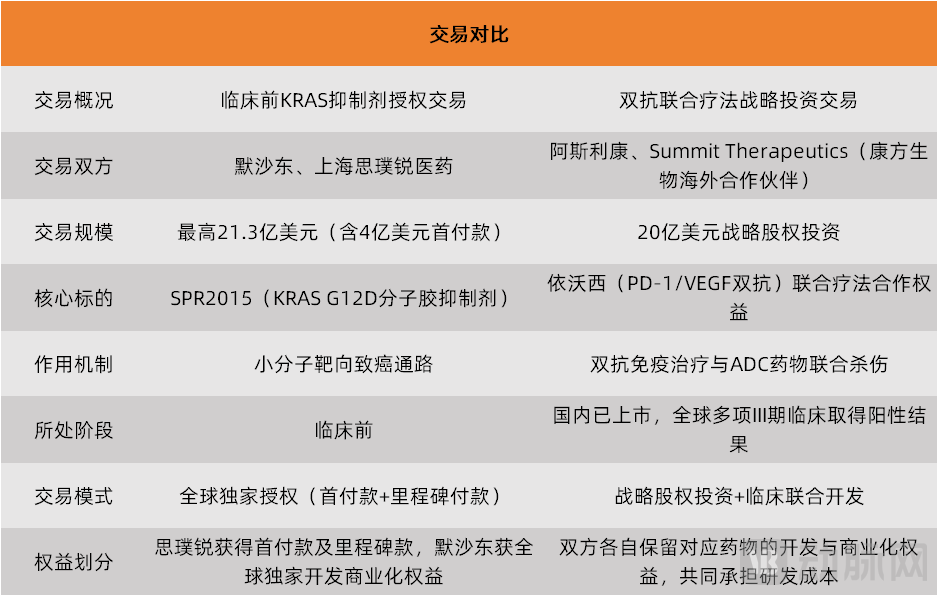
The two deals are comparable in scale, with core assets both originating from Chinese biopharmaceutical companies; yet they have followed entirely different paths in terms of target development stage, transaction structure, and strategic rationale. This reflects not only the individual choices of two multinational pharmaceutical companies but also the typical divergence currently seen in global oncology business development (BD).
Betting on Preclinical KRAS Assets: The Early-Positioning Logic of Pathway Completion
In an industry environment where most business development (BD) transactions chase mid-to-late-stage mature assets, choosing to acquire a preclinical small-molecule inhibitor may appear to entail higher R&D risk, but in reality, it is a typical manifestation of multinational pharmaceutical companies' strategy of "precise supplementation and deep strategic positioning" around their core pipelines.
KRAS is a widely recognized high-value target in the field of tumor-targeted therapy and one of the most common oncogenic mutations in human cancers. The G12C subtype has achieved the first breakthrough in druggability, with multiple drugs approved for market entry, leading to increasingly fierce competition in this therapeutic area. In contrast, the G12D mutation, which has a higher incidence rate, remains in the early stages of exploration globally due to greater challenges in protein binding and higher barriers to druggability. It represents the core direction of competition for the next phase in the KRAS therapeutic landscape.
SciBrunch's SPR2015, a novel molecular glue-type KRAS G12D inhibitor, demonstrated nanomolar-level anti-proliferative activity and favorable wild-type selectivity in preclinical studies. It exhibited significant antitumor efficacy in both CDX and PDX models, positioning it as a scarce and high-potential asset in this therapeutic area.
For MSD, the core value of this deal lies not only in acquiring a candidate drug, but also in strategically completing its solid tumor treatment portfolio.
Pembrolizumab constitutes the core foundation of MSD's oncology pipeline, while “immunotherapy + targeted therapy” combination regimens represent an essential pathway to break through the efficacy ceiling of monotherapies. As one of the most central oncogenic pathways in solid tumors, the KRAS pathway spans multiple major indications, including lung cancer, colorectal cancer, and pancreatic cancer, and its synergistic mechanisms with immunotherapy have been extensively validated.
Securing SPR2015 means that MSD will possess an independently controlled next-generation asset targeting the core KRAS pathway, laying the groundwork for its “immunotherapy + KRAS inhibitor” combination therapy strategy and further solidifying its leading position in first-line treatment of solid tumors.
From the perspective of transaction models, the classic "upfront payment + milestones" licensing structure deeply aligns risk with development progress: preclinical assets carry the highest uncertainty, so relatively controllable upfront payments are used to secure global exclusive rights, with the remaining consideration tied to development and commercialization milestones.
The advantage of this model lies in leveraging the early discovery capabilities of biotech companies to enter cutting-edge therapeutic areas, while utilizing its own world-class global clinical development and commercialization network to rapidly translate early-stage assets into clinical outcomes, thereby maximizing asset value. For startups like SciBrunch, leveraging the capabilities of industry giants to advance global development is more efficient than bearing the full spectrum of clinical risks independently.
It is worth noting that, In recent years, MSD's oncology business development has consistently maintained a distinct strategy of "focusing on core pathways and securing early-stage positions," rarely chasing after popular, mature assets blindly, but instead making proactive investments in next-generation molecules targeting validated pathways.
This strategy not only avoids high-priced competition for late-stage assets but also leverages in-house development capabilities to rapidly advance assets, thereby establishing long-term pipeline barriers. Securing a KRAS G12D inhibitor represents a continuation of this strategy: as competition in the G12C space has become saturated, proactively positioning in the broader G12D arena to stockpile cutting-edge assets for future targeted therapy competitions.
Bispecific Antibody Candidates Linked to Public Listings: An Ecosystem Co-construction Strategy for Combination Therapies
If the previous deal was a deep dive targeting a single point, AstraZeneca's $2 billion strategic investment represents a horizontal ecosystem build centered on its core strategy.
While superficially a financial investment in the biotech firm, this deal fundamentally secures a world-class next-generation immunotherapy partner for its own ADC pipeline, thereby implementing its core oncology strategy of "ADC + Next-Generation Immunotherapy."
AstraZeneca has continued to increase its investment in the antibody-drug conjugate (ADC) field in recent years, establishing an ADC pipeline matrix covering multiple targets. Among these, Sone-Ve, a CLDN18.2-targeting ADC, demonstrated a significant overall survival benefit in clinical studies for second-line and later treatment of advanced Claudin18.2-positive gastric cancer, making it a core asset in its gastrointestinal oncology pipeline.
However, the value of antibody-drug conjugate (ADC) therapies extends beyond monotherapy; combination with immunotherapy represents a key pathway to further enhance efficacy and expand indications. As the current mainstream PD-1 monoclonal antibodies are in a phase of intense competition, with their efficacy ceiling gradually becoming apparent, AstraZeneca requires a more differentiated immunotherapeutic agent to achieve stronger synergistic effects with its ADCs.
The emergence of Ivonescimab has precisely filled this gap.
As the world's first PD-1/VEGF bispecific antibody, ivonescimab simultaneously achieves dual effects of tumor immune activation and anti-angiogenesis, making it a representative drug in the era of cancer immunotherapy 2.0. Multiple Phase III clinical studies have confirmed that the efficacy of ivonescimab, both as monotherapy and in combination with chemotherapy, is significantly superior to that of traditional PD-1 monoclonal antibodies. It has even yielded positive results in head-to-head comparisons with pembrolizumab, fully validating its clinical value.
More importantly, the VEGF pathway and the mechanism of action of ADCs are highly complementary: ADC drugs directly kill tumor cells and release tumor-associated antigens; ivonescimab improves the tumor microenvironment by inhibiting angiogenesis while simultaneously activating the immune system. The combination of these two agents can achieve multiple effects, including tumor cell killing, immune activation, and microenvironment modulation, holding promise for further enhancing therapeutic outcomes in indications such as gastrointestinal tumors.
Rather than opting for a direct licensing deal for ivonescimab, AstraZeneca chose to collaborate through a strategic investment in Summit, a move that reflects the differentiated thinking behind its business development strategy.
Under the agreement, both parties retain their respective rights to develop and commercialize their own drugs, share the costs of clinical studies, and the collaboration involves no additional milestone payments, royalties, or revenue sharing. This "strategic binding + risk-sharing" model not only avoids high upfront licensing fees and royalty costs but also deeply aligns partners through equity stakes, ensuring priority and execution strength in joint development.
Meanwhile, the two parties also signed a memorandum of understanding (MOU) to expand the scope of collaboration to cover multiple antibody-drug conjugate (ADC) candidates in AstraZeneca's portfolio. This means that Ivonescimab will serve as a universal immunotherapy partner across AstraZeneca's entire ADC pipeline, rather than being limited to a combination with a single product.
For AstraZeneca, the core of this deal is not to acquire sales rights for a new drug, but to build an "ADC + IO 2.0" therapeutic ecosystem. By anchoring its portfolio with ivonescimab, a globally leading bispecific antibody, multiple ADC drugs under its umbrella will benefit from superior combination therapy regimens, thereby establishing differentiated advantages in cross-indication competition.
This strategy of "centering on core pipelines and building an ecosystem of combination therapies through business development (BD)" is the key logic behind the rapid growth of AstraZeneca's oncology business in recent years: rather than pursuing the dominance of a single product, it aims to establish systemic barriers for combination therapies.
From Product Acquisition to Ecosystem Building: The Shift in MNC Oncology BD Trends
Though the two deals follow vastly different paths, they conceal a shared shift in the business development (BD) strategies of global oncology pharmaceutical giants, reflecting a fundamental change in the industry's underlying logic.
As oncology treatment transitions from the era of monotherapy to combination therapy, and from follow-on innovation to source innovation, the business development (BD) logic of multinational pharmaceutical companies has long moved beyond the rudimentary stage of "buying what is missing," shifting instead toward deeper pipeline synergy and ecosystem building.
First, the core of both transactions is pipeline synergy orientation, rather than mere product in-licensing.
Whether it involves completing the KRAS pathway to facilitate combination strategies with immunotherapy, or pairing bispecific antibodies to empower ADC pipelines, the essence lies in leveraging one's core cornerstone products by adding mechanistically complementary partners to create synergistic advantages in combination therapies. This signifies that the evaluation criteria for oncology business development (BD) have shifted from "the intrinsic potential of the product itself" to "the synergistic value of the product within the existing pipeline." Isolated single-agent products are increasingly less likely to attract interest from industry giants; instead, assets that can be integrated into established therapeutic ecosystems have become the primary targets for BD.
Secondly, both transactions bet on next-generation therapeutic technologies, pointing to the competitive high ground for the coming decade.
One bet is on a preclinical KRAS G12D inhibitor, sidestepping the crowded G12C track to secure a position in the next generation of druggability breakthroughs; the other is on a PD-1/VEGF bispecific antibody, transcending the efficacy boundaries of traditional PD-1 monoclonal antibodies and positioning for combination therapies in the Immuno-Oncology 2.0 era.
Neither company has confined itself to the current standard-of-care framework; instead, both have proactively positioned themselves with next-generation technologies capable of iterating upon existing therapies. This forward-looking business development (BD) strategy reflects multinational pharmaceutical companies' assessment of the rapid pace of iteration in oncology treatment—only by securing next-generation technologies in advance can they maintain a competitive lead in the future.
Third, innovative drugs from China have become a core supply hub for global business development (BD) of multinational pharmaceutical companies.
The core assets in both transactions originate from China: SPR2015 comes from Shanghai-based SciBrunch, while ivonescimab was independently developed by Akeso. From the early licensing of me-too drugs to today's pursuit by pharmaceutical giants of first-in-class bispecific antibodies and next-generation KRAS inhibitors, the business development (BD) value of Chinese innovative drugs has achieved a qualitative leap. Chinese biotech companies have not only become a significant force in global innovation in terms of quantity but have also begun to enter the top tier globally in terms of quality, serving as a key source for multinational pharmaceutical companies to supplement their cutting-edge pipelines.
The deeper industry trend lies in the shifting relationship between multinational pharmaceutical companies and biotech firms, evolving from transactional buyer-seller dynamics to strategic partnerships. Traditional BD models involved biotechs selling assets and pharmaceutical giants paying for rights, resembling one-off transactions. In contrast, contemporary deal structures are increasingly diverse: milestone-based licensing deeply aligns the interests of both parties with development progress, while strategic investments achieve dual alignment of capital and business operations.
Risk-sharing, benefit-sharing, and long-term collaboration are becoming the new industry consensus. The R&D capabilities of biotech firms and the development and commercialization strengths of pharmaceutical giants are no longer simple buyer-seller relationships, but rather deeply integrated innovation communities.
These two transactions in late September are merely a microcosm of the global wave of business development (BD) in the oncology drug industry. As innovation in cancer treatment enters more complex and challenging territory, leveraging BD to achieve pipeline synergy and co-build ecosystems has become not only an inevitable choice for giants to maintain their competitiveness but also the underlying driving force for sustained innovation across the industry. Meanwhile, Chinese innovative pharmaceutical companies are transitioning from followers to core participants, and even definers of frontier directions, within this wave.