

Crossing Over into Chip Packaging: This Pharmaceutical Packaging Company Races Toward IPO
Linuo Pharmaceutical Packaging
Developer of New Glass Materials and Related Products
In June 2026, the pilot kiln at Linuo Pharmaceutical Packaging Company’s Glass New Materials Innovation Incubation Center was ignited. Three months later, the company filed its prospectus with the Hong Kong Stock Exchange.
Linuo was listed on the ChiNext board as early as November 2021. Based on 2025 sales revenue, it ranks first in China’s daily-use heat-resistant glass market and second globally. Many food storage containers, bakeware, and glass turntables for microwaves are produced on its manufacturing lines. Meanwhile, it is also a leading player in China’s pharmaceutical glass packaging market, holding a position in the supply chains of BRILLIANT PHARMACEUTICALS and China Resources Double-Crane Pharmaceutical.
Nearly five years after its A-share listing, why is it heading to the Hong Kong stock exchange? The answer lies in this newly commissioned kiln from June, which produces glass substrates for semiconductor packaging. Amid the AI boom, Frost & Sullivan projects this market will surge from RMB 100 million in 2026 to RMB 13.2 billion in 2030, representing a compound annual growth rate (CAGR) of 234.8%.
Why Does a Glass Bottle Manufacturer Dare to Bet on Chip Packaging Materials?
Linuo Group, the entity behind Linuo, has been deeply rooted in Shandong’s industrial landscape for decades.
Founder Gao Yuankun initially started out in the building materials industry. In 2002, he established Linuo Pharmaceutical Packaging through the Linuo Group. Linuo Group is a diversified industrial conglomerate that previously operated in multiple sectors, including solar energy and pharmaceuticals. Later, it concentrated its resources on the niche of borosilicate specialty glass, ultimately achieving the world’s second-largest market share.
Gao Yuankun himself did not remain continuously involved in day-to-day operations, instead handing over management authority to Song Lai, who has a technical background.
Song Lai has worked in the specialty glass industry for many years. After assuming his position, he accelerated the deployment of high value-added products such as pre-filled syringes, Ready-to-Use (RTU) packaging materials, and cartridge vials, building upon the foundation of strengthened middle borosilicate pharmaceutical packaging materials. Meanwhile, he promoted the optimization of traditional glass manufacturing through AI and intelligent manufacturing. In 2015, Linuo became the first domestic supplier of borosilicate specialty glass to pass the CMMM Level 4 certification.
Linuo’s development has coincided with three key technological upgrades.
The first step involved producing ordinary glass, mastering proprietary furnace technology, and developing China’s first hexagonal stepped all-electric glass melting furnace, thereby securing control over core processes and eliminating dependence on upstream equipment suppliers.
The second milestone was simultaneously penetrating the two major borosilicate glass markets for daily use and pharmaceutical applications. On one hand, it secured key consumer-end clients such as Lock&Lock and Midea; on the other, it obtained pharmacopoeia certifications in China, the United States, and Europe, thereby entering the supply chains of BRILLIANT PHARMACEUTICALS and China Resources Double-Crane. This dual-pronged strategy enhanced its risk resilience.
The third initiative involves the current layout of glass substrates for semiconductor packaging. In June 2026, the pilot-scale kiln was officially ignited, and sample testing began for industry clients, marking the company's entry into the threshold of its third growth curve.
Linuo’s core products are three types of borosilicate glass, each targeting a different market.
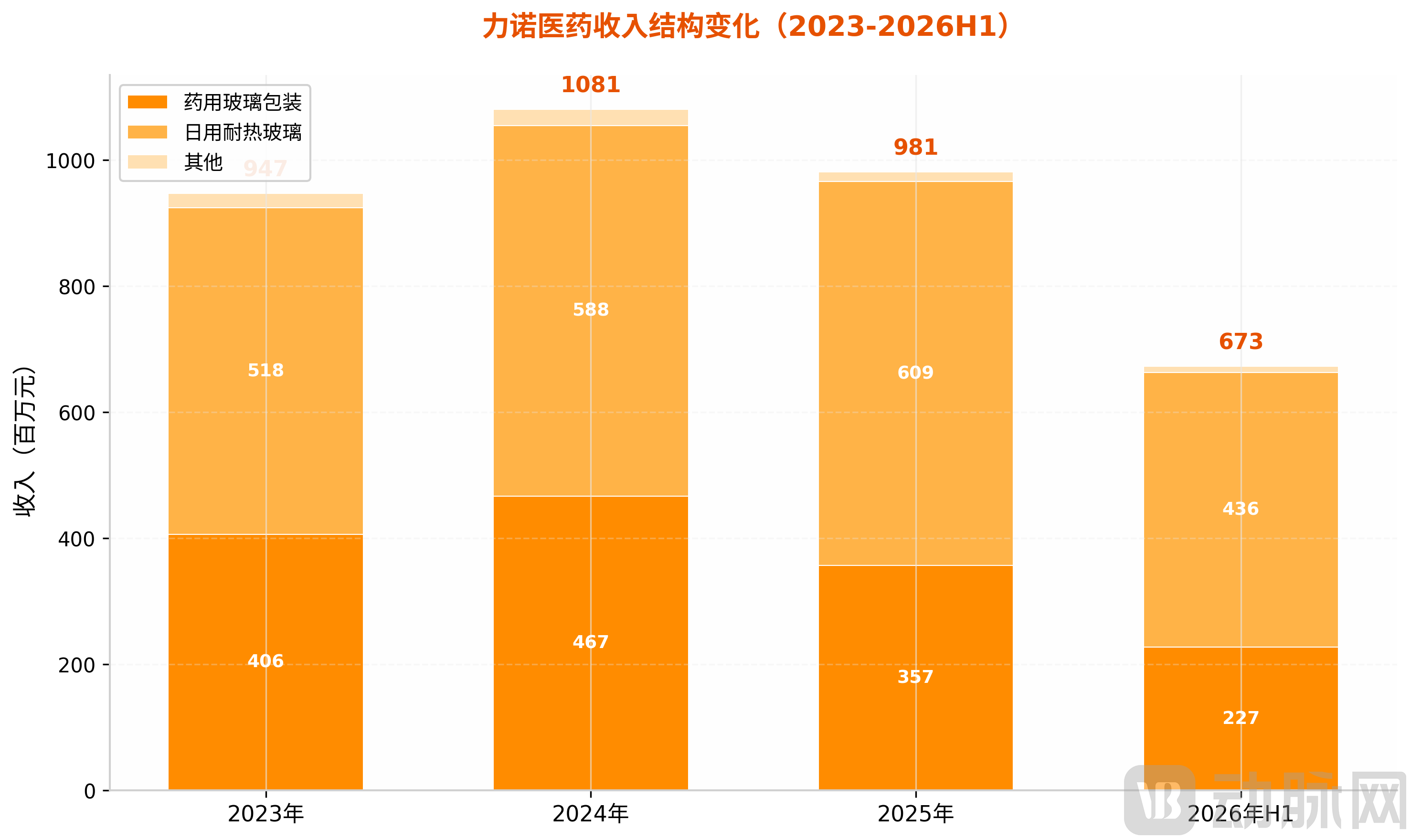
Corporate Revenue Structure, Charted Based on Prospectus Data
Daily Heat-Resistant Glass: The Hidden Champions Behind the Brands
Most people, upon their first encounter with Linuo’s products, would not realize that they are made by Linuo.
Many common household items, such as Lock & Lock glass food storage containers, Tupperware baking ware, and the glass turntables in microwave ovens, are often manufactured by Linuo through OEM production. Data from 2025 shows that for every 100 yuan worth of heat-resistant glass sold in China, nearly 9.5 yuan worth is produced by Linuo, ranking it first nationwide. In the global market, Linuo holds a 5.2% share, placing it second worldwide.
Daily-use heat-resistant glassware is the company’s cash cow. In 2025, it generated RMB 609 million in revenue, accounting for 62.1% of total revenue. This B2B OEM business has limited brand visibility but delivers stable cash flow and strong customer stickiness, with a 100% repurchase rate among the top ten clients, most of whom have maintained partnerships for over eight years. The gross margin for this segment rose from 12.2% in 2023 to 22.2% in the first half of 2026, primarily driven by orders from overseas brands and expansion into e-commerce channels.
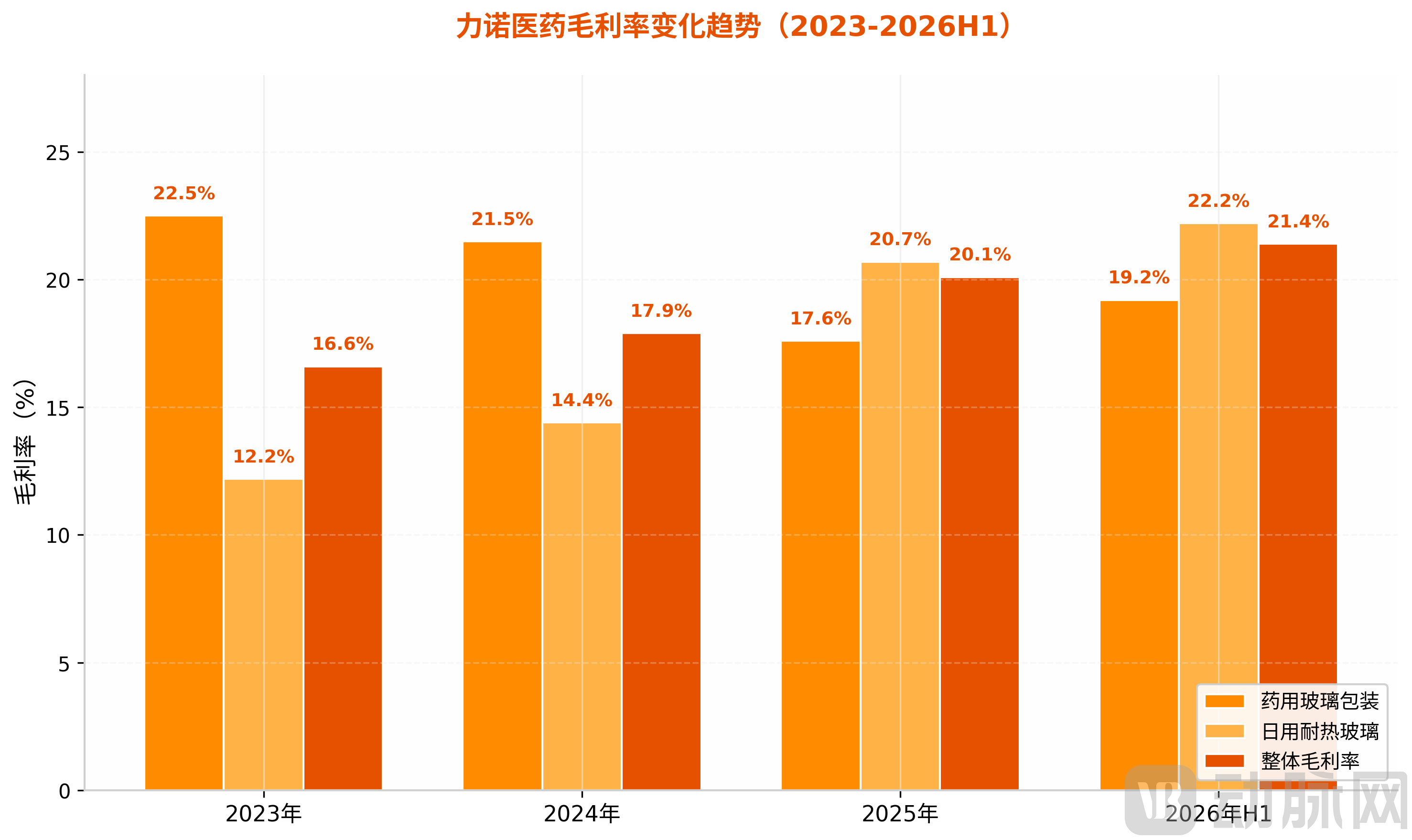
Changes in Corporate Gross Profit Margin, Charted Based on Prospectus Data
Pharmaceutical Glass Packaging: A High-End Breakthrough Under the Pressure of Centralized Procurement
Pharmaceutical glass is Linuo’s second core business pillar, but the industry has faced significant pressure in the past two years.
Impacted by medical insurance cost controls and centralized volume-based procurement, downstream pharmaceutical companies are cutting costs, which has adversely affected both the price and sales volume of traditional medicinal glass bottles. In 2025, revenue from medicinal glass packaging amounted to RMB 357 million, representing a year-on-year decline of 23.6%.
This is not a management issue but an industry-wide trend. Linuo’s response strategy is clear: stabilize market share with traditional products and drive growth with high-end offerings. As conventional controlled-vial products face pressure, the company is shifting toward higher value-added products such as molded glass vials, ready-to-use (RTU) sterile packaging, and pre-filled syringes (PFS).
Premium products do not need to compete on price with peers and can still capture the growth dividends from the volume expansion of biologics and innovative drugs. Data shows that revenue from high-end products such as RTU (Ready-to-Use) and PFS (Pre-filled Syringes) increased by 61.5% year-over-year in 2025, and surged by 304% year-over-year in the first half of 2026. The upgrade in product mix has begun to yield results, although the current base remains small.
Glass Substrates for Semiconductors: Betting on the Next Decade
The segment with the greatest growth potential is the nascent semiconductor glass substrate business.
As advanced packaging grows increasingly complex, issues with warpage and dimensional stability in traditional organic substrates have become more pronounced. Glass substrates, with their high flatness and controllable coefficient of thermal expansion, effectively address these pain points, making them a key material for AI chip and high-bandwidth memory packaging.
According to Sullivan’s forecast, the global market is expected to grow at a compound annual growth rate (CAGR) of 234.8% from 2026 to 2030, rising from RMB 100 million to RMB 13.2 billion, marking the eve of a true explosive growth phase.
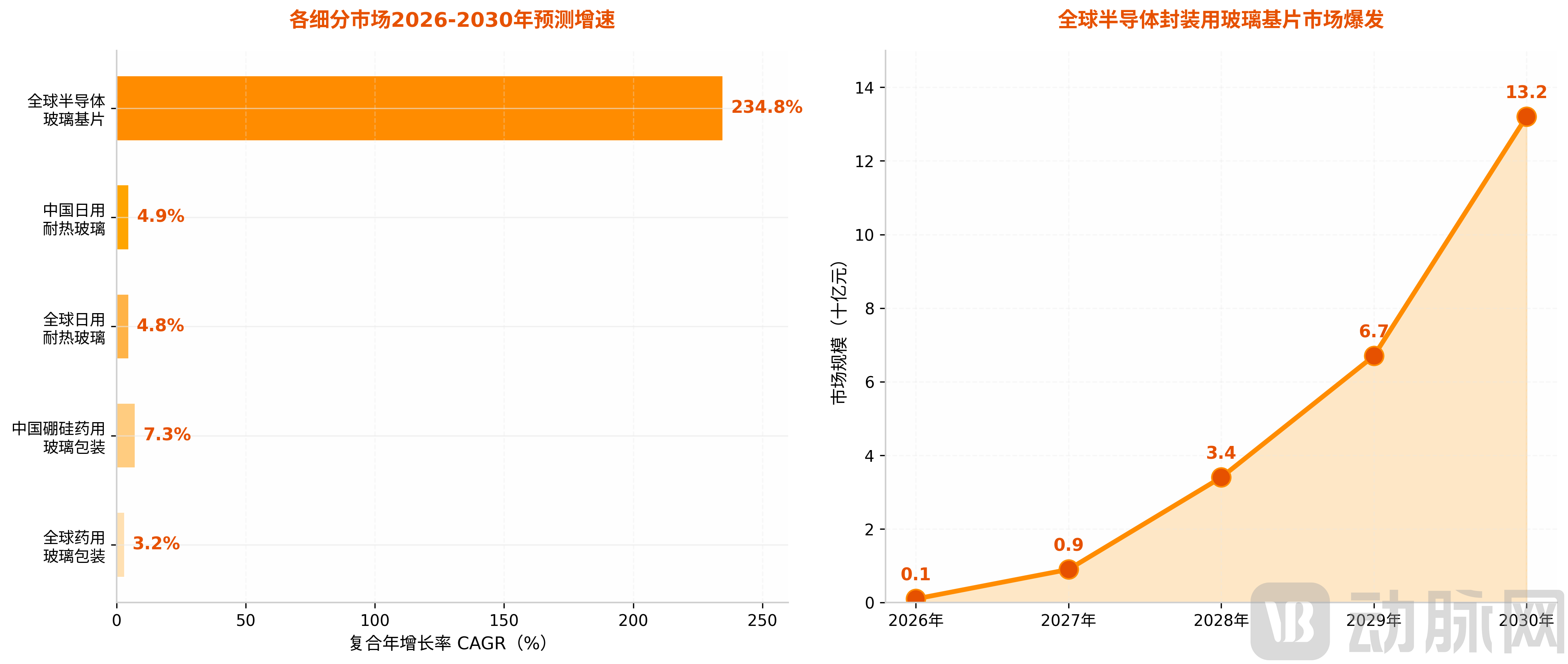
Growth Rates of Various Market Segments, Charted Based on Prospectus Data
In June 2026, the pilot kiln at Linuo Glass New Material Innovation Incubation Center was ignited, marking the commencement of initial trial production. As of the latest practicable date, samples had been provided to participants in the semiconductor packaging industry for testing. The company has developed the LN33 series of formulations and established a joint research and development center with Xiamen University.
Linuo has adopted the “shovel seller” positioning, focusing primarily on the development and production of glass substrates themselves. It currently does not engage in downstream processing steps such as Through-Glass Via (TGV) formation, shaping, metallization, or fine-line redistribution. These processes are carried out by downstream industry participants, thereby reducing technological risks.
Of course, this business is still in its early stages. There is a long way to go from sample delivery and validation to mass supply. Nevertheless, Linuo has at least secured its entry ticket into this high-growth sector.
Placing Linuo within the industry landscape reveals its position to be quite nuanced.
In the pharmaceutical glass packaging market, Linuo ranks ninth with a market share of only 2.4%. The market leader holds a 20.4% share, more than eight times that of Linuo. However, the CR5 (concentration ratio of the top five companies) in this market is just 42.7%, indicating a highly fragmented competitive landscape.
Linuo is a latecomer here, and the industry’s compound annual growth rate from 2021 to 2025 was -2.8%. Price reductions driven by centralized procurement pose a challenge across the entire industry.
In the daily-use heat-resistant glass market, Linuo ranks first in China and second globally. However, the industry’s growth rate is only 4.8%, indicating a clear ceiling. Currently, overseas revenue accounts for 32% of the company’s total revenue, primarily derived from the United States, Australia, Japan, and South Korea. Future changes in tariff policies and the implementation of the Carbon Border Adjustment Mechanism (CBAM) may exert cost pressures.
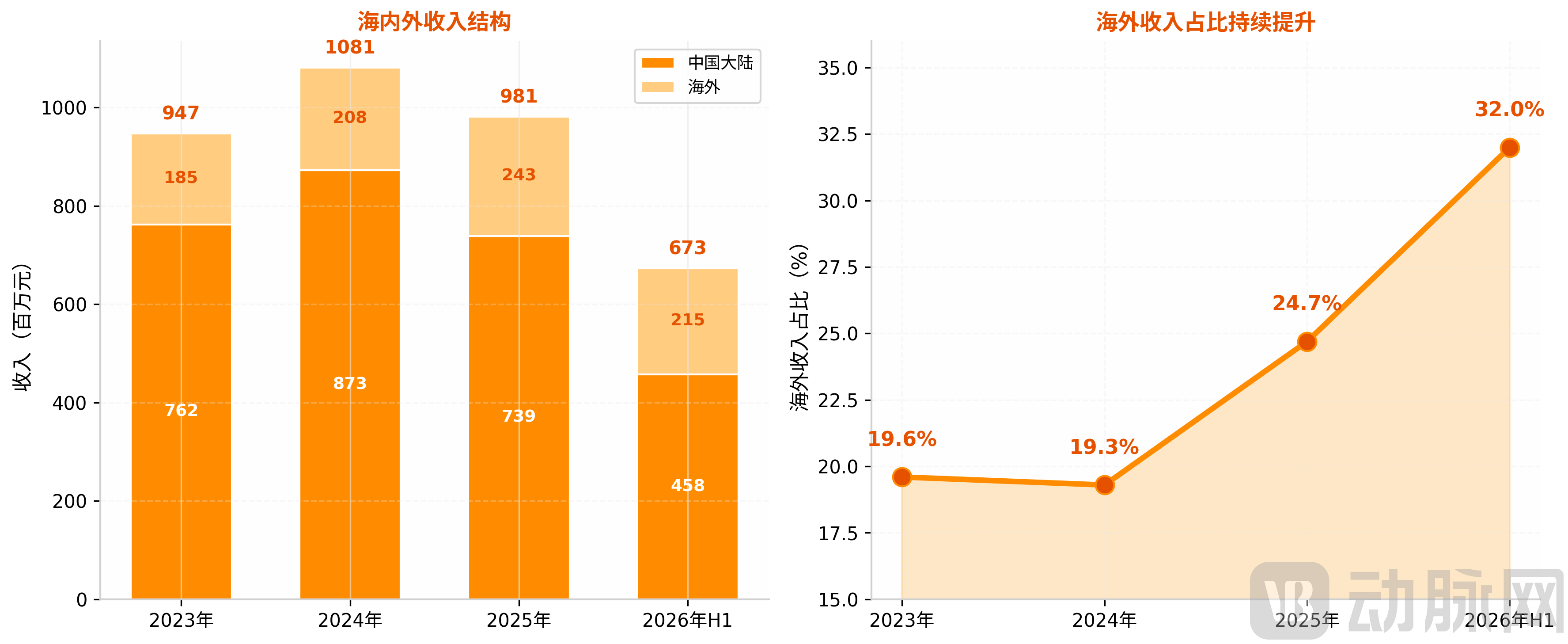
Changes in Overseas Revenue, Charted Based on Prospectus Data
Semiconductor glass substrates represent a blue ocean market, yet competition is equally intense. International giants such as Corning, AGC, and Schott have already established their presence. As a new entrant, Linuo faces challenges including lengthy customer certification cycles and slow yield ramp-up. Fortunately, the demand for domestic substitution in China’s semiconductor packaging sector has provided the company with a window of policy-driven opportunities.
Linuo’s strength lies in its end-to-end proprietary technologies spanning glass formulation, furnace design, melting processes, and forming inspection, backed by a portfolio of 156 patents.
Taking glass kilns as an example, once ignited, they must operate continuously, with energy consumption, yield rate, and stability directly determining costs. Linuo’s independently developed all-electric kiln offers advantages in energy efficiency and product consistency, with energy-related production costs accounting for 17.3% to 20.2% of total production costs—a level of cost control considered excellent within the industry.
Newcomers looking to enter the market can be deterred by the substantial investment and lengthy commissioning cycles required for kiln systems alone. In the pharmaceutical sector, products must also pass pharmacopoeia certification and undergo rigorous quality system audits by clients, with validation processes often spanning several years, making customers reluctant to switch suppliers easily. These accumulated barriers constitute the foundation of Linuo’s strong position in a fragmented market.
Of course, the industry is not a goldmine everywhere.
Upstream raw materials pose a hidden concern. Boric acid and borax together account for approximately 40% to 50% of production costs. The average import price of boric acid was around RMB 8,300 per ton in 2025, rising significantly to RMB 11,550 per ton by Q3 2026. Borax relies mainly on imports from Turkey and the United States, and geopolitical fluctuations may also impact gross profit margins.
Linuo has cultivated the niche sector of borosilicate glass for over two decades, rising to a leading position in the consumer goods market with an ordinary piece of glass, then overcoming the certification barriers of the pharmaceutical market, and now venturing into the deep waters of the semiconductor industry. Each step has been taken at key nodes of industrial upgrading, supported by technology and production capacity.
By filing for an IPO on the Hong Kong Stock Exchange, Linuo seeks to secure a more appropriate valuation for its hard-tech new materials business, specifically semiconductor glass substrates. Additionally, with overseas revenue accounting for 32% of total revenue in the first half of 2026 and products sold to approximately 60 countries and regions worldwide, the company aims to establish an international capital platform through this HKEX listing to facilitate future global expansion.