

Dropping Unprofitable Customers: 17 Listed Medical Device Enterprises Streamline Operations

HONSUN
Developer and Manufacturer of Home Medical Devices and Health Care Products

Dian Diagnostics Group
Third-Party Medical Diagnostic Service Providers
Something unusual is happening in the medical device industry: more and more companies are voluntarily giving up some of their customers.
A review of listed medical device companies' 2026 half-year reports shows that at least 17 companies mentioned optimizing their customer mix — each in its own words, but broadly falling into two categories.
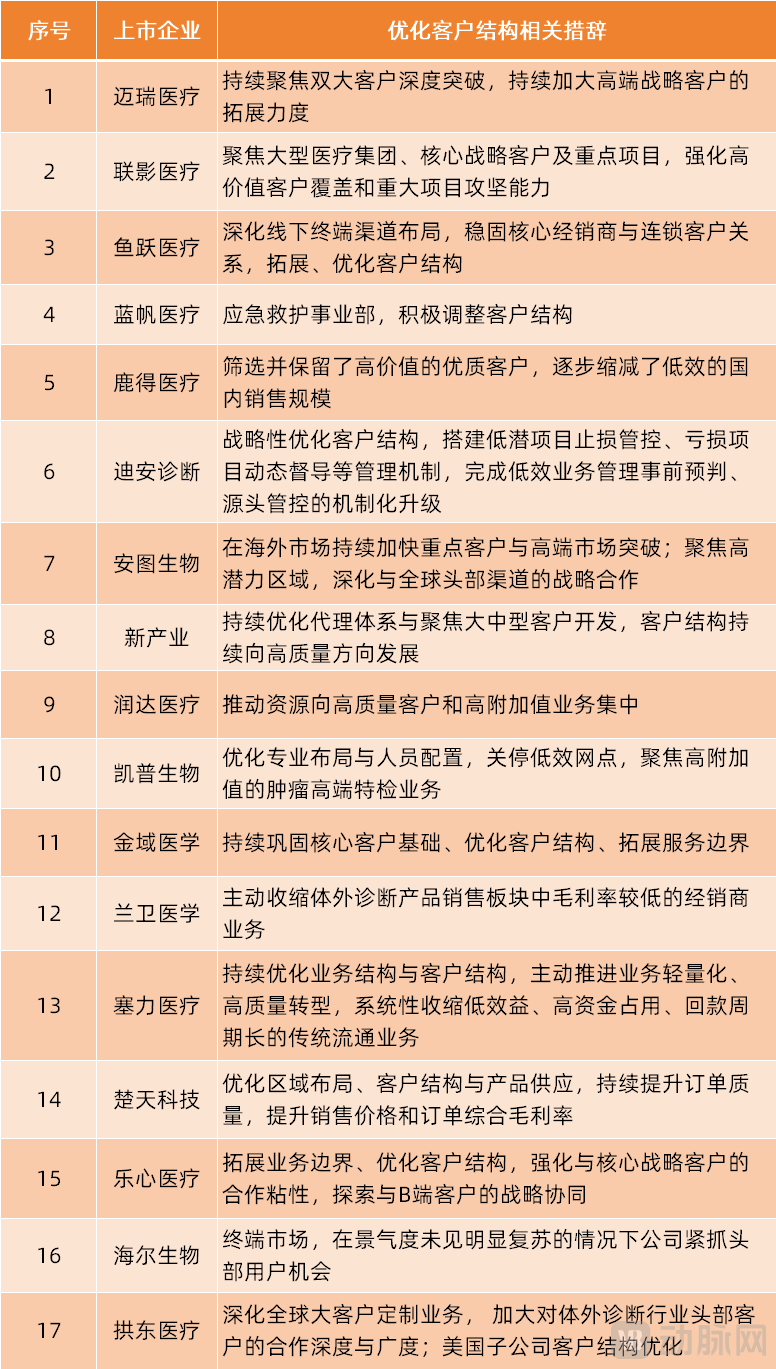
One category puts it more directly: screen for quality customers and remove low-value ones.
HONSUN screened for and retained high-value, quality customers; DIAN Diagnostics cut losses on low-potential projects, brought loss-making projects under control, and managed inefficient business lines; Hybribio shut down inefficient outlets; Labway proactively scaled back the lower-gross-margin distributor business within its IVD product sales segment; Thalys systematically scaled back traditional distribution business that was low-yield, heavily capital-consuming, and slow to collect on…
Some say outright "screen for quality customers," while others use phrases such as "scale back low-yield business," "give up low-margin orders," or "compress inefficient business." But behind every business line and every order is a customer — cutting low-margin business and abandoning low-margin orders is, in essence, abandoning low-margin customers.
The other category puts it more euphemistically: instead of "abandoning," it speaks only of "focusing."
Mindray is focusing on deep breakthroughs with its dual key accounts and stepping up expansion of high-end strategic customers; United Imaging is focusing on large medical groups, core strategic customers, and key projects; Yuwell is consolidating relationships with core distributors and chain customers; Snibe is continuing its key-account marketing strategy, focusing on developing medium and large customers; Runda Medical is concentrating resources on high-quality customers and high-value-added business; Gongdong Medical is deepening its global key-account customization business and continuing to advance customized collaboration with global IVD leaders…
The wording differs, but the direction is the same: resources are concentrating on top-tier customers, and by extension the resources devoted to developing small, low-quality customers naturally shrink.
From IVD to medical imaging, from home healthcare to pharmaceutical equipment, from third-party testing to high-value consumables, the 17 companies span multiple sub-sectors yet have made the same choice.
This is not a "winter strategy" for a handful of companies but a collective turn by the whole industry: from "grabbing customers" to "picking customers," from "competing on scale" to "competing on quality."
Exactly which customers are these companies cutting? Why cut them? And once they are cut, where does growth come from? What paradigm shift does all of this reflect?
The customers these 17 medical device companies have screened out go by different names, but by type they fall mainly into two categories: small distributors and grassroots hospitals.
Small distributors are the most-culled category. These distributors are small in scale with scattered orders; after price cuts under centralized procurement, their purchase volumes keep shrinking, and the revenue they contribute keeps falling.
The old logic was simple: medical device products carried high unit prices, and every unit sold generated ample profit. In that context, each additional distributor meant another sales channel, so the more distributors the better.
But the market has changed. End prices for medical devices have fallen sharply, leaving little margin for the distribution channel, so manufacturers no longer blindly expand channels and instead weigh the actual returns from each distributor. At the same time, channels are consolidating toward the top and large distributors' bargaining power keeps growing, while smaller distributors' purchase volumes keep shrinking and they can no longer generate returns for device makers — so they are gradually being dropped.
Take HONSUN: in the first half it progressively scaled back its inefficient domestic sales and screened for and retained high-value, quality customers, sending domestic sales revenue down 34.24% year on year while gross margin rose 1.51%.
Grassroots hospitals and financially strained medical institutions are the other key category being cleared out. The industry used to assume that nearly all hospitals were creditworthy and therefore quality customers — payment was merely a matter of time — so it was fairly tolerant of 3–9 month payment terms. In recent years, however, some institutions' payment terms have stretched to 1–3 years.
On the surface, taking on hospital customers with overly long payment terms boosts a device maker's reported revenue and profit; in reality, the company is advancing the funds, tying up cash flow. The more such customers there are, the larger the accounts receivable, and the greater the pressure on cash flow — ending in a situation where revenue keeps growing while operating cash flow shrinks.
And cash flow is often the lifeline that determines whether a company can keep operating.
Worse, some medical institutions are not only slow to pay but may be unable to pay at all. Hybribio, for example, has made collecting accounts receivable management's top priority and has even begun pursuing payment through litigation, yet its corresponding bad-debt provisions still stand at RMB 915 million; Thalys raised its bad-debt provision ratio for medical institutions markedly, from 12.98% at the start of the period to 15.82% at the end.
Beyond payment terms and cash flow, the input-output ratio matters just as much.
Whether the customer is a Grade 3A hospital or a grassroots institution, steps such as hospital access approval, tendering and bidding, compliance filing, and after-sales service and maintenance are all indispensable. That means a device maker's upfront investment in serving a single hospital is roughly similar, yet product usage varies enormously between institutions — so the returns different hospitals bring also differ greatly.
In cardiac electrophysiology, for instance, China's top cardiovascular centers such as Anzhen and Fuwai perform 4,000–5,000 EP procedures a year, whereas most grassroots hospitals, constrained by operators and cath labs, perform only a few dozen a year — many fewer than 20.
As a result, more and more medical device companies are directing more sales resources to strategic customers such as domestic Grade 3A hospitals and top overseas centers. Mindray, focusing on its dual key accounts, broke through nearly 40 international key strategic customers in the first half, while more than 60 existing international key strategic customers achieved horizontal breakthroughs; Snibe, through its key-account marketing strategy, kept expanding into large domestic medical endpoints, with large-scale instruments accounting for 85.86% of the chemiluminescence immunoassay analyzers it installed in the first half; KingMed Diagnostics strengthened the development and operation of tertiary hospitals and core customers, lifting the revenue share from tertiary hospitals to 54.37% in the first half…
Run the two sets of numbers and the conclusion is clear: small distributors take in more than they give back, grassroots hospitals carry long payment terms and high risk, and the gaps in returns are huge — so resources should be concentrated on serving strategic customers.
This is not companies suddenly getting smarter; the industry environment has changed. In the past, when the industry grew fast, companies could serve big and small customers alike — even if a small customer earned little, it still padded the scale. Growth masked most hidden problems: inefficient customers, unprofitable business, bloated organizations… As long as revenue was rising, none of it was a problem.
Now that industry growth has slowed and the pie is no longer expanding quickly, continuing to gnaw on low-quality customers amounts to "losing money just to make some noise." Companies have no choice but to shift from "winning by volume" to "winning by quality."
Still, cutting low-quality customers is not abandoning growth — it is growing in a different way.
"Cutting customers" is only the first step; "quality upgrading" is the goal.
After cutting low-quality customers, where does growth come from? The 17 companies give a highly consistent answer: customer upgrading.
From "small customers" to "large customers," from "low-end customers" to "high-end customers" — this is the industry's most mainstream and best-validated upgrade path.
Customer upgrading is not only the shift from grassroots hospitals to Grade 3A hospitals mentioned above; there are two other paths: going deeper, to develop existing customers thoroughly; and going overseas, to expand the customer base by an order of magnitude.
Going deeper centers on consistently delivering good customer service, increasing customer stickiness, and driving repeat purchases.
United Imaging, for example, offers a product matrix spanning CT, MR, ultrasound, PET/CT, and radiotherapy to meet the needs of hospitals at all levels. In the radiotherapy equipment market, its repeat purchase rate among top-tier hospital customers reached 30% in the first half, with 14 high-level clinical and research institutions making repeat purchases — 38 units in total. In the DSA market, among its more than 180 customers are more than 30 of China's top 100 hospitals; Grade 3A hospitals account for over 70% of users, and the repeat purchase rate is close to 30%.
Gongdong Medical, meanwhile, provides full-lifecycle "solutions" from R&D to production, raising customers' switching costs (they would need to redo technical adaptation and compliance validation), thereby building a moat of customer stickiness.
In addition, companies including Thalys, Truking, Transtek, and Gongdong Medical have said they will strengthen customer stickiness, upgrading from "simply selling products" to "providing customers with integrated solutions."
It follows that deeply cultivating existing customers can fully unlock their value and support long-term business growth.
Going overseas centers on building an overseas footprint, finding quality customers worldwide, and raising the customer base by an order of magnitude.
Mindray, for instance, broke through more than 140 overseas high-end IVD customers, nearly 40 high-end customers in patient monitoring and life support, and nearly 20 high-end customers in medical imaging in the first half. Driven by overseas high-end customers, Mindray's international revenue reached RMB 9.47 billion, up 18.42% year on year on a USD basis. International business accounted for 53% of the company's total revenue.
Mindray also said it will seek to break through more untapped high-end customers in the future and continue to cultivate existing ones, driving repeat purchases or purchases of its other products.
Besides Mindray, companies such as Haier Biomedical, Autobio, United Imaging, Yuwell, Gongdong Medical, and Transtek are also devoting more resources to strengthening strategic cooperation with global leading channels and quality overseas customers.
With the domestic market under pressure, overseas markets serve as both a growth engine and a risk hedge.
"Optimizing the customer mix" sounds wonderful, but not every company can pull it off. The results of the 17 companies' "subtraction" have already diverged markedly.
The most successful group cut the low end decisively and could bring the high end on board. Their traits are clear: revenue fell slightly or held flat, but profit grew substantially; the share of tertiary hospitals and high-end customers kept rising; and cash flow improved markedly.
DIAN Diagnostics is the most typical success story. Its first-half revenue fell 3.30%, but it turned profitable, with non-GAAP net profit attributable to shareholders reaching RMB 239 million. Revenue from Grade 3A hospitals rose to 52.68% of the total, and it signed 121 new Grade 3A hospitals.
DIAN Diagnostics also launched a "Precision Center" business model, partnering with Grade 3A hospitals to build in-hospital comprehensive specialty testing platforms (Precision Centers). During the reporting period it applied refined operations to existing customers and key departments, scaling up high-gross-margin testing items and improving per-center output and profit quality.
By the end of June, it had built 117 Precision Centers in total, 85 of which were profitable, with business revenue up 47% year on year.
Under the customer-mix adjustment, its credit impairment losses fell 89.60%, accounts receivable bad-debt provisions contracted sharply, and operating cash flow improved significantly.
KingMed Diagnostics was equally impressive. In the first half its revenue fell 3.76% year on year while net profit attributable to shareholders surged 324.27%, moving from "stopping the bleeding" into a quality-driven recovery cycle. Its customer mix continued to shift toward high-value endpoints, with tertiary hospitals contributing 54.37% of revenue, up 3.19 percentage points year on year; it has more than 800 co-built laboratories, including nearly 110 precision medicine centers in tertiary hospitals.
Truking began giving up low-margin orders in 2025, lifting its overall gross margin by 6.29 percentage points to 32.23%. In the first half of 2026 it continued to improve order quality, raising sales prices and the overall gross margin on orders, and will build tiered, dedicated service systems for leading pharma companies, innovative biotech companies, and customers in distinctive niche tracks, making deep dives into full-lifecycle customer needs a routine practice.
What these companies share: they cut low-end customers while quickly replacing them with high-end ones — even more than they cut. The result: revenue may come under short-term pressure, but profit, cash flow, and customer quality all improve.
Another group is still in the painful transition period: the subtraction is done, but high-end customers are still being developed. Their traits: revenue fell sharply, profit is still under pressure, but the customer mix is improving. The core issue is that how fast high-end customers can be developed determines how long the pain lasts.
Thalys, for example, optimized its customer mix in the first half, cutting revenue 41% year on year, while its non-GAAP loss narrowed 32.7% year on year. In other words, it is still losing money — just less.
Among the companies adjusting their customer mix, Thalys made the most aggressive moves: proactively divesting a group of subsidiaries that handled traditional distribution business and concentrating resources on its core SPD business. Financially, the direction is right, but the transformation burden is heavy and it remains in the painful period.
HONSUN is also in the transition period. It progressively scaled back inefficient domestic sales, cutting first-half domestic revenue 34.24%. But its overseas revenue grew 25.38% year on year, and overall revenue rose 10.90% year on year.
Unlike Thalys, HONSUN is optimizing its domestic customer mix while its overseas business provides a buffer.
The most uncomfortable are the "middle group": unable to keep the low end, unable to crack the high end.
Their traits: they want to cut low-end customers but cannot win high-end ones, so they are stuck in the middle, pleasing neither side.
Their predicament is very real: products are not strong enough to get into Grade 3A hospitals; channel strength is too weak to open overseas markets; and financial resources are not enough to survive until the transformation succeeds.
This is the situation for most small and medium-sized enterprises in the industry: "reducing volume" is easy, "improving quality" is hard.
The 17 companies' "customer mix optimization" is not 17 isolated business stories but a microcosm of an industry-wide paradigm shift.
For the past two decades the medical device industry's theme was "growth" — revenue growth, customer growth, channel growth, headcount growth. "Getting bigger" was right; the more customers the better, the bigger the scale the stronger the company.
But now the tide of growth has receded. Running the numbers, companies find that small distributors don't make money, grassroots hospitals don't pay it back, and the returns from large versus small customers differ enormously — so low-quality customers are better cut than kept.
From grabbing customers to picking customers, from competing on scale to competing on profit — this turn is painful but necessary. The medical device industry of the future will no longer reward "the biggest" but "the best."
Still, the market should see clearly: for leading companies, subtraction is emptying the cage for new birds; for SMEs, subtraction may be forced contraction.
Leaders have product strength, brand strength, and service capability; after cutting low-end customers they can quickly upgrade to high-end ones. SMEs may simply lose low-end customers passively while failing to win high-end ones — the result being shrinking scale.
Industry divergence will become ever sharper: the top harvests high-end customers, the middle tier struggles to survive, and the tail is cleared out faster.
This is nothing new — almost every industry goes through it when moving from an era of expansion to one of competing for an existing market. Medical devices have simply reached that inflection point.
Optimizing the customer mix is only the first step; the real test lies ahead: whether high-end customers can be held, whether new products can scale, and whether overseas markets can be opened up.
That is the second-half exam question every medical device company must face.