

“Cadaver Skin Needling” Stirs the Medical Aesthetics Industry, as the Underlying Biomaterials Gain Massive Popularity in China!

L & C Bio
Tissue Regeneration Medicine Product R&D and Manufacturer
Priced at thousands of yuan per injection, with raw materials sourced from human skin tissue donated by the deceased, a South Korean product named Re2O has recently sparked significant controversy in China.
This product, developed by the South Korean regenerative medicine company L&C Bio, is created by decellularizing human dermal tissue to retain its extracellular matrix (ECM), which is then micronized into an injectable material.
The public has coined a striking name for it: "Cadaver Skin Injection." Despite users sharing experiences of skin brightening and tightening after injection, public controversy has not subsided, with the focus squarely on the ethical and safety issues behind using deceased human tissue in consumer medical aesthetics.
The intense debate surrounding “cadaver skin needles” has also brought ECM materials, at the center of the controversy, into the public spotlight. While ECM remains relatively unfamiliar to ordinary consumers, it has already sparked a boom on the industry side: in China, related companies have intensively completed financing rounds, leading players in medical aesthetics and pharmaceuticals have heavily invested to enter the market, and multiple differentiated technological pathways have been implemented.
Historically, new medical aesthetics technologies from South Korea have often served as benchmarks for the domestic market. So, what is the current state of development in China’s ECM sector? Will controversial products emerge?
ECM, or Extracellular Matrix, is widely present in the tissues and organs of multicellular organisms. It is a complex network located outside cells, composed of various macromolecules. Primarily consisting of collagen, elastin, glycoproteins, proteoglycans, and glycosaminoglycans, it provides structural support to cells and tissues while participating in processes such as cell adhesion, migration, proliferation, differentiation, and tissue repair.
ECM materials, following decellularization and removal of immunogenic components, maximally preserve the inherent three-dimensional structure, mechanical properties, and bioactive factors of the ECM, demonstrating promising application prospects in the fields of tissue remodeling, injury repair, and functional tissue reconstruction.
Previously, ECM materials have been applied in tissue repair across fields such as dermatology, gynecology, stomatology, ophthalmology, and neurosurgery, with multiple medical devices approved for market launch in China.
Among them, a small portion of products are derived from skin donated by human cadavers, used for the replacement and repair of dermal defects in humans. The clinical application of such products is concentrated in treatment scenarios such as the repair of body surface defects and deformities, particularly for burn care. Regulatory authorities have specifically stipulated that the scope of application “excludes facial wrinkle removal.”
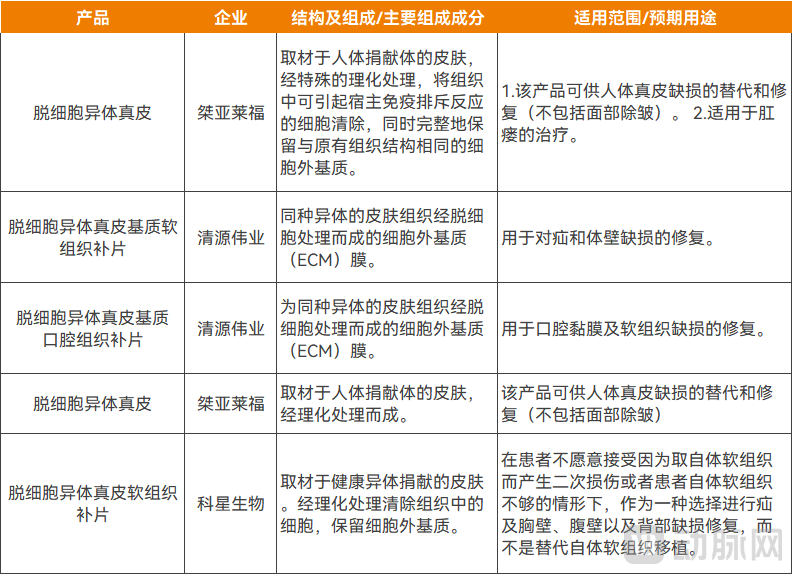
ECM Products Derived from Allogeneic Skin, Source: National Medical Products Administration
As academic research into the structure of the extracellular matrix (ECM), the cellular microenvironment, and tissue repair mechanisms has deepened, the ECM was designated as the thirteenth hallmark of aging in 2025. Meanwhile, ECM materials have evolved morphologically from sheet-like forms to microparticulate states, thereby becoming suitable for injection. Therefore, The application boundaries of ECM materials are rapidly extending into the medical aesthetics sector.
The application prospects have further expanded, attracting significant attention from capital and industry.
Over the past two years, multiple companies—including Shengzhi Runhe, Medgen Life Sciences, Sanyan Bio, and Baiyiyuan Biotechnology—have successively completed financing rounds. These funds have supported activities ranging from technology platform development and product R&D to clinical registration advancement, manufacturing base construction, and the establishment of scaled-up production capacity, thereby propelling extracellular matrix (ECM) materials from a cutting-edge conceptual novelty toward commercialized products.
As 2026 progresses, industry momentum continues to build. In September alone, two companies announced financing rounds within two consecutive days: On September 16, CELLEAF secured a new round of financing amounting to tens of millions of yuan, aimed at accelerating the clinical translation and industrialization of ECM-based endogenous regenerative devices for skin and soft tissue repair; on September 17, MAYBIO completed its Series B financing of tens of millions of yuan, with plans to expand human-derived ECM production capacity, enhance its product portfolio, and expedite the clinical translation of its ECM products.
Amid intensifying competition among products such as hyaluronic acid and collagen, many leading medical aesthetics companies have also prioritized extracellular matrix (ECM) as a key focus area in their development of next-generation anti-aging and dermal filler materials.
Bloomage Biotechnology has continued to deepen its ECM strategy in recent years. The latest 2026 semi-annual report reveals that the company’s self-developed humanized biomimetic ECM, a Class III medical device, has entered the pilot-scale amplification stage.
In July 2026, Imeik invested in Huaxia Biologics, becoming its second-largest shareholder with a 15.64% equity stake and securing the exclusive distribution rights for Huaxia Biologics’ ECM-related products in the Greater China region.
In September, Huadong Medicine announced that its wholly-owned subsidiary, Xinkeli Aesthetics, had signed an agreement with MAYBIO to establish an exclusive strategic partnership for the ECM collagen product MB007 in the Chinese market.
Clearly, Regardless of the public attention sparked by South Korea's Re2O, ECM materials have already ignited a concentrated industrial boom in China.
In China, ECM materials used in medical aesthetics primarily follow three technical routes based on their source: natural human-derived ECM, animal-derived ECM, and cell-engineered humanized ECM.
Natural human-derived ECM is sourced from native human tissues. In terms of tissue characteristics, it represents an ideal source for implantable materials, capable of reducing the risk of xenogeneic disease transmission.
However, it should be emphasized that, If donated human tissues are processed for use in aesthetic medicine injections, it will inevitably trigger multiple ethical controversies.
On one hand, whether consumers can be fully informed and psychologically accept such practices is a practical issue. On the other hand, the original intention of body donors and their families is mostly to save lives or promote medical research. Once families learn that donated tissues are used for consumer-oriented projects, emotional conflicts are likely to arise. In terms of priority of needs, human tissue resources from donations are inherently scarce. The relative importance of saving lives versus anti-aging and aesthetic enhancement is self-evident.
According to information obtained by VCBeat, Domestic natural human-derived ECM for medical aesthetics injection R&D has not seen cases using donated human skin as raw material, with its raw materials mainly coming from amniotic membrane, fat, and other human tissues.
Information disclosed by Imeik indicates that its investee, Huaxia Biotech, has developed an injectable decellularized amniotic matrix product indicated for infraorbital depression. CELLEAF has established a pipeline of human-derived decellularized adipose matrix products, covering indications such as acne-related atrophic scars, infraorbital depression, large-volume soft tissue defects, and skin rejuvenation. Additionally, Salifi has built China’s first large-scale, clinical-grade human adipose tissue resource bank.
Animal-derived ECM, which uses animal tissues as raw materials, represents the most concentrated strategic focus within China’s current industrial landscape.
Wang Chengzhen, Deputy General Manager of Healtech, introduced that common animal-derived raw materials include porcine small intestine, porcine skin, bovine hide, bovine pericardium, animal bladder, and omentum. In the research and development of injectable medical aesthetic products, porcine skin is more frequently utilized. As a CDMO platform, Healtech has accumulated a portfolio of patented technologies related to various extracellular matrix (ECM) materials for its R&D and manufacturing operations.
Furthermore, Baiyiyuan Biology has established an ECM material technology platform and product matrix, leveraging porcine small intestinal submucosa extracellular matrix (SIS-ECM) as its entry point.
Engineered human-derived ECM is not obtained directly from human tissue specimens; instead, it relies on in vitro cell culture followed by post-processing to yield ECM materials.
For example, leveraging its human induced pluripotent stem cell (CiPSC) technology derived from chemical reprogramming for in vitro expression, MAYBIO has established a tissue-specific biomimetic extracellular matrix biosynthesis platform, enabling the standardized and large-scale production of ECM closely resembling native human ECM.
HUAMEI BIOTEH utilizes 3D printing to fabricate organoids from engineered cells and biomaterials, simulating the human internal microenvironment to create a “cellular super-factory” that continuously secretes high-activity raw materials, thereby producing engineered human-derived ECM.
Each of the three routes has its own prominent value, but also faces its own realistic bottlenecks.
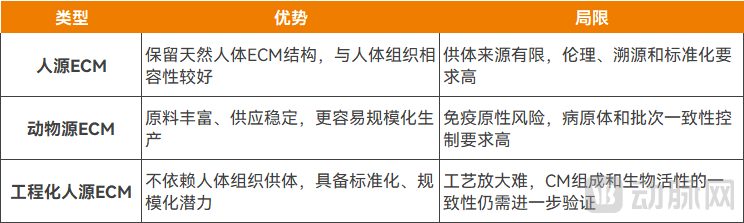
Advantages and Limitations of Different Technological Approaches for ECM Materials; Source: Interviews, Literature
The core advantages of natural human-derived ECM are its excellent biocompatibility and low risk of xenogeneic pathogen transmission, while its primary challenges lie in the instability of raw material supply and ethical constraints.
“Previously affected by the allogeneic bone incident related to the corpse trafficking case, regulatory authorities have further tightened the supervision and product approval of allogeneic materials.” Wang Chengzhen stated that although raw materials such as amniotic membrane and adipose tissue are not derived from corpses and are considered medical waste in a certain sense, their collection still requires obtaining informed consent from patients and passing ethical review.
The prominent advantage of animal-derived ECM lies in China’s robust livestock industry foundation, which facilitates easy access to raw materials, controllable costs, and scalable supply; the primary challenges, however, are safety risks related to viral transmission and immunogenicity.
“The greatest risk associated with animal-derived materials is immune rejection, with industry R&D efforts primarily focused on reducing the immunogenicity of these materials,” said Wang Chengzhen.
The advantage of engineered human-derived ECM lies in its potential for standardized biomanufacturing, thereby circumventing the supply constraints and ethical controversies associated with natural human-derived materials, while avoiding the safety risks inherent to animal-derived materials. However, this approach also faces bottlenecks in industrial scale-up: significant process development and product validation are required to determine whether small-scale cell culture can be smoothly transitioned to mass production, and whether the structure, composition, and bioactivity of the ECM remain stable after scale-up.
Overall, the landscape of ECM materials for medical aesthetics in China is characterized by diversified sources. Material preparation is merely the first step; subsequent thorough validation of safety and efficacy in vivo is required, and the materials can only be put into clinical use after obtaining medical device registration.
Currently, domestic companies are advancing the R&D of aesthetic injection products centered on ECM materials.
Among them, Baiyiyuan Biologics’ products have entered the registration application stage; products from MAYBIO, Shengzhi Runhe, and CELLEAF are in clinical trials; while Bloomage Biotech is advancing pilot-scale production and registration testing. Recently, a collagen implant developed by Shengzhi Runhe in collaboration with Dikang Pharmaceutical, a subsidiary of Healtech, received approval, with its raw material being extracellular matrix collagen.
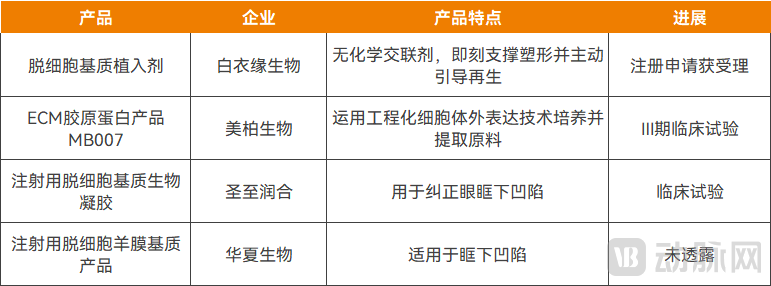
Selected ECM-based Aesthetic Injection Products Under Development in China, Source: Public Corporate Information
Previously, regulatory authorities established a basic classification for ECM-based injectables in medical aesthetics: In 2025, the National Medical Products Administration (NMPA) added "medical micronized acellular dermal matrix" to its medical device classification framework, explicitly stipulating that such products intended for aesthetic injections are to be regulated as Class III medical devices.
The above classification delineation shows:
“However, there are currently no specific review guidelines for ECM products used in medical aesthetic injections.” Wang Chengzhen stated that when companies conduct clinical trials and submit registration applications, many review details still require ongoing communication and confirmation with regulatory authorities.
Although ECM products have been applied in serious medical scenarios for many years and the relevant review framework has been established, aesthetic injectable ECM still faces numerous hurdles from material development to product approval and market launch.
First, the injection method necessitates more extensive research on material properties.
Previously approved serious medical ECM products are mostly in the form of patches, covering wounds or tissue defects to assist in tissue repair. Medical aesthetic injections are directly injected into the mid-to-deep dermis or subcutaneous tissue, where the material needs to remain locally within the body to provide support and induce tissue remodeling.
Wang Chengzhen stated that different application scenarios impose significantly different requirements on material properties; therefore, extensive targeted research on material performance is required for medical aesthetic injection applications.
Secondly, the sources of safety risks are more complex, necessitating a correlation analysis.
“At present, the most common adverse events observed in the industry are immune-related reactions, manifesting as allergies,” stated Wang Chengzhen. When adverse events occur during clinical trials, it is essential to thoroughly evaluate whether a causal relationship exists between the event and the material.
Meanwhile, the safety of ECM is influenced by various factors, including material source, decellularization process, residual substances, and the degree of matrix structure preservation. Any variation in these steps may alter the product’s immunogenicity and tissue response in vivo.
Furthermore, the reusable nature of these devices necessitates more long-term validation for medical aesthetic injections.
“ECM products in wound repair scenarios are mostly for single use, whereas medical aesthetic injections typically involve course-based treatments, with consumers potentially receiving multiple injections over months or even years. ‘Therefore, given the characteristics of repeated injections, ECM products for medical aesthetics require more extensive long-term validation.’”
During this process, companies need to verify more issues, such as whether repeated injections will lead to cumulative immune or tissue responses. How is the safety interval defined? What is the upper limit for the reasonable frequency of product use? These all require long-term follow-up data support.
The “cadaver skin injection” incident in South Korea has sounded an alarm for China’s extracellular matrix (ECM) sector. It is understood that Re2O follows the South Korean regulatory framework for human-derived tissues, governed by the Act on the Safety and Management of Human Tissues, and has not conducted product-level clinical trials.
China is currently in a phase of technological exploration and regulatory alignment. Regardless of the technical pathway chosen (even for ECM materials not derived from human tissues), companies must not blindly pursue commercialization speed; they must successfully navigate each mandatory compliance hurdle, including clinical trials and registration submissions.
Strict control over raw material traceability and process quality control, along with the rigorous completion of comprehensive validation for safety and efficacy, is not only a necessary prerequisite to avoid similar public opinion controversies but also the core of safeguarding product quality. Only by balancing technological innovation, regulatory compliance, and ethical constraints can the true value of ECM materials be unlocked, enabling the industry to achieve sustained growth.