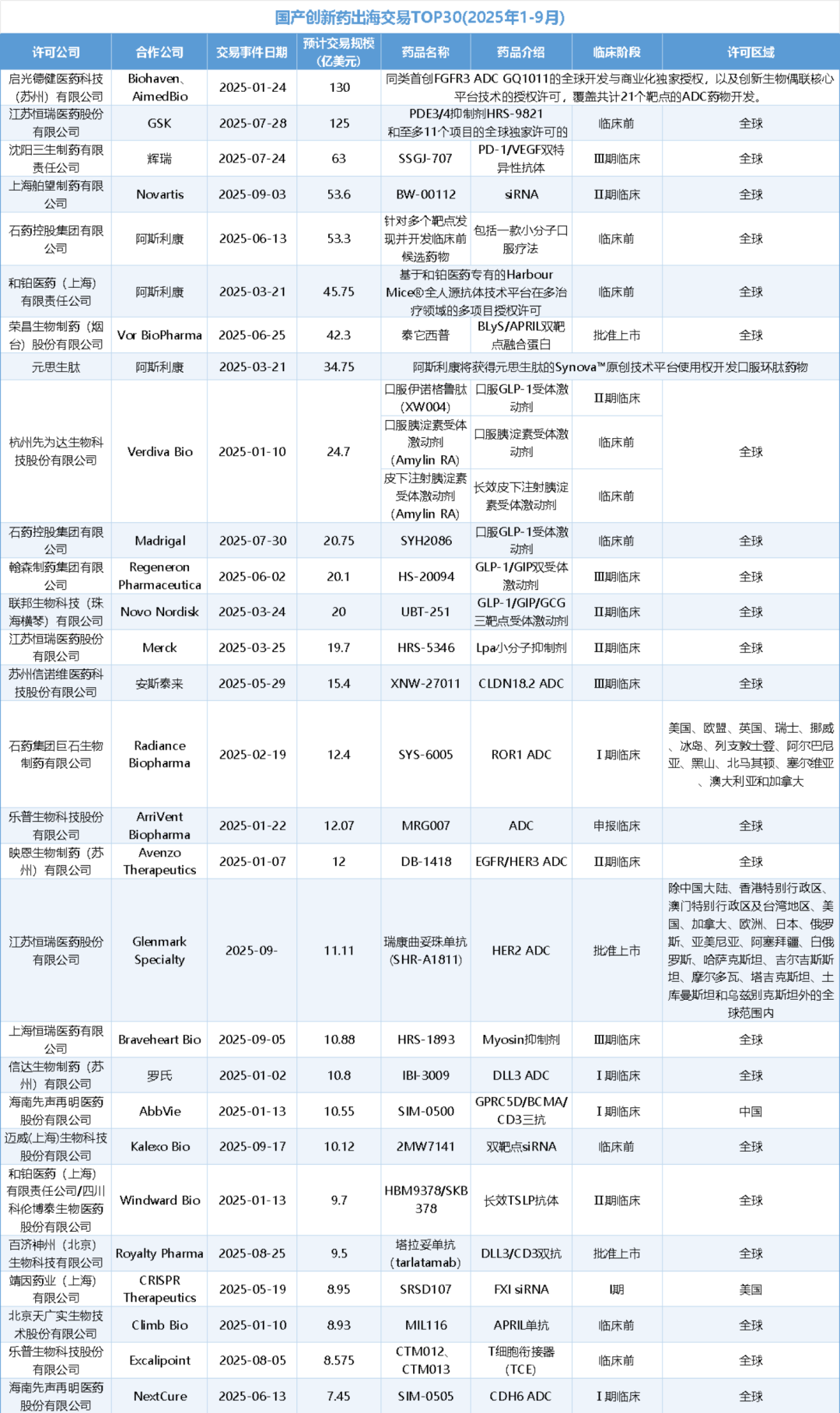
In 2025, China's innovative drug industry achieved remarkable results in global expansion, with the total value of outbound licensing agreements reaching $63.5 billion in the first half of the year, surpassing the total for all of 2024 and accounting for approximately 40% of the global total. Companies expanding overseas include leading firms such as Hengrui Pharma and emerging biopharmaceutical companies, adopting diverse models including License-out agreements. The types of drugs going overseas are varied, covering several cutting-edge fields such as ADCs. Below is a table summarizing the top 30 outbound transactions of domestically produced innovative drugs from January to September 2025:
$13 Billion: Qide Medical Technology(Suzhou)Co., Ltd. & Biohaven, AimedBio
2025On January 24, Qide Medical Technology (Suzhou) Co., Ltd. held a significant business cooperation signing ceremony at its R&D headquarters in Suzhou. The agreement involves collaborating with Biohaven and AimedBio to develop the FGFR3 ADC drug GQ1017 (GQ1011) and licensing its innovative bioconjugation core technology platform, empowering partners to innovate ADC drugs for a total of 21 targets. The total transaction amount exceeds 13 billion US dollars.The specific cooperation situation is as follows:
- Qide Medical Technology(Suzhou)Co., Ltd. and AimedBio have reached a multi-target innovative ADC drug development cooperation agreement for the licensing of a conjugation platform technology. The two parties previously established a new model of international cooperative innovation in the development of a first-in-class ADC drug targeting FGFR3. This collaboration represents AimedBio's effort to leverage Qide Medical Technology’s core expertise across more innovative targets and disease areas, further expanding the scope of their partnership.
- Qide Medical Technology(Suzhou)Co., Ltd. and Biohaven have signed two strategic cooperation agreements. According to the first agreement, Biohaven will obtain the global development and commercialization rights for the first-in-class ADC drug targeting FGFR3 jointly developed by Qide Medical Technology and AimedBio. The second agreement, through the licensing of Qide's core conjugation technology, will empower Biohaven and its partner Merus to develop innovative ADC drugs for 18 specific targets over the next five years.
$12.5 Billion: Hengrui Pharma & GSK
On July 28, Jiangsu Hengrui Pharmaceuticals Co., Ltd. announced that it had reached an agreement with GSK to grant GSK the global exclusive rights (excluding mainland China, the Hong Kong Special Administrative Region, the Macao Special Administrative Region, and Taiwan) for the HRS-9821 project, as well as the exclusive option for global exclusive licenses of up to 11 projects (excluding mainland China, the Hong Kong Special Administrative Region, the Macao Special Administrative Region, and Taiwan) on a paid basis. GSK will pay Hengrui Pharma an upfront payment of 500 million US dollars for this. If all projects are exercised and all milestones are achieved, Hengrui Pharma will be eligible to receive potential total milestone payments of approximately 12 billion US dollars based on successful development, registration, and sales in the future. Meanwhile, Hengrui Pharma will have the right to collect corresponding tiered sales royalties from GSK (excluding mainland China, Hong Kong Special Administrative Region, Macao Special Administrative Region, and Taiwan region).HRS-9821 is a potential best-in-class PDE3/4 inhibitor currently in clinical development for the treatment of chronic obstructive pulmonary disease (COPD) as an add-on maintenance therapy, regardless of prior treatment regimens. In addition to HRS-9821, the agreement includes the co-development of up to 11 projects covering multiple therapeutic areas such as oncology, respiratory, autoimmune, and inflammation, all of which are in the preclinical research stage. Each project has its own financial structure. Hengrui Pharma will lead the R&D of these projects, until the completion of Phase I clinical trials, including data from overseas participants at the latest. GSK will have the exclusive option to further develop and commercialize each project globally (excluding mainland China, Hong Kong SAR, Macao SAR, and Taiwan region) by the time Phase I clinical trials are completed at the latest, along with certain project substitution rights.
$6.3 Billion: 3SBio & Pfizer
On May 20, 3SBio announced that it had entered into a licensing agreement with Pfizer for the PD-1/VEGF bispecific antibody SSGJ-707. Pfizer will obtain exclusive global development and commercialization rights for the product (excluding mainland China). 3SBio will receive an upfront payment of $1.25 billion and potential payments of up to $4.8 billion, including development, regulatory approval, and sales milestone payments, as well as royalties in the double-digit percentage range.On July 24, both parties agreed,3SBioOn the basis of receiving a $1.25 billion upfront payment, an additional $150 million will be obtained to further grant Pfizer exclusive rights to develop and commercialize SSGJ-707 in mainland China. Meanwhile, Pfizer will subscribe to $100 million worth of ordinary shares of 3SBio.SSGJ-707 is3SBio's subsidiary 3SBio-GuojianAn innovative PD-1/VEGF bispecific antibody drug independently developed based on its proprietary CLF2 platform. It targets PD-L1 positive, locally advanced or metastatic non-small cell lung cancer (NSThe phase III clinical study for the first-line treatment of CLC has been approved by the Center for Drug Evaluation (CDE) of the National Medical Products Administration (NMPA) for initiation, in conjunction with Pa.Baliruzumab as monotherapy or in combination with chemotherapy for head-to-head comparison. Meanwhile, the product has also received the approval of the U.S. FDA's Investigational New Drug (IND) application.$5.36 Billion: Bowang Pharma & Novartis
On September 3, Bowang Pharmaceutical announced a new strategic cooperation agreement with Novartis to jointly develop multiple cardiovascular products. Previously, the two parties had reached a cooperation, and this newly reached agreement is a further expansion based on the existing cooperation.The new cooperation agreement includes:Bowang Pharma Grants Novartis Options for Rights Outside China to Two Early-Stage Molecules for the Treatment of Severe Hypertriglyceridemia (sHTG) and Mixed Dyslipidemia, as well as Preferential Negotiation Rights for the BW-00112 (ANGPTL3) Product. This product is currently in Phase II clinical trials in the United States and China, with Bowang Pharma leading subsequent clinical trials for combination therapies.For another siRNA candidate drug in the preclinical research stage, Bowang Pharma has granted Novartis an exclusive license outside of China, with a reciprocal option to share profits and losses (P&L) in the United States and China. This product is expected to initiate Phase I clinical trials in 2026.Bowang Pharma will receive an upfront payment of $160 million and is eligible for potential milestone and option payments, as well as tiered royalties on commercial sales, with a total potential milestone value of up to $5.2 billion. Additionally, Novartis has expressed preliminary interest in participating in Bowang Pharma's next round of equity financing. The specific details of its participation (including investment amount and timing) are still subject to routine due diligence and will be determined through negotiations and the signing of a formal agreement by both parties.$5.33 Billion: CSPC Pharmaceutical Group & AstraZeneca
On June 13, AstraZeneca and CSPC Pharmaceutical Group reached a strategic research collaboration. The two parties will discover and develop preclinical candidate drugs targeting multiple pathways, which are expected to treat chronic diseases, including a preclinical small-molecule oral therapy for immune disorders.According to the agreement,CSPC will receive an upfront payment of $110 million and is eligible for up to $1.62 billion in potential development milestone payments as well as up to $3.6 billion in sales milestone payments.In addition, there are potential single-digit royalty payments based on the product's annual net sales. AstraZeneca will have the right to opt for an exclusive license to develop and commercialize the candidate drugs identified through this agreement on a global scale.The study will be conducted by CSPC Pharmaceutical Group in Shijiazhuang City, utilizing its AI-driven dual-engine efficient drug discovery platform. The platform uses artificial intelligence technology to analyze the binding patterns of target proteins with existing compound molecules and carries out targeted optimization, aiming to screen out highly effective small molecules with good developability.$4.575 Billion: Harbour BioMed & AstraZeneca
On March 21, 2025, Harbour BioMed announced a global strategic collaboration with AstraZeneca to jointly develop next-generation multispecific antibody therapies targeting immunological diseases, cancer, and various other conditions.Under the agreement, AstraZeneca has obtained the option for licensed rights to two preclinical immunology programs and will nominate additional targets for Harbour BioMed to develop next-generation multispecific antibody therapies. AstraZeneca can exercise the option to advance these programs into the clinical development stage, with potential future expansion to include more project collaborations.Harbour Pharma will obtainTotal upfront payment of $175 million, recent milestone payments and additional option exercise fees for new projects, as well as up to$4.4 billionDevelopment and commercial milestone payments, plus a certain percentage of sales royalties. Both parties may choose to include more projects in the cooperation scope within the next five years, and the agreement term can be extended for another five years upon mutual consent.The total amount of the agreement is as high as 4.575 billion US dollars.$4.23 Billion: Rongchang Bio & Vor Bio
On June 25, Rongchang Bio announced that it had granted a paid license for its proprietary drug, Telitacicept, to Vor Biopharma, a company listed on NASDAQ in the United States. Vor Bio will obtain exclusive rights to develop, manufacture, and commercialize Telitacicept globally, excluding Greater China.According to the agreement, Rongchang Bio will acquire the value of Vor Bio.$125 Million in Cash and Warrants(including a $45 million upfront paymentAnd warrants worth 80 million US dollars, the warrants can subscribe for 320 million ordinary shares of Vor Bio at $0.0001 per share, representing approximately 23% of Vor Bio's enlarged total issued share capital), and milestone payments of up to $4.105 billion,Total Amount of USD 4.23 BillionIn addition, Rongchang Bio will receive high single-digit to double-digit sales royalties.Telitacicept is a novel fusion protein product independently developed by RemeGen, which is the world's first and first-in-class injectable recombinant dual-targeting product for B lymphocyte stimulator (BLyS) and a proliferation-inducing ligand (APRIL). It can simultaneously inhibit the binding of two cytokines, BLyS and APRIL, to their receptors on the surface of B cells, preventing the abnormal differentiation and maturation of B cells, thereby treating autoimmune diseases. Currently, Telitacicept has been approved for marketing in China for three indications: myasthenia gravis, systemic lupus erythematosus, and rheumatoid arthritis. Its commercialization maintains rapid growth, with sales exceeding 1.5 million vials in 2024. The global multicenter Phase III clinical trial for Telitacicept in myasthenia gravis is proceeding smoothly. This indication has received Fast Track designation and Orphan Drug designation from the U.S. Food and Drug Administration (FDA), as well as Orphan Drug designation from the European Union.$3.475 Billion: Yuansi Shengtai & AstraZeneca
On March 21, Syneron Bio, an innovative oral macrocyclic peptide drug development company, announced a strategic partnership with AstraZeneca to jointly develop first-in-class macrocyclic peptide drugs for chronic diseases. According to the agreement, AstraZeneca will gain access to Syneron Bio's proprietary Synova™ technology platform. This intelligent high-throughput macrocyclic peptide drug discovery platform will help advance the development of innovative drugs targeting rare diseases, autoimmune disorders, and metabolic diseases.Under the terms of the agreement, AstraZeneca will pay a $75 million upfront payment and near-term milestone payments, up to a total of $3.4 billion in development and commercialization milestone payments, along with tiered royalties based on global sales. Additionally, AstraZeneca will make an equity investment in YuSi Biopeptide. YuSi Biopeptide plans to expand its Beijing R&D center through this collaboration.It is reported that Yuan Si Biopeptide was formerly known as Chengyuan Technology. Its investors include Hillhouse Ventures, Lilly Asia Ventures, 5Y Capital, Innovation Works, Legend Capital, and Gree Industrial Investment, among others.$2.47 Billion: Xianweida Bio & Verdiva Bio
On January 10, Xianweida Bio announced that it had reached a global development and commercialization licensing and cooperation agreement with Verdiva Bio, excluding Greater China and South Korea.The product portfolio of this collaboration includes:- Oral Ecnoglutide (Ecnoglutide Oral, XW004): A once-weekly oral GLP-1 receptor agonist currently in preparation for Phase 2 clinical trials.
- Oral Amylin Receptor Agonist (Amylin RA): A once-weekly oral amylin receptor agonist in the preclinical stage, which can be used as monotherapy or in combination with a GLP-1 receptor agonist.
- Subcutaneous Injection of Amylin Receptor Agonist (Amylin RA): A long-acting subcutaneous injection of amylin receptor agonist in the preclinical stage, which can be used as monotherapy or in combination with GLP-1 receptor agonists.
According to the cooperation agreement, Synvada Bio will grant Verdiva exclusive rights to develop, manufacture, and commercialize the aforementioned product portfolio globally, excluding Greater China and South Korea. Synvada Bio will retain the rights to development, manufacturing, and commercialization in regions outside the agreement area. Synvada Bio will receive an upfront payment of nearly 70 million US dollars and is entitled to potential development, registration, and commercialization milestone payments for the products up to 2.4 billion US dollars, as well as tiered sales royalties after product commercialization. The two companies will also collaborate on other preclinical stage projects, and Synvada Bio is entitled to corresponding milestone revenues and sales royalties.$2.075 Billion: CSPC & Madrigal
On July 30, 2025, Madrigal Pharmaceuticals announced that it had entered into an exclusive global licensing agreement with CSPC Pharmaceutical Group for the preclinical oral small molecule glucagon-like peptide-1 (GLP-1) receptor agonist (orforglipron derivative) SYH2086, with a total transaction value of $2.075 billion. Madrigal plans to initiate clinical development in the first half of 2026. The licensing agreement supports Madrigal's pipeline strategy to develop innovative combination therapies for MASH based on its foundational therapy Rezafra™ (resmetirom). Under the agreement, CSPC Pharmaceutical Group has granted Madrigal exclusive global rights to develop, manufacture, and commercialize SYH2086. CSPC Pharmaceutical Group will receive an upfront payment of $120 million and is eligible to receive up to $1.955 billion in milestone payments if certain development, regulatory, and commercial milestones are achieved, along with royalties on net sales. CSPC Pharmaceutical Group may develop and commercialize other oral GLP-1 agonists in China based on certain conditions. The transaction is expected to close in the fourth quarter of 2025, subject to applicable regulatory approvals.
$2.01 Billion: Hansoh Pharma & Regeneron
On June 2, 2025, Hansoh Pharma and U.S.-based Regeneron announced a major licensing collaboration: Regeneron paid $80 million upfront and up to $1.93 billion in milestone payments to obtain the global exclusive license (excluding mainland China, Hong Kong, and Macau) for Hansoh's investigational GLP-1/GIP dual receptor agonist HS-20094.HS-20094 is a once-weekly subcutaneous injection candidate drug that demonstrated significant weight loss and safety data comparable to Eli Lilly's tirzepatide (the world’s only approved GLP-1/GIP dual agonist) in a Phase II trial involving over a thousand subjects. It is currently undergoing Phase III trials for obesity and Phase 2b trials for diabetes in China.$2 Billion: Federal Pharmaceuticals & Novo Nordisk
On March 24, Federal Pharmaceutical announced that its wholly-owned subsidiary, Federal Biotech, had reached an exclusive licensing agreement with Novo Nordisk for UBT251. Novo Nordisk will obtain the global rights (excluding mainland China, Hong Kong, Macao, and Taiwan regions) for the development, production, and commercialization of UBT251, while Federal Biotech will retain the rights to UBT251 in China.According to the exclusive license agreement and subject to its terms and conditions, Federal Bio will receive an upfront payment of $200 million from Novo Nordisk, potential milestone payments of up to $1.8 billion, and tiered royalties based on net sales outside mainland China, Hong Kong SAR, Macao SAR, and Taiwan region.UBT251 is a GLP-1/GIP/GCG tri-target receptor agonist currently in the early stage of clinical development for the treatment of obesity, type 2 diabetes, and other diseases. To date, UBT251 has been approved in China for clinical trials targeting adult type 2 diabetes, overweight or obesity, metabolic associated fatty liver disease (MAFLD), and chronic kidney disease (CKD), and has also been approved in the United States.Conduct clinical trials for adult Type 2 diabetes, overweight or obesity, and chronic kidney disease (CKD).Federated Bio recently launched the Phase 2 clinical trial of this product among overweight and obese populations in mainland China.
$1.97 Billion: Hengrui Pharma & Merck
On March 25, 2025, Hengrui Pharma announced the global rights (outside Greater China) of Lp(a) small molecule inhibitor HRS-5346 have been licensed to Merck. HRS-5346 is an investigational oral small molecule inhibitor of Lp(a), currently in Phase II clinical trials in China.Under the agreement, Hengrui Pharma has granted Merck & Co. exclusive rights to develop, manufacture, and commercialize HRS-5346 globally, excluding Greater China. Hengrui Pharma will receive a $200 million upfront payment and is eligible for milestone payments related to certain development, regulatory, and commercial milestones of up to $1.77 billion, as well as royalties on net sales of HRS-5346 (if approved).$1.54 Billion: Xingnuo & Astellas
On May 29, Cinoval Pharmaceuticals announced that it had entered into an exclusive licensing agreement with Astellas, granting the latter exclusive rights to develop and commercialize XNW27011 worldwide (excluding mainland China, Hong Kong, Macao, and Taiwan).
According to the terms of the agreement, Xinnovate will receive an upfront payment of $130 million and is eligible to receive near-term payments of up to $70 million, as well as milestone payments related to development, registration, and commercialization of up to $1.34 billion (totaling $1.54 billion, approximately 11.066 billion RMB, calculated at the latest exchange rate of 1 USD ≈ 7.1859 RMB). In addition, after XNW27011 is approved for marketing, Xinnovate will also receive royalties on the product’s net sales.
XNW27011, developed by Xinnovate Bio, is a next-generation antibody-drug conjugate (ADC) targeting Claudin18.2, demonstrating promising anti-tumor efficacy in Claudin18.2-expressing solid tumors (such as gastric cancer, pancreatic cancer, etc.). On June 14, 2024, XNW27011 received Fast Track designation from the U.S. FDA for the treatment of gastric cancer. On July 10, 2025, the China Drug Clinical Trial Registration and Information Disclosure Platform showed that XNW27011 registered a clinical trial targetingPatients with locally advanced or metastatic gastric/gastroesophageal junction adenocarcinomaA Phase III study aims to compare the efficacy of XNW27011 and investigator-selected treatments in later-line therapy for gastric or gastroesophageal junction adenocarcinoma. The trial plans to enroll 375 participants in China, with the primary endpoint beingProgression-Free Survival and Overall Survival。
$1.24 Billion: Shijiazhuang Pharmaceutical Group & Radiance
On February 19, Radiance Biopharma reached an agreement with Jushi Biopharmaceuticals Co., Ltd., a subsidiary of CSPC Innovation Pharmaceutical Co., Ltd. According to the agreement, Radiance Biopharma will obtain the rights for the development and commercialization of SYS6005, a recombinant anti-human receptor tyrosine kinase-like orphan receptor 1 (ROR1) antibody-drug conjugate independently developed by Jushi Biopharmaceuticals, within a specific regional scope.
According to the agreement, Radiance Biopharma will obtain exclusive rights to develop and commercialize SYS6005, a project independently developed by Giantstone BioPharma, in the United States, the European Union, the United Kingdom, Switzerland, Norway, Iceland, Liechtenstein, Albania, Montenegro, North Macedonia, Serbia, Australia, and Canada. Additionally, Radiance Biopharma will gain exclusive rights to manufacture the product under subsequent clinical/commercial supply agreements.Giantstone Biologics will receive an upfront payment of 15 million USD; as well as corresponding milestone payments, wherein the cumulative development milestone payments will not exceed 150 million USD, and the cumulative sales milestone payments will not exceed 1.075 billion USD. The total amount will not exceed 1.24 billion USD (approximately 9.027 billion RMB, calculated at the latest exchange rate of 1 USD ≈ 7.2796 RMB).SYS6005 is a monoclonal antibody-drug conjugate. The anti-ROR1 antibody in SYS6005 can specifically recognize and bind to the ROR1 receptor on the surface of tumor cells, then enter the cell through endocytosis. Inside the cell, the toxin in the drug is released under the action of lysosomes, thereby exerting its tumoricidal effect to achieve the purpose of cancer treatment. SYS6005 was approved for IND in China in December 2024, with proposed indications for advanced malignancies, expected to be applicable for treating hematologic tumors, ovarian cancer, non-small cell lung cancer, etc.Recent Popular Resource AcquisitionTrends in Clinical Trials in China and the Outlook for International Multicenter Clinical Trials - 2025052024 Pharmaceutical Enterprise Comprehensive Strength Ranking - 202505Analysis Report on China's Shingles Vaccine Industry - 202505Analysis Report on Pharmaceuticals in China 2023H2-2024H1 - 202504Data Insights: Application, Approval, and Sales of Innovative Traditional Chinese Medicine, Classic Prescriptions, Modified New Drugs, and Same-name Same-formula Products - 2025032024 China Class 1 New Drug Targets White Paper - 202503Top 100 List of Innovative Development of China's AI Medical and Health Enterprises - 202502Decoding Skincare Anti-Aging: Consumer Preference Insights and Market Landscape Analysis - 202502Analysis Report on New Drugs Approved by the FDA in 2024 - January 2025Small Molecule Chemical Drugs White Paper (Part I) - 2025012024 China Healthcare Investment and Financing Panoramic Insights Report - 2025012024 National Medical Insurance Negotiation and Market Analysis Report - 202501More RecentlyMoxie ConsultingPopular Report, Scan the QR Code Below to Claim

![]()
Contact us to experience more professional services from Mosen Pharma. |
WillDiscussion CombineWork | GardenDistrict TakeMission | Database Consultation | Customization Service | Media Cooperation |
ClickImage Above, to activate Mosan Chemical Data Query
ClickReadRead the Original Text, apply for a free trial of MoEntropy Pharma Enterprise Edition!