

$900 Million! A Radiopharmaceutical Asset From Suzhou Has Been Sold
BoomRay
Developer of Tumor Therapeutics

Novartis
Drug Development and Manufacturing
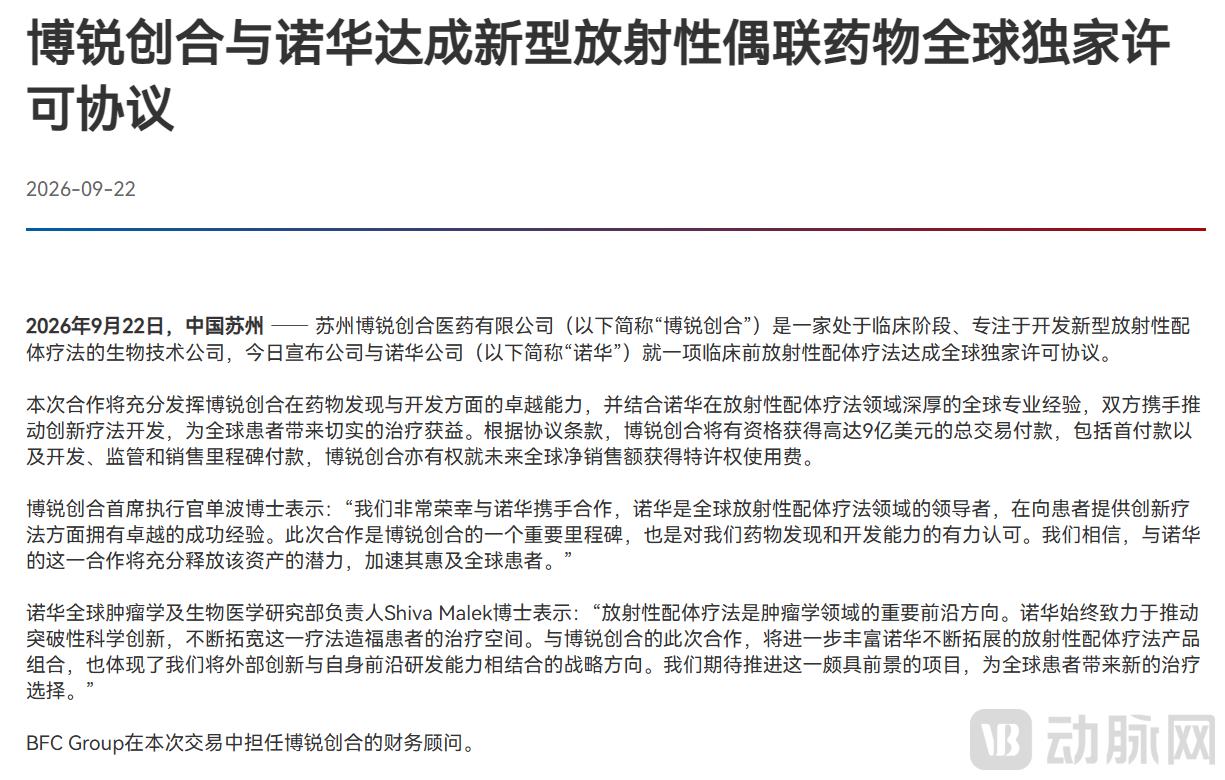
On September 22, Suzhou-based clinical-stage biotechnology company Boomray Pharmaceuticals Co., Ltd.(hereinafter referred to as “Boomray”) announced that it had entered into an exclusive global licensing agreement with Novartis, granting Novartis the rights to one of its preclinical radioligand therapy (RLT) assets.
Under the terms of the agreement, Boomray will be eligible to receive payments of up to $900 million, including an upfront payment and development, regulatory, and commercial milestone payments, as well as royalties on future global net sales.
Two RLTs Have Been Launched; Novartis Continues to Seek Early-Stage Assets in China
This is not the first time this year that Novartis has licensed early-stage RLT assets from China.
In January this year, Hunan PepLib also reached a relevant cooperation agreement with Novartis, receiving a $50 million upfront payment. The continuous introduction of early-stage RLT assets in China reflects Novartis’s ongoing supplementation of its next-generation pipeline after establishing a commercialization foundation.
Novartis currently has two commercialized RLT products: Lutathera and Pluvicto. Among them, Pluvicto has become a significant commercial product in this field, with sales exceeding $1.9 billion in 2025; sales in the first half of 2026 reached $1.293 billion, representing a year-on-year increase of 57%.
However, the commercial success of existing products does not mean that RLT pipelines can cease iteration. On the contrary, as current products enter the commercialization phase, Novartis needs to continuously explore new combinations of targets, ligands, and radionuclides to build up its product pipeline for the next stage.
Based on the public pipeline, Novartis’s radioligand therapy (RLT) portfolio has covered multiple targets, including PSMA, SSTR, FAP, and GRPR, while also exploring novel therapeutic radionuclides such as actinium-225 (²²⁵Ac). Meanwhile, internal projects continue to undergo screening. In July 2026, Novartis terminated the development of ¹⁷⁷Lu-NeoB, a GRPR-targeted agent, citing that early clinical data did not support advancement to the next phase.
This also indicates that R&D in radioligand therapy (RLT) is not merely about identifying a target and completing a molecule; factors such as target expression, ligand affinity, radionuclide selection, and tumor uptake and retention all require clinical validation. Therefore, for Novartis, which has already established an RLT R&D and commercialization framework, continuously acquiring early-stage assets from external sources serves as a strategy to supplement and screen its next-generation pipeline.
Multiple Pipelines in Parallel: Borui Chuanghe Licenses Out Single Assets
Beyond this transaction, BoomRay has already established a portfolio of RLT assets covering diverse targets, ligands, and radionuclides.
Founded in 2018, the company has established a comprehensive R&D system covering drug discovery, radiochemistry, and clinical translation. Among its publicly disclosed pipeline, BR-02 is an 18F-PET tracer targeting L-type amino acid transporter 1 (LAT1), primarily used for the imaging diagnosis of brain tumors; BRP-010 targets fibroblast activation protein (FAP) and is being developed as a theranostic agent using 68Ga and 177Lu; BRP-020 targets Nectin-4, with development plans involving radionuclides such as 68Ga and 177Lu. The company has also obtained a radiation safety license and built capabilities related to the R&D and clinical translation of radiopharmaceuticals.
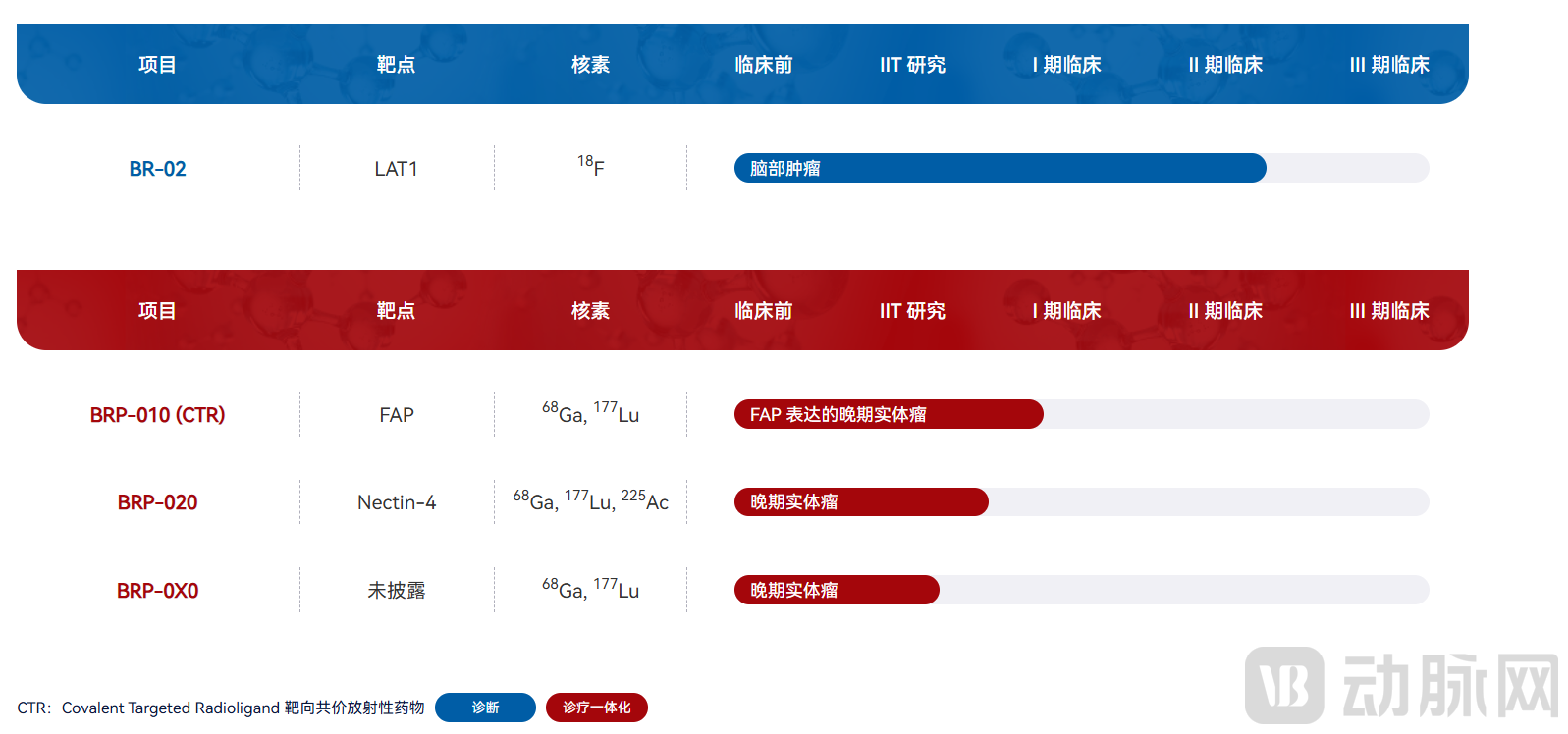
From the perspective of pipeline layout, BoomRay is not centered around a single candidate drug; instead, it combines different targets, ligands, and radionuclides to establish an R&D system capable of continuously generating radioligand therapy (RLT) assets.
Why Choose to License in the Preclinical Stage? One Possible Reason Is That Global Development of Radioligand Therapy (RLT) Has High Resource Thresholds.
As the project enters the global clinical phase, R&D is no longer solely concerned with the candidate drug itself, but also encompasses multiple aspects including radiopharmaceutical manufacturing, radionuclide supply, cross-regional clinical trials, regulatory affairs, and commercialization.
In contrast, Novartis has established a more mature R&D, manufacturing, and commercialization system for radioligand therapy (RLT), and continues to expand its pipeline and production capacity around targets such as PSMA, SSTR, and FAP, as well as radionuclides including ^177Lu and ^225Ac.
For BoomRay, licensing the global development rights of a single asset to Novartis can be understood as leveraging the large pharmaceutical company’s established global development infrastructure to advance the asset, while retaining R&D capacity for its other pipeline candidates. This does not signify that BoomRay is abandoning its radioligand therapy (RLT) strategy; rather, it reflects a strategic allocation of resources across different assets.
Of course, the above analysis of the transaction logic is based on publicly available information and does not constitute an explicit statement by BoomRay or Novartis regarding the rationale for their collaboration. Ultimately, whether this preclinical asset can realize the subsequent value outlined in the agreement will depend on clinical validation encompassing human safety, dosing, pharmacokinetics, tumor uptake, and efficacy.
Preclinical Assets Secure Major License-Out Deals, RLT Enters Asset Competition
Why Did This Preclinical RLT Secure a Major License-Out Deal? Novartis May Have Already Provided the Answer.
In 2024, Novartis acquired the preclinical radioligand therapy (RLT) company Mariana Oncology with a $1 billion upfront payment and up to $750 million in milestone payments, bringing the total potential deal value to $1.75 billion. Compared to mature assets already in clinical development, such transactions prioritize not yet-validated efficacy but rather novel targets, new ligands, new radionuclide combinations, and their potential for further development.
This type of asset screening is becoming the norm in the RLT industry. According to relevant industry review data[1]As of July 2025, more than 400 RLT clinical trials have been registered globally, covering over 20 cancer types. Meanwhile, the clinical pipeline is expanding from mature targets such as PSMA and SSTR to a broader range of targets including FAP, GRPR, CAIX, and Nectin-4.
The competition in RLT is thus no longer just about “who can develop a product first,” but is shifting toward who can consistently generate assets worthy of clinical validation. For large pharmaceutical companies, the preclinical stage serves as a window to screen next-generation pipelines; for biotech firms, it is essential to demonstrate their capability to continuously produce such assets.
This also means that when large pharmaceutical companies evaluate an RLT biotech firm, they may look beyond a single candidate drug to include its underlying product portfolio and R&D system. RLT itself involves multiple variables, including targets, ligands, and radionuclides. A multi-target, multi-radionuclide strategy enables companies to continuously screen and iterate their assets around various combinations.
From this perspective, the target of BoomRay’s recent license-out deal is a preclinical asset; however, it already underpins an RLT product portfolio covering targets such as LAT1, FAP, and Nectin-4, as well as radionuclides including 18F, 68Ga, 177Lu, and 225Ac.
The transaction involves a single asset, but the underlying R&D system and product portfolio will serve as key references for multinational corporations (MNCs) in assessing the long-term value of a biotech company.
Returning to this transaction, what truly merits observation is perhaps not “how much preclinical assets are worth,” but whether Chinese RLT companies can continuously generate assets that global pharmaceutical firms are willing to further validate.
References:
[1]Ninatti, Gaia et al. “Radioligand Therapy in Cancer Management: A Global Perspective.” Cancers vol. 17,21 3412. 23 Oct. 2025, doi:10.3390/cancers17213412