

With RMB 4 Billion in Revenue and Nearly RMB 6 Billion in Net Assets, This Long-Established Zhejiang Pharmaceutical Company Is Still Striving for a Hong Kong Stock Exchange Listing

Jingxin Pharmaceutical
Pharmaceutical R&D Developer
In September 2026, Jingxin Pharmaceutical submitted an application for H-share listing to the Hong Kong Stock Exchange.
In the innovative drug industry, it is not uncommon for biotech companies to go public within six years. However, it is indeed rare to find a company like Jingxin Pharmaceutical that has spent nearly 30 years evolving step by step from active pharmaceutical ingredient (API) manufacturing to developing Class 1 innovative drugs.
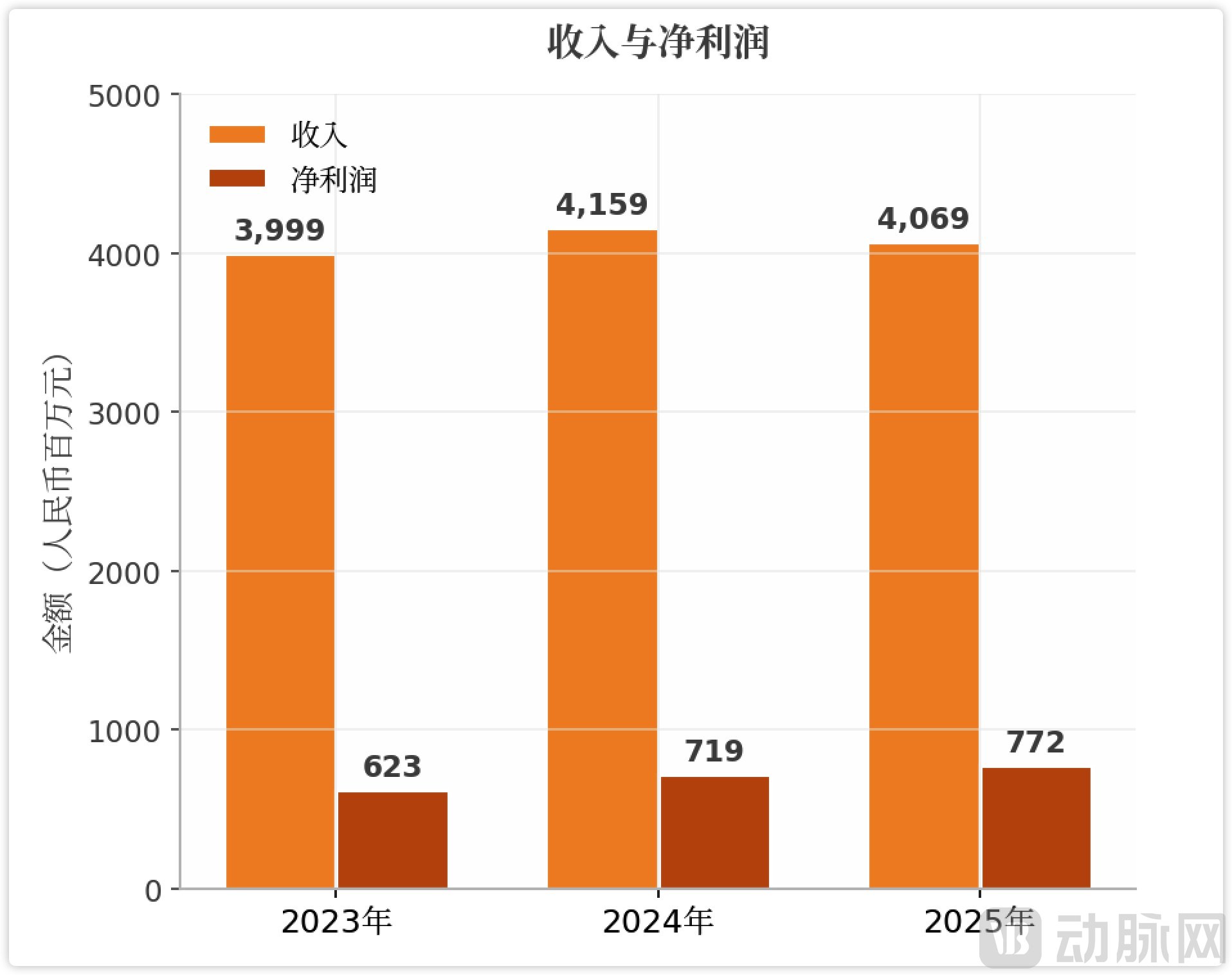
Recent Corporate Revenue Performance, Charted Based on Prospectus Data
Jingxin Pharmaceutical listed on the Shenzhen Stock Exchange as early as 2004. In 2025, it reported revenue of RMB 4.069 billion, net profit of RMB 772 million, and operating cash flow of RMB 781 million. As of June 30, 2026, its net assets amounted to approximately RMB 5.952 billion, with cash and cash equivalents totaling around RMB 480 million during the same period. Why would an A-share listed pharmaceutical company still seek a listing in Hong Kong? The answer lies in its pipeline timeline and international capital requirements.
In 1999, Lü Gang, the helmsman of Jingxin Pharmaceutical, spearheaded the company’s restructuring, initiating its transition toward formulation business, and the company was listed on the Shenzhen Stock Exchange in 2004.
Jingxin Pharmaceutical’s origins as an active pharmaceutical ingredient (API) manufacturer compelled it to make significant efforts in cost control, quality stability, and supply chain security. Lu Gang relentlessly focused on these areas for over a decade before making a pivotal decision in 2010 to sign an agreement with Germany’s Evotec to license an innovative drug molecule for the treatment of insomnia, which later became daridorexant.
This decision appeared somewhat risky at the time. In China’s pharmaceutical industry in 2010, generic drugs were still the absolute mainstream, and companies engaged in innovative drug development were exceedingly rare. However, Lü Gang believed that profit margins for generic drugs would continue to shrink, and only innovative drugs could deliver true pricing power and long-term value.
From signing in 2010 to approval in November 2023, it took a full 13 years. Didasini was included in the National Reimbursement Drug List in November 2024, making 2025 its first full year of commercialization, during which it generated RMB 195 million in sales, accounting for 4.8% of total revenue. In the first half of 2026, Didasini’s revenue reached RMB 153 million, representing a year-on-year increase of 176.6%.
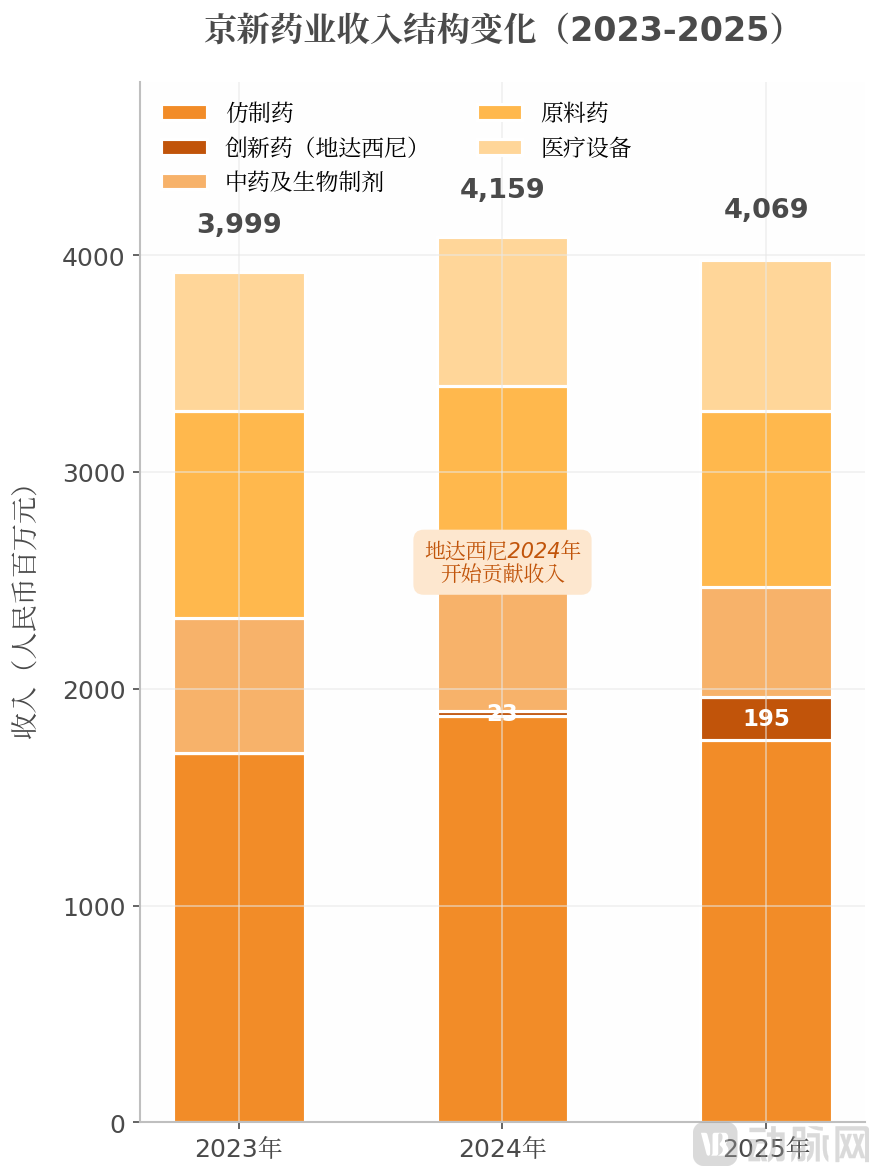
Corporate Revenue Structure, Charted Based on Prospectus Data
Jingxin Pharmaceutical’s Strategy to Transition into Innovative Drugs Shows Initial Success.
From 2023 to 2025, Jingxin Pharmaceutical invested RMB 216 million, RMB 230 million, and RMB 227 million respectively in clinical trials alone, with an additional RMB 100 million invested in the first half of 2026. This level of investment is considerable for a company primarily focused on generic drugs. More importantly, Jingxin’s innovation-driven transformation is not reliant on single-point breakthroughs but involves the simultaneous advancement of multiple pipeline projects. As these projects enter late-stage clinical development, their capital requirements will rise non-linearly.
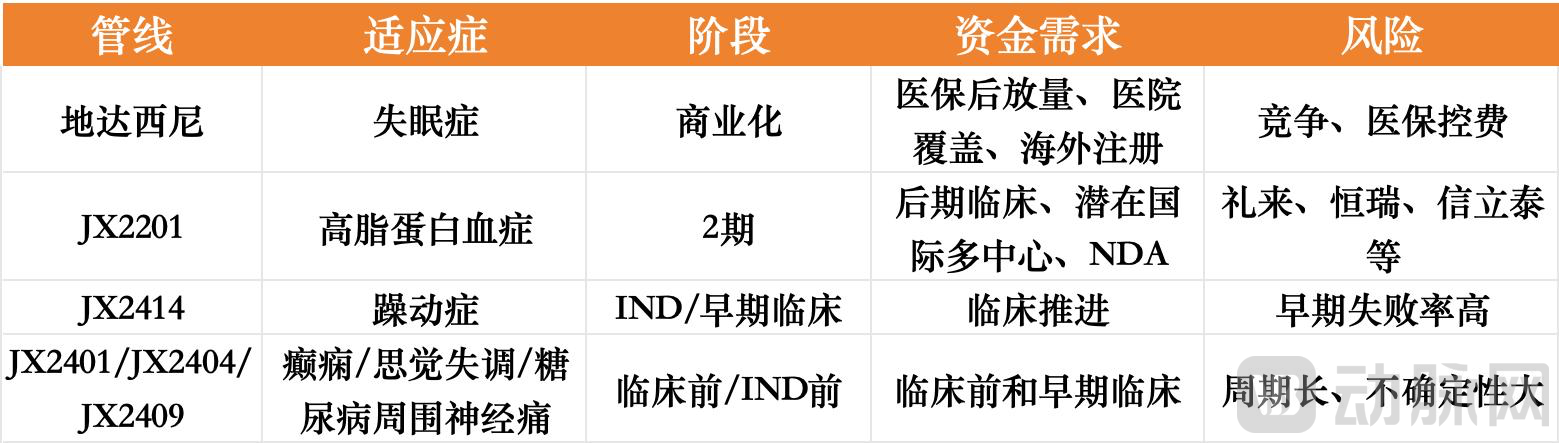
Capital Requirements for Multiple Pipelines, Charted Based on Prospectus Data
Therefore, Jingxin Pharmaceutical’s actual situation is that it does not lack funds for daily operations, but the capital required for the internationalization of its innovative drugs is significantly higher than its current resources. Subsequent activities, including overseas clinical trials, international regulatory registrations, and cross-border business development (BD), will all require substantial funding. The cross-border capital capabilities offered by an H-share listing are what Jingxin will need in its next phase of development.
Market acceptance ultimately hinges on the quality of the pipeline.
Didadexini is the first card played by Jingxin Pharmaceutical. The insomnia drug market is not short of products; traditional benzodiazepines such as estazolam and alprazolam have been used for decades. There are also newer non-benzodiazepine drugs such as zolpidem and zopiclone.
These medications all have next-day residual effects, meaning patients are prone to dizziness and drowsiness the day after taking them, and long-term use may also lead to dependence.
The mechanism of action of daridorexant is as a partial agonist at the GABA_A receptor. Traditional drugs act like a key that fully opens the receptor channel, producing strong sedative effects but also significant side effects. Daridorexant only partially opens the channel, thereby inducing sleep while avoiding excessive sedation.
According to the prospectus, daridorexant’s maximal agonist effect is approximately 62% that of diazepam, a design that strikes a balance between efficacy and safety. Market data show revenue of RMB 195 million in 2025 and RMB 153 million in the first half of 2026, representing a year-on-year increase of 176.6%, demonstrating initial potential.
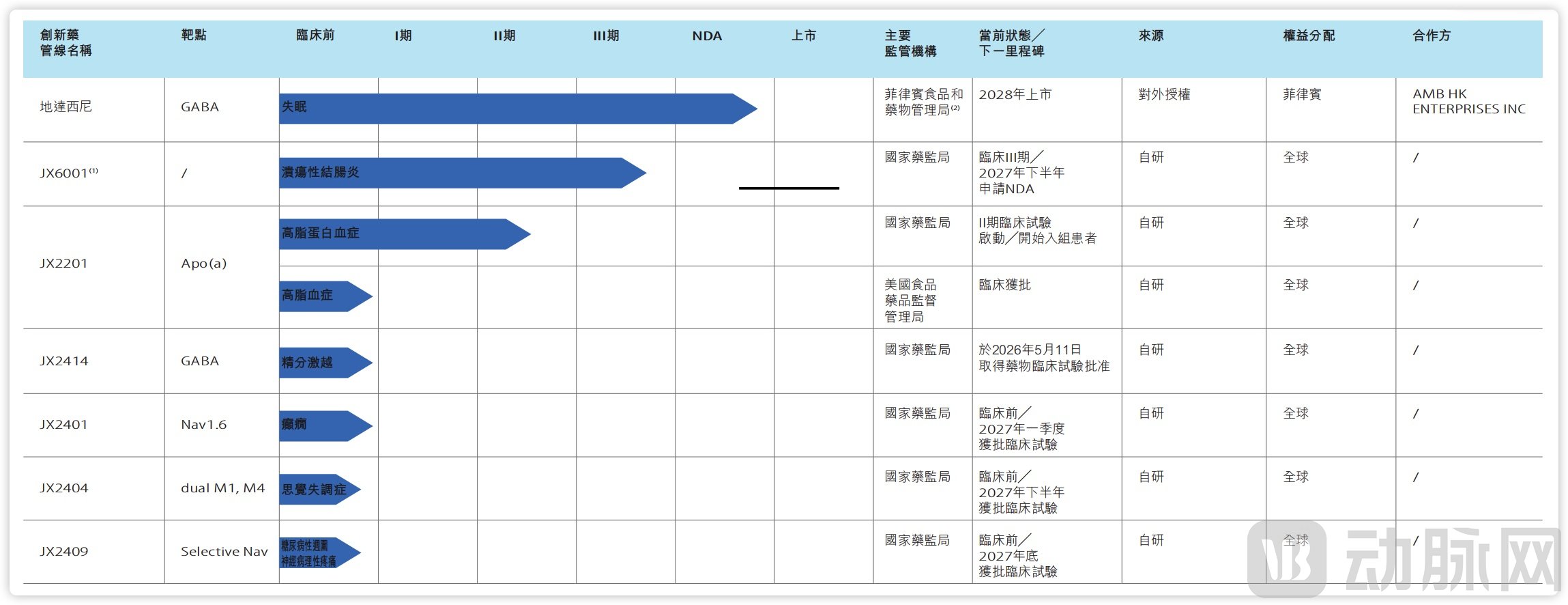
Corporate Pipeline Layout, Image Source: Prospectus
JX2201 is Jingxin Pharmaceutical’s second card, and one with greater potential. This small-molecule inhibitor targeting lipoprotein(a) is currently in Phase II clinical trials, ranking third globally among small-molecule Lp(a) inhibitors in terms of development progress. Only Eli Lilly’s Muvalaplin (Phase III) and Hengrui Medicine’s HRS-5346 (Phase II) are ahead.
Lp(a) is one of the hottest new targets in the cardiovascular field in recent years. Globally, no Lp(a)-lowering drugs have yet been commercialized. China’s lipid-lowering drug market is projected to reach RMB 53.2 billion by 2030, with a compound annual growth rate (CAGR) of 11%. If JX2201 successfully gains approval, it will address an unmet market worth tens of billions of yuan.
However, JX2201 faces intense competition. Eli Lilly’s muvalaplin is ahead in development, and both domestic and international pharmaceutical companies—including Hengrui Medicine, Salubris, and AstraZeneca—are actively positioning themselves in this space. To stand out in this therapeutic area, Jingxin Pharmaceutical needs to accelerate its clinical progress and even consider launching international multicenter trials.
Furthermore, JX2414 is a gamma-aminobutyric acid type A (GABA-A) receptor modulator indicated for acute agitation, and it has currently received approval from the National Medical Products Administration (NMPA) to conduct clinical trials. In contrast, JX2401, JX2404, and JX2409 are in the early stages of development.
Placing Jingxin Pharmaceutical within the industry context makes it easier to identify opportunities and pressures.
Jingxin Pharmaceutical has selected the central nervous system and cardiovascular/cerebrovascular therapeutic areas, both of which are typical chronic disease markets. These sectors feature a large patient base and long treatment durations, yet exhibit modest growth rates.
The compound annual growth rate (CAGR) of China’s central nervous system (CNS) drug market from 2021 to 2025 was -0.7%, with growth expected to recover to 1.6% from 2026 to 2030, reaching RMB 179.1 billion. The challenges in this market stem from complex disease mechanisms, difficulties in conducting clinical trials, and conservative prescribing habits among physicians. However, viewed from another perspective, these very challenges mean that once differentiated products are developed, they benefit from a deeper competitive moat.
The cardiovascular and cerebrovascular market is in a slightly better position. China's cardiovascular drug market was valued at RMB 178.9 billion in 2025 and is projected to reach RMB 199.8 billion by 2030, representing a compound annual growth rate (CAGR) of 2.7%. Among these, lipid-lowering drugs constitute the fastest-growing segment, with a CAGR of 11%.
Jingxin Pharmaceutical’s position in the generic drug market constitutes its core foundation. Levetiracetam tablets hold a 38.1% market share in the domestic generic drug segment, ranking first. Pramipexole Hydrochloride tablets also claim the top spot with a 32.4% market share in their respective generic segment. Rosuvastatin Calcium tablets rank second, capturing a 21.7% market share in the generic drug segment.
Although these products face price pressures from volume-based procurement (VBP), Jingxin Pharmaceutical has maintained stable cash flow by trading price for volume. In 2025, the revenue share of products affected by VBP accounted for 35.6%, and the company’s historical success rate in VBP bidding stood at 85.7%.
The commercialization of innovative drugs is another challenge Jingxin Pharmaceutical needs to prove itself in. The success of Didaxini partly benefited from the rapid inclusion in the national medical insurance and the company's channel accumulation in the psychiatric and neurological fields. However, JX2201 targets the cardiovascular field, where the competitive landscape is entirely different, requiring the re-establishment of physician education and market promotion efforts.
Currently, Jingxin Pharmaceutical has initiated its international expansion strategy. Previously, it entered into a licensing agreement with Germany’s Evotec, securing overseas rights to daridorexant. The market size for insomnia medications in Europe and the United States far exceeds that of China. To tap into the potential of overseas markets, substantial efforts are required, including conducting international clinical trials and obtaining regulatory approvals abroad.
In terms of the use of proceeds, Jingxin Pharmaceutical’s upcoming objectives include pipeline R&D, network construction, and expanding its pipeline through acquisitions and licensed-in products. Future initiatives—such as the overseas expansion of didasini, the potential global clinical development of JX2201, and the introduction of potential overseas projects—will all require the status of an H-share listed company. For Jingxin Pharmaceutical, the Hong Kong IPO is paving a path from Xinchang, Zhejiang, to the global innovative drug market.