

Insurers Start to Backstop the Money Burned on Innovative Drug R&D
At the start of the year, I attended a closed-door seminar on biomedical innovation and tech finance. When a speaker reached the core pain point constraining innovation at domestic drugmakers, he abruptly pivoted to a new track rarely discussed in China — innovative drug R&D insurance.
By August, news broke. PICC P&C Beijing Branch, together with Taiping P&C Beijing Branch and Sunshine P&C Beijing Branch, successfully issued Beijing's first life-science R&D insurance policy — a dedicated policy for a biopharma company's investigational drug for adult fever. The landing of new drug R&D insurance in China drew industry attention.
Can you buy insurance for innovative drug R&D? We break it down along three core threads: the overseas ecosystem, the ice-breaking pilot in China, and the industry's core bottlenecks and future direction.
Understanding innovative drug R&D insurance requires separating two concepts clearly:
Clinical liability insurance covers a drugmaker's liability to third parties. The policyholder is the drugmaker; the beneficiary is the trial subject.
The leader in this field is Chubb — the world's foremost human clinical trial insurance company, operating in 54 countries and regions, with more than 30 years of experience underwriting clinical trial insurance.
R&D loss insurance covers the drugmaker's own investment losses. If a clinical trial fails to meet its predetermined targets and the program is terminated, the insurer reimburses the R&D costs the drugmaker has already spent, as agreed. The policyholder is the drugmaker, and so is the beneficiary.
The core question for drug developers: if a clinical trial fails and hundreds of millions of yuan in investment goes down the drain, is there insurance that will pay?
Clinical Trial Funding Insurance (CTFI), a type of R&D loss insurance in overseas markets, meets that need.
CTFI's logic is entirely different from that of traditional liability insurance. Its payout trigger is this: if a clinical trial fails to meet the success criteria set out in the policy (usually aligned with the primary endpoints of the trial protocol), the insurer reimburses the trial costs the drugmaker has already incurred.
The premium is prepaid in a lump sum, transferring the risk from the drugmaker to the insurer. Covered costs include CRO fees, clinical protocol design and related consultancy fees, hospital and investigator costs, and monitoring, data collection, and analysis costs.
The most dedicated player in this field is MCI (Medical & Commercial International), a specialist underwriting institution that has focused on life science and clinical trial risk since 2015. Its team includes people with industry and academic backgrounds, and its flagship offering is clinical trial funding insurance.
MCI's underwriting appetite is clear: Phase I, Phase II, and some small Phase III trials, with trial budgets typically between USD 3 million and USD 35 million, and trial durations of 24 months, extendable to 48 months.
Insurable asset types include small molecules, peptides, antibodies, and some biologics, but gene therapies, opioids, and programs with budgets exceeding USD 45 million are currently outside its underwriting scope. Sponsors are limited to biotech companies in the United States, the United Kingdom, Europe, and Canada, while trial sites can be distributed globally.
A landmark case is the CTFI policy obtained in April 2026 by AB Science, a French biopharmaceutical company.
The policy was underwritten by MCI through Lloyd's Syndicate 1902, with Acrisure Re as the broker, providing up to EUR 25 million in coverage for its Phase III clinical trial in ALS (amyotrophic lateral sclerosis), potentially extendable to EUR 39 million, with zero deductible. The policy takes effect on the date the first patient is enrolled, and covers the agreed financial costs of clinical trial failure within the coverage limit.
The parties to this policy need some introduction: MCI operates through Lloyd's Syndicate 1966 and Syndicate 1902. Syndicate 1966 is the underwriting vehicle MCI set up specifically for CTFI, approved in 2024; Syndicate 1902 is MCI's core underwriting platform, handling its regular business and also participating in some CTFI arrangements.
The AB Science policy was underwritten by Syndicate 1902, showing that CTFI policies are not issued through a single vehicle.
The relationship among the three can be understood this way: MCI handles underwriting, pricing, and product design — the operator; Syndicate 1966 and Syndicate 1902 are the vehicles that actually underwrite — the tools; Lloyd's provides market rules, an A+ credit rating, and the Central Fund as the ultimate backstop — the platform. The three work closely together.
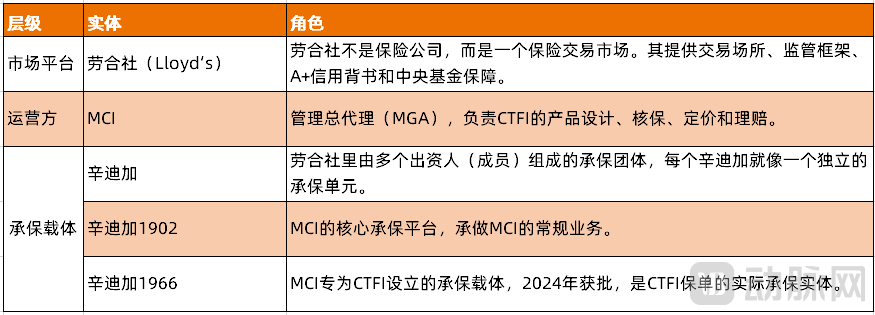
How Lloyd's CTFI products work (compiled by VCBeat)
Alain Moussy, CEO of AB Science, said ALS is considered one of the hardest indications to develop, and the insurance itself is a kind of "vote of confidence" in their project's probability of success. MCI co-founder James Banks put it more directly: "By promoting lending through insurance, we help companies raise capital; through downside protection we reduce equity dilution, allowing innovators to retain more control and ownership."
But CTFI has its limitations. The market is still relatively small, underwriting is concentrated in Phase I and Phase II, and for Phase III it only takes on "select small trials." Gene therapies and cell therapies — the most cutting-edge directions — cannot be insured yet.
Moreover, CTFI underwriting relies on in-depth due diligence: reviewing historical clinical data, real-world data, and trial design, plus computer-based simulation modeling. That means each policy is expensive to underwrite and hard to scale in the short term.
Innovatrix Capital is another UK specialist insurance platform headquartered in London, founded in 2021, focused on risk-transfer solutions for clinical trial failure in the life sciences, helping drugmakers and investors hedge R&D investment losses. Large insurance groups such as Chubb are also beginning to move into R&D insurance.
Today, overseas R&D insurance has long moved beyond the single logic of "pure claims payout" and is deeply embedded in the industrial and capital ecosystem.
For overseas biotechs, this policy is not just a risk backstop but also a credit endorsement for financing and deals. At key pipeline milestones, in new funding rounds, M&A, BD deals, and asset securitization, sound R&D risk protection can greatly stabilize investor expectations and reduce pipeline valuation volatility.
At the same time, overseas markets have developed a model in which insurers, specialized CROs, and research institutions coordinate on risk control, paired with reasonable corporate risk retention and premium adjustment mechanisms, minimizing the pressure of innovation trial-and-error on drugmakers.
Rates are reportedly clear-cut by clinical stage: preclinical and IND (Investigational New Drug) stages carry the highest risk, with rates reaching 15%–30%; the core Phase II underwriting stage runs 8%–18%; and in the mature Phase III and NDA filing stages, rates drop to 4%–10%.
Of course, such R&D loss insurance never fully backstops R&D investment: deductibles for companies are generally high, and risks such as human decision errors, voluntary strategic termination, and data fraud are strictly excluded — only purely technical R&D failure is covered. High-risk first-in-class programs with novel mechanisms still face high premiums and high underwriting thresholds, a common challenge across the industry.
So the accurate conclusion on the overseas part is: liability insurance is long since routine; R&D insurance remains a frontier product — already in use overseas, but far from "universal access."
China's pharmaceutical insurance products have long been extremely limited: the relevant policies available on the market basically cover only clinical trial liability risk — that is, trial subjects' personal safety and medical dispute payouts. The cost losses from a drugmaker's own R&D failure are completely uninsured. Once a program is terminated, hundreds of millions or even billions of yuan in early-stage investment is sunk entirely.
It was not until 2026 that the situation began to change. Beijing recently began piloting R&D loss insurance on the ground.
The Beijing policy precisely covers cost losses arising from R&D failure at the critical stages of R&D tackling and commercialization, filling Beijing's gap in coverage for innovative drug R&D failure losses and sharing companies' tech-innovation trial-and-error costs.
On September 9, the first policy of the Beijing biomedicine insurance co-insurance pool officially landed, with the insured party being Changzheng Medical's ECMO consumables development project. The policy is led by PICC P&C Beijing Branch as lead underwriter, co-underwritten with Ping An P&C, CPIC P&C, China Life P&C, and Taiping P&C, with Beijing Zhongwei Insurance Brokerage Co., Ltd. providing full-process brokerage services.
The two first policies are not contradictory; they validate two different things: the former proves that "R&D failure losses can be insured," while the latter proves "how multiple companies can insure together." The co-insurance pool is an organizational mechanism; R&D cost loss insurance is the product direction.
The core innovation of this scheme is staged underwriting — breaking a long-cycle, high-risk R&D project into assessable, insurable units by stage: preclinical, Phase I, Phase II, Phase III, and NDA. If R&D fails, the corresponding stage's R&D investment is paid out.
This solves a problem that has long troubled the industry: insurers dare not cover long-cycle projects because they cannot assess overall risk; companies find premiums too expensive because coverage cannot be matched to stages. Once broken down, insurers can price by stage and companies can insure by stage.
The core value of the co-insurance model lies in solving the problem that a single insurer "cannot carry it alone": multiple companies underwrite together in agreed proportions, sharing premiums and claims liability in parallel, forming a two-tier risk diversification structure of "direct insurance + reinsurance." The pool also unifies policy terms, rates, and risk-control admission, pooling multiple institutions' underwriting experience and actuarial capacity into one standard.
For a low-frequency, high-severity risk like R&D failure, the pool turns "one company can't carry it" into "many companies share the load," placing a previously uninsurable risk on enough shoulders.
As the driving force behind this, the Beijing Municipal Science and Technology Commission and the Zhongguancun Science Park Management Committee have included R&D cost loss insurance in the city's key work for the pharmaceutical and health industry, organizing multiple rounds of special seminars and validation together with the Beijing Financial Regulatory Bureau since January 2026, building a supply-demand matchmaking platform, and driving deep engagement between nearly 30 innovative drug and device companies and insurers.
But there is a very important limitation here: Beijing's pilot initially provides coverage mainly for projects funded by the Beijing Municipal Science and Technology Commission. Put plainly, it is an exclusive program within the commission's system, not open to the market, and not commercially promoted. Companies cannot simply buy it — they must first be on the commission's funding list or its "project-based" key service catalog.
This model is the normal state of a pilot phase. Any new insurance product, going from zero to one, needs to first run through the process, accumulate data, and validate models within a controllable scope.
Beijing's choice to start with projects inside the municipal science and technology commission's system is clear in logic: their R&D progress is tracked by the government, data is collected, and risks are relatively assessable, making them suitable first underwriting targets. But it also means that, at this stage, the product is still out of reach for ordinary biotechs on the market.
The pool's next step is to focus on key tracks such as innovative drugs and devices, cell and gene therapy, and brain-computer interfaces, providing full-cycle insurance for innovative drugs and devices.
The common judgment among industry observers is that the co-insurance pool is a transitional mechanism for the startup phase, not the end point. No single insurer dares to cover it alone, so many band together to share. Once enough data is accumulated and actuarial models mature, it will gradually transition to market-based underwriting by single insurers.
So, can this actually be done?
The direction is right, but there are several hard nuts to crack.
Data is an unavoidable hurdle. Innovative drug R&D confronts entirely new targets and mechanisms, with no historical claims data. Actuarial work relies on the law of large numbers — but where do the "large numbers" come from? The industry is now trying to build models using industrial data in place of historical data. In July 2026, China Life P&C released an "innovative drug full-lifecycle risk protection model," seeking to bridge the gap between industrial data and financial risk control.
Loss assessment is another hurdle. The reasons for R&D failure are too complex: the scientific hypothesis itself may not hold, the clinical protocol design may be flawed, changes in the external environment may make patient enrollment difficult, or regulatory requirements may have changed. How do you attribute the cause? How do you determine that "this failure is one the insurance should pay for"? Beijing's staged underwriting model eases this problem to some extent, since each stage's goals are relatively clear, but in practice it still requires a great deal of professional judgment.
Moral hazard is also unavoidable. Once a drugmaker buys insurance, will it become less prudent in R&D decisions? Will it selectively insure high-risk pipelines? How should deductibles be designed? How should co-insurance ratios be set? These must be figured out in practice. MCI's CTFI has set a "zero deductible," which is actually a strong signal — it shows the underwriter has enough confidence in the project's probability of success to dare to go with zero deductible.
Cost is another practical threshold. Rates for early-stage projects may exceed what small and mid-sized biotechs can afford. Under China's current co-insurance model, the premium-sharing mechanism is still being worked out. Moreover, Beijing's pilot is currently supported by special funds from the municipal science and technology commission; once it enters market-based promotion, how premiums are set and whether companies are willing to pay become another question.
Beijing's first policy has just landed, and several more companies are signing, with the pace accelerating.
What to watch next: whether Beijing's pilot can expand from commission-exclusive projects to a broader set of market players, whether data accumulation can keep up, whether actuarial models can mature, and whether insurers can truly understand the biopharma industry.
The "language gap" between insurers and drugmakers is real. Insurance looks at the probability distribution of economic loss; drugmakers look at the probability of success of a technology path. How to translate and align these two languages is the key to whether R&D insurance can grow from a "policy bonsai" into a "standard tool."