

Full Online Processing for Drug Import Clearance! Time Required for Single-Batch Import Registration Reduced to Minutes
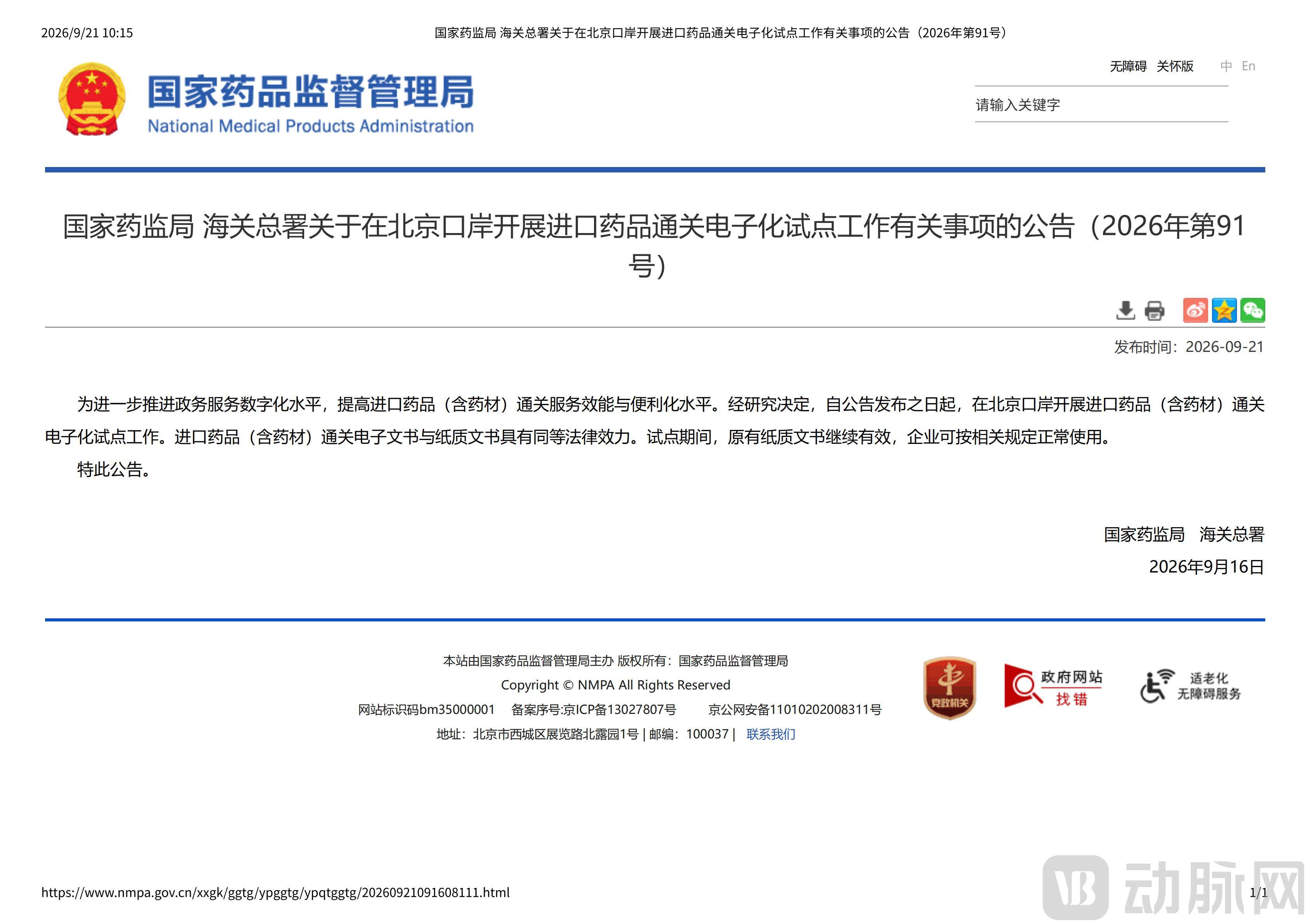
On September 21, an import inspection and declaration entity in Beijing successfully downloaded and printed the nation’s first electronic “Customs Clearance Certificate for Imported Drugs,” marking Beijing Port as the first in China to achieve fully online processing for the entire customs clearance procedure for imported pharmaceuticals.
Imported drugs are critical to ensuring public access to medications and represent one of the most highly regulated and strictly approved categories in cross-border trade. From January to July 2026, the import value of pharmaceutical materials and drugs through Beijing ports reached RMB 77.34 billion, a year-on-year increase of 17.2%, ranking first nationwide. The "Import Drug Customs Clearance Form" serves as the core statutory document for customs declaration and release of imported drugs. It is not only a mandatory requirement for maintaining compliance but also a key link in ensuring smooth customs clearance and shortening the overall logistics cycle.
Previously, although the application and approval processes for drug import registration had been moved online, the issuance of the key document, the “Customs Clearance Slip for Imported Drugs,” remained non-electronic. Companies were required to dispatch designated personnel to visit administrative service windows in person to collect the physical document, a process that was time-consuming, labor-intensive, and incurred high costs in terms of both manpower and time.
On September 21, 2026, the Beijing Port officially launched a pilot program for the digitalization of import drug customs clearance, enabling fully online processing of the "Import Drug Customs Clearance Form." With the introduction of the electronic version of the form, enterprises handling import drug customs registration at the Beijing Port can now complete the entire process online without leaving their premises. After submitting applications online and passing verification, the system automatically generates the "Import Drug Customs Clearance Form" with an official electronic seal. Users can download the PDF file with a single click and print it on standard A4 paper for immediate use.
Printed documents include a QR code that, when scanned, displays information such as the certificate number, drug name, and real-time certificate status, enabling verification of whether the certificate has been invalidated or modified, thereby facilitating rapid validation of document authenticity.
The implementation of electronic customs clearance for imported drugs has further driven efficiency gains and value release across the entire supply chain and among multiple stakeholders.
At the warehouse in the Tianzhu Comprehensive Bonded Zone, a rare-disease medication for the treatment of neuroblastoma cleared customs rapidly through a fully online process. According to Hu Xiaoxia, head of the External Affairs Department at a medical supplies trading company, since the implementation of Beijing’s green channel policy for clinically urgent needs in September 2024, the company has had multiple urgently needed drugs approved for clinical use through this channel. This has further reduced the “transit time” for such medications, securing more precious windows of opportunity for patient treatment.
Mr. Thomas Jacxsens, Vice President of the Prescription Drug Division in China and Head of Product Supply for China at a foreign-invested enterprise, stated, “The new initiatives not only directly serve clinical patients but also inject strong momentum into biopharmaceutical production. Facilitated customs clearance measures for imported drugs have accelerated the entry of key production materials, including active pharmaceutical ingredients (APIs), thereby helping companies accelerate the localization of innovative product manufacturing.”
The digitization of customs clearance for imported drugs has reduced the processing time for single-batch import registration to minutes, with the issuance of the "Import Drug Customs Clearance Slip" completed in seconds. Meanwhile, the "Green Priority" integrated inspection service model at the Beijing Port provides enterprises with dedicated liaison officers, specialized follow-up, and professional technical guidance, maximizing the acceleration of product market launch. For a multinational pharmaceutical company, the first import inspection of a subcutaneous monoclonal antibody injection was completed in just 18 days, making China the first country in the Asia-Pacific region to achieve clinical supply of this drug.
According to Hu Qin, Deputy Director of the Beijing Institute for Drug Control, efforts are being made to transform drug testing services from a “passive receipt-based” model to a “proactive engagement” model. While strictly adhering to the “four strictest” requirements for quality and safety, this initiative significantly shortens testing timelines and enhances testing efficiency.