

Next-Gen Heirs Take the Helm: 30-Something Scions Lead Billion-Dollar Pharma Firms Amid Strategic Transformation

MicroPort CardioFlow
A Provider of High-End Interventional Medical Devices in the Cardiac Valve Field, Engaged in R&D, Manufacturing, Sales, and Related Technical Consulting Services

Salubris
Pharmaceutical Product R&D Developer
More “second-generation” successors are stepping into the spotlight in the healthcare industry.
On September 19, Joincare Pharmaceutical Group and Livzon Pharmaceutical Group simultaneously announced the nomination of Ms. Zhu Linlin as a candidate for non-independent director. Ms. Zhu is the daughter of Zhu Baoguo, the actual controller of both Joincare and Livzon. Born in 1995, Ms. Zhu holds a Master’s degree in Applied Economics from Johns Hopkins University. She previously served as Deputy Marketing Director of the Health Products Division at Joincare Pharmaceutical Group Co., Ltd., and currently serves as Chairperson of Mao Haizi Animal Health (Guangdong) Co., Ltd.
Recently, it has become common for second-generation leaders of pharmaceutical companies to join the management team. From late 2025, when Cai Lei, the eldest son of CSPC Pharmaceutical Group’s founder Cai Dongchen, assumed the role of Group CEO, and Li Xinyi, daughter of Li Shaobo, the actual controller of Sinocare Inc., took over as General Manager, to 2026, when Brian Chang, son of MicroPort founder Dr. Chang Chao-hua, was appointed Chairman of the Board of MicroPort CardioFlow, and Peng Ling, daughter of Peng Yixing, Chairman of Sanxin Medical, was promoted to Executive Chairman, followed by Yuan Fenni, daughter of Yuan Jiandong, the actual controller of BrightGene Biomedical Technology, joining the board, and Che Yuxuan, son of Che Fengsheng, Chairman and controlling shareholder of SihuanPharm, assuming the position of Non-Executive Director—multiple second-generation successors in the healthcare industry are accelerating their advance toward the centers of power.
However, the key figures involved in the power transition have tacitly chosen to reduce their public exposure. Most information about the second-generation successors who have entered management roles comes solely from announcements made by listed companies. In reality, this group of second-generation successors has quietly orchestrated multiple mergers and acquisitions, becoming key players behind several significant collaborations.
According to VCBeat statistics, among healthcare companies listed on the A-share and Hong Kong stock markets, several have completed second-generation succession or appointed second-generation family members to core management roles.
This transfer of power is occurring in sync with the pharmaceutical industry’s structural shift, as China’s healthcare sector transitions toward innovation-driven growth. As the luster of the founding generation gradually fades, the successors now in the spotlight face their ultimate test. How will they steer their companies through economic cycles and deliver satisfactory results?
In the intergenerational succession of the pharmaceutical industry, the age of founders has become a core consideration for companies in determining power transitions. According to statistics from VCBeat, among the 511 pharmaceutical companies listed on China’s A-share market, the average age of their leaders has reached 57.0 years old, with individuals aged 50 to 59 constituting the absolute majority, accounting for over 40%; when the age range is expanded to 50–69 years, this proportion rises to as high as 74.6%.
Even on the STAR Market, which represents the force of innovation, the average age of the leaders of its 108 listed pharmaceutical companies has reached 58.8 years.
The first generation of private entrepreneurs in China’s pharmaceutical industry mostly started from scratch in the 1980s and 1990s, achieving a leap from imitation-based following to innovation-driven transformation over three decades. Now, as they generally fall within the age range of 60 to 75, corporate governance must directly address the challenges of succession and leadership transition.
Hong Kong stocks differ from A-shares to some extent. Among the 232 listed pharmaceutical companies in Hong Kong, a significant portion comprises Chapter 18A biotech firms (approximately 50 companies, including Innovent Biologics, Akeso, BeiGene, Zai Lab, InnoCare, and RemeGen). The founders of these companies are mostly scientists who returned to China from overseas, with the founding scientists serving long-term as both Chairman and CEO. Consequently, these companies have the lowest number of second-generation family members entering their management teams.
Since its inception, Company 18A has been highly institutionalized. Early investors and cornerstone shareholders wield significant influence in corporate governance, and management succession follows market-oriented logic rather than familial logic. Consequently, 18A biotech companies predominantly opt for professionalized management over family-led governance models.
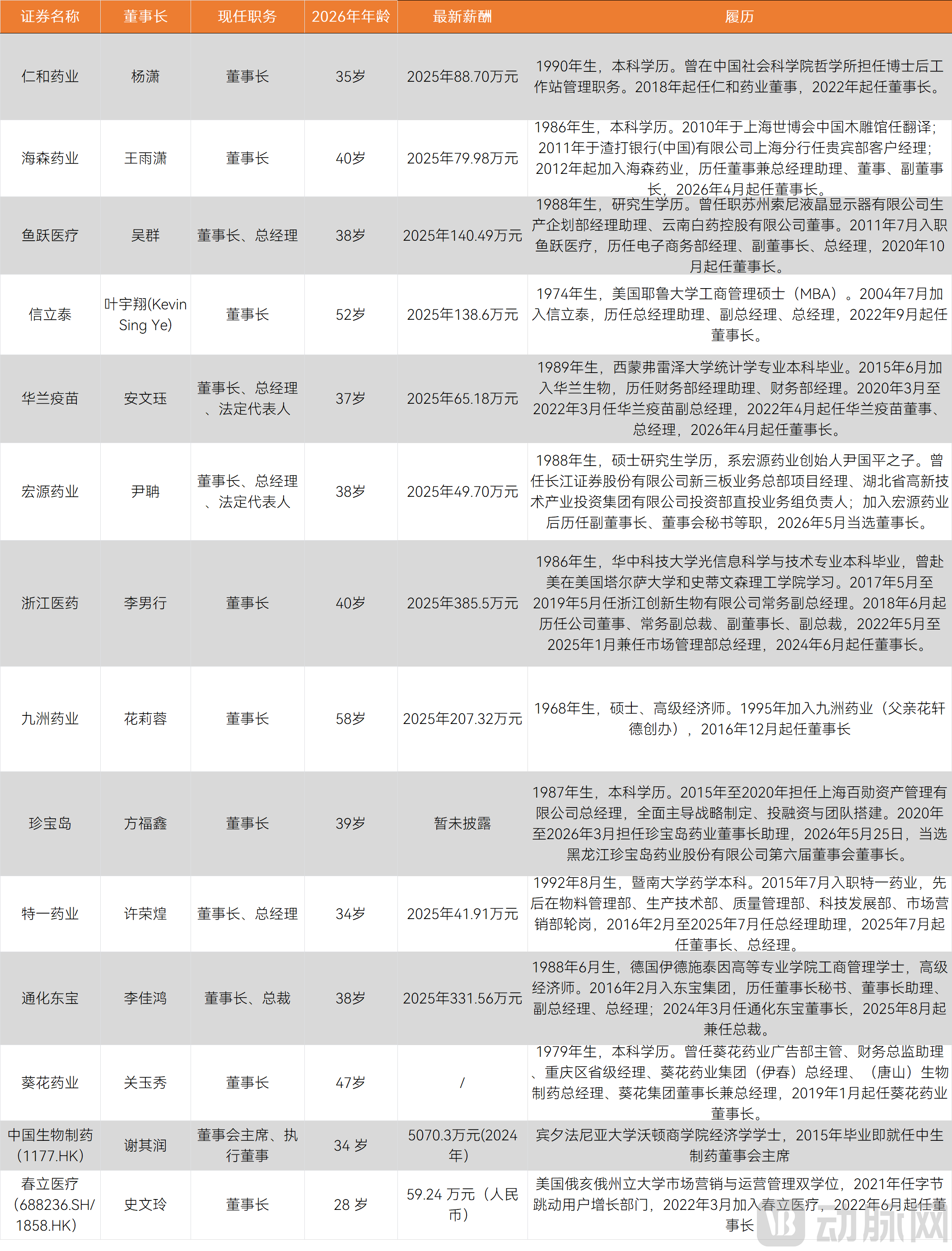
Some Listed Pharmaceutical Companies Have Completed the Second-Generation Succession
In this wave of collective succession, a number of companies have already completed the transition to the second generation of leadership, including Yang Xiao at Renhe Pharmaceutical, Wang Yuxiao at Haisen Pharmaceutical, Wu Qun at Yuwell Medical, Ye Yuxiang at Salubris, and An Wenjue at Hualan Vaccine.
Among enterprises that have completed succession, the process is typically marked by the dual transfer of power and equity. Most second-generation successors gain actual control or status as concerted action parties while taking over operations, thereby achieving a succession that aligns title with substance.
In terms of educational background, the first generation of entrepreneurs mainly came from backgrounds in manufacturing, pharmaceutical technology, and grassroots management. Their knowledge structure was formed during the early stages of industry development—understanding products, production, and markets—and they relied on decades of frontline experience to build their industrial intuition and resource networks. In contrast, the second generation generally pursued studies in business administration, economics, finance, statistics, and MBA programs, developing a composite skill set characterized by "international perspective, capital operation, and modern management."
It is also worth noting that some second-generation heirs have chosen to “follow in their fathers’ footsteps” by pursuing further studies in medicine-related fields. In innovative pharmaceutical companies, those with backgrounds in medicine or pharmacy often engage earlier in R&D and pipeline decision-making, thereby building a moat for family governance by establishing professional barriers.
In terms of the succession timeline, second-generation successors typically undergo approximately 9 to 10 years of training before fully assuming leadership. They take over complete control only after demonstrating the ability to operate independently, thereby ensuring a smooth intergenerational transition within the company.
More listed pharmaceutical companies have appointed second-generation family members to management roles, preparing for future succession. In our sample, over 20 A-share listed companies have completed this arrangement. These “heirs apparent” often hold core positions such as general manager, vice chairman, or president, forming a co-leadership structure with the founding generation still in place, thereby jointly governing the enterprise.
It is foreseeable that as this cohort of second-generation successors gradually completes their professional grooming, the pharmaceutical and healthcare industry will witness a wave of succession over the next five to ten years.
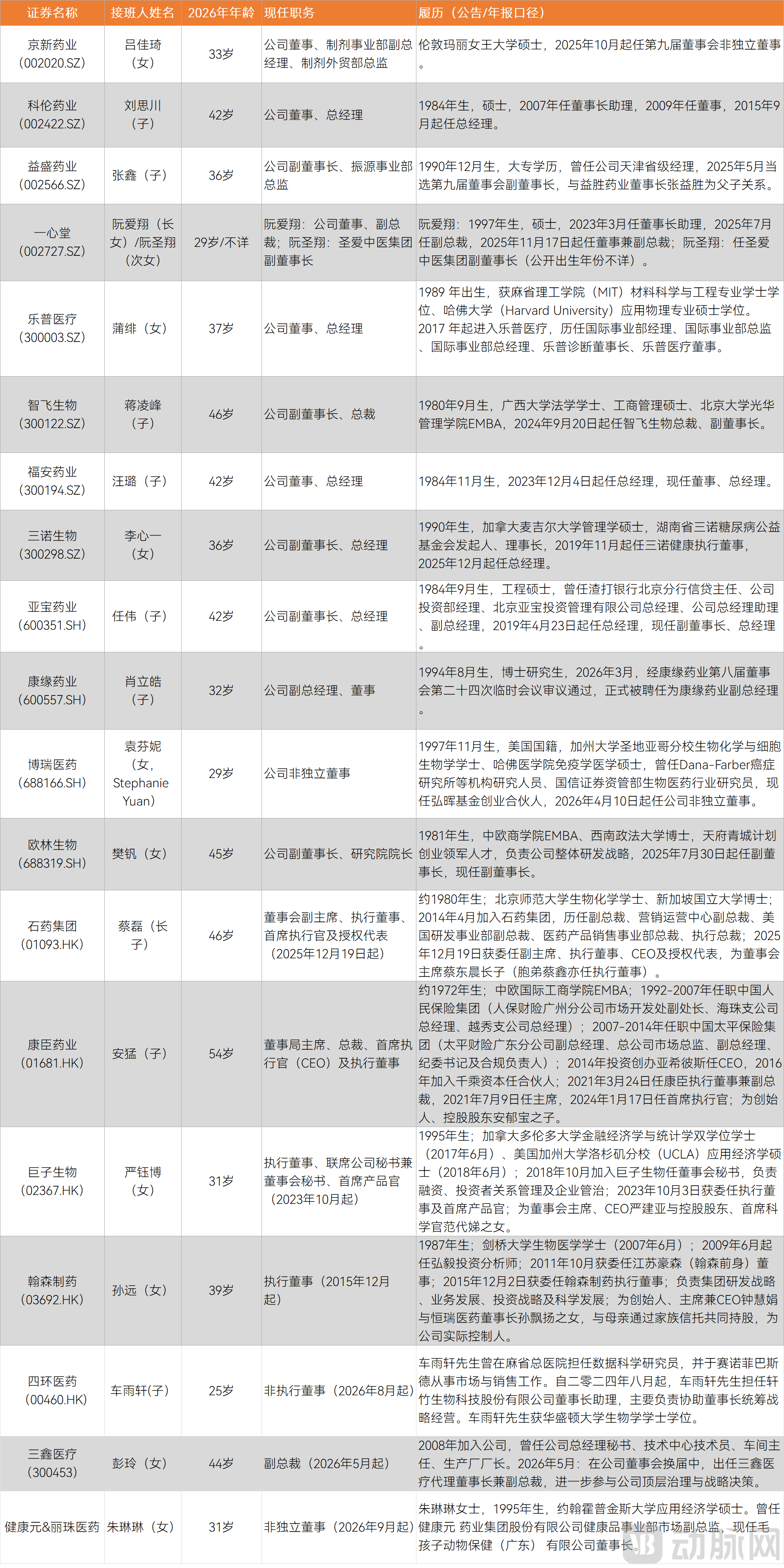
Listed Healthcare Companies with Second-Generation Successors Joining the Management Team
Looking ahead to the next decade, as a cohort of “second-generation founders” who have already entered core management gradually completes the full succession, the governance models of family businesses are undergoing profound reshaping.
In the strategic interplay between family governance and professional management, many enterprises have made their choice in advance by placing their children in frontline roles for practical training. Looking at the current cohort of successors who have already entered senior management, its succession path exhibits two distinct characteristics: one is "technology-driven succession," with professional expertise as the entry point; the other is "operator-led succession," centered on capital operations.
Brian Chang (Chang Yang), son of MicroPort founder Chang Zhaohua, is a quintessential example of a "technology-driven succession." Dr. Chang’s professional background spans physician-scientist and engineer roles, with over a decade of experience in the medical technology industry. He has co-founded and spearheaded early-stage research, development, and business strategies for multiple medtech enterprises.
Prior to this, Dr. Chang served as a postdoctoral fellow and lecturer at the Massachusetts Institute of Technology (“MIT”), where he oversaw interdisciplinary research teams and developed curricula in cardiovascular physiology and medical technology. His academic research focused on cardiac assist devices and extracorporeal life support systems. He has authored 17 peer-reviewed academic papers and is an inventor on multiple patents related to cardiovascular and extracorporeal life support technologies. Dr. Chang has received numerous honors, including the Paul & Daisy Soros Fellowship, the Seidman Prize for Outstanding Thesis, and teaching awards from Harvard Medical School and MIT.
Dr. Chang earned his Bachelor of Science and Master of Science degrees in Mechanical Engineering from Carnegie Mellon University in December 2013 and May 2014, respectively, graduating with university honors and minoring in Biomedical Engineering. He obtained his Ph.D. in Medical Engineering and Medical Physics from the Massachusetts Institute of Technology in June 2018, and his M.D. from Harvard Medical School in May 2023, graduating with high honors. In June 2025, he completed his residency training in Internal Medicine through the Stanbury Physician-Scientist Program at Massachusetts General Hospital.
After establishing an academic pathway for the integration of medicine and engineering, Brian Chang joined MicroPort in 2020 as a Medical Technology Advisor. He played a pivotal role in the clinical validation of core projects, including cardiovascular interventions and surgical robots, and was instrumental in securing FDA and CE certifications for the company’s flagship Toumai surgical robot, thereby helping MicroPort achieve a critical victory in its global expansion efforts.
Leveraging his distinguished academic background and contributions to the commercialization of core products, Brian Chang was appointed Chief Medical Officer of MicroPort in June 2025 and assumed the role of Non-Executive Director of MicroPort CardioFlow Medtech in December of the same year. This career trajectory, which began in specialized technical roles and progressively accumulated management experience, has provided professional endorsement for his succession.
Running parallel to the “technical succession” model is another major path: “succession by capital operators.” These second-generation successors typically possess backgrounds in finance, investment banking, or overseas business schools. They penetrate the core decision-making layer of enterprises through capital operations such as mergers and acquisitions, investments, and overseas business development (BD), thereby securing their succession eligibility by rapidly delivering performance results.
Wu Bin, the son of TIANYIMED’s actual controller and a co-actual controller, is a representative figure of this strategic path. Currently serving as a Director and Deputy General Manager at TIANYIMED, Wu has an educational background in Canada and has been back in China for 12 years to pursue his career. In 2025, he spearheaded two major cross-border mergers and acquisitions for TIANYIMED: acquiring the CRRT (Continuous Renal Replacement Therapy) business of Japan’s Nikkiso, a giant in hemodialysis, for RMB 400 million; and acquiring the CRRT filter business assets of Bellco, an Italian subsidiary of Medtronic, for €11.99 million in a cross-border transaction.
These two transactions have helped TIANYIMED establish an independent, closed-loop ecosystem for its CRRT products. Wu Bin revealed that he and his father have clear divisions of labor: his father oversees domestic production and operations, while he is responsible for overseas mergers, acquisitions, and management. Over the next five years, the focus will be on integrating overseas targets into the listed company and commencing production at overseas factories.
After taking over the reins, Wu Qun of Yuwell Medical also completed several key acquisitions, securing multiple high-growth innovative products. Since becoming Chairman in 2020, he has rapidly expanded the company’s footprint through a series of mergers and acquisitions, including the acquisition of POCTech (CGM) and Chalice Solution (contact lenses), as well as subscribing to equity stakes in Inogen, a North American manufacturer of portable oxygen concentrators. On the business front, he previously drove the company’s e-commerce revenue from RMB 7 million in 2012 to RMB 600 million in 2016, making it a phased growth engine. Whether through deep technological cultivation or capital operations, second-generation successors are leveraging their respective professional advantages to guide enterprises in finding new growth anchors amidst fierce industry turbulence.
The first generation of entrepreneurs largely built their businesses on generic drugs, active pharmaceutical ingredients (APIs), or sales-driven models, fully capitalizing on the industry dividends prior to the implementation of centralized volume-based procurement (VBP). In contrast, the “second generation” successors have taken the helm amid a new reality characterized by the normalization of VBP and compressed profit margins in a zero-sum game for existing market share. Against this backdrop, generational succession is deeply intertwined with strategic corporate transformation, making the pursuit of new growth curves—such as innovative drug development and international expansion—an inevitable choice.
Based on the profile, this cohort of "second-generation entrepreneurs" generally possesses educational backgrounds from top-tier European and American universities, and has accumulated practical experience in multinational corporations, investment banks, or private equity firms. Leveraging this composite background, they have predominantly made capital operations and international expansion the core strategic levers for breakthroughs after assuming leadership.
CSPC Pharmaceutical Group is a typical example of second-generation leadership driving external collaboration. Cai Lei, the eldest son of founder Cai Dongchen, joined the company in 2014 and has long overseen its U.S. R&D division, playing a key role in overseas capital engagement, the Hong Kong IPO, and a landmark $420 million partnership with AstraZeneca. His younger brother, Cai Xin, who also holds a pharmacy degree from Purdue University and previously worked at CDH Investments, returned to the company in 2022 as Executive President and President of the Marketing Decision-Making Center, focusing primarily on sales operations.
Business development (BD) efforts have played a pivotal role in CSPC’s transformation. In the first half of 2026, CSPC Pharmaceutical Group reported revenue of RMB 18.594 billion, representing a year-on-year increase of 40.09%. BD licensing income emerged as a performance highlight, with the recognition of upfront payments from long-acting peptide platform BD deals contributing RMB 5.895 billion in licensing fee revenue to CSPC Pharmaceutical Group.
The case of Sino Biopharmaceutical illustrates the accelerating role of the second generation in driving innovation and transformation. Following the full succession of the fourth generation of the Chearavanont family, namely Kevin Hsieh and Richard Hsieh, Charoen Pokphand Group has shifted its strategic focus entirely toward innovative drugs. In terms of capital and business development (BD), the company has successively acquired Lexin Pharma, Hegia Biologics, and Haoubo, while also establishing collaborations with Sanofi and GSK, thereby advancing pipeline construction through a dual-drive strategy of external in-licensing and internal R&D.
Currently, China Biopharma has officially entered a period of intensive harvest for innovative drugs, with a cumulative total of 20 National Class 1 or Class 2 innovative drugs and 8 biosimilars approved, placing its technology transfer efficiency at the forefront of the industry. In the first half of 2026, China Biopharma achieved revenue of RMB 19.44 billion, a year-on-year increase of 10.6%; among this, BD (Business Development) revenue reached RMB 980 million, surging by 2101.9% year-on-year, while sales revenue from innovative drugs amounted to RMB 7.81 billion, representing a year-on-year growth of 29.2%.
Amid the impact of centralized volume-based procurement (VBP), second-generation successors have also demonstrated the resolve to decisively restructure their business portfolios. Taking Salubris, a leading cardiovascular pharmaceutical company, as an example, current Chairman Ye Yuxiang officially took the helm in 2022. Confronted with growth bottlenecks and declining revenues in its generic drug business, he firmly anchored the company’s strategy in its core cardiovascular strengths, increased investment in innovation, and divested low-end generic drug projects to free up capital. This transformation has yielded significant results: in the first half of 2026, innovative drugs accounted for 54.8% of Salubris’ revenue, surpassing traditional businesses and marking a substantive shift in strategic focus. Furthermore, third-generation family members have joined the management team, signaling a long-term governance planning intent.
Collectively, these cases reflect the common characteristics of second-generation succession in the pharmaceutical industry: intergenerational transitions are often accompanied by profound strategic adjustments. The second generation tends to respond to industry shifts through capital operations and business restructuring, rather than simply continuing their predecessors’ operational models. This generational shift is essentially an inevitable strategic choice for pharmaceutical companies under the dual pressures of normalized centralized procurement and innovation-driven transformation.