

Hospital-Facing Medtech Giants Like Mindray, United Imaging, and WEGO Turn to Cutthroat Home Medical Device Market as Institutional Profits Shrink

Weigao
Blood Purification Product R&D and Manufacturer

Mindray
Medical Device R&D Manufacturer

United Imaging
High-end Medical Device Developer
Medical device companies that once relied heavily on hospital-based sales and enjoyed high margins are now feeling the industry’s chill. Mounting pressure from centralized procurement, price competition, and delayed hospital payments is squeezing margins in the hospital market.
In this scenario, leading companies are quietly positioning themselves in the home medical device market.
Lao Zhou remembers the winter of 2019 with exceptional clarity.
That year’s annual party was held at a resort hotel in the suburbs. With over thirty employees, we had booked an entire floor. After several rounds of drinks, Lao Zhou stood on stage, raising his glass, his face flushed red. He urged everyone to work hard, promising to double our revenue the following year and give each employee a substantial year-end bonus. The audience erupted in thunderous applause, with some even whistling.
That year, he held the distribution rights for several imported orthopedic products. A set of imported hip prostheses had an ex-factory price of approximately RMB 11,000, but could be sold to hospitals for RMB 40,000–60,000. At times, distributors earned even more than the manufacturers.
That was the golden age of hospital-side medical devices.
How profitable is it? The figures sound like a fantasy. Take a domestically produced coronary stent as an example: its ex-factory price is 3,000 yuan, but the price rises to 11,500 yuan once it enters hospitals. For a set of domestically produced artificial joints, the ex-factory price ranges from 3,000 to 4,000 yuan, while the terminal price ranges from 15,000 to 60,000 yuan.
Lao Zhou estimates that at the time, the cost for distributors to procure goods from manufacturers accounted for only about one-third of the hospital procurement price. The price difference in between was entirely retained as a profit pool for the distribution chain.
Back then, success in this business depended not on product quality but on personal connections. Those who had strong ties with hospital presidents, department heads, and equipment division managers, and who maintained effective client relationships, were the ones whose products could gain entry, achieve widespread distribution, and see actual clinical use.
Lao Zhou was one of the distributors. In 2008, he resigned from his sales position at a foreign medical device company, armed with tens of thousands of yuan in savings and a contact list, and rented a 20-square-meter office to start his business. Over ten years, he transformed from a traveling salesman carrying a backpack into a boss managing thirty employees, bought a house, upgraded his car, and enrolled his child in a prestigious local private school.
He thought the good times would last forever.
In 2019, the market size of China's medical device industry exceeded RMB 600 billion, with an annual growth rate surpassing 10%. That year, following the launch of the STAR Market, a batch of medical device companies, including MicroPort Endovascular and Nanwei Medical, rang the bell for their IPOs, experiencing widespread stock price increases in the early stages of listing. Everyone believed that the convergence of three major trends—accelerating population aging, consumption upgrading, and import substitution—made medical devices the most certain high-growth sector for the next decade.
No one would have imagined that a storm had already formed on the sea.
The Storm’s Name: Volume-Based Procurement.
From 2020 to 2026, over the course of a few years, volume-based procurement has evolved from a new variable in the industry into a normalized policy environment.
From coronary stents to orthopedic joints, from spinal consumables to dental implants, and from electrophysiology to biochemical reagents and trauma care supplies, an increasing number of high-value medical consumables have been included in the scope of centralized procurement. Prices have generally declined, with average reductions ranging from 50% to 70%, and some categories seeing price cuts of up to 90%. Companies have widely adopted a strategy of exchanging volume for price, leveraging successful bids to expand market share and offset the impact of lower unit prices.
However, the downward pressure on prices has been tangibly transmitted throughout the entire industry chain. Manufacturers’ profits are shrinking, and distributors have shifted from being mere intermediaries to logistics and distribution service providers, with gross profit margins falling from the tens of percent in the past to single digits.
If centralized procurement has driven down overall industry prices, then homogeneous competition has further intensified the price war.
In the medical device industry, the technical barrier to entry is neither particularly high nor low. For globally pioneering or truly critical high-end products that address key bottlenecks, only a handful of domestic companies in China are capable of manufacturing them. However, for most conventional categories—such as drug-eluting stents, trauma plates, surgical staplers, and low-value catheters—the technology is already highly mature, leading to a surge of Chinese manufacturers entering these markets.
For products within the same category, where materials and manufacturing processes are similar and there are no significant differences in clinical outcomes, price often becomes a key competitive factor when physicians have considerable discretion in their selection.
For instance, in the sixth round of China’s National Centralized Procurement (Coronary Drug-Coated Balloon Category), more than 30 companies submitted bids and were selected, with final prices dropping from over RMB 10,000 in the past to RMB 1,677–6,015. Moreover, similar price wars are unfolding in niche segments such as surgical staplers, ultrasonic scalpels, and disposable flexible ureteroscopes.
Perhaps in response to the detrimental effects of cutthroat competition on the industry, the National Healthcare Security Administration (NHSA) explicitly included “anti-cutthroat competition” principles in its centralized procurement guidelines for the first time in 2025. Furthermore, in the sixth batch of centralized procurement for high-value medical consumables in 2026, the NHSA introduced anchor pricing and a revival mechanism to guide enterprises toward rational bidding.
The launch of policies to “counter involution” itself indicates that involution has reached a severity necessitating policy intervention.
Lao Zhou said: "In the wake of the storm, medical device companies focusing on the hospital market are finding it increasingly difficult to make profits."
Taking high-value consumables companies as an example, profits continue to thin under multiple factors, including price declines, R&D investment, channel adjustments, and foreign exchange losses.
For example, WEGO Orthopedics reported revenue of RMB 2.154 billion and net profit attributable to shareholders of RMB 690 million in 2021, with an overall gross margin as high as 81.17%. In 2022, the centralized procurement of trauma and joint products was implemented successively, causing revenue to drop first to RMB 2.058 billion; In 2023, the national centralized procurement for spinal implants was fully implemented across China, compounded by channel inventory adjustments of Single-Impact, with its revenue dropping directly to RMB 1.284 billion (-37.63%), Net profit drops to just 112 million yuan,Reduce by 80%(-81.30%), with the gross profit margin also compressed to 66.5%。In 2024, its Revenue (1.453 billion) and net profit (224 million) are gradually recovering, but Gross profit margin further declined to 65.73%. Over the past four years, the gross profit margin on sales rose from 81% dropped to 66%, a decline of Approx 15 percentage points.
The 2026 interim reporting season has pushed the sentiment of “increasingly difficult to make money” to its peak.
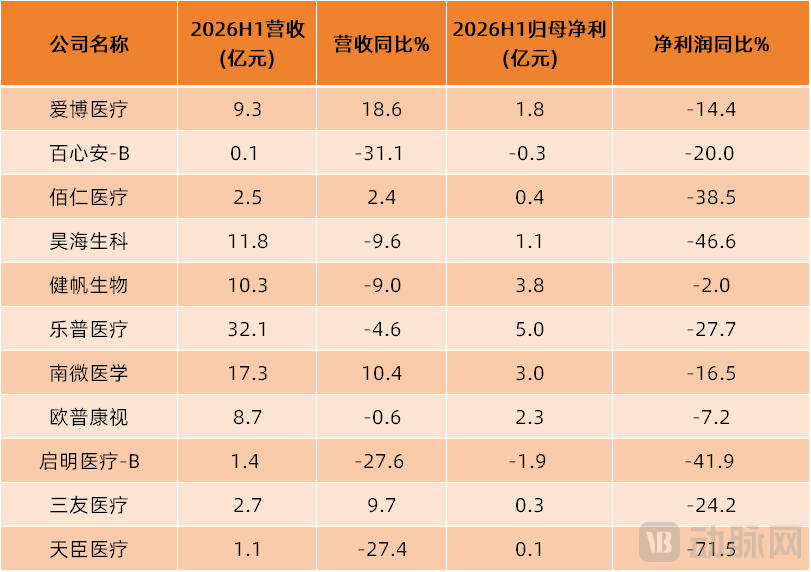
(Data sourced from corporate financial reports)
Touchstone’s net profit dropped by 71.5%, Venus Medtech by 41.9%, Haohai Biological Technology by 46.64%, Balance Medical by 38.54%, and Lepu Pharmaceutical by 27.71% (a year-over-year decline of approximately 14.8% in non-recurring net profit after excluding one-time expenses)... Although the reasons for the decline in net profit vary among companies (pricing, R&D, distribution channels, foreign exchange fluctuations, etc.), the trend is highly consistent. This indicates that generating profits has become significantly more challenging for high-value medical consumable companies than it was in the past.
However, the profitability of some high-value consumables companies continues to grow.
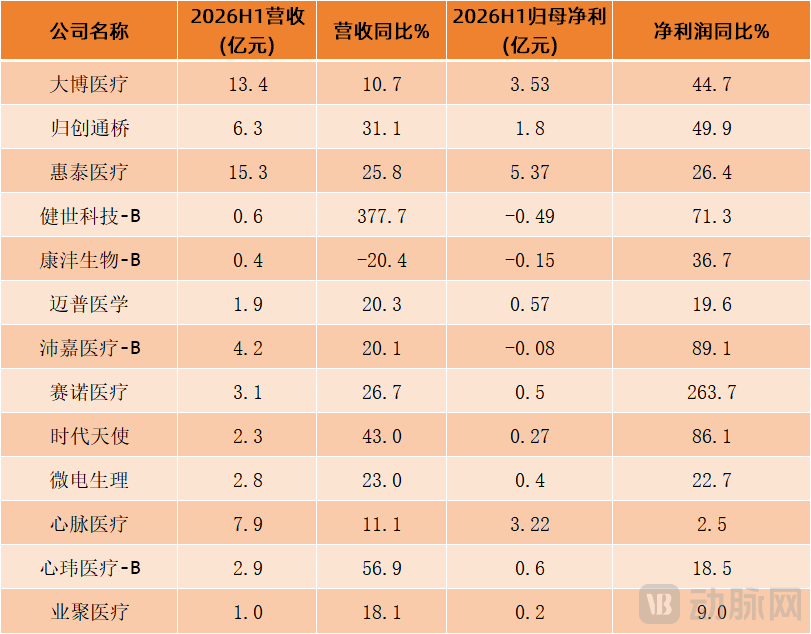
(Note: The financial report currencies for Angelalign and OrbusNeich are in US dollars.)
Sinomed’s net profit increased by 263% year-on-year, APT Medical grew by 26%, Zylox-Tonbridge grew by 50%, and Double Medical grew by 45%. After excluding the impact of factors such as share-based payments and foreign exchange losses, Sanyou Medical’s net profit attributable to shareholders of the parent company increased by 41.58% year-on-year... The underlying logic behind these outperforming companies is largely similar.
The most critical strategy is global expansion: In the first half of 2026, APT Medical’s overseas revenue reached RMB 195 million, a year-on-year increase of 35.9%; Endovastec’s overseas revenue grew by more than 21% after excluding exchange rate impacts. As domestic competition intensifies, companies are seeking incremental growth in overseas markets.
In addition to overseas expansion, another driving factor is the ramp-up of innovative products. For instance, Sino’s neurointerventional coated dense-mesh stents and APT Medical’s pulsed field ablation (PFA) systems have been on the market for a short period and face limited competition, thereby maintaining high gross profit margins.
However, these companies with positive growth are ultimately a minority within the high-value consumables sector. For distributors like Lao Zhou, the fact that the profits of the vast majority of manufacturers are declining means that their own profits will fall even more sharply.
Hospital-side business: Not only high-value consumables, but also medical equipment are becoming increasingly difficult to operate.
Based on bidding data from recent years, prices for high-end medical equipment have seen only a slight decline, whereas prices for mid- to low-end medical equipment have dropped significantly. Taking the bundled procurement of equipment upgrades within county-level medical consortia as an example, domestically produced basic 1.5T MRI systems can be priced as low as RMB 2 million, basic 64-slice CT scanners at approximately RMB 1 million, and basic whole-body ultrasound systems at under RMB 500,000. A few years ago, the standalone procurement prices for equipment of comparable tiers were nearly double these levels.
This downward pressure on prices is also evident in the financial reports of listed companies.
Taking WDM as an example, its revenue in the first half of 2026 reached RMB 875 million, a year-on-year increase of 3.71%. However, the net profit attributable to parent company shareholders recorded a loss of RMB 91.67 million, marking a shift from profit in the same period last year to a loss. The comprehensive gross profit margin dropped directly from 35.16% in the same period last year to 24.94%, a decrease of 10.21 percentage points within one year.
It stated that the decline in gross profit margin was primarily attributable to the “price-for-volume” strategy adopted in centralized volume-based procurement (VBP). Other contributing factors included reduced hospital procurement, high costs of core components, and the failure of economies of scale to materialize. In 2025, WDM participated in 34 provincial-level VBP programs, winning bids for 932 units of equipment with a total bid amount of RMB 520 million and an average discount rate of 46%. The company’s annual gross profit margin fell to 26.56%, representing a drop of nearly 20 percentage points from 45.82% in 2021.
The price cut has significantly eroded profits in the medical device industry. Yet, pricing is not the most critical challenge.
The most critical issue is the inability to recover payments.
Lao Zhou has a friend who works as an agent for medical imaging equipment. The business was manageable in the previous couple of years: although payment collection was slow and capital tie-up was significant, the high unit price and substantial profit margins of the equipment made it sustainable. However, conditions have become increasingly difficult in the past two years. Previously, a payment cycle of three to six months was considered normal within the industry. Currently, many public hospitals have extended their payment cycles, placing immense cash flow pressure on both distributors and equipment manufacturers due to increased capital tie-up.
This trend of slowing payment collections is inescapable, even for industry leaders. United Imaging Healthcare reported accounts receivable of RMB 5.59 billion in 2025, a year-on-year increase of 28%. In the first half of 2026, its days sales outstanding (DSO) reached 146.2 days, an increase of approximately 5 days compared to the same period last year.
If even the industry leaders are facing such challenges, the pressure on small and medium-sized equipment manufacturers and distributors is unimaginable.
The squeeze from slow collections and falling prices was directly reflected in the 2026 interim report.However, the decline in net profit for these companies was also influenced by a combination of factors, including R&D expenses, overseas investments, foreign exchange losses, and new business development.
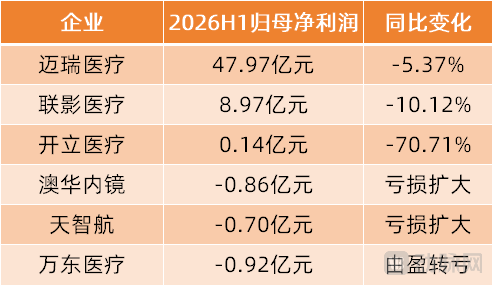
Data Source: 2026 Semi-Annual Reports of Various Companies
And this applies only to listed companies. Small and medium-sized equipment manufacturers that are not publicly listed have even weaker risk resilience: lacking access to capital market financing, they rely entirely on reinvesting their own funds; a single large accounts receivable delayed by a year or even half a year could sever their cash flow.
Inventory ties up principal capital, while delayed payments strangle cash flow. Centralized procurement and cutthroat competition further squeeze profit margins. Under the weight of these three major burdens, medical device manufacturers have seen their profits steadily decline. The once high-spirited bosses who distributed medical devices are no longer as confident; today, they either quietly dissolve their companies and exit the market or swallow their pride to seek employment with manufacturers, taking fixed salaries as regional managers.
From Boss to Employee: The Nuances of This Transition Are Hard to Grasp Without Personal Experience.
Unlike the hospital-end market, the domestic home medical device market in China has been growing in recent years. From RMB 53.3 billion in 2017 to RMB 102.5 billion in 2021, and further to RMB 168.2 billion in 2023, the market size of home medical devices in China has almost grown at a double-digit rate every year. LeadLeo Research Institute predicts that it will reach RMB 178.4 billion in 2026.
Amid overall market growth, most domestic home-use medical device companies have achieved positive growth in revenue and profits. In the first half of 2026, BMC Medical’s revenue increased by 40.3%, Cofoe Medical grew by 38.51%, Sinocare’s net profit rose by 22.52%, and Transtek Medical’s net profit surged by 41.96%... In contrast to the chill felt in the hospital sector, the home-use medical device segment remains largely characterized by growth and profitability.
More Notably, Leading Players in the Hospital Sector Are Also Beginning to Shift Their Focus Toward the Home Care Market.
As the undisputed leader in China’s medical device industry, with a significant lead in both revenue and profits, Mindray identified public demand for patient monitoring and life support products as early as 2025. This demand has expanded from mere treatment to long-term disease management and proactive health maintenance. In response to this shift, Mindray has independently developed A Novel Solution for Chronic Disease Management Based on Wearable Sensors and AI-Driven Diagnostic and Early Warning Algorithms. This program aims to address the bottlenecks across hospitals, primary care facilities, and home settings, thereby achieving continuous, integrated management.
Currently, Mindray’s chronic disease management solutions have gained recognition from some top-tier hospitals in international markets such as Europe and have begun to be implemented.
In the first half of 2026, Mindray Medical once again disclosed that its Developing Next-Generation Wearable Monitoring Products, specifically including lighter, miniaturized ECG sensors with extended battery life, miniature temperature patches supporting wireless continuous monitoring, and more comfortable, lightweight integrated blood pressure monitors.
As Mindray expands into the home medical device sector, WEGO Group is also intensifying its efforts: Expanding Its Presence in the Home Medical Device Market Through the “WEGO Health” Brand. In 2025, the company exclusively launched a range of home-use medical devices at CMEF (China International Medical Equipment Fair), including positive-pressure ventilation therapy devices, automatically oxygen-controlled oxygen concentrators, wrist-worn pulse oximeters, and blood pressure monitors with atrial fibrillation detection.
Following the launch of the new product, WEGO’s oxygen concentrator production line quickly reached full capacity, with the company initially projecting that sales revenue for this single product would reach RMB 100 million in 2025.
In 2026, WEGO partnered with JD.com to launch the Weigao Health AOT Oxygen Concentrator online for the first time. Sales exceeded 200 units in a single live-streaming session, surpassing the daily sales volume of leading oxygen concentrators in the industry, making it a significant new product in the oxygen concentrator market.
WEGO Group’s entry into the home medical device market is not a tentative effort through OEM or other minor approaches, but rather a significant investment in independent R&D. The company has not only overcome critical bottlenecks in core components but also developed the world’s first AOT (Automatic Oxygen Flow Regulation) technology. This sufficiently demonstrates its strong commitment to betting on the home medical device market.
In addition to Mindray and WEGO, United Imaging, a leading medical equipment manufacturer, is also increasing its investment in the home medical device market. In 2024, United Imaging developed its own heterogeneous hexa-core chip and Chinese speech enhancement algorithm, launched its first medical-grade hearing aid, and began selling it through offline outlets.
At the 2025 CMEF, United Imaging Health signed strategic cooperation agreements with JD Health and Tmall Health, officially launching the sales of its hearing aid products on the JD.com and Tmall e-commerce platforms.
At the 2026 CMEF, United Imaging Healthcare showcased four major home medical devices: the uOrigin Source Series medical-grade hearing aids, the uCGM continuous glucose monitoring system, the all-in-one flexible dynamic ECG system, and the integrated remote consultation insulin pump system.
In fact, hospital-side leaders such as Mindray, WEGO, and United Imaging have intensively entered the home medical device sector, not to tap into a low-competition, high-margin market for easy profits. Nowadays, competition in the home medical device market has long since reached a fever pitch; with industry giants entering the fray, companies must be prepared for intense, close-quarters combat.
For instance, in the CGM market, companies are embroiled in price wars, with the price per sensor dropping from several hundred yuan in previous years to around one hundred yuan currently. Similarly, the hearing aid market is crowded with brands and suffers from serious homogenization, as domestic and imported brands engage in direct competition across channels, technology, and cost-effectiveness, leading to escalating rivalry...
Undeniably, leading hospital-based players are crossing over into the home-use sector, Possessing Distinct Competitive Advantages: Leveraging the R&D capabilities for medical-grade products developed through long-term in-house accumulation, it boasts strong hardware technical prowess; meanwhile, its products can integrate with the hospital’s internal systems, creating opportunities to build an integrated, end-to-end health solution that spans both in-hospital and out-of-hospital settings.
However, the shortcomings also objectively exist: Corporate inertia has perpetuated the hospital-centric industry mindset, with continued heavy emphasis on traditional offline medical device exhibitions such as CMEF. In contrast, when facing the home-use market, insufficient experience reserves in e-commerce operations, online traffic management, and B2C consumer brand marketing have become evident weaknesses.
Overall, hospital-side powerhouses such as Mindray, United Imaging, and WEGO are collectively crossing over into the home medical device market. This previously hyper-competitive sector is poised for a new competitive landscape. Hospital-side leaders, armed with medical-grade technologies and in-hospital resources, will engage in direct confrontation with home-device giants that have deep expertise in consumer-facing channels and mass-market dynamics, ushering in an intense, head-to-head market battle.
As incumbents and newcomers compete on the same stage, leveraging complementary strengths while engaging in strategic rivalry, the logic of industry competition and the market landscape may be thoroughly reshaped. VCBeat will continue to monitor the ultimate outcome of this cross-sector breakthrough, the future development trajectory of the home-use segment, and the evolving competitive dynamics across the entire medical device industry.