

Cell: In Vivo mRNA-Encoded CD19×CD3 T Cell Engager ABO2203 Shows Safety and Efficacy in Refractory Immune Thrombocytopenia

Abogen
Nucleic Acid Drug Developer

By Wang Cong
Editor | Wang Duoyu
Typesetting | Shui Chengwen
Immune Thrombocytopenia(ITP)is a life-threateningAutoimmune Diseases, which is associated with an increased risk of bleeding. The disease is classified into two types: primary and secondary. Secondary ITP is often associated with systemic lupus erythematosus.(SLE), Sjögren's Syndrome (SS) and Antiphospholipid Syndrome(APS)Relevant. ITP is characterized by accelerated platelet clearance and impaired megakaryocyte production, primarily driven by the loss of immune tolerance to platelet autoantigens. Only 20%-40% of patients can maintain therapeutic efficacy after gradual tapering of glucocorticoids. A significant proportion of patients receive other treatments(e.g., thrombopoietin receptor agonists, rituximab, BTK inhibitors, or splenectomy), adequate remission still could not be achieved.
In recent years, innovation in the treatment of autoimmune diseases has shifted toward potent immunomodulatory strategies, such asCAR-T Cell TherapyandT Cell Engager(T cell engager,TCE). However, CAR-T cell therapy is limited by complex manufacturing processes, long production cycles, the need for lymphodepleting preconditioning, and the risk of cytokine release syndrome.(CRS), Immune Effector Cell-Associated Neurotoxicity Syndrome(ICANS)such as side effects, and the limitations of potential mutagenesis risks caused by genomic integration or insertion. Protein-based TCEs require gradual dose escalation to mitigate the risk of CRS, thereby increasing the complexity of clinical management. Furthermore, TCEs carry a risk of immunogenicity.
In contrast, mRNA-based TCE enables progressive systemic exposure, avoiding high peak concentrations(Cmax)Associated toxicities, such as cytokine release syndrome(CRS). Furthermore, endogenously expressed TCE may reduce the risk of immunogenicity. Overall,The mRNA-encoded TCE platform has emerged as a potent strategy to “reboot” the immune system in patients with refractory autoimmune diseases, owing to its superior safety profile, ease of administration, and robust penetration into deep tissues.。
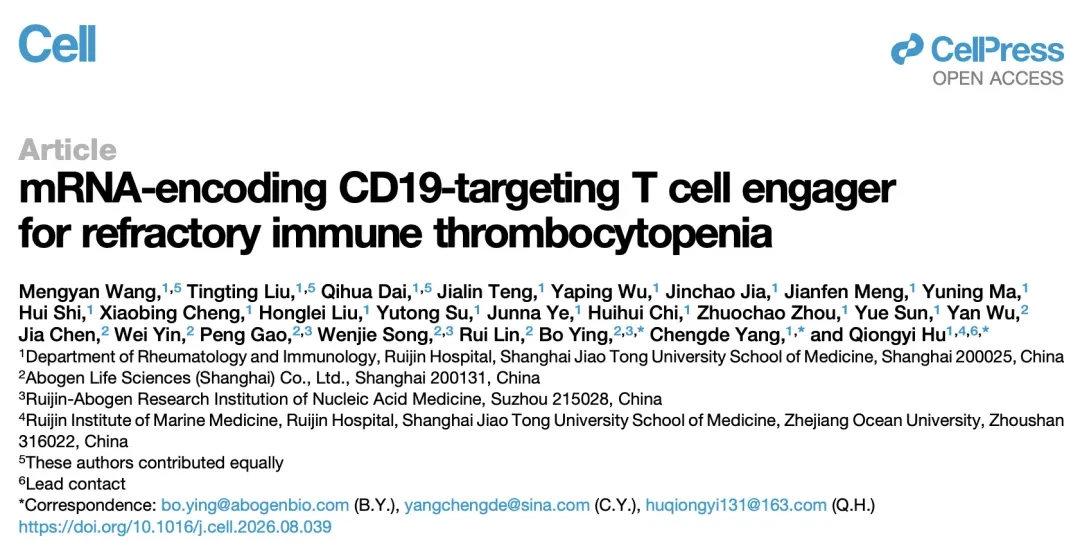
DespiteT Cell Engager(TCE)andCAR-T Cell TherapyShows clinical promise in B-cell depletion but still faces challenges in terms of safety, efficacy, and durability.
ABO2203is byAbogenA developed method employingLipid Nanoparticles(LNP)DeliveredmRNAProduct, encodableCD19×CD3 TCE. In this study involving three patients with refractory secondaryImmune Thrombocytopenia(ITP)In a small clinical study of patients, ABO2203 achieved CD19 in peripheral blood and bone marrow+Rapid and complete B-cell depletion achieved a complete platelet response and demonstrated a favorable safety profile.
This paper elaborates in detail on the development progress of ABO2203, integrating preclinical data with the firstFirst-in-Human Study(first in human)The results were bridged.
Specifically, ABO2203 is an mRNA-based therapeutic encoding a multispecific T-cell engager—P4107—for B-cell depletion. The P4107 protein has a molecular weight of only approximately 67 kDa and features a trifunctional domain design—Anti-CD19 scFv(Precise Targeting of B Cells)、Anti-CD3 scFv(Binding and activating T cells)andAnti-human serum albumin heavy chain variable region(Extended half-life)Furthermore, to enhance the translation efficiency and transcriptional stability of the mRNA, the research team employed codon optimization, nucleoside modification, and engineering of the untranslated regions. The mRNA is encapsulated in a proprietary lipid nanoparticle (LNP) formulation, which offers high delivery efficiency and a favorable safety profile.

The research team confirmed that, in transgenic mice, ABO2203 induced complete B-cell depletion and elicited a lower degree of cytokine release compared with the TCE protein.
The research team further conducted a study targeting three patients with refractory secondaryImmune ThrombocytopeniaSymptom(ITP)First-in-Human Study in Patients(first in human), Patient 1(35-year-old female)For Systemic Lupus ErythematosusSecondary ITP; Patient 2(46-year-old female)for Sjögren's syndromeSecondary ITP; Patient 3(48-year-old female)For Antiphospholipid SyndromeSecondary ITP.
The results demonstrated that ABO2203 achieved rapid and complete depletion of peripheral B cells, with sustained depletion effects maintained in the bone marrow. During the 6-month follow-up period, patients exhibited durable platelet recovery, improved serological markers, and reduced disease activity. ABO2203 was well tolerated, with only Grade 1 and Grade 2 adverse events reported, and no cases of cytokine release syndrome occurred.(CRS), the study also observed B-cell reconstitution in patients, predominantly consisting of transitional and naive B cells.
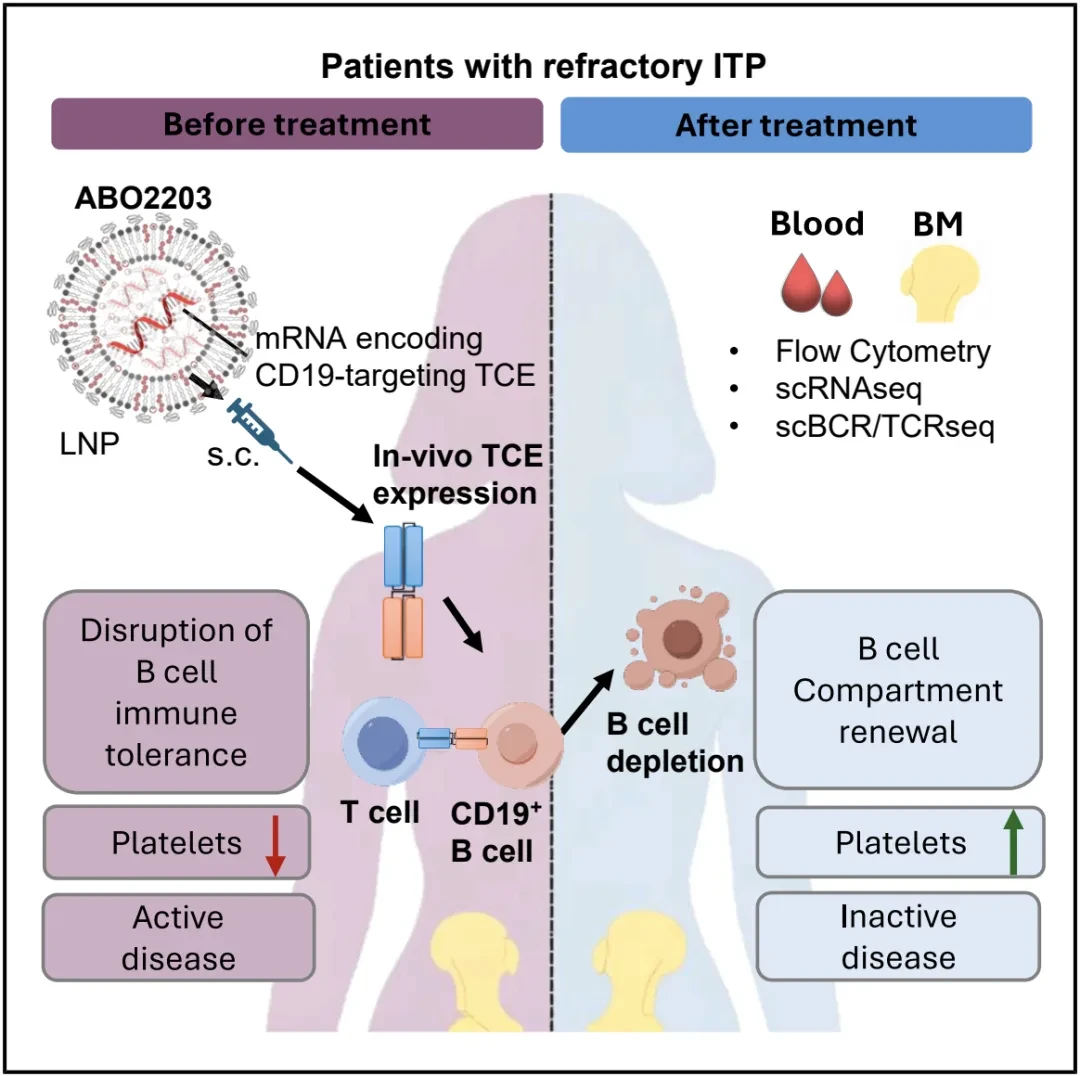
Highlights of the Study:
ABO2203 is an mRNA-LNP encoding a CD19×CD3 TCE for B-cell depletion;
ABO2203 induces complete B-cell depletion in mice, accompanied by attenuated cytokine release;
ABO2203 achieved rapid and complete B-cell depletion in three patients with refractory ITP;
All three patients demonstrated durable platelet recovery without severe toxicities.
Overall, these results confirm that mRNA-encoded TCE is a more effective and safer therapeutic approach for B cell-mediated autoimmune diseases.
Overall, this study is the first to validate “mRNA In Vivo Encoding of TCE"This novel therapeutic modality, withCompared with CAR-T cell therapy, ABO2203 achieves comparable depth of B-cell depletion with only microgram-level subcutaneous doses, and offers a more controllable recovery process; compared with protein-based TCEs,ABO2203 half-life extended to 7-11 days, enablingClearance of deep tissues such as bone marrow and lymph nodes without the need for complex, long-term dose-escalation regimens. This study inProof of concept completed in patients with refractory secondary ITP, confirming thatmRNA-encoded TCE is a more effective and safer therapeutic approach for B cell-mediated autoimmune diseases.
Paper Link:
https://www.cell.com/cell/fulltext/S0092-8674(26)01012-3








DotWatching, Convey Your Taste