Dedicated BCI Testing Platform Launched in Tianjin; Consortium Tender Initiated for Four Categories of Medical Consumables

Sunnyou
Intelligent Rehabilitation Equipment R&D and Manufacturer

Comprehensive Medical Information
1. Brain Science and Brain-Computer Interface Industry Cluster Area Plaque Unveiling
Recently, the Beijing Brain Science and Brain-Computer Interface Industry Innovation and Development Promotion Conference was held at the Changping Life Valley International Precision Medicine Industrial Park. During the conference, the Brain Science and Brain-Computer Interface Industry Cluster Zone was established in Changping, and the Brain Science and Brain-Computer Interface Industrial Park was officially inaugurated. The Zhongguancun (Changping) Brain Science and Brain-Computer Interface Industry Cluster Zone will focus on building a "one core, one city" industrial structure: "one core" refers to leveraging the leading role of the Zhongguancun Life Science Park, relying on its concentration of innovative resources and elements to accelerate enterprise incubation and the transformation of scientific achievements, promoting the rapid formation of an industrial cluster; "one city" refers to accelerating the construction of the International Medical Device City to support industrial implementation and create a high-end manufacturing base. According to the plan, by 2027, the industrial cluster zone will have initially taken shape, promoting the application of new technologies, products, and models in various scenarios. By 2030, the industrial cluster zone will be fully completed, with innovation capabilities and overall strength ranking among the world's best, striving to form a new billion-yuan-level future industrial cluster. (China News Service)
2. A Special Testing Platform for Brain-Computer Interfaces Established in Tianjin
Recently, the "Brain-Computer Interface 50 Forum" of the Brain-Computer Interface Industry Alliance and the Tianjin Brain-Computer Interface Industry Innovation and Development Promotion Conference were held in Tianjin Binhai High-Tech Zone. The specialized testing platform for brain-computer interfaces was officially signed and started construction. This signed specialized testing platform for brain-computer interfaces, established through the cooperation between the Haihe Laboratory of Brain-Computer Interfaces and the Tianjin Medical Device Quality Supervision and Inspection Center, will promote industry standardization, improve product quality, enhance China's technical independence and international discourse power, and facilitate the practical application of brain-computer interface technology by establishing relevant testing standards. It was announced at the conference that the first “Global Brain-Computer Interface Developers Conference” in 2025 will soon be launched in Tianjin, promoting the open sharing of upstream development platforms and resources for brain-computer interfaces, sowing the seeds of “open source” for numerous midstream and downstream enterprises and technology enthusiasts, allowing brain-computer interface technology to empower various industries and benefit thousands of households. (Tianjin Daily)
Launch of the Category 3 and 4 Consumables Alliance Centralized Procurement
Recently, the "Notice on the Centralized Maintenance of Information for Medical Consumables Such as Ureteral Stents" revealed that Sir Run Run Shaw Hospital of Zhejiang University School of Medicine, Zhejiang Cancer Hospital, Zhejiang Hospital, and the Obstetrics and Gynecology Hospital of Zhejiang University School of Medicine will jointly lead the organization of a new round of consumables procurement in Zhejiang Province. According to the notice, the types of consumables involved in this information maintenance include: ureteral stents, microwave ablation electrodes (needles, knives), coronary cutting balloon catheters, and cervical dilation balloons. The product maintenance period is from 9:00 on September 26, 2025, to 17:00 on October 16, 2025. Notably, the procurement categories in Zhejiang this time have all entered the scope of national or provincial large-scale alliance procurement. (Medical Device Dealers Alliance)
4. Sunnyou Medical Signs Cooperation Agreement with Zhejiang Provincial People's Hospital
Recently, the launch ceremony of the Brain-Computer Interface and Neuromodulation Clinical Research Ward and the International Frontier Technology Seminar were held at Zhejiang Provincial People's Hospital. At the event, Wang Yong, Party Secretary of Zhejiang Provincial People's Hospital, and Ye Xiangming, Director of the Department of Rehabilitation Medicine, jointly unveiled the Brain-Computer Interface and Neuromodulation Clinical Research Ward. Among the innovations, Sunnyou’s Brain-Computer Interface - Neurorehabilitation EMG Biofeedback Therapy System, Brain-Computer Interface - Swallowing Nerve and Muscle Electrical Stimulation Device, and Brain-Computer Interface - Ward Care System will be introduced into the ward for clinical validation, providing targeted treatment and care support for patients. Subsequently, He Yongzheng, Chairman of Sunnyou, and Zhang Dahong, Vice President of Zhejiang Provincial People's Hospital, signed a cooperation agreement. In the future, the two parties will carry out in-depth cooperation in areas such as clinical research, technology transfer, and talent training related to brain-computer interfaces and neuromodulation. (Securities Times Network)
5. Biolinq's Autonomous Glucose Sensor Receives FDA Approval
Recently, Biolinq, a developer of wearable technology, has received FDA approval for its biosensor that can continuously measure glucose levels just below the skin's surface without the use of needles. The San Diego-based company claims that its coin-sized Biolinq Shine device incorporates several innovations, including being a fully autonomous, needle-free glucose sensor with an integrated display, allowing it to show readings without needing to connect to a smartphone. According to Biolinq, this forearm-worn device can also monitor activity and sleep information through a smartphone app and provides real-time feedback on the user’s blood sugar levels via LED indicator lights. A blue light indicates that glucose is within the target range, while a yellow light signals a high blood sugar state. (pharmaphorum)
6. A New Method for Early Screening of AD Has Been Approved by IVDR
Recently, ADmit Therapeutics, a Spanish biotechnology company, announced that its MAP-AD blood test for assessing the risk of Alzheimer's disease has received IVDR CE registration. The test is an in vitro diagnostic method that evaluates the likelihood of individuals with mild cognitive impairment (MCI) progressing to Alzheimer's disease dementia by measuring epigenetic markers in mitochondrial DNA. Although brain amyloid pathology is commonly used to identify patients at risk of Alzheimer's disease, not all individuals with amyloid pathology will develop symptoms such as dementia. The MAP-AD test aims to assess the likelihood of individuals with MCI progressing to dementia, regardless of their amyloid status. (IVD Tool)
7. What is the medical device public service platform?
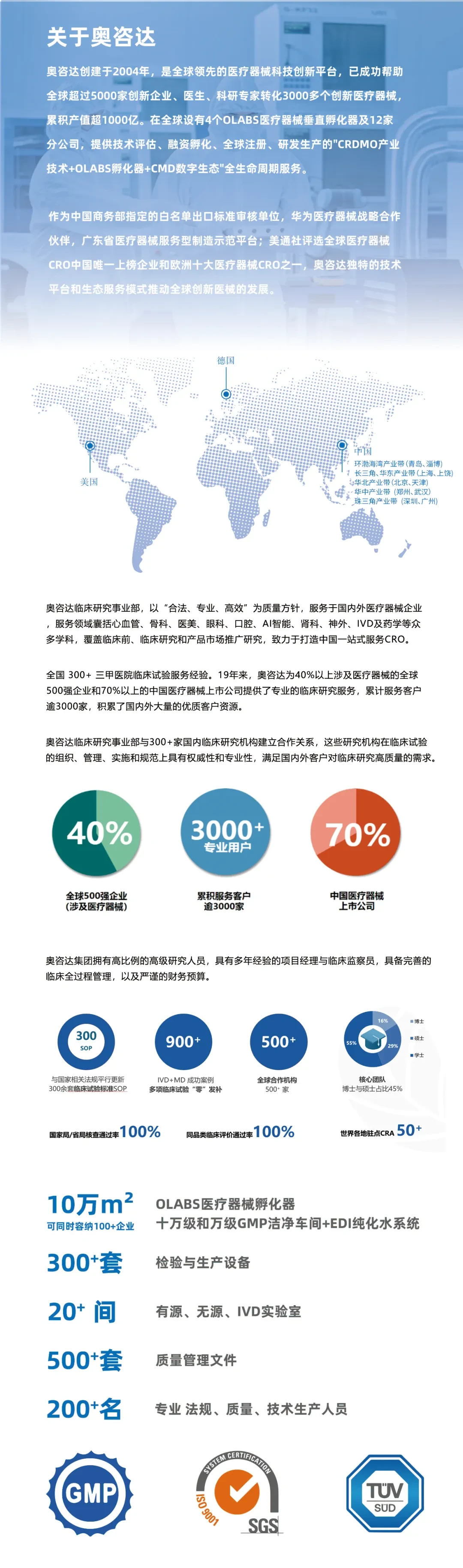
The Medical Device Public Service Platform, jointly developed by the Orthomed Group in collaboration with local governments, parks, medical institutions, and research academies across China, focuses on incubating, transforming, and investing in cutting-edge and innovative global medical device projects. By establishing scientific research and transfer mechanisms that align with international standards and implementing an open and shared operational model, the platform attracts top-tier scientific researchers, doctors, and innovators from around the world. It provides comprehensive industry technical services covering R&D transformation, incubation, and investment, nurturing innovative medical device achievements with significant innovation and application value. This effort strongly supports the development of the medical device industry and technological innovation. (Compiled by Orthomed)
8. Chinese-Made Ophthalmic Surgical Robots Receive Additional Hundreds of Millions in Funding
Recently, Antai Micro-Incision Medical Technology (Shanghai) Co., Ltd. announced the completion of a multi-hundred million yuan Series B financing round. This round of financing was jointly participated by industrial capital and well-known investment institutions, with Chunmu Capital serving as the exclusive financial advisor. The funds will mainly be used to consolidate the technical advantages of core products, improve the product ecosystem of microsurgical robots, accelerate the clinical registration process, and promote the international market layout. Antai Micro-Incision's core products mainly include three types of surgical robots: general-purpose microsurgical robots, ophthalmic surgical robots, and trans-endoscopic gastrointestinal robots. The general-purpose microsurgical robot can cover multiple surgical fields such as ENT, neurosurgery, vascular surgery, and plastic surgery, assisting existing medical robots in completing procedures that require high precision. The ophthalmic surgical robot has completed registered clinical trials and officially entered the critical stage of registration and listing, effectively filtering out physiological hand tremors to meet the operational requirements of high-precision retinal surgeries. (Eye Future)