

A Historic Breakthrough for China's Innovative Drugs!
Akeso
Innovative Antibody Drug Developer
Hansoh Pharma
Pharmaceutical Research, Production, and Sales

MediLink
Antibody-Drug Conjugates Developer
On the afternoon of September 15 (Seoul time), a special session titled “Breakthrough Immunotherapy for Advanced Non-Small Cell Lung Cancer” was held as scheduled at the COEX Convention Center.
As Zhou Caicun took the podium, he held two titles: President of the International Association for the Study of Lung Cancer (IASLC) and Principal Investigator of the HARMONi-2 study. He was set to present a figure that many had been awaiting for over three years.
The full results of this large-scale randomized controlled trial have finally been revealed: the median overall survival for patients treated with Akeso’s ivonescimab was 30.8 months, compared to 22.6 months for those receiving the control medication.
A difference of more than eight months.
As a high-standard, randomized, controlled Phase III clinical study, HARMONi-2 directly designated the global “gold standard” for lung cancer treatment—pembrolizumab (Keytruda)—as the control arm. Notably, Keytruda has consistently ranked first in global anti-cancer drug sales, with worldwide revenue reaching $31.6 billion in 2025. It has been a blockbuster oncology product over the past decade and serves as the ultimate benchmark for the development and clinical comparison of novel immunotherapies globally.
Prior to this, no monotherapy worldwide had achieved a statistically significant overall survival (OS) benefit by head-to-head defeating Keytruda in a Phase III randomized controlled trial.
Ivonescimab has broken this stalemate.
Not only that, but the World Lung Cancer Conference (WCLC) held in Seoul, South Korea, witnessed a qualitative breakthrough in Chinese innovative drugs. The results presented by Chinese companies over the four days from September 12 to 15 almost covered all the mainstream technical routes currently used in lung cancer treatment.
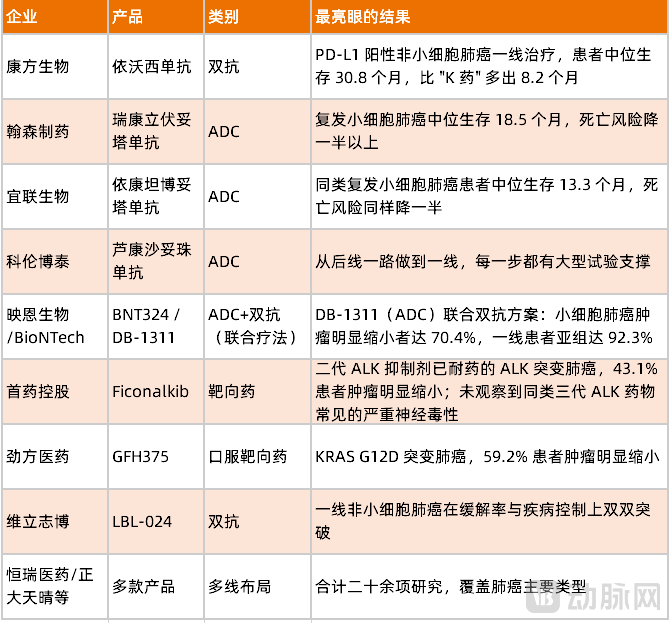
WCLC 2026: Summary of Innovative Drug Achievements from China (Source: Compiled by VCBeat)
Beneath the Glamour, What Truly Warrants Analysis Are Three Key Breakthroughs from This Conference That Are Poised to Reshape the Landscape of China’s Innovative Drug Industry.
The most landmark breakthrough at this year’s WCLC comes from Akeso’s ivonescimab.
Complete data show that, under a rigorous observation period with a median follow-up of up to 36 months, the median overall survival (OS) in the ivonescimab group reached 30.8 months, significantly surpassing the 22.6 months observed in the Keytruda control group, thereby extending patient survival by more than 8 months. The risk of death was significantly reduced by 27%, with clear and statistically significant differences.
This is also the world’s first innovative therapy to demonstrate a positive overall survival (OS) benefit over Keytruda in a randomized, double-blind, controlled Phase III clinical trial, marking a historic first victory for China’s bispecific antibody sector against a leading global drug.
Amidst the impressive data, rational assessments from the international academic community hold greater reference value. During the conference evaluation session, Mariana Brandão, a renowned expert from the Jules Bordet Institute in Belgium, provided a restrained and professional assessment, explicitly stated that there will be no immediate adjustment to current clinical practice.
The core reason lies in the fact that the survival benefit of this drug is not universal across the entire population, with clear inter-population heterogeneity: the benefit is primarily concentrated in High PD-L1 expression population (HR=0.58) and squamous cell carcinoma population (HR=0.65), with a significant reduction in the risk of death; however, in the PD-L1 low-expression population (HR=0.85) and the non-squamous cell carcinoma population (HR=0.79), the criteria for statistical confirmation were not met, failing to demonstrate a clear survival benefit for these two patient groups.
This means that ivonescimab’s breakthrough represents a victory in specific patient subgroups rather than comprehensive dominance across the entire population, with its clinical value dependent on precise patient stratification.
While achieving a historic breakthrough in the bispecific antibody arena, this year’s WCLC witnessed another iconic moment for China’s innovative pharmaceuticals: Two Domestic B7-H3-Targeted ADC Drugs Debut on the Highest-Specification Presidential Forum of the Conference on the Same Day, marking the first time since the inception of the WCLC that two pivotal Phase III studies on domestically developed agents targeting the same molecule have been presented together, signifying that China’s R&D capabilities in the frontier field of antibody-drug conjugates (ADCs) have firmly established it among the global first tier.
Presented together were Hansoh Pharmaceutical’s Risvutatug Rezetecan (HS-20093) and MediLink’s Tambotatug Pelitecan (YL201). Both studies targeted relapsed small cell lung cancer, a condition with extremely poor prognosis and limited clinical treatment options. Using the traditional standard therapy topotecan as a control, they delivered robust Phase III survival data.
The ARTEMIS-008 study by Hansoh Pharmaceutical, led by Professor Wang Jie, enrolled 461 patients with recurrent small cell lung cancer. The final data were striking: the median overall survival (OS) in the treatment group reached 18.5 months, a substantial improvement compared to 10.3 months in the control group. The reduction in mortality risk was as high as 54% (HR=0.46), setting a new global record for the longest survival in second-line treatment of small cell lung cancer.
What’s even more remarkable is that this drug offers universal benefits across the entire population.
Stable survival benefits are achieved regardless of platinum resistance status, presence or absence of brain metastases, or prior immunotherapy use.
Its safety profile is significantly superior to that of traditional chemotherapy, with a substantial reduction in the incidence of severe adverse events; although the risk of interstitial lung disease is slightly elevated, the overall benefit-risk profile remains favorable.
Following closely, Professor Zhang Li led the MediLink TAISHAN-302 study, which covered 85 centers across China. The published data from 451 enrolled patients showed that the median overall survival (OS) in the econtamab botulimumab group was 13.3 months, demonstrating a significant benefit compared to 9.4 months in the control group. Mortality risk was also reduced by 54% (HR=0.46).
The identical risk reduction figures reported in the two studies emerged as the most closely watched highlight of the conference, yet also constitute a key point most prone to misinterpretation.
It must be clarified that: Identical HR Does Not Equate to Equivalent Efficacy. The absolute difference in median OS between the two drugs reached 5.2 months; significant differences existed in median follow-up duration, patient baseline characteristics, stratification design, and analysis time points across the studies. Direct cross-study comparison of efficacy lacks scientific basis.
The true industry value lies in the perfect complementarity of the two studies: Hansoh’s HS-20093 demonstrated consistent benefits across the overall population, while MediLink’s YL201 focused on validating efficacy in high-risk, refractory populations.
The two sets of data, one highlighting breadth and the other precision, jointly solidify China’s global leadership in the B7-H3 ADC sector. Achieved Substantial Breakthroughs in Validating the Druggability of the B7-H3 Target.
If Ivonescimab demonstrated the potential for a single-point breakthrough, and Risvutatug Rezetecan proved another capability—truly advancing a target long lacking confirmatory evidence to the finish line—then what is more noteworthy at this conference is the common foundation underlying these two achievements: China’s innovative drugs have moved beyond merely “creating a molecule” to being able to “build an entire clinical development system.”
Kelun Biotech’s sacituzumab govitecan provides the most comprehensive chain of evidence. This ADC, licensed to Merck & Co., has conducted one randomized controlled trial each in the third-line, second-line, and first-line settings, with robust data at every step: in the third-line setting versus docetaxel, median overall survival increased from 13.5 months to 20.0 months; in the second-line setting versus platinum-based chemotherapy, it likewise demonstrated significant survival benefits; and in a head-to-head study, the combination regimen with Keytruda was significantly superior to Keytruda monotherapy, reducing the risk of disease progression or death by approximately 65%.
For a drug to advance from later-line to first-line therapy, with each step supported by large-scale clinical trials, is in itself a testament to its efficacy. At the joint forum, Zhou Caicun stated that the role of chemotherapy may be further relegated, with novel ADCs moving up to first-line therapy. Sacituzumab govitecan, an original Chinese drug, is expected to become the first such agent in this class.
If Kelun Biotech demonstrates the comprehensive development capability of advancing from later-line to first-line therapies, then the strategic layouts of other Chinese companies at this conference correspond to different stages of this framework: Some have completed druggability validation for their targets, others are exploring combination regimens, and still others are betting on cutting-edge technological approaches. Together, they constitute the breadth and depth of China’s innovative drug clinical development ecosystem.
SHOUYAO HOLDINGS’ third-generation ALK inhibitor achieved a 43.1% tumor shrinkage rate in 153 patients who had developed resistance to second-generation drugs, with an intracranial response rate of 65.0%. Notably, no investigator-assessed neurotoxic adverse events were observed in the study, whereas neurotoxicity is the most troubling side effect for patients taking currently marketed third-generation ALK inhibitors of the same class.
GenFleet Therapeutics’ oral KRAS G12D inhibitor achieved a 59.2% response rate in 71 previously treated patients and has entered late-stage clinical development.
The drug co-developed by DualityBio and BioNTech, in combination with another bispecific antibody, resulted in significant tumor shrinkage in 70.4% of evaluable patients with small cell lung cancer (SCLC), reaching 92.3% among first-line patients. However, these are only early-stage data with a limited sample size.
Hengrui Medicine arrived with over a dozen lung cancer studies, Chia Tai Tianqing announced 11 findings at once, and the pipelines of Leads Biolabs and Biokin Pharmaceutical were also showcased at the conference. The sheer number of studies is not in itself persuasive; what lends credibility is the complete chain from early exploration to registrational Phase III trials, which is taking shape within the same group of companies.
The shift in academic discourse power also left a clear footnote at this conference.
Statistics show that at this conference, Chinese new drugs were selected for 19 oral presentations and 45 mini-oral presentations, setting a new record.
Additionally, From the composition of society leadership to the design of thematic agendas, the rising stature of Chinese influence within the global academic framework for lung cancer is equally evident. Professor Zhou Caicun became the first Chinese chair in the history of the International Association for the Study of Lung Cancer (IASLC); meanwhile, the special session co-hosted by IASLC, CAALC, and CSCO was directly themed “ADCs, Bispecific Antibodies, and AI Agents in Lung Cancer: China-Led Innovation and Global Translation,” centrally showcasing China’s original breakthroughs and global translation pathways in the three major areas of ADCs, bispecific antibodies, and AI-assisted diagnosis and treatment.
From quantity to representation, from topics to rules, Chinese innovative drugs are transforming from the subject of discussion into the initiators of the agenda.
Beyond achievements in clinical research, the field of humanistic care has also garnered international recognition: the multidisciplinary team led by Professor Lu You from West China Hospital of Sichuan University received the IASLC Oncology Care Team Award, making them the only Asian team to receive this honor at this year’s conference. Nominated by patients, the award evaluates patient education, empathy, shared decision-making, and rehabilitation support, rather than survival data. The winning case involved a patient with advanced lung cancer who was managed by the team for ten years, unexpectedly became pregnant during targeted therapy, and ultimately had a successful delivery.
As the Chinese team not only set new records in data but also emerged as the sole Asian recipient in patient-nominated awards, it provided a complete testament to China’s growing influence in the global lung cancer field.
However, despite the excitement and notable achievements, a rational perspective remains essential. The stream of landmark data presented at this year’s WCLC highlights the significant progress in China’s innovative drug development capabilities, while also revealing the practical limitations behind these impressive advances.
The clinical benefits of many drugs do not extend to all patients, with advantages predominantly concentrated in specific tumor subtypes and biomarker-defined populations. Even if a drug demonstrates excellent efficacy in Asian populations, its therapeutic value in patients of different ethnicities overseas requires further validation through larger-scale, global, multicenter studies. For instance, the benefit of ivonescimab in patients with low PD-L1 expression and non-squamous histology remains unclear, and long-term survival data in Western populations still require further follow-up. In the face of impressive conference data, an objective evaluation is essential; the true value of a drug awaits continued substantiation by additional clinical evidence.
Currently, the U.S. FDA has formally accepted the marketing application for ivonescimab, with the final review decision scheduled for November 14, 2026. This milestone in New York represents not only the globalization outcome of a single drug but also a critical test for Chinese innovative medicines as they transition from “domestic leadership” to “global recognition.”