Domestic Innovation Breakthrough: CH-VAD Plus, a Next-Gen Implantable Artificial Heart, Launches Commercially in China

BrioHealth Solutions
Ventricular Assist Device Developer and Manufacturer
Source: Medical Device Business Review
Author: Lin Xi
On September 14, according to a report by the Shanghai Securities News,BrioHealth SolutionsIndependently DevelopedThe New Generation Implantable Left Ventricular Assist System, CH-VAD Plus, Is Officially Launched, and withinLeading Domestic Heart Center Completes First Patient Implantation。
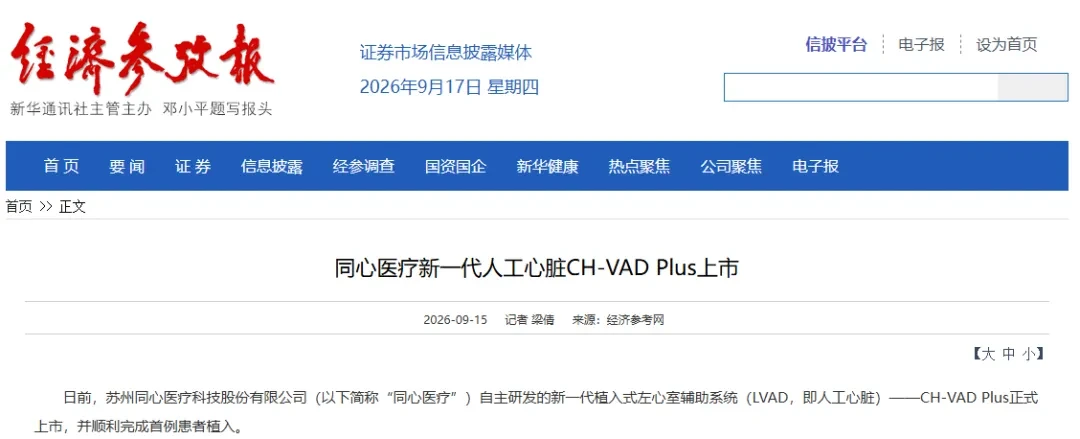
The product had previously received approval for registration changes from the National Medical Products Administration (NMPA) in December 2025. This milestone marks its commercial launch and first-ever implantation, featuring key improvements tailored to the “patient side” based on the original technology.

Clinical imperative for over 60 million patients,
Technological Leap in Domestically Produced Artificial Hearts
Heart failure is known as"The Cancer of the Cardiovascular Field". According to World Health Organization statistics, global heart failure patientsOver 60 million, the 5-year mortality rate after diagnosis is approximately50%. According to Frost & Sullivan data, in 2024, heart failure patients in ChinaOver 15 million, including patients with end-stage diseaseOver 1.5 million, and approximately annually at a rate of1.6%the rate continues to increase.
For patients in the early to middle stages, pharmacological and device-based interventions remain effective; however, in the end stage, heart transplantation becomes the last resort. According to the 2024 report from the Global Observatory on Donation and Transplantation (WHO-ONT), the annual number of heart transplants worldwideOnly 10,287 cases, withTens of millionsin stark contrast to the gap among heart failure patients.
In a field with such severe supply-demand imbalance, artificial hearts have emerged as a scalable treatment pathway for end-stage heart failure.It functions like an implanted “auxiliary engine,” taking over the pumping function of the failing heart to circulate blood throughout the body, thereby freeing patients from the cycle of repeated hospitalizations and prolonged bedridden states.
The demand is clearly present; what truly determines whether patients can access these devices is whether the supply-side technological pathways are viable. Yet, it has been less than ten years since the first domestically produced artificial heart received approval.
From the EVAHEART, the first commercially available implantable artificial heart launched in China by Chongqing Yongrenxin, to the approval of Aerospace Taixin’s HeartCon and the market approval of BrioHealth’s Corheart 6, the domestic artificial heart market has, within just a few years, evolved from"Technology Exploration Phase" Enters "Large-Scale Application Phase"。
In this rapidly evolving market,BrioHealth SolutionsAdopted a strategy of differentiated iteration:CH-VAD Plus is not merely an upgrade in performance parameters, but a systematic optimization of the patient’s daily usage experience.。

Domestically Developed Original Innovation!
The Self-Evolution of a "Chinese Heart"
The core design of the CH-VAD Plus continues BrioHealth Solutions' signature architecture featuring separate magnetic levitation and motor units. By designing the motor and magnetic levitation system separately, the pump body can be made more compact while maintaining a larger impeller diameter, thereby balancing miniaturization with hemodynamic performance.
Building on this foundation, CH-VAD Plus has made several key improvements targeting the most frequently reported pain points in clinical use:
Automatic Power Switching, Enhanced Device Safety Performance.CH-VAD Plus has a built-inIndependent Backup Battery, which can automatically switch to an alternative power source in the event of an external power failure, ensuring uninterrupted device operation. For end-stage heart failure patients who rely on life-sustaining devices 24 hours a day, power supply reliability is the most fundamental requirement.
Exclusive Power Supply Design, Reducing Daily Management Burden.CH-VAD Plus adopts a simplifiedSingle-Channel External Power Supply DesignDuring the day, patients only need to carry an external battery, while at night they can directly connect to a bedside adapter. This reduces the complexity of the power supply system and also lowers the burden of daily management.
Audio-visual alarm function enhances safety for the elderly population.Most LVAD patients are elderly, and the controller may be obscured by clothing or bedding at night, making alarm sounds difficult to hear.CH-VAD Plus is also on the adapter sideSet up the audio and visual alarm module, synchronized with controller alerts to ensure that critical alarms are accurately perceived by the patient during sleep.
While these improvements may seem like mere “details,” for patients with end-stage heart failure who must carry the device 24 hours a day and rely on lifelong mechanical circulatory support, every refined detail directly impacts their quality of daily life—determining whether they can go out alone, sleep soundly, and return to normal social activities.
The clinical evidence for CH-VAD Plus is not built from scratch. It follows the regulatory pathway of “adding a new model to an existing registration certificate,” with the blood pump and percutaneous cable being consistent with those of CH-VAD. Therefore, it leverages the same set of clinical data for the implantable device.The clinical evidence supporting its implanted components covers nine years and over one thousand clinical cases.
The highest level of evidence is still on the way. U.S. INNOVATE Trial, the blood pump and percutaneous cable of BrioVAD are identical to those of CH-VAD, currentlyHead-to-Head Randomized Controlled Trial with Abbott HeartMate 3As of May 2026, 218 patients had been enrolled across 35 centers nationwide in the United States. This marks the first time a Chinese artificial heart has undergone randomized controlled testing on its competitor’s home turf.
This iterative upgrade stems from BrioHealth Solutions’ eighteen-year commitment to a single technological pathway.

Over a decade of honing one sword,
Domestic “Little Giant” Breaks Through with Exclusive Technological Route
BrioHealth SolutionsEstablished in July 2008 and headquartered in the Suzhou Industrial Park, the company specializes in the research and development, manufacturing, and sales of ventricular assist devices, and is recognized as a national-level “Little Giant” enterprise specializing in sophisticated, niche, and innovative technologies.
The company’s exceptional technological foundation stems from its founder. The company’s Founder, Chairman, and Chief Technology OfficerChen ChenDuring his tenure at World Heart in the United States, he spearheaded the development of Levacor, the first fully magnetically levitated artificial heart in the U.S.; although the device was not clinically adopted due to its excessive size, it laid the groundwork for subsequent technological pathways.
In 2008, he returned to China to establish BrioHealth Solutions, and the fully magnetically levitated artificial heart was subsequently listed as a key project under the Ministry of Science and Technology’s “863 Program.” From 2008 to 2021, the company spent13 yearsOnly then was the first product launched onto the market.
November 2021,CH-VADApproved for market launch by the National Medical Products Administration, becomingChina's First Fully Maglev Artificial Heart with Complete Independent Intellectual Property Rights Approved for Market Launch。
Domestically,CH-VAD has been implanted in over 800 cases across more than 100 hospitals nationwide, with the first recipient having lived normally for over nine years post-implantation.; The device success rate was 92% in the pivotal clinical trial at 3 months. According to follow-up data from Fuwai Hospital: in a single-center cohort of 50 patients at Fuwai Hospital, the survival rates were 96% at 6 months, 93% at 1 year, 93% at 2 years, and 89% at 3 years.
Overseas, BrioHealth Solutions isThe Only Chinese Medical Device Company Currently Conducting Clinical Trials of Left Ventricular Assist Devices in the United States—The INNOVATE Trial of BrioVAD Conducted in the United States.This trial has been included in U.S. Medicare coverage, with an average reimbursement per case ofApproximately $220,000support, enabling the company toGenerate Substantial Revenue During the Clinical Stage。

Under a market scale of tens of billions,
How Can the Commercialization of Domestically Produced "Artificial Hearts" Be Implemented?
The Chinese LVAD market is rapidly expanding. In 2025, the national volume of LVAD implants reached1,217 cases, year-on-year growth52.7%. According to Frost & Sullivan's forecast, the market size of implantable artificial hearts in China will reach approximately in 2033RMB 5.5 billion–5.7 billion; by 2035, the overall market size of VADs in China is expected to reach approximately8 billion yuan. Globally, QYResearch predicts that the global implantable VAD market in 2031$4.69 billion。
The competitive landscape is being reshaped, and domestic substitution has become a reality.In 2024, the domestic market for implantable artificial hearts in China showed clear segmentation. Corheart 6 by Core Medical emerged as the leader with over 45% of terminal implantation market share, followed by CH-VAD from BrioHealth Solutions with approximately 26.9%.
In 2025, the market share of domestically produced fully magnetically levitated LVADs surged from 31% to 47%, while Abbott’s HeartMate 3 accounted for only approximately 1.14% of implants in China. With HeartMate 3 having ceased commercial sales in China in 2025, this has provided domestic brandsAccelerate Market Captureopportunity.
Technological convergence: Full magnetic levitation becomes the mainstream.Currently, four out of the five products adopt magnetic levitation or full magnetic levitation technology. The reason is straightforward: full suspension of the rotor eliminates mechanical friction, resulting in lower hemolysis and reduced thrombosis risk, which determinesLong-term Quality of Life in Patientsthe core variable.
The iterative focus shifts from the "pump" to the "system."Three years ago, the industry competed on who could make the pump smaller and lighter; now the focus is shifting to external controllers, power management, alarm mechanisms, and follow-up services. For example, Aerospace Taixin’s HeartCon II initiated a multicenter clinical trial in May 2026, weighing only 75 grams and targeting pediatric and low-body-weight patients; Yongrenxin Medical launched a new generation of intelligent integrated controllers equipped with emergency backup batteries in 2025.
The upgrade of CH-VAD Plus is highly aligned with these strategic directions, “"User experience" is not a marketing concept of any particular company, but an inevitable question that must be answered after the industry enters the deep-water zone of commercialization.。
The core variable of competition has shifted from technology to payment.In March 2025, the National Healthcare Security Administration uniformly added three new price items nationwide: “Ventricular Assist Device Implantation Fee,” “Ventricular Assist Device Removal Fee,” and “Cardiac Implantable Device Adaptation Fee.” During the same period, it engaged in one-on-one communications with five domestic and foreign companies whose products had been approved for market launch in China, guiding them to lower their listed online terminal prices.
BrioHealth Solutions’ prospectus shows that the average selling price of CH-VAD decreased from RMB 459,600 in 2022 to RMB 362,300 in the first half of 2025, representing a cumulative decline of approximately 21.2%.
Price, speed of insurance coverage adoption, single-center surgical volume, and follow-up service capacity—these metrics, once regarded as mere “commercial support” factors, are now becoming the primary battlegrounds determining market share.。
BrioHealth Solutions’ CH-VAD Plus Completes First Implantation: A Milestone in Technological Iteration and a Microcosm of Intensifying Competition in the Domestic Artificial Heart Sector. As More Products Gain Approval and New Players Enter the Market, the Competitive Landscape of the LVAD Market Will Accelerate Its Evolution.
Currently, BrioHealth Solutions’ domestic market share in China has been surpassed by Core Medical. However, its U.S. clinical trials are still in a cash-burning phase, with accumulated losses exceeding RMB 1 billion. If BrioVAD can successfully complete its confirmatory trials in the United States and gain regulatory approval for market launch, it will unlock a global-scale market opportunity. Can this “Chinese Heart” leap forward?“Technologically Advanced, Commercially Lagging”The predicament hinges on breakthroughs in global commercialization over the next two to three years. The answer is emerging.