

RMB 2 Billion First Round! ByteDance's Spun-Off AI Drug Discovery Unit Lands Massive Financing

Anew Labs
Small-Molecule Drug Developer
On September 16, a startup AI drug discovery company called Anew Labs announced the completion of a US$290 million financing round, drawing industry attention. Beyond setting a record for a single AI drug discovery round in China this year and attracting an exceptionally star-studded investor lineup, what makes Anew Labs most unusual is that this team emerged entirely from ByteDance's AI drug discovery business. To this day, ByteDance still holds a 56% stake in Anew Labs.
In fact, Anew Labs is not an isolated case in AI drug discovery as far as ByteDance is concerned. Isomorphic Labs, formed from the spin-off of Google DeepMind's drug discovery business; EvolutionaryScale, founded after being cut from Meta; and BioMap, founded under the leadership of Baidu founder Robin Li—all were born with a golden spoon in their mouths, forged by the heavy spending of tech giants, and have become the most dazzling stars in the primary market, chased feverishly by capital.
These tech giants with pharmaceutical ambitions have become almost the best talent incubator for AI drug discovery, and they continue to generate new star projects. For example, Atomelody, which just closed an angel round in August, has a core team drawn from Baidu's former AI protein team. Behind the comings and goings between tech giants and AI drug discovery upstarts lies an important turning point for AI drug discovery: the way AI drug discovery grows in the future may indeed differ from the algorithm, computing power, and traffic era that tech giants excel in.
One ByteDance, Two AI Drug Discovery Startups
Rewind three months: ByteDance spun off in its entirety an AI drug discovery business that had run internally for five years, injecting the core team, algorithm platform, and existing pipeline assets into a new entity under the brand Anew Labs.
The team ByteDance spun out can be traced back to 2020 at its earliest starting point. That year, ByteDance began positioning itself in the AI drug discovery arena and launched dedicated talent recruitment; in 2021, the team was formally assembled, at a scale of about 50 people, made up of AI4S algorithm talent and veteran pharmaceutical experts, led by none other than the later Anew Labs founder Liu Kai. Liu Kai joined ByteDance in 2021. Before that, he spent seven years in venture capital at IDG Capital and Volcanics Venture. Today, IDG Capital has become one of the lead investors in this round for Anew Labs. But that comes later.
ByteDance's AI drug discovery team was never organized as a pure research group from the outset; it carried the full remit from foundational model research to industrialization. As a result, Anew Labs inherited considerable resources, enough to stand at a starting line closer to the finish.
Specifically, the first layer is models. In 2025, ByteDance's internal AI4S team released the molecular structure prediction models Protenix and Seedfold. In 2026, Protenix iterated to v2, alongside the launch of the protein binder design tool PXDesign. Platforms gradually made public since then include AnewSampling, AnewOmni, AnewSynth, AnewFEP, and scNext, plus AnewMind, a scientific reasoning large model for drug R&D decisions.
The second layer is pipelines. In April 2026, ByteDance became an unusual attendee at the annual meeting of the American Association of Immunologists. There, ByteDance disclosed a preclinical-stage IL-17 small-molecule inhibitor, calling it the world's first "full-spectrum" IL-17 small-molecule inhibitor—that is, full blockade of the IL-17 family's three subtypes, AA, AF, and FF, at the small-molecule level. Beyond that, ByteDance's currently public drug pipeline also includes IL4R and two programs with undisclosed targets—four candidates in total, all at the preclinical stage.
The third layer is organization and capital structure. After the spin-off, Anew Labs established its domestic headquarters in Yangpu, Shanghai, with additional offices in San Jose and Singapore. ByteDance continues to provide computing power support through Volcano Engine. With ByteDance's backing, Anew Labs' investors in this round include HSG (formerly Sequoia China), IDG Capital, Hillhouse, and 5Y Capital as co-lead investors, with Gaorong Ventures, Primavera Capital Group, and Boyu Capital participating, while the Shanghai Future Industry Fund and Sino Biopharmaceutical were also on the list.
As for the reason for the spin-off, ByteDance's official line points to one thing: the industry logic and management approach of AI drug discovery differ from ByteDance's other businesses, and an independent entity was needed to establish an organizational incentive structure suited to it. According to Reuters sources, the decision was intended to drive the business's long-term development.
In fact, Anew Labs is not the only AI drug discovery star project ByteDance has produced. Gu Quanquan, who left ByteDance in June 2026, announced on September 10 the founding of Geodesic Intelligence, simultaneously releasing three products: NovaDDE, a scientific reasoning agent platform for drug discovery; NovaAtom-Lite-Preview, the first preview version of the all-atom structure prediction model NovaAtom; and NovaLab, a self-built automated wet lab. Geodesic Intelligence positions itself as connecting agents, foundation models, and a wet-lab closed loop, focusing on AI-driven new drug discovery. Before leaving ByteDance, Gu Quanquan led the company's SeedFold, SeedProteo, and DPLM series of protein foundation models—a different entity from the AI drug discovery line injected into Anew Labs.
Tech Giants and Their Unattainable Pharmaceutical Ambitions
Beyond ByteDance, the world's most prominent AI drug discovery companies today all came out of tech giants.
In 2019, Alexander Rives, an algorithm researcher at FAIR, Meta's artificial intelligence research institute, launched the ESM project to build a protein language model that lets machines read protein sequences. The first-generation model, ESM1b, was trained on about 27 million protein sequences. In 2022, the second-generation model ESM2 surged to 15 billion parameters, and the accompanying structure prediction model ESMFold predicted more than 600 million protein structures from the collective genomes of all microbes in the environment—already a formidable performance. Then, in 2023, Meta pushed cost-cutting and efficiency, laying off 10,000 people in a single year, and Alexander Rives' AI protein research team was among them. Meta's stated reason for the layoff, reportedly, was that the team was too academic and the company needed to pivot to money-making projects.
The team's eight founding members then struck out on their own, founding EvolutionaryScale under the ESM name, with Rives as CEO and chief scientist. On the change, Rives said the team was about to push the model to the next level, and that Meta is not a biotech company. In June 2024, EvolutionaryScale completed a US$142 million seed round, with Amazon and NVIDIA's NVentures joining. In July of the following year, EvolutionaryScale announced a Series A, raising about US$540 million and pushing its valuation to about US$3.3 billion.
Meanwhile, EvolutionaryScale's products iterated rapidly: the third-generation model ESM3 reached 98 billion parameters, and its signature output, esmGFP, shared about 58% sequence similarity with known green fluorescent proteins. EvolutionaryScale does not build its own pipeline; it provides licensing partnerships to pharmaceutical companies only through the Forge platform. In November 2025, EvolutionaryScale was acquired by Chan Zuckerberg Biohub, the philanthropic research institute of Mark Zuckerberg and Priscilla Chan, with the company folded in entirely and Rives becoming head of science at CZI.
In November 2021, DeepMind, Google's artificial intelligence company, spun off its drug discovery business to establish the AI drug discovery company Isomorphic Labs, with DeepMind co-founder and CEO Demis Hassabis doubling as founder and CEO of the new company, wholly owned by parent Alphabet. In 2024, Demis Hassabis shared the Nobel Prize in Chemistry for developing the AI model AlphaFold, which can predict protein structures.
Capital moved in faster than expected. In March 2025, Isomorphic Labs' first external round was led by New York venture firm Thrive Capital at US$600 million. In May of the following year, sovereign funds from Abu Dhabi, Singapore, and the UK joined Isomorphic Labs' Series B, which raised as much as US$2.1 billion.
Isomorphic Labs' technological and commercial progress is equally striking. In February 2026, IsoDDE, the drug design engine Isomorphic Labs developed in-house, claimed to push the accuracy of predicting protein-small molecule binding structures from AlphaFold 3's 23.3% to about 50%, and the accuracy of predicting antibody-antigen binding structures from 17% to 39%; its affinity metric for predicting the strength of drug-target binding also reportedly surpasses traditional physics-based simulation methods without requiring experimental crystal structures.
Although it has not yet built a dry-wet closed loop to validate model capabilities, Isomorphic Labs has already established commercial partnerships with several MNCs. In January 2024, Isomorphic Labs signed a multi-target small-molecule collaboration with Eli Lilly, with a US$45 million upfront payment and up to US$1.7 billion in milestone payments. Two days later, Novartis entered, with a US$37.5 million upfront payment and up to US$1.2 billion in milestones. In January 2026, Johnson & Johnson joined, covering new drug modalities such as small molecules, biologics, peptides, and molecular glues; the two disclosed partnerships have a cumulative potential value approaching US$3 billion.
In China, the pharmaceutical ambitions that tech giants are unwilling to internalize have likewise produced star AI drug discovery projects and extreme product forms in the primary market. In August 2020, Baidu founder Robin Li led the founding of BioMap and personally serves as chairman, holding about 40% directly and indirectly at inception. BioMap's technology foundation is the xTrimo all-modal life science foundation model, now at 268 billion parameters, which the company claims can compress R&D cycles from 5–10 years to 1–2 years. Its commercialization covers more than 800 institutional users worldwide.
One of BioMap's most closely watched deals is its collaboration with Sanofi: a US$10 million prepayment and a potential total value exceeding US$1 billion. In addition, in June 2026, BioMap and Harbour BioMed jointly established MegaStream TechBio, pivoting from an AI platform to AI plus biotech. Before that, in March 2026, BioMap confidentially filed with the Hong Kong Stock Exchange in a push for listing.
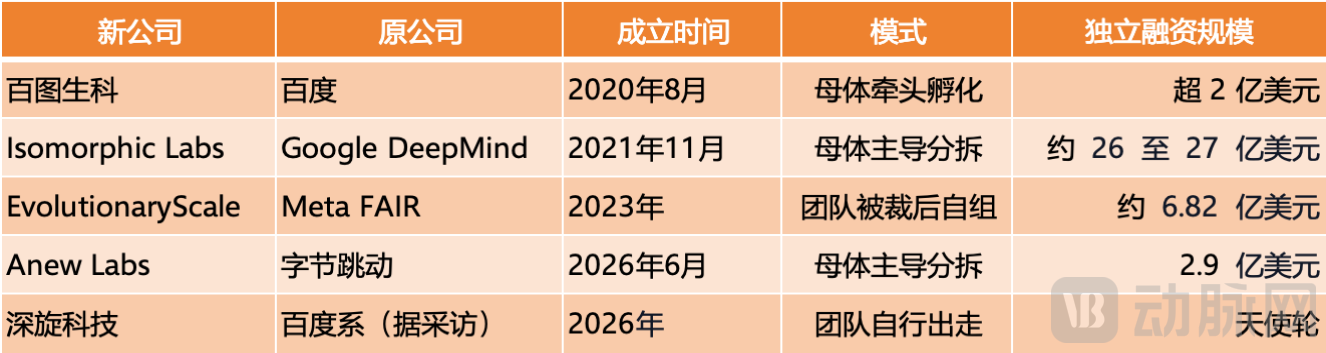
Some AI drug discovery ventures that emerged from tech giants. Source: VBInsight
Interestingly, in August 2026, an AI drug discovery startup called Atomelody, based in Nanshan, Shenzhen, completed an angel round with investment from Lanchi Ventures and Tsinghua Capital. The company's core members all come from Baidu's former AI protein research team. Atomelody is betting on a metric the outside world pays little attention to—structural validity—and has already released the general biomolecular foundation model Melo-1 Preview, claiming that multiple metrics surpass AlphaFold 3.
Although the patterns of separation and coming-together differ, these AI drug discovery teams that emerged from tech giants share a similar pursuit of extreme technical capability. Perhaps for capital that always chases the spotlight, what is truly scarcest is not the hype the media repeatedly cites, but the unique sensitivity to technology trends and gaps that these AI drug discovery teams developed during years steeped in tech giants.
The Tipping Point for AI Drug Discovery: Is a Purely Technological Approach No Longer Viable?
In a sense, the reason AI4S teams leave tech giants lies not in the business itself, but in a mismatch of models.
On one hand, tech giants settle accounts quarterly and annually, assessing results that can be shown in the current period, while drug R&D runs on a ten-year cycle, and most programs may be eliminated midway. There are also peer differences in talent pricing: overseas biotechs price scientists with options and milestones, tools that tech giants' compensation systems cannot provide. Tech giants do not lack computing power, capital, or talent; what they lack is the patience to be assessed on a ten-year cycle, an evaluation approach that tolerates high failure rates, and incentive tools that price biomedical talent. The difference lies in how the organization operates, not in the scale of investment.
On the other hand—and more importantly—the technical mismatch is more direct. Tech giants excel at making models bigger and approaching the ceiling through the scale effect of computing power, but this logic fails in AI4S, because the endpoint of drug R&D is not in the digital world. Language models process text written by humans, whereas the properties of proteins and molecules are determined by the laws of physics; a hydrogen bond off by a few angstroms is enough to turn a candidate molecule from binding to not binding.
Methodologies thus diverge. One path continues to make bigger models and climb leaderboards; the other puts physical constraints and experimental data inside the model, so the algorithm is also physically valid and can be verified by wet-lab experiments. In physicochemical modeling, high-quality experimental data, and wet-lab closed loops, tech giants have neither accumulated expertise nor found it easy to win internal support. Computing power can build a bigger model, but it cannot build the experimental data and mechanistic understanding that come only from years of working with wet labs—and such investment is also harder to get through internal project approval.
Of course, not all tech giants fail to find a path compatible with AI drug discovery. Huawei formed a pharmaceutical legion that works only on the underlying layer and does not develop its own pipelines; Tencent focuses on capital, taking heavy positions in XtalPi and Insilico Medicine; Alibaba Health and JD Health settle on medical AI and healthcare services. Overseas, OpenAI and Novo Nordisk, and NVIDIA and Eli Lilly, work through partnership or investment.
The advantages of separating tech giants from AI drug discovery are obvious. In the first ten years of drug R&D there is almost no positive cash flow, requiring a shareholder structure that can tolerate long periods without dividends and keep injecting capital—a structure neither tech giants' financial reporting system nor the public markets can provide, but primary-market biotech equity can. An independent entity can therefore hire using biotech's equity structure and let the capital markets price it separately; Anew Labs secured US$290 million just three months after the spin-off. Incentive tools also switched back at this step: options and milestones replaced annual salary and job grades, tying scientists' returns to the risks they bear. Independence also has a practical rationale: a dry-wet closed loop requires design, experimentation, and judgment to sit at the same table, whereas the parent's project system cuts these three into different budgets.
But what separation cannot solve is equally clear. It changes the funders and the incentive approach; it does not change the scientific success rate, and clinical trial costs and attrition rates do not shift with equity structure. There is no direct correspondence between financing scale and clinical results: Isomorphic Labs raised about US$2.6 billion over five years and has disclosed partnerships worth nearly US$3 billion, yet not a single molecule has entered human trials. Nor does independence guarantee a margin of safety: Recursion posted a net loss of over US$600 million in 2025 and sharply cut its pipeline, and BenevolentAI delisted the following year.
In essence, separating tech giants from AI drug discovery is a redistribution of risk. Whether that redistribution delivers benefits will only be discernible once molecules designed by AI can truly cross clinical trials at scale and enter application scenarios.