

Up 72% at the Open, the Biotech Behind a US$1.5 Billion BD Deal Just Went Public
Evopoint Biosciences
Biological New Drug Developer
On September 16, 2026, Evopoint Biosciences Co., Ltd. formally listed on the STAR Market. As of press time, the stock opened at RMB 47.57, up about 72%, giving the company a market capitalization of about RMB 20 billion.
Evopoint Biosciences is an innovative drug R&D company focused on oncology and multidrug-resistant bacterial infections. Drawing on three in-house platforms — small molecules, antibodies, and protein degradation — it has built a pipeline of one anti-infective NDA under review, for injectable imipenem/cilastatin sodium/funobactam (XNW4107), plus three oncology pipelines.
Founded in 2017, the company has yet to win approval for a single drug. Yet through one blockbuster overseas BD license, it secured a US$130 million upfront payment, with subsequent milestones of up to US$1.406 billion, for a total deal value of US$1.536 billion. On the strength of that deal, the company booked RMB 935 million in revenue and RMB 203 million in profit in 2025.
Under the company's own pipeline plan, four late-stage pipelines are expected to hit key approval milestones over the next two years. Turning a book profit with no product sales, funding R&D through BD proceeds — that is rare in today's innovative drug industry.
Evopoint Biosciences founder Qiang Jing earned a bachelor's degree in pharmacy from Shanghai Jiao Tong University, then went on to a master's in financial engineering management at Fudan University and a doctorate in applied economics at Tsinghua University, and studied oncology at Harvard Medical School. That hybrid background — fluent in both drugs and money — set the stage for his later cross-sector venture.
After graduating, Qiang Jing did not go straight into a pharmaceutical company; he first joined CICC, where he stayed for more than seven years. As a managing director in the research department and chief healthcare analyst, he watched a great many pharmaceutical companies rise and fall in the capital markets. Around 2015, he sensed that the moment for Chinese innovative drugs had arrived, and decided to build a company himself.
In 2017, Evopoint Biosciences was founded in BioBAY in Suzhou. To turn the blueprint into reality, Qiang Jing brought in Le Meijie. A battle-tested industry veteran from multinational drugmakers such as Bayer and Sino-American Tianjin SmithKline & French Laboratories (TSKF), Le brought more than 20 years of R&D and commercialization experience and took charge of operations at Evopoint Biosciences. At the same time, Qiang Jing brought in Yun Song, his old partner from CICC, to steer the company's capital operations and path to listing.
On the R&D side, Qiang Jing also deployed heavy firepower. The arrival of Dr. Yonghan Hu injected a thoroughly international R&D pedigree into Evopoint Biosciences.
This scientist studied at the University of Science and Technology of China and the Chinese Academy of Sciences and holds a chemistry PhD from the University of Southern California, and previously served as a senior principal scientist at U.S. giants including Wyeth and Pfizer. With his team, he has accumulated 46 domestic invention patents and 22 overseas invention patents, and built three major technology platforms: small-molecule targeted drugs, complex antibody drugs, and targeted protein degradation.
Evopoint Biosciences describes its pipeline layout as "1+3+N": one NDA accepted for review, three in Phase 3, and N early-stage pipelines.
The nearest to market is injectable imipenem/cilastatin sodium/funobactam (XNW4107), a combination formulation in the anti-infection field that targets hospital-acquired pneumonia caused by Gram-negative bacteria. Its NDA was accepted for review in July 2025 and approval is expected in 2026. If all goes well, it will be Evopoint Biosciences' first product to actually reach the market.
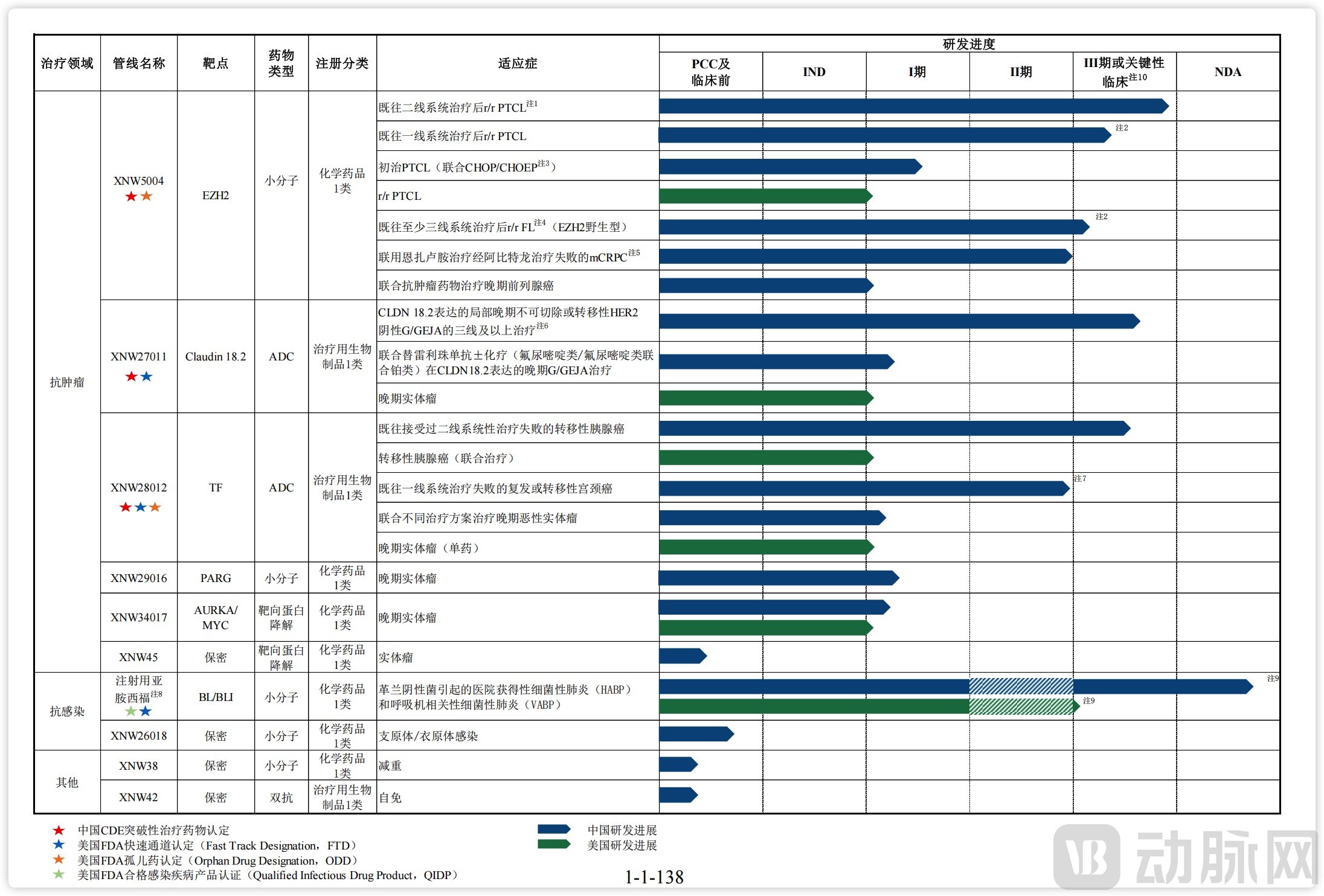
Evopoint's pipeline layout. Source: prospectus
Oncology is the real headline act.
XNW5004 is an EZH2 inhibitor for peripheral T-cell lymphoma (PTCL) and follicular lymphoma (FL). In relapsed or refractory patients who had previously received second-line systemic therapy, the objective response rate reached 70.3%. More importantly, it also works in EZH2 wild-type patients, who make up roughly 80% of the follicular lymphoma population.
Existing EZH2 inhibitors cover only mutant patients, and the only approved one, tazemetostat, has already been withdrawn from the market. If XNW5004 reaches the market, it would fill a gap.
XNW27011 and XNW28012 are both ADC drugs. The former targets Claudin 18.2 for gastric cancer; the latter targets tissue factor (TF) for pancreatic and cervical cancer. Both have received Fast Track Designation (FTD) from the U.S. FDA, and their development progress ranks in the global top five among drugs against the same targets.
XNW27011 is the pipeline licensed to Astellas that brought in the hefty BD upfront payment. Astellas, the world's 21st-largest pharmaceutical company, was willing to pay a high price for its overseas rights because it sees the target's potential in gastric cancer. Gastric cancer is highly prevalent in China, and Claudin 18.2 has been a hot ADC target in recent years, yet no ADC against it has been approved anywhere in the world.
Evopoint Biosciences' strategy is clear: pick targets with differentiation potential, aim at unmet clinical needs, and then look for partners worldwide.
Evopoint Biosciences' future depends on whether its four late-stage pipelines can gain an edge in their respective arenas.
In anti-infection, injectable imipenem/cilastatin sodium/funobactam targets drug-resistant Gram-negative pneumonia. MSD's imipenem/cilastatin/relebactam (Recarbrio) was approved in China at the end of 2024; it is likewise a three-drug combination and a direct, same-mechanism competitor. Everest Medicines' Taniborbactam and Fosun Pharma's OP0595, two β-lactamase inhibitor combinations, are in Phase 3 in China and will enter the market in due course.
Phase 3 data show Evopoint Biosciences' combination is non-inferior to MSD's, with some advantage on safety. But antibiotics come with hard real-world constraints: even with smooth approval, the product will most likely fall into the special-use class of antibacterials, which restricts prescribing rights. In its response to the review inquiry letter, the company projected domestic capacity utilization of just 5.71% in 2027, suggesting the market ramp-up will not be fast.
On another pipeline: in the EZH2 inhibitor arena, for the relapsed or refractory peripheral T-cell lymphoma indication that XNW5004 targets, Hengrui Pharmaceuticals' zeprumetostat (SHR2554) has already received conditional approval in China and is the most direct competitor. On published clinical data, XNW5004's 70.3% objective response rate compares favorably with the approved drug's figures — but this is a non-head-to-head comparison and cannot be equated directly with better clinical performance.
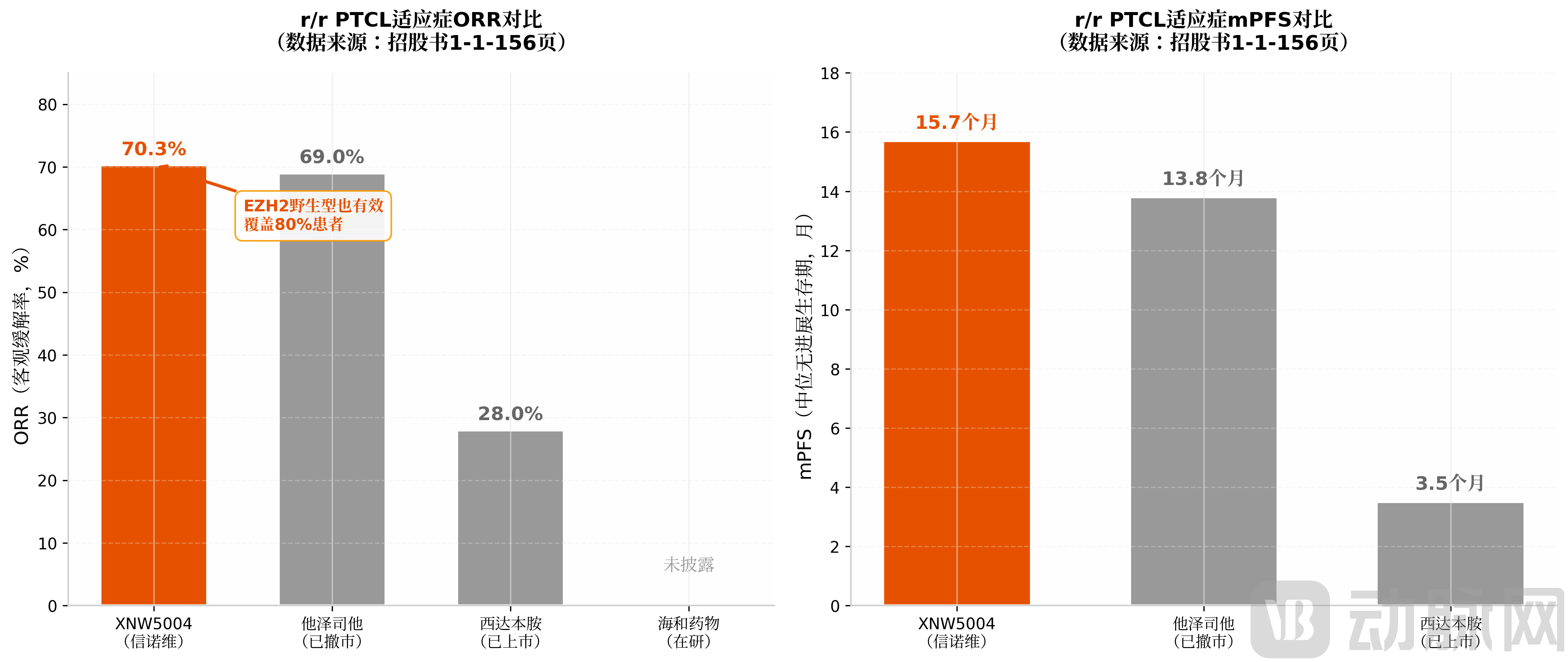
XNW5004 vs. competitors (non-head-to-head), charted based on prospectus data
For mCRPC (metastatic castration-resistant prostate cancer), no EZH2 inhibitor has been approved in China or abroad; XNW5004 and Pfizer's mevrometostat are in the leading group. The risk for this pipeline is that tazemetostat, a same-target product overseas, has already been withdrawn, and the overall safety of the EZH2 target still needs more real-world data.
ADC is one of the most fiercely competitive arenas in China.
Most importantly, for the Claudin 18.2 target chosen by XNW27011 — the pipeline licensed to Astellas — no matching ADC has been approved anywhere in the world, yet a large cohort of peers' pipelines is clustered here, at home and abroad. Innovent Biologics' IBI343 and LaNova Medicines' LM-302 have already filed NDAs and are closest to launch.
Junshi Biosciences' JS107, KeyMed Biosciences' CMG901, Biokin Pharmaceutical's BL-M05D1, and Hengrui's SHR-A1904 are likewise in Phase 3, with dozens of programs crowding the same arena.
XNW27011's overseas rights were sold to Astellas, while the China rights were kept. Its early Phase 2 objective response rate was 65.2%, again without head-to-head data. The biggest variable in this arena is who completes Phase 3 readouts and wins an NDA first. If several domestic products are approved in quick succession, the Claudin 18.2-positive gastric cancer population is limited, and they will face head-on competition over efficacy, pricing, and commercialization.
The fourth pipeline: for the TF target, one overseas product, tisotumab vedotin, has been approved for cervical cancer, while no TF-ADC is on the market in China. The main direct domestic competitor is Lepu Biopharma's MRG004A in Phase 2; overall competition is less intense than in the Claudin 18.2 arena.
XNW28012 has received Breakthrough Therapy Designation (BTD) from the CDE for metastatic pancreatic cancer in the second-line setting and beyond. Clinical options for pancreatic cancer are few, reflecting a clear unmet need. But its Phase 1/2 data show a considerable share of Grade 3 or higher adverse events related to hematology and oral mucosa; in Phase 3, safety will be the key variable determining market acceptance.
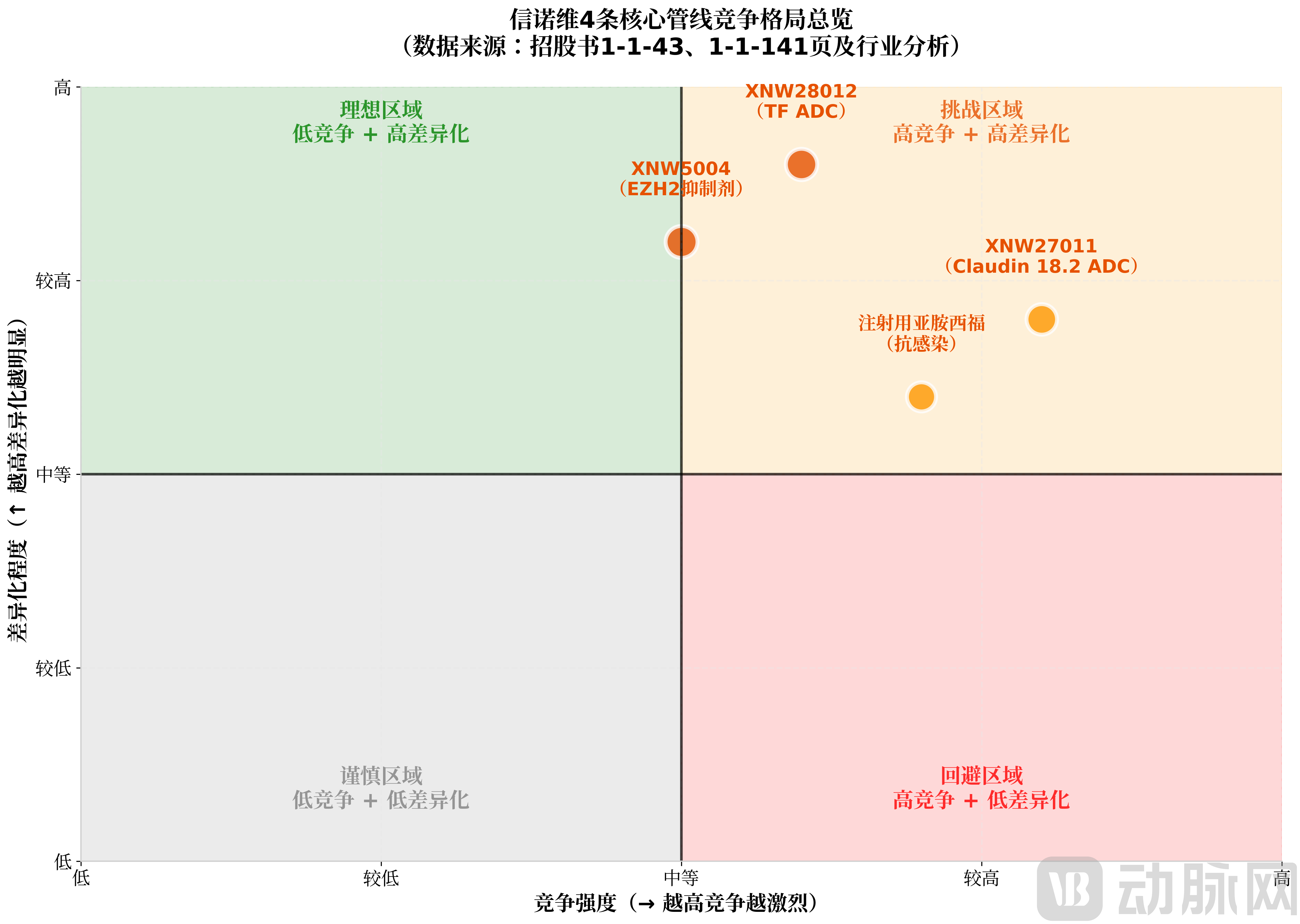
Competitive landscape, charted based on the prospectus description
Each of the four pipelines has its opportunity and its challenge. Evopoint Biosciences' strength is that four pipelines have advanced to late stage at once, so multiple assets can spread the risk of failure. Yet no arena is a smooth road: competitor progress, clinical results, regulatory approval, reimbursement pricing — every gate shapes the final value.
Since its founding in 2017, Evopoint Biosciences has been through multiple rounds of capital increases and transfers of existing shares, drawing sustained backing from a number of top-tier institutions.
Its RMB 1 billion Series C, completed in 2020, was led by Loyal Valley Capital together with international long-only funds. In its RMB 700 million Series E, completed in February 2024, Tencent came in, joined by state-owned investors including Guoxin Investment and Jinan Jingfa. Beyond capital increases, there was also heavy pre-IPO trading in existing shares, with institutions such as CDH Investments, GF Qianhe, and Asymchem No. 3 buying in by acquiring shares from existing holders.
The shareholder register spans financial investors steeped in biomedicine, such as Loyal Valley Capital and Lilly Asia Ventures; industrial capital such as Tencent, Lepu Medical, and Asymchem; plus state-owned investment platforms from several localities. Evopoint Biosciences' standout ability to execute global BD deals was also an important factor in institutions' willingness to keep investing.
Many domestic biotechs have solid clinical pipelines but struggle to connect with MNCs and turn clinical value into hard cash. Evopoint Biosciences, by contrast, has completed one heavyweight out-licensing deal after another. Carved-out rights to XNW1011 were licensed first to SinoMab Bioscience and then to Everest Medicines, while XNW27011 brought in a US$130 million upfront payment from Astellas.
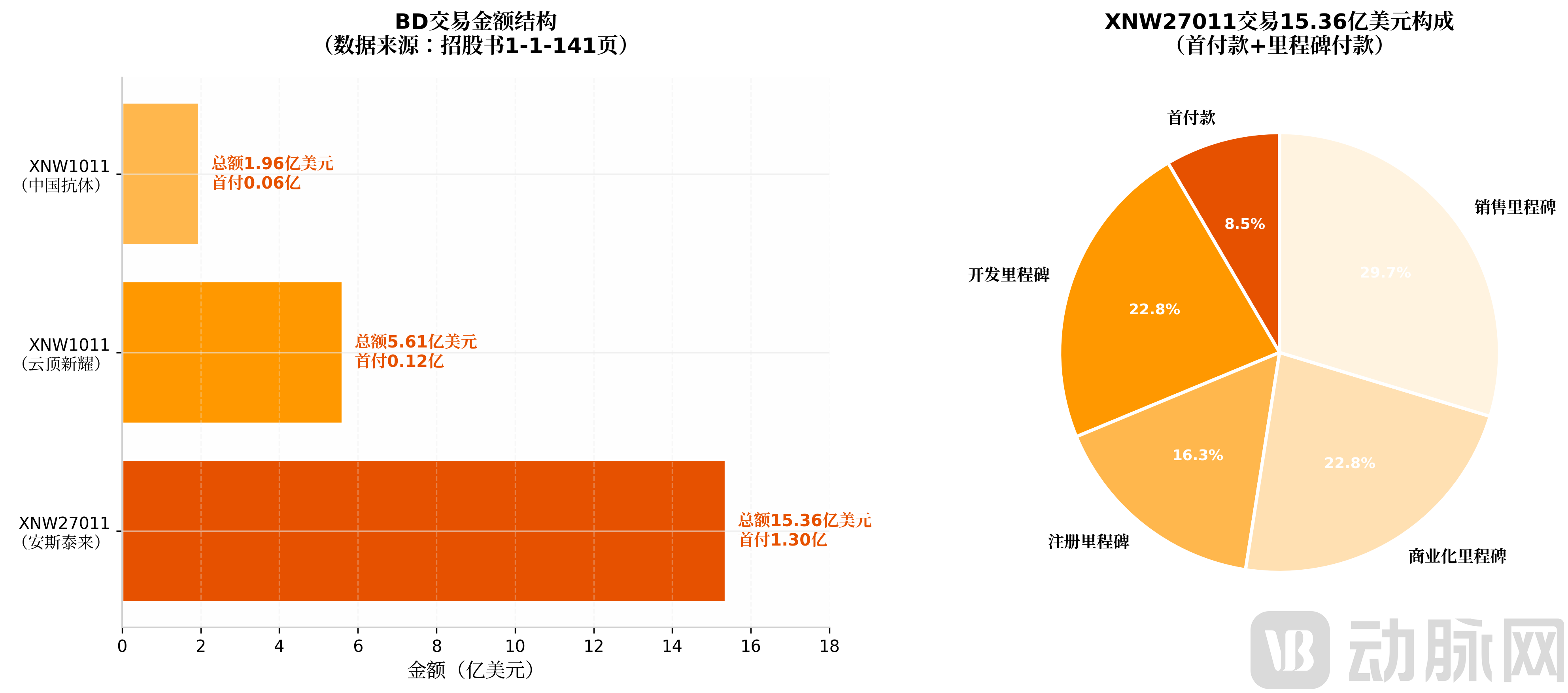
BD transactions, charted based on prospectus data
Cumulative potential value across the deals exceeds US$2 billion, and some upfront payments have already been recognized as revenue. This early closed loop — R&D output converted into global commercialization proceeds — is uncommon among innovative drug companies of the same vintage that are not yet profitable.
In 2023 and 2024, the company had no operating revenue and kept losing money. In 2025, once the BD upfront payment from Astellas was booked, revenue jumped to RMB 935 million and net profit turned positive; three-year cumulative R&D investment reached RMB 1.264 billion.
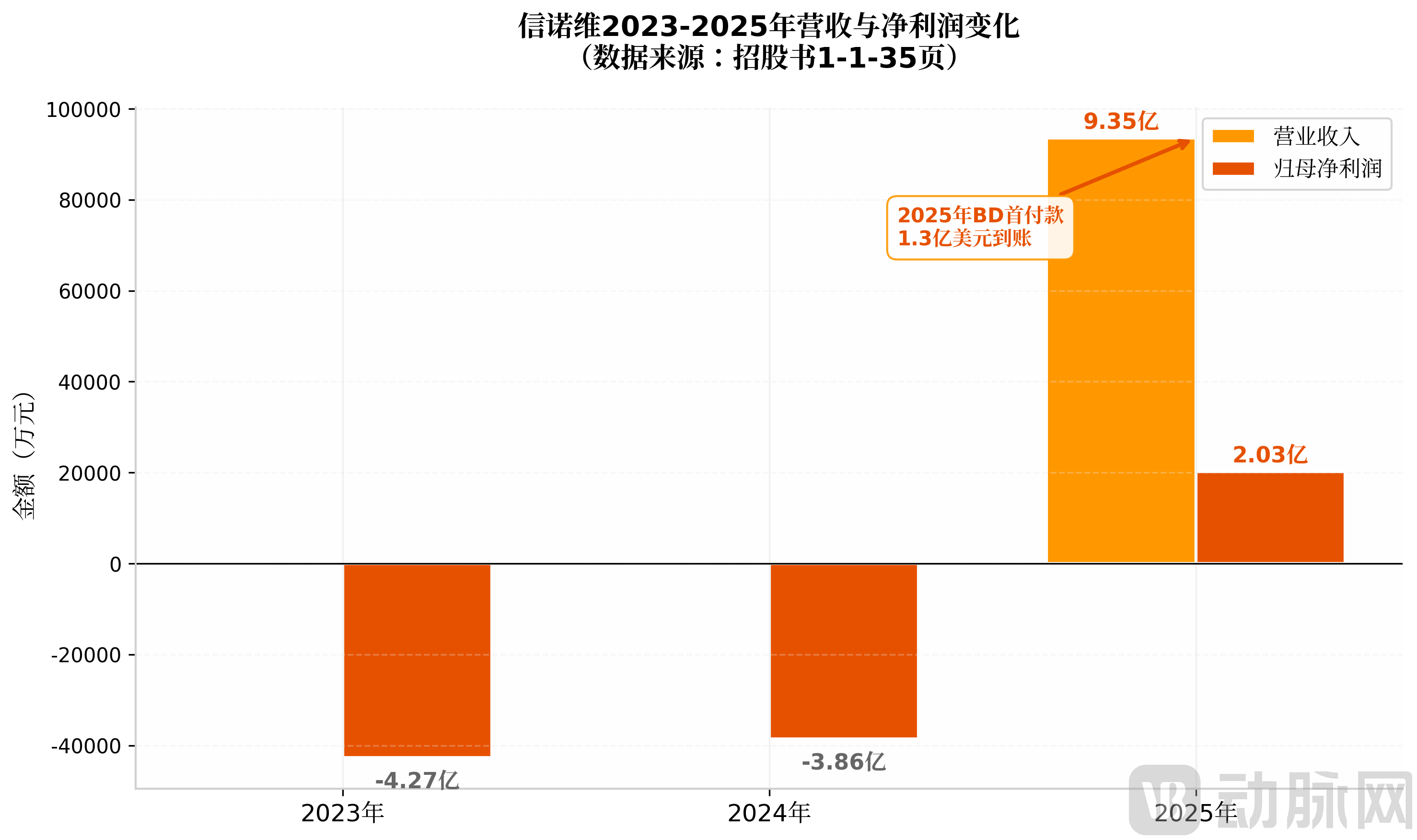
Revenue over the past three years, charted based on prospectus data
Net proceeds from this IPO totaled about RMB 2.94 billion, of which RMB 2.34 billion will go to new drug R&D programs and the remaining RMB 600 million to working capital. The money is mainly meant to push the pipelines forward, not to fund a large one-off expansion of the sales team. Before any product reaches market, Evopoint Biosciences is already pulling in hard cash from global BD and proving its pipelines' commercial value to the market — but the real test will arrive as those four products advance.