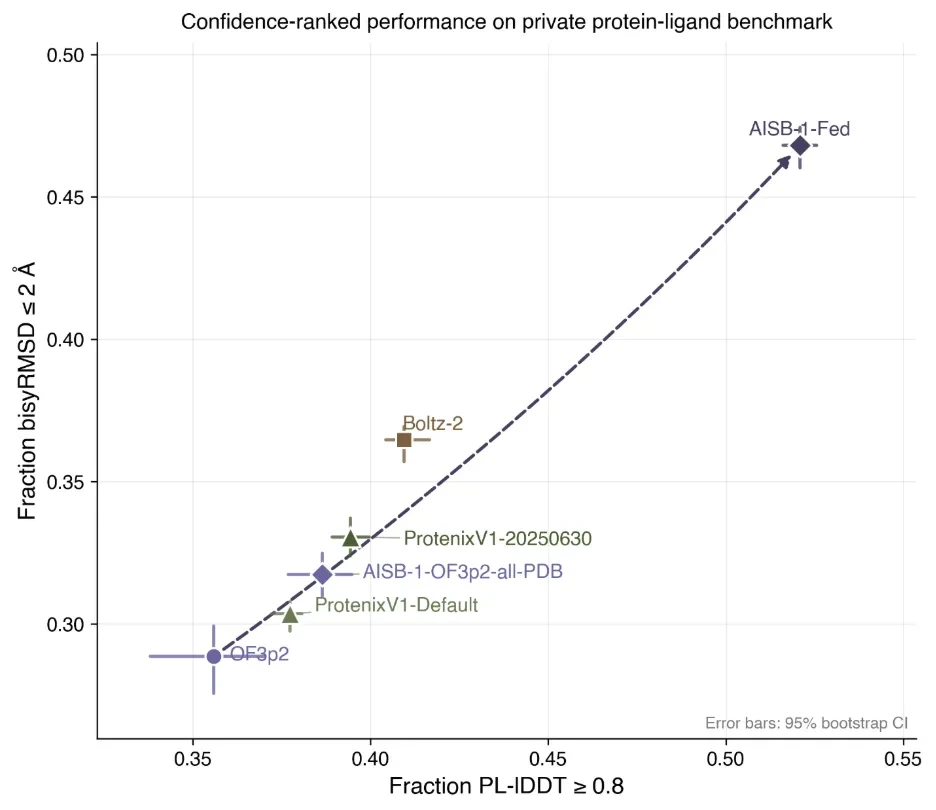
The Value of High-Quality Data Has Been Empirically Verified Once Again! Recently, byAbbVie, Astex, BMS, Johnson & Johnson, and TakedaFive CompaniesLed by pharmaceutical companiesAI Structural Biology (AISB) AllianceGood news has emerged. The team is currently「AlphaFold3 Open-Source Version」Fine-tuning Based on OpenFold3, after incorporating 20,167 sets of proprietary protein structure data from pharmaceutical companies,Within less than ten weeksSolidAchieved a significant performance improvement. According to the public information on the official website,Final birthDeveloped ModelAISB-1-FedTestingIt outperformed all publicly available models in the trials, and also surpassed any model fine-tuned solely on data from a single partner. In 1,056 protein-ligand test sets, the AISB model achieved high-accuracy predictions for more than half of the samples, far exceeding35% of OpenFold3 and40% of the competing open-source model Boltz-2. However, this study has currently only been released as a blog post and has not yet undergone peer review, nor is the model publicly available. Nevertheless, the person in charge stated that over the next few years, 500,000 experimentally determined structures of protein fragments bound to drugs will be generated using X-ray crystallography and made fully public. Eli Lilly and Others Lead the Creation of an AI Drug Discovery Data Alliance The AI Structural Biology (AISB) Alliance was established in March 2025, initially with onlyAbbVie, Johnson & JohnsonHome Medicines... Subsequently, AstraZeneca, Boehringer Ingelheim, BMS, Johnson & Johnson, Sanofi, and Takeda joined in succession, making it now a considerably large organization. The underlying technology of the allianceThe procedure is focused onAI Pharmaceutical Companies Using Federated LearningApherisLiftSupply, capable ofUnder the premise of protecting data privacyCo-Training AI model; and withDeveloped by Mohammed AlQuraishi’s Laboratory at Columbia UniversityOpenFold3There is deep cooperation. In fact, far more multinational pharmaceutical companies than those mentioned above have recognized the value of proprietary data. Pharmaceutical GiantEli LillyIt owns the TuneLab platform,Includes valueExcess Value10$100 millionproprietary data,Will also provide12machine learning models. Small biopharmaceutical companies can contribute their proprietary datato improve these models,without directly exposing its proprietary data or Eli Lilly and Company’s proprietary data. The Structural Genomics Consortium (SGC) in Europe also launched a project with a budget exceeding €60 million last year.Ligand-AIPublic-Private Partnership Project Focused on Generating Large-Scale Open-Source Datasets of Protein-Ligand Interactions