

AstraZeneca Submits TriMab Trispecific T-Cell Engager for Dual-Antigen Targeting in Solid Tumors

AstraZeneca
Pharmaceutical Technology Research and Development Provider

AstraZeneca
Biopharmaceutical Manufacturer
TCell Connector (TCEs) By redirecting the patient themselvesTCellular killing of tumors has shown significant efficacy in hematological malignancies, but in the treatment of solid tumors, the lack of tumor-specific antigens often leads to“Targeted yet tumor-free”Toxicity, Therapeutic Index (TI) Extremely low.“Dual-Antigen Targeting”(While identifying two types of tumor surfaceTAA) can be passed through“ANDGating”Logical Enhancement of Specificity—Only dual-antigen positive tumor cells are killed, while single-antigen positive normal tissues are preserved. However, traditional dual-antigenTCEsExistSeveralLimitations:Dual High Affinity Design Risk、Complex molecular structure、Synapse formation out of control.
2025Year10Month8Day,AstraZenecaTeamIn《mAbs》Propose Innovative Solutions—Trispecific AntibodyTriMab, through“Anchoring Arm-Active Arm-Anti-CD3”The ternary structure design, combined with“Synaptic Gating”And“Affinity Modulation”Mechanism to achieve dual-antigen positive tumors“ANDGating”Selective killing,Significantly enhance the therapeutic index in models such as non-small cell lung cancer and gastric cancer, for solid tumorsTCEsR&D provides a new paradigm.
One:TriMabThe“Ternary Structure+Dual Regulation”Mechanism
TriMabBased on clinical validationDuetMabBispecific Antibody Platform Upgrade: Construction of Three Unique Antigen-Binding Fragments (Fab) ofThree AntibioticsMolecule, core design includes three key elements:
1.Triadic Structure: Anchoring Arm-Active Arm-Anti-CD3Precise Layout
1)Anchoring Arm (Anchoring Arm):High-affinity bindingTAA1(Such asROR1、HER2), but due to epitope selection (e.g., membrane-distal domains) and molecular geometric constraints, it cannot independently mediate the formation of functional immune synapses and only serves“Tumor Localization”Function。2)Active Arm (Active Arm):Affinity AttenuationTAA2Binding Domain (such asEGFR), unable to effectively activate when combined aloneTCells, only after binding to the anchor arm through“Cross-Arm Affinity”Enhanced Binding, Initiate Synapse Formation。3)Anti-CD3Arm:Located in the vicinity of the active arm, only in doubleTAAEfficient Recruitment After CombinationTCells, avoiding the free stateTCell non-specific activation.
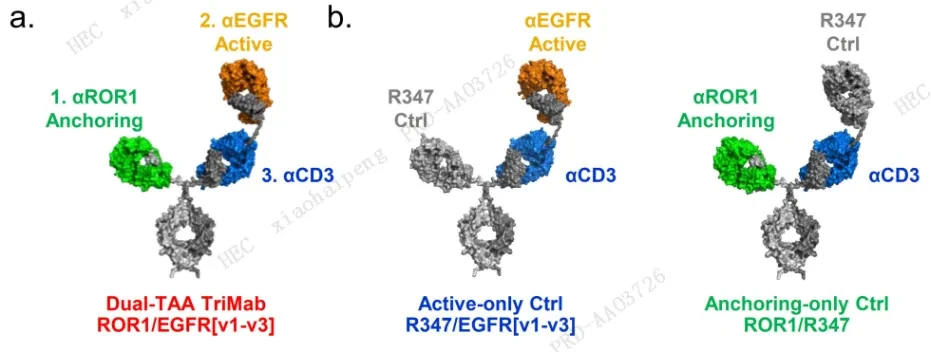
2.Synaptic Gating (Synapse Gating): Restricting immune synapse formation to dual-antigen positive cells only
The selection of anchoring arms has strict criteria: high-affinity binding is required.TAA1, but cannot mediate aloneTFunctional synapses between cells and tumor cells. For example, anti-ROR1Antibody (ERR1-TOP43) Although the affinity reaches9.5nM, but its combination ofROR1The distal epitope of the membrane cannot support the spatial structure of the immune synapse, and it is ineffective when used alone.TCell-dependent cytotoxicity (TDCC) Activity。And when the active arm (such asEGFRAfter the antibody) binds simultaneously, the anchor arm passes through“Spatial Localization”Activate the arm withCD3Form effective synapses, triggerTCell Killing.
3.Affinity Modulation: Activity Arm Attenuation Implementation“Dual Antigen Dependency”Activation
Wild-typeEGFRAntibody (v1)Affinity0.7nM, can independently mediate weakTDCC。Modification of Active Arm Affinity through Site-Directed Mutagenesis:BuildAttenuated Variantv2, itsAffinity decreased to8nM(8(Double attenuation), no activity when bound alone, requires anchoring arm synergy。AndAttenuated Variantv3Affinity decreased to32nM(30With double attenuation), it achieves specific activation only on dual-antigen positive cells through cross-arm affinity-enhanced binding.
Two:TriMabMolecular Construction and Drugability Validation
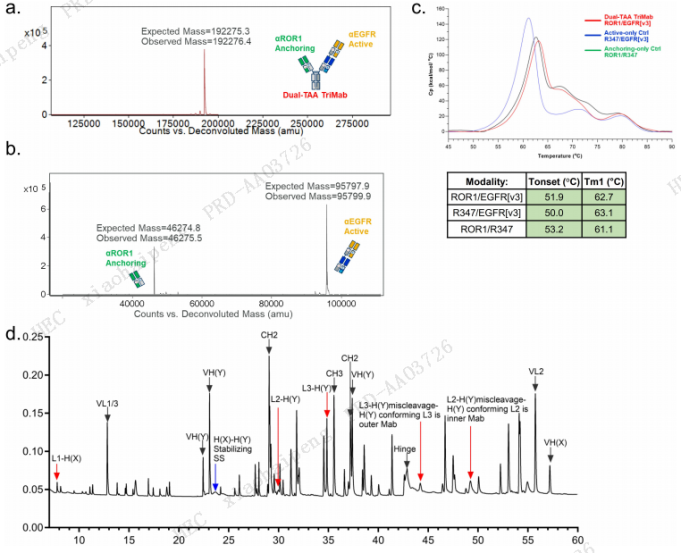
TriMabBased on“Knob-into-Hole”(KiH)FcHeterodimerization Technology, CombinedCH1-CLField's“Electrostatically Directed Mutation”And“Engineered Disulfide Bonds”, achieving threeFabPrecise Matching。CHOCell transient transfection expression exceeds200mg/L, Stable cell line production reached2-3g/L, compared with conventionalIgGEquivalent。Size Exclusion Chromatography (SEC) Show monomer ratio>95%, Differential Scanning Calorimetry (DSC) Measured melting temperature (Tm)>61℃, meeting clinical production requirements。TwoLiquid Chromatography-Mass Spectrometry (LC-MS) confirmed no chain mismatch, peptide mapping analysis verified correct disulfide bond formation, with no fragmentation or aggregation.
In ChinaFcRnGenetically ModifiedTg32In mice,TriMabExhibit similar pharmacokinetic characteristics to monoclonal antibodies:Half-life (t₁/₂)4.2-5.8Day, Close to ParentEGFR IgG(5.9days), much longer than traditional bispecific antibodies (usually<2Day)。In11.1-14.1mL/d/kgWithout significant target-mediated drug disposition (TMDD), avoiding rapid drug clearance caused by high-affinity anchoring arms.。Tissue DistributionDisplayMainly enriched in double-antigen positive tumors, with low exposure in normal tissues, reducing the risk of off-tumor toxicity.
Three:TriMabIn Vitro Selective Killing and Mechanism Validation
InROR1/EGFRFor the dual antigen model, inNCI-H358(ROR1⁺EGFR⁺) andNCI-H358.ROR1.KO(ROR1⁻EGFR⁺) Cells Validation`, the results showed`High-affinity active arm (v1) forKOCells still have cytotoxicity (EC₅₀=1.8nM), Selective Multiple (FCP) Only3。AndLow-affinity active arm (v3) Parental cellsEC₅₀=6.25nM, forKONo cell killing (EC₅₀>1000nM),FCPAchieve502。At the same timeIn gastric cancer (AGS), Breast Cancer (MDA-MB-231), Colorectal Cancer (CACO-2) and other double-antigen positive cells,TriMab(v3)FCPAverage>800, confirming broad-spectrum selectivity.
TraditionalTCEsOften causesCRS,AndTriMab(v3) The killing efficiency reached90%Time,TNF-α/IL-6The concentration is only high affinity.v1Variant1/10, close to baseline levels。In addition,Induced only in the presence of double antigen-positive cellsCD69⁺CD25⁺TCell (Activation Marker), Activation Rate in a Single-Antigen Environment<6%(Figure4B), avoiding excessive activation of the systemic immune response.
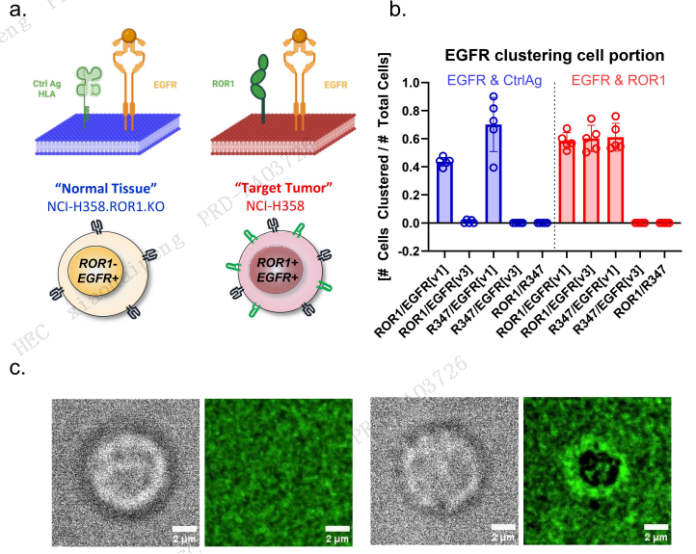
By supporting the lipid bilayer (SLB) Simulate tumor cell membrane,ConfocalImaging shows:High Affinityv1Variant regardless of existenceROR1`, can induce`EGFRAggregation and Synapse Formation。AndLow Affinityv3Variant: Only inROR1AndEGFRCo-expression,EGFRInTClustering at the cell interface forms functional immune synapses, confirming“Synaptic Gating”Effectiveness of the mechanism.
Four:TriMabIn vivo efficacy and target universality
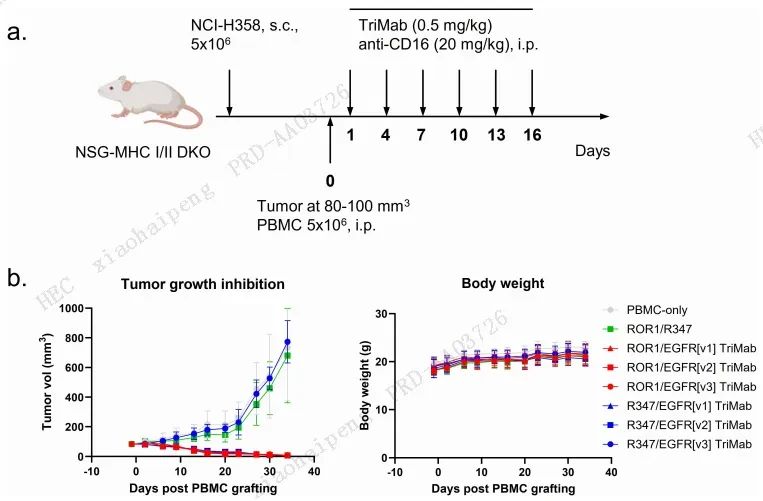
InNCI-H358(ROR1⁺EGFR⁺) Xenotransplantation model,TriMab(v3) Every3Day0.5mg/kgAt the dose,10/10Complete in miceTGI, and no weight loss。
AndActive Arm Alone Control Group (R347/EGFR[v3]) NoneTGI, Anchor Arm Separate Control Group (ROR1/R347) Non-toxic, confirming the efficacy dependent on dual antigens。After the treatment ends4No tumor recurrence this week, indicatingTriMabMay induce tumor-specific immune memory.
Replace the anchoring arm withHER2Antibody,When the membrane-proximal epitope antibody (trastuzumab) serves as the anchoring armFCPOnly10-15, as it can partially mediate synapse formation, there is a risk of tumor shedding.。AndMembrane distal epitope antibody (clone4380): When used as an anchoring armFCPReach713-1100, NoneTumor External TargetToxicity, andROR1Model results are consistent。At the same time, mechanism research shows,HER2/EGFR TriMabSimilarly dependent on the presence of dual antigens to form an immune synapse, confirmed“Anchor Arm Epitope Selection+Activity Arm Affinity Modulation”It is the principle of universal design.
Five:TriMabClinical Translation Advantages
InROR1Single-positive cells (CA46) and double-positive cells (NCI-H358) In the co-culture model, even ifCA46Cell Proportion Reached20:1,TriMab(v3) toNCI-H358TheEC₅₀No significant changes (FCPMaintain500Left and right), confirming that the high-affinity anchoring arm does not detach due to single-positive tissue.“sinkEffect”Resulting in reduced efficacy, SurfaceNon-target-mediated drug clearance。
In addition,HEKCell Binding AssayDisplayTriMabBinding Rate with Irrelevant Cells<5%, without significant non-specific adsorption。AC-SINSAnalysisAlso showsSelf-aggregation index approaches monomerIgG, no concentration-dependent aggregation,CanReduce the risk of immunogenicity in the body.
Summary and Reflection
The study through innovative“Tri-specific Structure+Dual Regulation Mechanism”, makingTriMabWhile maintaining potent anti-tumor activity, the therapeutic index is improved.500Several times over. Its core value lies not only in verifying the feasibility of dual-antigen targeting but also in establishing“Synaptic Gating”“Affinity Gradient”Design principles that can be promoted,Is expected to drive more solid tumorsTCEsFrom the laboratory to the clinic, bringing new hope to patients with difficult-to-treat solid tumors such as gastric cancer, lung cancer, and pancreatic cancer.
In the future, pH-sensitive or protease-cleavable structures can be introduced into TriMab to activate the active arms only in the acidic tumor microenvironment, or toxin payloads of ADCs can be fused to achieve "immune killing + chemical killing" dual effects on dual-antigen positive cells, reducing the risk of T-cell overactivation.
Improving dual targeting selectivity in T-cell engagers via synapse-gated and affinity-tuned trispecific antibody design. MAbs. 2025 Dec;17(1):2570748. doi: 10.1080/19420862.2025.2570748. Epub 2025 Oct 8.