

Qubot Technology Raises Nearly RMB 100 Million in Pre-A+ Financing to Accelerate Development of AI-Powered Fully Automated Magnetic-Control Interventional Surgery Platform

Shanghai Qubot Technology
Developer of Magnetic-Controlled Interventional Surgery Platform
Qubot Technology recently announced the completion of a Pre-A+ financing round of nearly RMB 100 million.
The round was led by Noyu Capital, with participation from Pudong Venture Capital, Pien Tze Huang Yingke Fund, Tongyang Fund, and Taihu Aerospace Power Qimingxing. Bitola Capital served as Qubot Technology’s long-term exclusive financial advisor.
The proceeds will primarily be used to advance regulatory approvals, clinical trials, and commercialization of the company’s core product — a fully automated magnetic-control interventional surgical robotic platform — with the goal of establishing a new paradigm for automated interventional surgery.
Interventional therapy is widely regarded as the third major form of treatment, alongside pharmaceutical therapy and conventional surgery. With the advantages of being minimally invasive, precise, and associated with faster recovery, it has become an important treatment option for cardiovascular and cerebrovascular diseases, cancer, and peripheral vascular diseases.
Driven by an aging global population and the increasing adoption of minimally invasive treatments, the worldwide interventional diagnosis and treatment market continues to expand rapidly. Tens of millions of interventional procedures are now performed every year, making the field one of the largest and fastest-growing areas of minimally invasive medicine.
Despite this growth, current procedure volumes remain far below actual clinical demand.
Cardiovascular and cerebrovascular diseases affect a very large patient population worldwide, and many patients who could benefit from interventional treatment still do not receive timely care. The penetration rate of certain high-value and time-critical procedures remains particularly low.
Acute ischemic stroke is one example. Mechanical thrombectomy has become an important standard treatment for patients with large-vessel occlusion. However, limited access to interventional centers, shortages of trained specialists, the technical complexity of the procedure, and regional disparities in healthcare resources mean that only a small proportion of potentially eligible patients worldwide actually receive thrombectomy.
This gap between supply and demand represents both substantial clinical value and significant market potential.
Cardiovascular and cerebrovascular diseases have long been among the leading causes of death worldwide, while vascular intervention is one of the key approaches for restoring blood flow and reducing the risks of death and disability.
As interventional equipment becomes more widely available, local hospitals strengthen their treatment capabilities, and technologies such as intelligent imaging, surgical robotics, and automation continue to reduce the technical barriers to interventional procedures, these treatments are expected to become less dependent on a small number of specialists and major medical centers.
This could enable interventional therapy to reach a much broader range of healthcare institutions and patients, addressing a significant level of currently unmet clinical demand.
Despite the significant clinical need, the wider adoption of interventional surgery continues to be constrained by five major challenges:
1. Limited precision and standardization. Traditional guidewires and catheters are controlled by pushing and rotating them from their proximal ends. This limits precision and makes procedural outcomes highly dependent on physician experience, making standardization difficult.
2. Shortage of trained specialists and long training cycles. Interventional procedures have a high technical learning curve. A physician typically requires at least two to three years of clinical training before becoming fully competent, contributing to a significant shortage of qualified specialists.
3. Limited intraoperative imaging and navigation. During procedures, physicians often lack intuitive, real-time three-dimensional information about vascular anatomy and the precise position of guidewires and catheters. As a result, conventional procedures can involve a significant degree of experience-based navigation.
4. Strict time requirements for emergency treatment. Conditions such as stroke and coronary artery disease often require treatment within a very short therapeutic window. Patients therefore need access to appropriate treatment as quickly and locally as possible, yet high-quality interventional resources remain unevenly distributed.
5. Occupational radiation exposure. Interventional procedures require the use of X-ray imaging, resulting in repeated radiation exposure for physicians and other medical staff. Long-term occupational exposure can increase the risk of health problems, including cataracts and hematological disorders, and may also discourage younger physicians from entering the specialty.
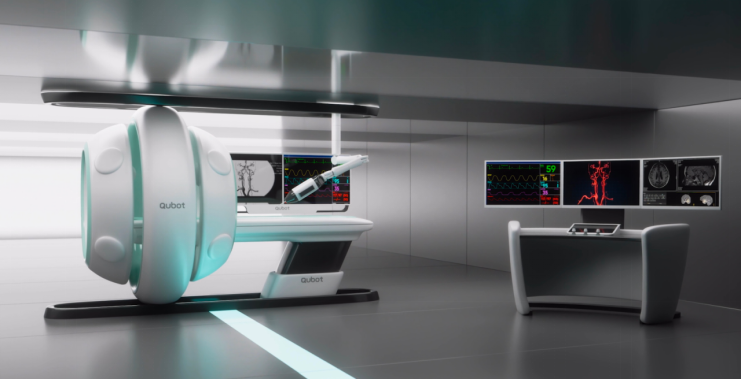
To address these challenges, Qubot Technology has been developing what it describes as the world’s first magnetic-control interventional surgery platform with an LLM agent participating throughout the entire procedure.
The platform is designed to automate the complete surgical workflow, substantially lower the technical barriers to performing interventional procedures, shorten physician training cycles, reduce variability between operators, and ultimately improve the overall quality of care.
At the algorithmic level, the platform is powered by a VLA — Vision-Language-Action — foundation model.
Through large-scale self-reinforcement learning within a physics-based simulation and world-model environment, the system is designed to learn and reproduce the procedural strategies and operating techniques of highly experienced interventional specialists.
As the platform is deployed more widely, Qubot Technology envisions it continuously learning from high-quality surgical practices around the world, creating an evolving surgical intelligence platform — a continuously improving “super brain” — ultimately capable of performing interventional procedures autonomously with a high degree of safety, efficiency, and precision.
At the hardware level, Qubot Technology has developed three major innovations.
1. Precise distal-tip catheter control
Qubot Technology’s intelligent magnetic-control technology applies force directly to the distal tip of the catheter.
The company states that the system can achieve tip-control precision at approximately the 0.1 mm level, representing an improvement of more than tenfold compared with conventional proximal pushing methods. This is designed to significantly improve procedural precision and safety.
2. 4D-DSA digital twin system
The company’s 4D-DSA digital twin system provides physicians with real-time three-dimensional vascular reconstruction as well as positional information for guidewires and catheters.
By providing more intuitive visualization and navigation, the system is designed to transform conventional experience-dependent catheter manipulation into precise, real-time, visualized navigation.
3. Flexible, detachable catheter advancement system
Qubot Technology has also developed a proprietary detachable advancement device together with innovative magnetic-control interventional consumables.
The system is designed to allow physicians to operate remotely from a radiation-safe area, potentially eliminating occupational radiation exposure for the operator while also providing a technological foundation for remote interventional procedures in the future.
Qubot Technology’s core team brings extensive experience in medical AI and advanced medical devices.
Founder and CEO Joe Wu received his undergraduate education in Mathematics and Physics from the National University of Singapore and completed graduate studies in Computer Science at McGill University. He previously conducted deep-learning research at MILA and Microsoft Research in the United States.
Partner and President of Marketing Yan Zhou has more than 20 years of experience in the medical device and artificial intelligence industries. He previously held senior positions at multinational companies including GE and has extensive experience in national market strategy and large-scale project development.
Qubot Technology is currently advancing the regulatory registration of its products.
Regulatory programs have been initiated for both its Foton 4D-DSA module and its complete Maxwell system, covering NMPA registration in China, FDA regulatory approval in the United States, and CE certification in the European Union.
Between 2026 and 2028, the company plans to progressively conduct animal studies and clinical trials and submit regulatory documentation as it works toward bringing its products to market.
Investor Perspective
The lead investor in this financing round, Noyu Capital, is an early-stage venture capital fund established by investors with extensive experience in the healthcare industry.
The firm focuses on early-stage investment opportunities in areas including medical devices and innovative therapeutics, with the goal of identifying entrepreneurs and technologies capable of addressing meaningful unmet medical needs.
Key members of Noyu Capital’s investment team each have more than ten years of healthcare industry experience, with expertise spanning medical technologies, clinical practice, business models, early-stage investment evaluation, and post-investment support.
Its portfolio covers a range of sectors, including neuroscience, cardiovascular and cerebrovascular diseases, surgical robotics, and innovative cancer therapies.
Zhiwen Yang, Founding Partner of Noyu Capital, commented:
“Treatment of cardiovascular and cerebrovascular emergencies is highly time-sensitive. In thrombectomy, every minute saved can improve a patient’s chance of survival. Yet these procedures are technically demanding, and many local hospitals currently do not have the capability to perform them. As a result, patients may lose valuable treatment time while being transferred to larger medical centers.
“What Qubot Technology is building is essentially a true embodied AI system for medicine. By combining artificial intelligence with magnetic-control technology, the company is transforming complex distal catheter manipulation into precise, direct control of the catheter tip. This has the potential to enable physicians at local hospitals, after a significantly shorter training period, to independently perform complex interventional procedures that today can generally only be carried out by highly experienced specialists.
“Qubot Technology is not only advancing the technology of interventional surgery; it is also opening access to a large patient population that existing healthcare infrastructure has been unable to adequately serve. If AI can make highly complex procedures easier to learn and perform, patients in local communities may no longer need to lose critical treatment time through long-distance hospital transfers.
“We are very pleased to support Qubot Technology’s technological innovation and look forward to seeing its work benefit more patients with cardiovascular and cerebrovascular diseases.”
With the completion of this financing round, Qubot Technology will accelerate the development and commercialization of its fully automated magnetic-control interventional surgery platform.
The company aims to provide more efficient and safer treatment options for patients with vascular diseases worldwide while contributing to the continued development of China’s advanced medical equipment industry.
About Bitola Capital
Bitola Capital, Qubot Technology’s exclusive financial advisor for this financing round, is a financial services firm focused on the global life sciences and healthcare sector.
Its businesses span investment banking, financial services for entrepreneurs and small businesses, asset management, commercialization services, and cooperation with government-backed industrial parks.
Bitola Capital aims to connect promising life sciences companies with long-term investors around the world and to build a platform where capital, industry resources, and innovative companies can identify opportunities and create value together.
Meng Liuqing Yang, Vice President of Bitola Capital, commented:
“As the exclusive financial advisor for Qubot Technology in this financing round, we are honored to have witnessed and supported this important milestone.
“In medical technology, teams that are willing to focus deeply on solving genuine clinical problems through technology are particularly valuable. Qubot Technology’s work in automating interventional surgery demonstrates the potential to make high-quality medical care accessible to a much broader patient population.
“Noyu Capital’s participation represents not only financial support, but also a long-term commitment to Qubot Technology’s vision and technology.
“We are very pleased to see an advanced technology company with a strong focus on meaningful clinical impact find a partner that truly understands its mission and is prepared to support its long-term development.”