

Up 92%! The Device Company That Broke the Johnson & Johnson–Medtronic Duopoly Goes Public

Bmdevice
R&D and Manufacturing of Medical Devices and Peptide Pharmaceutical Equipment
On September 9, BMDEVICE (Hainan Biomedical Device Co., Ltd.) officially listed on the Beijing Stock Exchange (BSE). Its shares opened at RMB 32.86, surging 92%, with a market capitalization of about RMB 1.7 billion. As of press time, the share price had pulled back to RMB 27.84 in real time, up 62.81%, with total market capitalization exceeding RMB 1.5 billion.
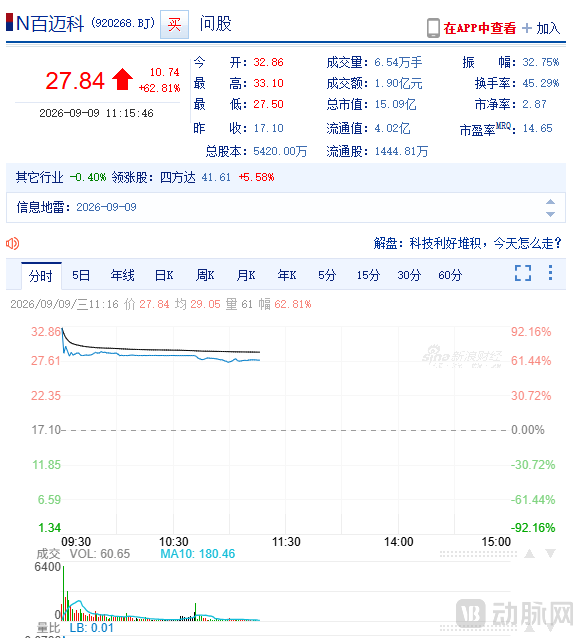
This national-level specialized and innovative (SRDI) enterprise's core product, Fengchuangling, obtained China's first Class III medical device registration certificate for absorbable knotless surgical sutures, breaking the monopoly of three foreign giants — Johnson & Johnson, Surgical Specialties, and Medtronic — in this segment.
In 2025, BMDEVICE generated revenue of RMB 214 million and net profit of RMB 70.8087 million, with a gross margin above 75%. Annual sales of its core product Fengchuangling exceeded 2.01 million pieces, covering nearly 3,000 hospitals nationwide and more than 50% of the country's top-100 hospitals by surgical volume; by sales revenue, it ranks fourth in the industry and first among domestic brands, right in the most bountiful period of the import-substitution dividend.
This report card owes much to founder Yang Dingjian's cross-disciplinary entrepreneurship. A former university teacher, he started by exploring peptide pharmaceutical equipment, then spent nearly a decade tackling the bottleneck process of surgical sutures, completing a genuine from-zero-to-one breakthrough.
Yang Dingjian's cross-disciplinary story begins in a laboratory at Lanzhou University.
In the late 1990s, this PhD, freshly graduated from Lanzhou University's biochemistry and molecular biology program, stayed on as a university teacher. Life at the lectern was stable and respectable, but over time Yang Dingjian harbored a nagging question: scientific research is pure, yet how many results can truly land and become products that benefit ordinary people?
In his spare time, he loved tinkering with electromechanical products. Colleagues thought this biology PhD was a bit off-track, but precisely this curiosity about mechanics and electronics became the starting point of his later cross-disciplinary entrepreneurship.
In 2001, he made a choice those around him could not understand: giving up his stable position at Lanzhou University, he went south alone to Hainan and joined Hainan Zhonghe Pharmaceutical, where he stayed for five years. A biology PhD accustomed to holding a pipette plunged headfirst into a completely unfamiliar industrial arena, accumulating pharmaceutical industry experience.
In 2006, in a cheaply rented old villa on Jinpan Road in Haikou, Yang Dingjian founded Hainan Jianbang Pharmaceutical (now a BMDEVICE subsidiary), embarking on his entrepreneurial path. But entrepreneurial passion met the cold water of policy: he had intended to develop new drugs, only to coincide with the nationwide suspension of approvals for new drug license numbers.
For more than a year after its founding, the company was almost entirely loss-making. Thanks to an introduction from a friend, he received an order to build a 200-liter peptide synthesizer. "As long as you can build it, I'll buy it." At that time, no peptide synthesizer of this specification existed in China, and to ease Yang Dingjian's concerns, the customer even paid a deposit in advance.
Drawing on his amateur electromechanical interests and the pharmaceutical industry experience accumulated over several years, he moved from drawing and drafting to repeated experiments, finally developing China's first fully automated large-scale peptide synthesizer with independent intellectual property rights.
At this point Yang Dingjian handled not only product development and sales but also installation and after-sales service. On the day the first unit was delivered, he flew to Shanghai for installation and testing, his heart full of uncertainty: "Can this product really operate safely?"
It proved to be an extremely successful attempt, giving the revenue-less company a strong start. Yang Dingjian began to focus his goals on medical devices with broad uses and considerable R&D difficulty.
Later, in 2007, he founded Jianke Co., Ltd. (the predecessor of BMDEVICE). Around 2009, through hospital clinical research, he set his sights on a track monopolized by three foreign giants — Johnson & Johnson, Surgical Specialties, and Medtronic — for decades: knotless absorbable barbed sutures.
Surgical sutures directly affect the quality of wound healing. Traditional sutures often lead to poor wound closure quality; foreign barbed sutures solved this problem but at a high price — a 40-centimeter imported barbed suture sold for more than RMB 2,000.
Yang Dingjian wanted to try, but found that production equipment could not be purchased at all, and even relevant technical literature was almost unavailable — foreign companies had long kept the technology strictly locked down. He assembled a team covering biomaterials, precision machinery, and clinical medicine, working day and night: reviewing extensive materials, consulting experts, and hand-building prototypes.
The process is like using a machine to cut a notch in a strand of human hair: more than a dozen barbs of appropriate depth must be carved per centimeter, with micron-level precision, and under a microscope they must present a three-dimensional effect like a dragon's fin. The first generation of equipment was built, but the barbs would not stand up.
The team refined it repeatedly, conquering one by one the process challenges of barbs that stand up, stand long, and feel smoother. This grinding went on for several years. In 2015, BMDEVICE obtained approval for Fenbihe, a non-absorbable self-anchoring surgical suture, achieving the first breakthrough in domestic knotless suture technology.
That was only an appetizer; the real hard battle was barb-cutting on absorbable materials. The material's degradation rate in the body must precisely match tissue healing time, and the depth and angle of the barbs directly determine anchoring force — any deviation means surgical failure.
In 2019, Fengchuangling, China's first domestically produced barbed, knotless, absorbable medical suture, was finally approved for market launch. It was the first Class III medical device registration certificate for absorbable knotless sutures obtained by a domestic company, breaking more than a decade of monopoly by foreign brands.
Today, BMDEVICE has formed two major business segments — medical devices, comprising surgical sutures, interventional embolization, and hemostatic materials, and pharmaceutical equipment.
That biology PhD who once tinkered with electromechanics in his spare time ultimately used a single thread honed over ten years to break the foreign monopoly and carve out his own path.
Fengchuangling's market performance after launch validated Yang Dingjian's judgment.
BMDEVICE's revenue in 2023–2025 was RMB 174 million, RMB 185 million, and RMB 215 million respectively, with the revenue structure highly concentrated in the medical device segment. Among these, the absorbable surgical suture business centered on Fengchuangling is the largest revenue source, generating RMB 166 million in 2025, with the three-year shares being 79.24%, 84.75%, and 77.59% respectively.
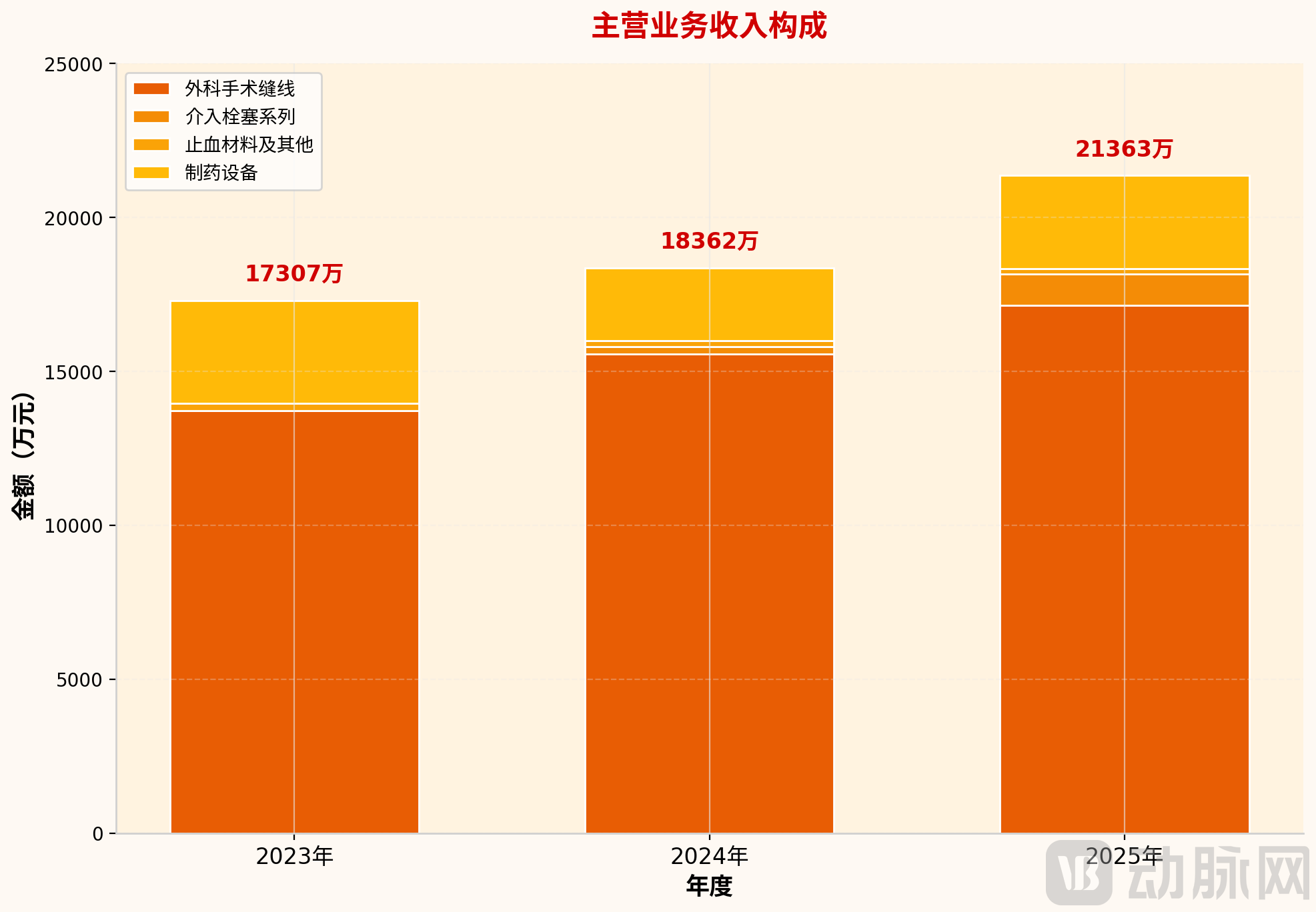
Corporate Revenue Structure, Charted Based on Prospectus Data
The other business, peptide pharmaceutical equipment, saw its revenue share fluctuate between 12.83% and 19.29% over the three years. These customized projects have longer cycles, but as the GLP-1 drug wave drives growth, the peptide drug market is expanding rapidly.
BMDEVICE's peptide pharmaceutical equipment customers include leading domestic pharma companies such as Sinopep, WuXi AppTec, Hengrui Medicine, and Qilu Pharmaceutical. Once such customers establish partnerships, they do not easily switch. As these customers ramp up production, peptide pharmaceutical equipment will become the company's second growth curve for revenue.
Fengchuangling's full-year 2025 sales exceeded 2.01 million pieces, up 21.11% year over year. The product covers nearly 3,000 hospitals across all 31 provinces and municipalities nationwide, and more than 50 of the country's top-100 hospitals by surgical volume.
In terms of market size, from 2019 to 2024, China's surgical suture market grew from RMB 5.8 billion to RMB 6.5 billion in sales, with an expected RMB 9 billion by 2030. The growth rate is not spectacular — it grows with surgical volumes and cannot create incremental demand the way innovative drugs can.
What truly deserves attention is that the penetration rate of knotless sutures (barbed sutures) is climbing rapidly.
According to Frost & Sullivan data, from 2019 to 2024, China's absorbable knotless suture market grew from 4.8 million pieces to 8.2 million pieces in sales volume, a CAGR of 11.4%; it is expected to reach 39.9 million pieces by 2030, a CAGR of 30.1%.
By sales value, from 2019 to 2024, China's absorbable knotless suture market grew from RMB 1.3 billion to RMB 1.7 billion, a CAGR of 5.7%; by 2030 it is expected to reach RMB 3.9 billion, a CAGR of 14.8%. By extension, penetration rose from 4.99% in 2019 to 6.42% in 2024, and is projected to reach 18.84% by 2030.
Previously, China's knotless suture market was monopolized for more than a decade by three foreign giants — Johnson & Johnson, Surgical Specialties, and Medtronic. Whether clinical usage habits, channel penetration, or product portfolios, years of accumulation had formed competitive barriers. The 2024 market landscape clearly showed this: Johnson & Johnson 48.9%, Surgical Specialties 17.8%, Medtronic 12.3% — the three foreign players together accounting for nearly 80%.
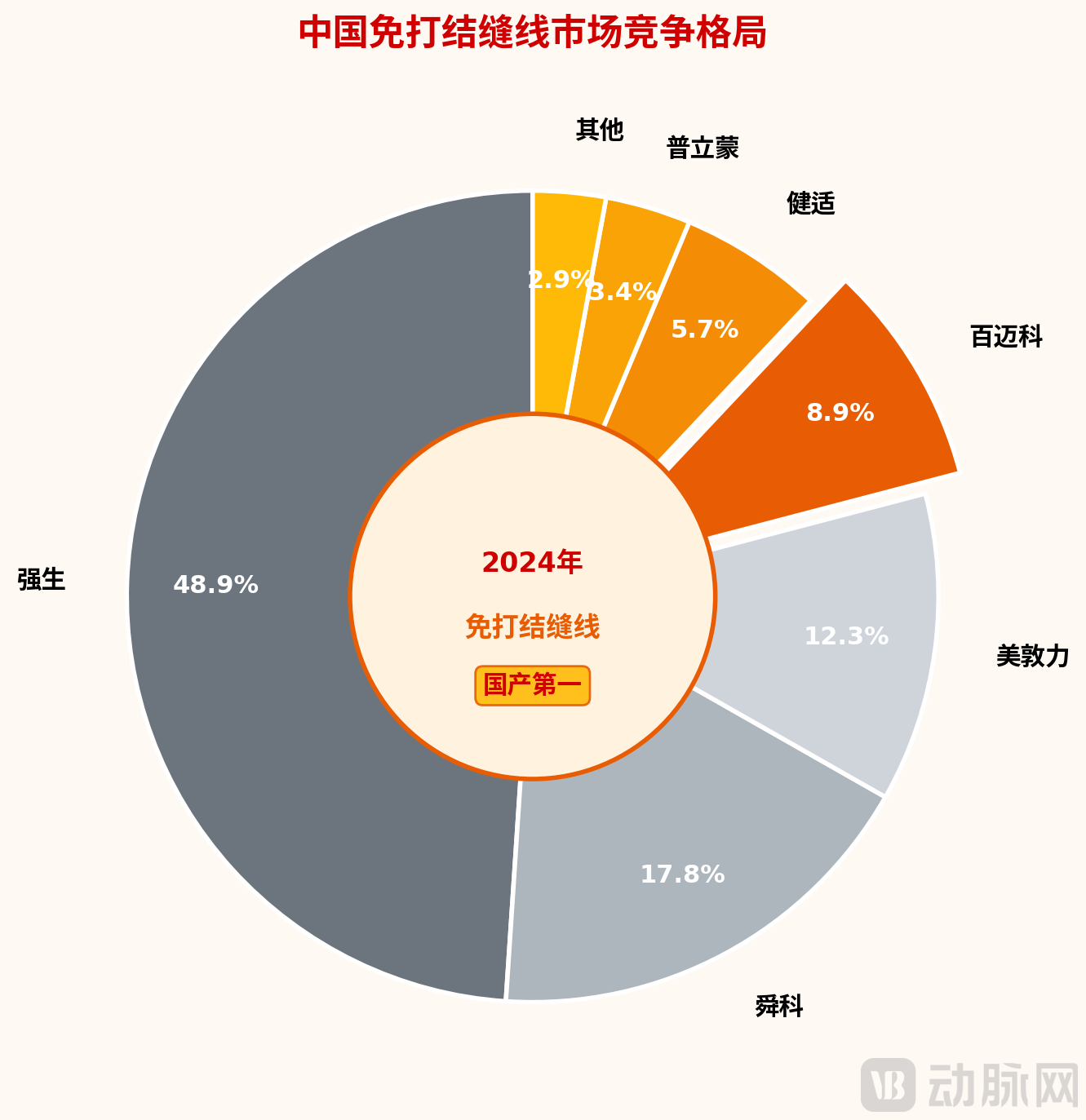
China's Knotless Suture Market Landscape, Charted Based on Prospectus Data
Among domestic brands, BMDEVICE ranked fourth with an 8.9% share, followed by Genesis MedTech at 5.7% and Nanjing Polymer Medical at 3.4%, with other manufacturers together accounting for 2.9%.
The intervention of volume-based procurement began to break this landscape.
In 2023, Hebei Province, leading the Sanming Procurement Alliance, included barbed sutures in volume-based procurement of medical consumables — the first time knotless sutures entered the procurement catalog. Subsequently, the large 24-province inter-provincial alliance procurement led by Liaoning took effect, covering most of the domestic market space, shifting the market from academic- and brand-driven sales to a comprehensive contest of pricing, cost control, and capacity supply.
Volume-based procurement has brought BMDEVICE both volume growth and price declines. On volume, winning procurement bids significantly accelerated hospital entry and opened incremental markets — for example, after Fujian's procurement took effect, Fengchuangling's local sales grew 64.92% year over year. Beyond the core Fengchuangling, new products such as gelatin sponge embolization microspheres and Weiling Plus antibacterial sutures participated in procurement upon launch, becoming new revenue sources.
On price, unit prices have continued to decline; in the Liaoning procurement, Fengchuangling's winning hospital-entry price fell 17.82% versus the previous terminal price. As a result, although revenue has grown steadily over the past three years, net profit has hovered around RMB 70 million.
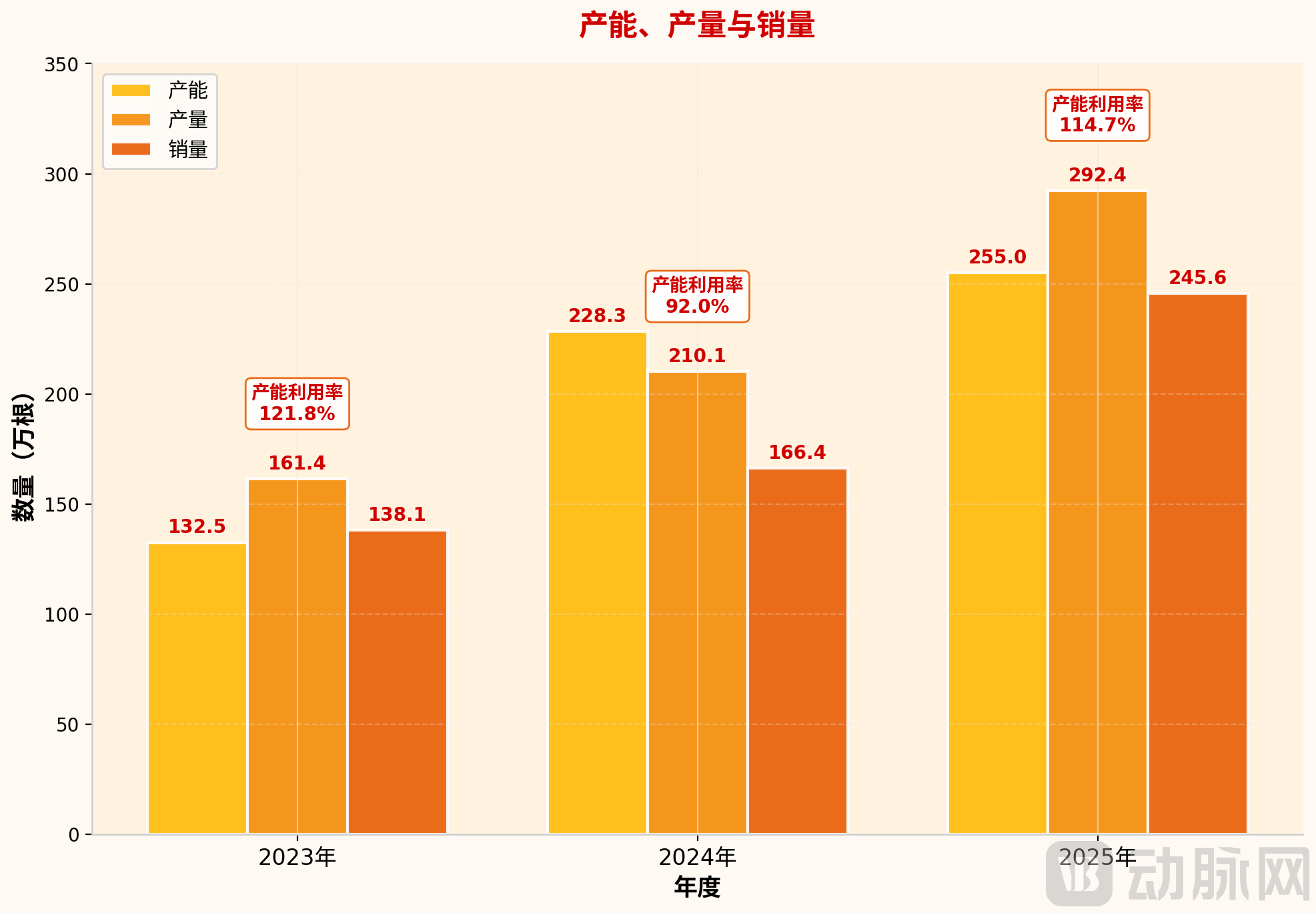
Enterprise Production Capacity, Output, and Sales Volume: Charted Based on Prospectus Data
Currently, BMDEVICE's capacity utilization has reached 114.66%, with production lines operating in overload for an extended period. This means its core product is at the peak of dividend release.
Proceeds from this BSE IPO will be used mainly for capacity expansion: Fengchuangling capacity is expected to reach 3.25 million pieces, antibacterial fishbone sutures 250,000 pieces, and antibacterial barbed sutures 500,000 pieces. Capacity for absorbable surgical sealing adhesive and skin wound adhesive will also be added.