

With No Clinically Available Drug to This Day, an Academician-Led Team at Sun Yat-sen University Cancer Center Breaks the EBV Prevention and Treatment Impasse
In 1964, EBV (Epstein-Barr virus, a double-stranded DNA virus of the herpesvirus family) became the first virus in human history identified as tumor-associated — earlier than HPV. Over the following sixty years, EBV's associations with nasopharyngeal carcinoma, various lymphomas, post-transplant lymphoproliferative disorder (PTLD), and even multiple sclerosis were confirmed one by one. More than 90% of adults worldwide harbor this virus in latent form.
Unfortunately, the number of EBV-specific drugs approved worldwide to date is zero.
The reason lies not in science, but in a misalignment of the academic landscape. "The high-incidence regions for EBV-related lymphoma are in Africa, and for nasopharyngeal carcinoma in South China and Southeast Asia. These two regions have long been outside the center of the mainstream, US- and Europe-led academic world, and few resources have flowed in over the decades," Yang Jie, PhD, CEO of CBNOVA Medical Technology, recalled to VCBeat.
Fortunately, this situation has begun to change in recent years.
Multiple international studies have successively confirmed a strong causal association between EBV and multiple sclerosis (MS), prompting US and European research institutions and pharmaceutical companies to re-enter the field. International companies represented by Moderna have successively launched clinical studies of EBV-related mRNA products, and global competition is rapidly heating up.
145% of Global EBV-Related Deaths Occur in China, Yet No Approved Drugs Are Available for EBV Infection
More than 95% of people worldwide will be infected with EBV at some point in their lives.
The virus first enters the body through oropharyngeal epithelial cells, then infects B cells and establishes long-term latency. When the body's immune balance is disrupted, EBV may reactivate, triggering infectious mononucleosis, post-transplant lymphoproliferative disorder (PTLD), nasopharyngeal carcinoma, gastric cancer, lymphoma, and various autoimmune diseases.
According to research data from the Sun Yat-sen University Cancer Center, deaths from EBV-related tumors in China account for about 45% of the global total, and new nasopharyngeal carcinoma cases account for nearly 40% of the world's total. Whether for EBV reactivation infection, autoimmune diseases, or nasopharyngeal carcinoma treatment, there is currently a lack of truly effective targeted drugs.
This string of data reveals a harsh reality: the populations at high risk of EBV infection are in China, yet no effective solution is available to Chinese people.
"For a long time, this could only be solved by Chinese research teams themselves — and through this twist of fate, we have actually taken the lead in EBV research worldwide," Yang Jie said.
CBNOVA Medical Technology, founded in Guangzhou, Guangdong, hopes to seize this track opportunity, drawing industry attention to this niche virus that many people may never have heard of but whose harm is severely underestimated, and hopes that through the team's innovative designs, it can bring new solutions to EBV infection prevention and treatment.
2Backed by the World's Largest Nasopharyngeal Carcinoma Center
Unlike other startup biotechs, CBNOVA Medical Technology has not followed the traditional biotech startup model.
The company's core team has long been deeply engaged in EBV research, backed by the academician-led team at the Sun Yat-sen University Cancer Center. Over the past two decades-plus, the team has continuously conducted research on EBV pathogenic mechanisms, viral infection pathways, and tumorigenesis mechanisms, publishing more than 80 high-quality EBV-related papers, filing more than 40 patents, and undertaking multiple National Key R&D Programs and major special projects.

Sun Yat-sen University Cancer Center academician-led team
What truly sets CBNOVA Medical Technology apart from other startup biotechs is that, backed by the academician team and the Sun Yat-sen University Cancer Center, it has secured one of the world's scarcest resources: nasopharyngeal carcinoma clinical resources.
The Sun Yat-sen University Cancer Center is the world's largest nasopharyngeal carcinoma diagnosis and treatment center, receiving thousands of patients each year. This means the team can continuously obtain clinical samples, disease data, and a foundation for real-world studies.
But this advantage cannot simply be equated with hospital resource support — it represents a closed loop of "basic research – clinical application – market and patient data feedback – basic research optimization."
Given the structural complexity of EBV itself, drug engineering capability alone is far from sufficient. What determines the probability of success also includes a deep understanding of the viral life cycle, infection mechanisms, latency states, and disease evolution pathways.
That happens to be where the CBNOVA Medical Technology team excels.
3Dual-Target Design Covering Two Major Infection Pathways
Having addressed the clinical research resource problem upfront, CBNOVA Medical Technology has turned to building its product pipeline, with an EBV acute infection neutralizing antibody as a relatively advanced output.
At the target selection level, CBNOVA Medical Technology worked backward from EBV's unique infection mechanism and population clustering characteristics to choose a "dual-target blockade" strategy.
The virus first enters the body through epithelial cells, then infects B cells and establishes a long-term latent reservoir. In other words, EBV infection essentially comprises two critical stages.
On this basis, CBNOVA Medical Technology's design logic is not to block only one stage, but to intervene simultaneously at the two key nodes of epithelial cell infection and B-cell infection.
"Our dual-target design comes from these two directions: the first target blocks the epithelial cell infection pathway, and the second blocks the B-cell infection pathway," Yang Jie explained. "We not only want to block viral reactivation and replication in the body, but also hope to exert a blocking effect at the initial infection stage."
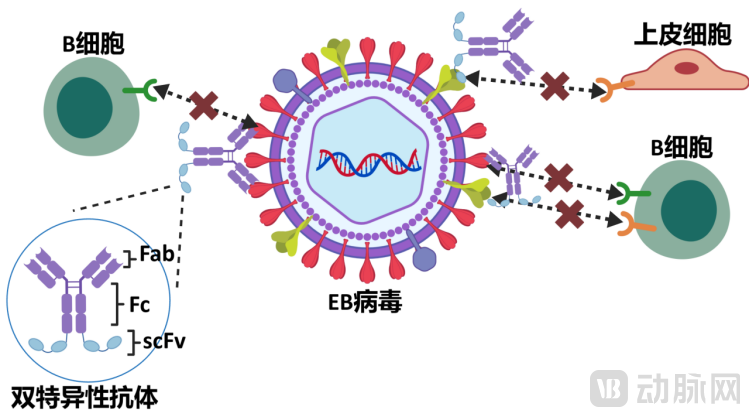
Mechanism of action of the bispecific antibody
This strategy gives its pipeline an important feature that distinguishes it from traditional neutralizing antibodies.
According to Yang Jie, this dual-target antibody has shown high protective activity in PTLD models, with strong viral neutralization at extremely low drug concentrations.
In terms of market selection, CBNOVA Medical Technology did not set its first target market on highly competitive large indications, but on EBV infection prevention after organ transplantation.
It must be emphasized that there is currently no prophylactic drug for EBV infection anywhere in the world.
In addition, a background that cannot be ignored is that for patients receiving organ transplantation and hematopoietic stem cell transplantation, EBV reactivation infection has a high probability of rapidly developing into severe lymphoproliferative disease (lymphoma), especially in children, because the age at which Chinese people are first infected with EBV highly overlaps with the age of children receiving hematopoietic stem cell transplantation.
This means that once the product successfully reaches the market, it will have the opportunity to be the first to enter a market with a clear unmet need and relatively limited competition.
This strategy also reflects CBNOVA Medical Technology's development philosophy, which differs from many biotechs: solve the most urgent problem first, then gradually expand market boundaries.
4Multi-target mRNA: Integrating "Prevention" and "Treatment" into a Single Design
Compared with its antibody pipeline, another core product of CBNOVA Medical Technology holds even greater imagination.
It is an EBV tumor prevention and treatment mRNA product with the dual attributes of "treatment + prevention."
The current mainstream routes in the industry fall broadly into two categories: one emphasizes inducing neutralizing antibodies to block viral infection; the other emphasizes T-cell immunity, killing tumors by activating cytotoxic immunity.
CBNOVA Medical Technology has likewise taken a different path, choosing a third route.
"In early research we found that for virus-induced tumors, relying on only one or two targets makes it difficult to achieve ideal results," Yang Jie said. "For tumor killing, cellular immunity is important; but protective antibodies generated through the humoral immunity pathway greatly help deepen killing and prevent recurrence. The two pathways are not separate — only their synergy can achieve better clinical outcomes."
Based on a deep understanding of tumor immunotherapy mechanisms, the R&D team has integrated multiple antigens related to B-cell immunity and T-cell immunity into a single product system.
According to Dr. Yang Jie, the product covers multiple key EBV antigen targets and, through fusion design, ultimately forms six mRNA sequences delivered by different LNP systems.
In terms of target count, this pipeline has become one of the mRNA products with the broadest EBV antigen coverage in the world.
The direct advantage of this design is that it can both activate antitumor T-cell responses and generate protective neutralizing antibodies.
Animal experiments show that low-dose administration can induce a significant antitumor immune response and achieve tumor clearance.
More importantly, its indication coverage far exceeds that of traditional tumor vaccines.
Underpinning this design is EBV's virological characteristic: it is a double-stranded DNA virus that does not mutate frequently like SARS-CoV-2. Its highly conserved sequences mean that the same drug design is expected to be broadly applicable across the different diseases caused by EBV.
From relapsed/metastatic nasopharyngeal carcinoma, to prevention for high-risk populations, to future expansion to other EBV-related diseases, this "one drug, multiple scenarios" design gives the product greater commercial value imagination.
5Autologous Protein Therapeutic Development: Empowering Tumor-Infiltrating T Cells to "Truly Kill"
The neutralizing antibody and mRNA products form CBNOVA Medical Technology's current value foundation, while reserve programs will bring new market growth.
This is a novel cold-tumor immunotherapy drug developed based on the concept of "autologous protein-based drug development."
One of the biggest challenges in the current immunotherapy field is cold tumors.
Many solid tumor patients do not respond to PD-1 therapy, primarily because the tumors lack sufficient immune cell infiltration.
The new mechanism discovered by CBNOVA Medical Technology can, by simulating viral infection states, activate signaling pathways such as STING (stimulator of interferon genes), promoting immune cell entry into the tumor microenvironment; it simultaneously induces tumor neoantigen release and T-cell education, achieving precise killing.
Unlike traditional "cold-to-hot" approaches, the CBNOVA Medical Technology team is not satisfied with merely increasing T-cell numbers; it focuses on ensuring that T cells entering tumors undergo advance tumor neoantigen education and possess clear killing capability.
According to team-disclosed data, in animal models, the complete clearance rate of some cold tumors reached 70%–80%, and the program has now entered the pre-IND development stage.
For a biotech that has been actually established for less than two years, this pipeline raises the ceiling of CBNOVA Medical Technology's innovation value and future imagination.
6Small and Specialized, Not Large and Comprehensive
Unlike many startups, CBNOVA Medical Technology did not choose to directly attack the largest market. Starting from its own realistic foundation, it first set its goal on becoming No. 1 in a niche track.
From infection prevention in organ transplantation, to treatment of relapsed/metastatic nasopharyngeal carcinoma, to disease prevention for EBV high-risk populations, CBNOVA Medical Technology has planned an expansion path from small to large.
This path fits the reality of a startup's limited resources while maximizing its unique advantages in the EBV field.
At the end of the interview, Yang Jie summarized CBNOVA Medical Technology's characteristics with three plain keywords: "smart, efficient, resilient."
In fact, these three words exactly correspond to CBNOVA Medical Technology's development logic.
Smart means avoiding red-ocean competition and choosing a track with genuine cognitive and resource barriers;
Efficient means leveraging the academician team's more than 20 years of accumulation to rapidly convert basic research into products;
Resilient means persisting in a field neglected for decades and waiting for the industry inflection point.
As global pharma refocuses on the EBV track, CBNOVA Medical Technology has already accumulated the deepest disease understanding, the richest clinical resources, and an R&D system closest to patient needs.
For CBNOVA Medical Technology, the key proposition it needs to answer next is how to complete the transformation from research advantage to industrial advantage first, before global industrial competition fully begins.
And that is the most anticipated story of China's EBV innovative drug industry.
7Expert Comments

Chen Yiqun, general manager of Shangjun Investment
Shangjun Investment began promoting the marketization of CBNOVA Medical Technology in 2023. This project, backed by the SYSUCC academician team, aims to build the only translational platform in the EBV prevention and treatment field, with the scarcity of a "source innovation + clinical monopoly + capital exit" trinity. With a global EBV infection rate exceeding 95%, EBV is linked to hundreds of billions of RMB of unmet clinical needs across nasopharyngeal carcinoma, lymphoma, multiple sclerosis, and more, yet no drug has been approved globally — a significant market gap. The company's two core pipelines — an EBV acute infection neutralizing antibody and a tumor prevention and treatment mRNA vaccine — are both in the stage of advancing from preclinical toward IND, with clinical applications expected in 2027 and Phase I in 2028, on a clear and defined timeline. Led by academicians, the team combines top research strength with industrial translation experience and, backed by the world's largest nasopharyngeal carcinoma clinical resources, has built an extremely high competitive moat. Its commercialization path is also very clear: the project carries both major social value and expectations of high-multiple returns — a typical frontier biomedical target of "hard tech + large market + strong team" that deserves close attention.