Weekly Medical Device News Roundup (Aug 31 - Sep 6): Funding, Approvals, Regulatory Updates, and Strategic Collaborations

Kossel
Vascular Interventional Device Manufacturer and R&D Developer

Medtronic
Medical Device Manufacturer

Cornerstone Robotics
Innovative Surgical Robot Developer
Haofeng
Interventional Device CDMO Service Provider

Stryker
Medical Device R&D, Production, and Sales Company



01
Kossel CompletedRMB 400 Million Series C Financing, Co-led by Shenzhen Capital Group and Jinhe Capital
On September 1, 2026, Kossel, a platform enterprise specializing in pan-vascular interventional devices, announced the completion of its C-round financing totaling RMB 400 million. The round was co-led by Shenzhen Capital Group and Jinhe Capital, with participation from Frontier Investment and Chuangjing Capital. Existing shareholders, including Suzhou Venture Capital (National Social Security Fund), Suzhou High-Tech Financial Holdings, and Joyin Medical Fund, made oversubscribed follow-on investments. Xiqiao Capital served as the financial advisor. The funds will be used to expand production capacity and support the R&D and global regulatory registration of products in peripheral intervention, coronary intervention, and cardiac electrophysiology. Founded in 2013 and headquartered in Suzhou, Kossel is a national-level specialized, refined, distinctive, and innovative “Little Giant” enterprise and a platform company in the pan-vascular interventional device sector. It holds more than 300 domestic and international invention patents and nearly 100 regulatory approvals in China and overseas markets.
02
Medtronic Announces Acquisition of Cornerstone Robotics$700 Million Strategic Investment: Chinese-Made Surgical Robots Go Global, Driven by the Dual Engines of "Capital + Distribution Channels"
On September 1, 2026, global medical device giant Medtronic announced an investment of approximately $700 million in Cornerstone Robotics, a Hong Kong-based company specializing in laparoscopic surgical robots. Through this investment, Medtronic has secured distribution rights for Cornerstone’s Sentire laparoscopic surgical robot in markets outside the United States where it has already received regulatory approval, including China, the European Union, and Singapore, as well as a seat on the board of directors. Founded in Hong Kong in 2019, Cornerstone Robotics was established by Ouyang Guowei, a former senior engineering director at Intuitive Surgical. The company achieves a 99% self-research and self-production rate for its core components and operates a 30,000-square-meter manufacturing base in Shenzhen.
03
Medtronic Strategic InvestmentPi-Cardia: $80 Million Investment to Develop Valve-in-Valve TAVR Solutions for Coronary Obstruction
On September 1, 2026, Medtronic announced a strategic investment of $80 million in Pi-Cardia, an Israeli structural heart disease company, along with an acquisition option worth up to approximately $210 million upon the achievement of certain milestones. Founded in 2017, Pi-Cardia specializes in the development of leaflet modification technologies. Its ShortCut device is the first FDA-approved leaflet modification technology, designed to reduce the risk of coronary obstruction during valve-in-valve TAVR procedures.
04
Haofeng Completes Nearly RMB 100 Million in Strategic Financing, Exclusively Invested by a Fund Under Huayin Jintou of China Medical City (Taizhou)
On September 1, 2026, Haofeng Medical, a platform-based CDMO enterprise specializing in Class III interventional medical devices, completed a strategic financing round of nearly RMB 100 million. The investment was made by funds under Huayin Jintou at China Medical City (Taizhou). The proceeds will be used for capacity expansion, business development, and global layout. Founded in 2013, Haofeng Medical has established four major platforms covering components, materials, equipment, and energy technologies. It has served over 60 domestic and international clients, with its products spanning nine key areas including neurointervention, coronary intervention, electrophysiology, and orthopedics.
05
Stryker Announces Acquisition in SwitzerlandZuriMED Technologies AG Expands Shoulder Product Portfolio
On August 31, 2026, Stryker, a global leader in orthopedics and sports medicine, announced the acquisition of ZuriMED Technologies AG, a Swiss innovator in sports medicine, to expand its shoulder product portfolio and strengthen its positioning in the rotator cuff augmentation and repair segment. ZuriMED specializes in devices for augmenting rotator cuff tear repairs, and this acquisition will further enhance Stryker’s global competitiveness in the field of shoulder sports medicine.

06
Kossel has successively entered into strategic partnerships with Yingsheng Medical and Senfeng Medical, securing exclusive overseas distribution rights for two products.
On September 1, 2026, it was disclosed that Kossel had entered into strategic partnerships with Yingsheng Medical and Senfeng Medical, securing the exclusive overseas master distribution rights for Yingsheng Medical’s Python DCB peripheral drug-coated balloon and the exclusive overseas commercialization rights for Senfeng Medical’s Clothoid vascular closure device. Previously, Kossel had already established synergies with international giants such as Abbott and Medtronic in areas including product development, joint clinical initiatives, and market promotion.
07
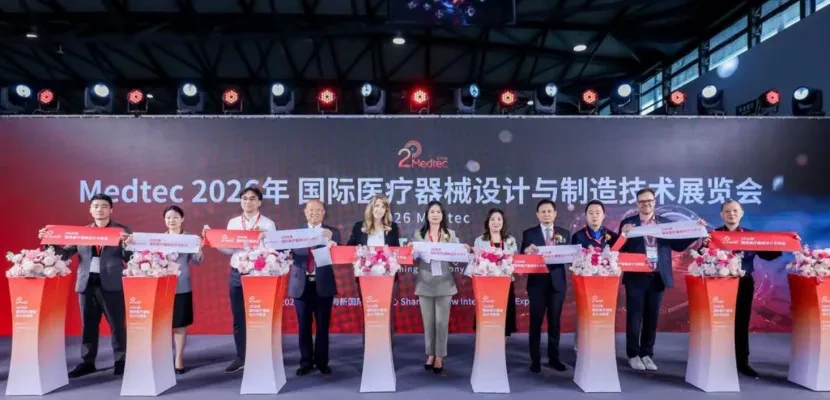
Medtec 2026 China International Exhibition on Design and Manufacturing Technology for Medical Devices Held in Shanghai
From September 1–3, 2026, Medtec China 2026, the global brand exhibition for medical device manufacturing technology, was held at the Shanghai New International Expo Centre. The event spanned Halls N1–N4, bringing together more than 1,100 suppliers from around the world. Concurrently, the 2026 Medical Device Supply Chain Industry Summit took place, featuring eight thematic conferences, 29 forums, and 189 topics, with over 200 speakers. The Chinese Association of Medical Equipment, the China Medical Devices Industry Association, Fudan University, and the Institute of Medical Robotics at Shanghai Jiao Tong University were deeply involved. For the first time, Hall N4 hosted a dedicated Brain-Computer Interface (BCI) zone and closed-door seminars in the Engineers’ Zone, focusing on frontier sectors such as surgical robots, brain-computer interfaces, and cardiovascular implantable and interventional materials.
08
"2026 Seminar on Full-Chain Empowerment for Medical Device Export" Held in Suzhou, with Nearly 20 Key Enterprises from the Industrial Park Participating
On September 2, 2026, the "2026 Seminar on Full-Chain Empowerment for Medical Device Export" was held in Suzhou, jointly organized by the Hongqiao Overseas Development Service Center and the Jiangsu Medical Device Science and Technology Industrial Park, with participation from nearly 20 key medical device enterprises in the park. Representatives from Guorui Zhongan, Informa, and Weigao deconstructed export pathways from the three dimensions of compliance foundation, market expansion, and strategic upgrading, respectively, and provided on-site answers to pain points concerning Outbound Direct Investment (ODI), overseas bidding and tendering, cross-border transfer of healthcare data, and overseas human resources.
09
No.Preview of the 94th Autumn CMEF: To Be Held in Beijing from October 21–24, with a Dedicated Medical Robotics Exhibition Zone Debuted for the First Time
News on September 3, 2026: The 94th CMEF (China Medical Equipment Fair) Autumn Edition is scheduled to be held from October 21 to 24 at the Beijing Capital International Exhibition Center. The event plans to feature an exhibition area of 180,000 square meters, with more than 7,000 companies participating. For the first time, a special exhibition zone dedicated to medical robots will be established, covering a comprehensive portfolio including multimodal surgical robots, orthopedic navigation robots, neurointerventional robots, rehabilitation exoskeletons, and AI-assisted diagnostic and therapeutic robots. Concurrently, a High-Level Forum on the Medical Robot Industry and a Seminar on Clinical Applications will be held.
10
Center for Medical Device Evaluation Publicizes Proposed Approval11 Products Enter the Special Review Procedure for Innovative Medical Devices
From September 1 to 3, 2026, the Center for Medical Device Evaluation of the National Medical Products Administration (NMPA) released the "Public Notice on Review Results of Applications for Special Review of Innovative Medical Devices (No. 14, 2026)," proposing to approve 11 products for entry into the special review procedure. These include Hunan Yiwedi's Disposable Steep Pulse Ablation Electrode Needle, Beijing BaiRen Medical's Aortic Root Patch, Shenzhen Jianxin Medical's Aortic Valve Replacement System, and Shenzhen Boruijie's 3D-Printed Breast Reconstruction Tissue Engineering Scaffold, among others. The special review procedure for innovative medical devices serves as a "green channel" for high-end domestically produced medical devices, significantly accelerating the evaluation process.
11
Public Notice by the Center for Medical Device Evaluation on Proposed InclusionPriority Review Granted for Three Products, Including Two for Rare Diseases and One Filling a Domestic Gap
From September 1 to 3, 2026, the Center for Medical Device Evaluation of the National Medical Products Administration released the "Public Notice on the Review Results of Priority Approval Applications for Medical Devices (No. 17 of 2026)," proposing to include the Shenzhen Huiyun Biological Direct Bilirubin Assay Kit (Liquid Chromatography-Tandem Mass Spectrometry), Guangzhou Anbiping Claudin18.2 Antibody Reagent (Immunohistochemistry), and Wenzhou Puxi Gene Leber Hereditary Optic Neuropathy Genetic Testing Kit (PCR-Fluorescent Probe Method) in the priority approval process. The reasons are, respectively, significant clinical advantages in the diagnosis of rare diseases, urgent clinical need, and no domestically registered products of the same variety having been approved.
12
Shenzhen Boruijie"3D-Printed Tissue Engineering Scaffolds for Breast Reconstruction" Approved for Special Review of Innovative Medical Devices
This week in 2026, Shenzhen Boruijie Medical’s “3D-Printed Tissue Engineering Scaffold for Breast Reconstruction” was approved to enter the National Innovative Medical Device Special Review Procedure. Addressing the challenge of filling and repairing defects following breast-conserving surgery for breast cancer, the product is flexible, biodegradable, and highly porous, capable of inducing cell ingrowth and soft tissue regeneration after implantation. Boruijie Medical specializes in the research and development of 3D-printed tissue engineering scaffolds. Its core technology stems from the commercialization of achievements by the team of Professors Li Dicheng and He Jiankang from the School of Mechanical Engineering at Xi’an Jiaotong University. The company has been included in the list of key service projects of the Greater Bay Area Sub-center of the Center for Medical Device Evaluation.
13
Tianjin Shiyu Technology"Near-Visual Function Training Therapy Software" Proposed for Provincial Innovative Special Review
On September 2, 2026, the Tianjin Municipal Medical Products Administration published the list for the review and recognition of Class II innovative medical devices (2026, Issue No. 4). The "Near-Visual Function Training and Treatment Software" developed by Tianjin Shiyu Technology Co., Ltd. is proposed to enter the special review procedure, with a public notice period from September 3 to September 16, 2026. During the same period, Sichuan Gongwu Chuangzhi's "Medical Sterile Interventional Radiation Protection Gloves" were included in Sichuan Province's special approval procedure for Class II innovative medical devices. These gloves are the world's first ultra-thin medical radiation protection gloves with variable wall thickness.
14
NMPA Approves Two mNGS Diagnostic Reagents for Class III Certification, Making China the First Country with Compliant Market Launch of mNGS
On August 31, 2026, the National Medical Products Administration (NMPA) approved two Class III in vitro diagnostic (IVD) reagents for pathogen metagenomic next-generation sequencing (mNGS): Guangzhou Weiyuan Medicine’s “Respiratory Pathogen Nucleic Acid Detection Kit (Joint Probe-Anchored Polymerase Sequencing Method)” (National Medical Device Registration No. 20263401813), used for the auxiliary diagnosis of suspected severe and critical lower respiratory tract infections, immunodeficient cases, and difficult-to-diagnose cases, marking it as the world’s first mNGS-based reagent for respiratory pathogen detection; and Tianjin Jinshi Medicine’s “Bloodstream Infection Pathogen Nucleic Acid Detection Kit (Reversible Terminator Sequencing Method)” (National Medical Device Registration No. 20263401810), the first mNGS reagent for bloodstream infections in China. Both companies are representative enterprises in the field of precision infectious disease diagnostics, signifying the transition of mNGS from the Laboratory Developed Test (LDT) model to the standardized IVD era.
15
Sichuan Dachuan Heyi"Gelatin Sponge Embolization Microspheres" Receive Class III Certification: China's First Uniform, Biodegradable Embolization Microspheres
On August 31, 2026, the National Medical Products Administration (NMPA) approved the Class III medical device registration certificate for Sichuan Dachuan Heyi’s “Gelatin Sponge Embolic Microspheres” (Registration No.: Guo Xie Zhu Zhun 20263131783, valid until August 23, 2031). The product is indicated for embolization therapy in adults with primary hepatocellular carcinoma and for palliative treatment of renal tumors, representing the first truly uniform biodegradable embolic microspheres in China. Dachuan Heyi specializes in the research and development of interventional embolization materials; the approval of this product marks the first industrial application of droplet microfluidics technology in the interventional field in China.
16
Completion of Force Feedback Technology for Domestic Laparoscopic Surgical Robots2,400-Kilometer Cross-Provincial Clinical Trial: First Domestic Product to Achieve Clinical Implementation
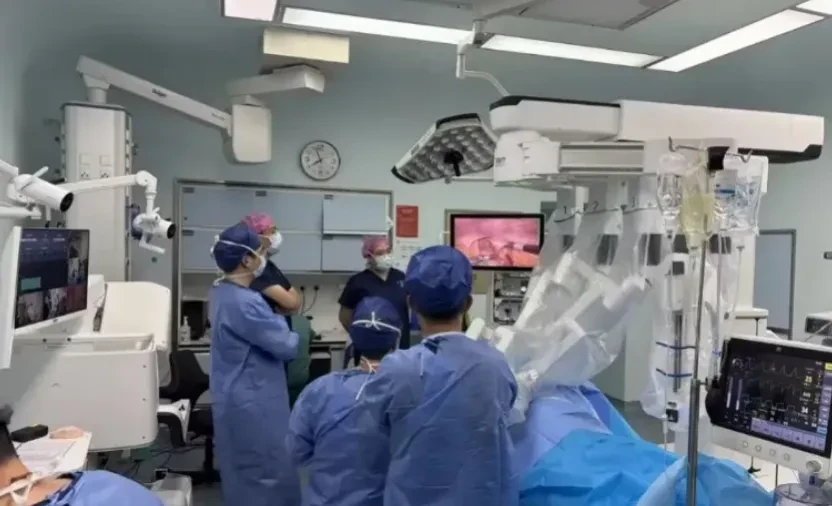
On September 2, 2026, the force-feedback laparoscopic surgical robot, jointly developed by Professor Song Aiguo’s team at Southeast University and Nanjing Tuodao Medical Technology, successfully completed two partial nephrectomies and one radical prostatectomy (with a total duration of 1 hour and 9 minutes) in collaboration with the urology teams at the First Affiliated Hospital of Zhengzhou University and the First Affiliated Hospital of Xinjiang Medical University, spanning a distance of 2,400 kilometers. This marks the first domestic laparoscopic robot with force-feedback technology to achieve clinical implementation in China. Tuodao Medical focuses on the localization of laparoscopic surgical robots. The team has achieved multi-dimensional force sensing within an instrument shaft less than 9 millimeters in diameter, filling the technological gap in force sensing for domestically produced laparoscopic surgical robots and creating a dual "visual + tactile" sensing system in conjunction with 3D 4K fluorescence endoscopy.
17
Peking University People's Hospital Completes Cross-Provincial5G Remote Robotic Radical Nephroureterectomy for Renal Pelvic Cancer with Stable Latency of 42 Milliseconds
On September 4, 2026, media reports stated that Hu Hao, Chief Physician of the Urology Department at Peking University People’s Hospital, remotely operated a domestically produced surgical robot from Beijing to perform a radical nephroureterectomy for renal pelvic cancer on a 70-year-old patient at Qingyuan People’s Hospital in Guangdong Province, more than 2,000 kilometers away. The two-way transmission latency between the two locations remained stable at 42 milliseconds. The surgery lasted less than two hours, with minimal intraoperative blood loss. The patient was able to get out of bed and drink water on the second day postoperatively. The hospital’s Urology Department has long been dedicated to advancing minimally invasive surgical robot technology. This procedure marks a shift in remote robotic surgery from single-point technical validation to cross-provincial, multi-center, and multi-specialty clinical exploration.

18
The "Medical Security Law" was voted and passed.Effective January 2027, it is China’s first foundational law in the field of medical security.
On August 31, 2026, the 24th Session of the Standing Committee of the 14th National People’s Congress voted to adopt the “Healthcare Security Law of the People’s Republic of China” (Presidential Decree No. 80), which will come into effect on January 1, 2027. Comprising seven chapters and 56 articles, it is China’s first foundational and comprehensive law in the field of healthcare security. The law specifies that the payment scope of the basic medical insurance fund must promote the rational use of pharmaceuticals and medical devices, and requires the State Council’s healthcare security department to solicit opinions from medical institutions, enterprises, and experts when organizing evidence-based medicine and health economic evaluations. Medical device companies are advised to proactively establish systems for real-world evidence and health economic evidence.
19
The National Healthcare Security Administration IssuedDRG/DIP Version 3.0 Grouping Scheme: First-Time Addition of Groups Related to Robot-Assisted Surgical Procedures
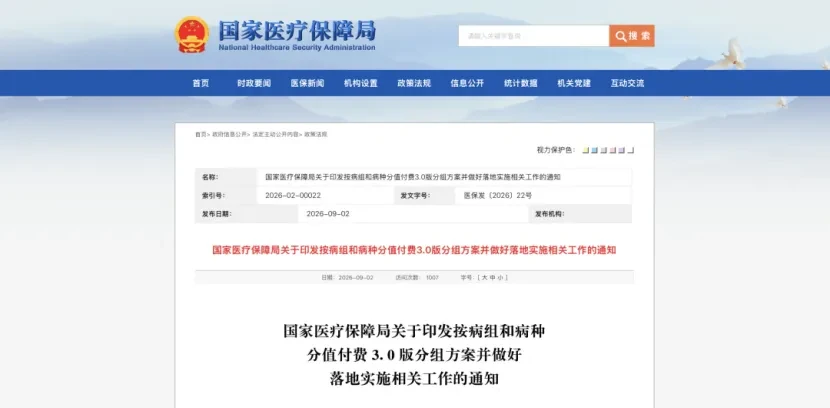
On August 31, 2026, the National Healthcare Security Administration issued the "DRG Payment Grouping Scheme Version 3.0" and the "DIP Payment Grouping Scheme Version 3.0" (Document No. 22 [2026] of the National Healthcare Security Administration). The number of Diagnosis-Related Group (DRG) core groups (ADRGs) was expanded to 492, with 825 subgroups (DRGs). The DIP core disease catalog was expanded to 5,125 entries, increasing case coverage from 92% to 95%. Among the six major changes, the scheme explicitly introduced the principle of "same payment for the same disease" for primary care conditions to guide tiered diagnosis and treatment, and added new grouping categories for robot-assisted surgical procedures for the first time, thereby directing medical insurance payments toward high-value innovative medical devices.
20
Announcement by the Center for Medical Device EvaluationSolicitation of Comments on the Registration Review Guidelines for 55 Class II Passive Medical Devices (Batch 2)
On September 1, 2026, the Center for Medical Device Evaluation of the National Medical Products Administration (NMPA) released draft guidelines for public comment on 55 registration review guidance documents for Class II passive medical devices (Batch II), including the “Guiding Principles for the Registration Review of Protective Products for Radioactive Seed Implantation (Draft for Comment).” These guidelines cover subcategories such as surgical staplers, implantable drug delivery devices, single-use drainage tubes, medical dressings, plastic surgery implants, and orthopedic consumables. The deadline for submitting feedback is October 8, 2026. This batch extends the initial 50 items issued in 2024, with a strengthened focus on biocompatibility evaluation of passive devices, traceability of raw material supply chains, and the integrity of production process validation data.
21
Announcement by the Center for Medical Device EvaluationPublic Consultation on 59 Class II Active Medical Devices and 6 Specific Guiding Principles
On September 1–2, 2026, the Center for Medical Device Evaluation of the National Medical Products Administration (NMPA) released 59 technical review guidelines for the registration of Class II active medical devices (including the “Technical Review Guidelines for Vacuum Source and Pressure Source Suction Devices (Draft for Comments)” issued on September 1) and 6 special technical review guidelines (issued on September 2, including the 2026 revised versions for Gamma Beam Stereotactic Radiotherapy Systems and Implantable Cardiac Pacemakers and Leads, as well as guidelines for hemodynamic monitoring products, among others). The deadline for submitting comments on both sets of drafts is October 8, 2026.
22
CMDE Solicits Public Comments on the Technical Review Points for Implantable Brain-Computer Interface Medical Devices for Motor Function Compensation
In early September 2026, the Center for Medical Device Evaluation of the National Medical Products Administration (NMPA) publicly solicited comments on the "Technical Review Points for Implantable Brain-Computer Interface Medical Devices for Motor Function Compensation (Draft for Comments)." The draft outlined key review considerations regarding summary data, non-clinical data, product instructions and labeling, quality system inspections, and the standardization of information specified in registration certificates. The deadline for feedback was September 7. As brain-computer interfaces represent a cutting-edge area in global medical technology, these review points provide the first clear technical reference for the registration and evaluation of such products in China.
23
The National Medical Products Administration held a conference in Beijing on the translation of clinical research achievements of medical devices and"Spring Rain Action" Work Promotion Meeting
On August 31, 2026, the National Medical Products Administration (NMPA) convened a meeting in Beijing to promote the translation of clinical research achievements for medical devices and advance the “Spring Rain Action.” Lei Ping, a member of the Party Leadership Group and Deputy Director of the NMPA, attended and delivered remarks. He summarized the phased achievements of the “Spring Rain Action” and outlined four key priorities for the next stage: securing “source water” by deeply exploring genuine clinical needs; fostering vertical integration to break down barriers between medical and engineering sectors; leveraging demonstration projects to unleash policy vitality; and enhancing inter-departmental coordination to streamline the entire chain from clinical research through technological iteration to the implementation of results. Representatives from 17 provincial-level drug regulatory administrations, medical institution researchers, and industry stakeholders participated in the meeting.
24
National Medical Products Administration Suspends Import, Distribution, and Use4 Overseas Products
This Week in 2026, the National Medical Products Administration Issued Two Announcements Deciding to Suspend the Import, Distribution, and Use of Three Products from US-based Avinger Inc. (Single-use Peripheral Vascular Plaque Excision Catheters, Registration Certificate Nos. Guo Xie Zhu Jin 20263010082 and Guo Xie Zhu Jin 20253010610; Intravascular Optical Coherence Tomography and Power Control Equipment, Registration Certificate No. Guo Xie Zhu Jin 20263010131) and One Product from Aaron Optical Instrument Co., Ltd. (Ophthalmic Surgical Knife, Registration Certificate No. Guo Xie Zhu Xu 20252160016).
25
Intensive Implementation of Selected Results from Centralized Procurement of Medical Consumables in Multiple Provinces: Shaanxi/Zhejiang/Shandong Centralized Implementation
August 31–September 1, 2026: Multiple Provinces Intensify Implementation of Selected Results from Centralized Procurement of Medical Consumables. Starting August 31, Shaanxi Province uniformly implemented the centralized procurement results for six categories of medical consumables, including coronary stents (the second round of national follow-up procurement for coronary stents will run until June 30, 2029; this also includes the 29-province alliance led by Hunan for high-frequency electrosurgical units and neutral electrodes, the 16-province alliance led by Henan for coronary intervention balloons, and the inter-provincial alliance led by Zhejiang for cardiac pacemakers and neurointerventional microcatheters). Starting September 1, Zhejiang Province implemented price reductions for four categories of medical consumables, including the follow-up procurement of coronary stents. Shandong Province implemented the second round of follow-up procurement for coronary stents and contract renewals for three categories of medical consumables, including wound protectors. Non-selected coronary stents in Shandong are classified under yellow-label management if priced at up to 1.8 times the highest selected price, and under red-label management if priced at up to 2.5 times the highest selected price.
26
Three Departments in Xinjiang Jointly Issue Notice on Further Promoting the Implementation and Application of Unique Device Identification
On August 26, 2026, the Drug Administration of Xinjiang Uygur Autonomous Region, the Health Commission, and the Healthcare Security Administration jointly issued the "Notice on Further Promoting the Implementation and Application of Unique Device Identification (UDI)," specifying that starting from June 1, 2027, all remaining Class II medical devices and Class I in vitro diagnostic products must implement UDI, and starting from June 1, 2029, all Class I medical devices will be required to implement UDI. The main tasks include coding assignment, inventory management with code tracking during distribution processes, and full-process code recording for procurement, clinical use, and payment settlement by healthcare institutions, thereby establishing a collaborative regulatory framework among drug administration, health authorities, and healthcare security departments ("Three-Medical Linkage").
Note: The information in this article is compiled based on online news sources.
Recent Highlights
Featured Recommendations
Recommended Articles Collection
Corporate News
2025 Annual Chronicle of Major Events ▏Zhongguancun Shuimu Medical|Shuimu Jingchuang|Chengdu Shuimu|Shuimu Jiheng|Shuimu Jinsheng|Shuimu Jingzhi
Recent News ▏Group Good News|Research Visit

END