

With 442 Innovative Medical Device Products Approved, How Many Can Top RMB 100 Million in Sales?
In 2014, when the first product was approved through the special review procedure for innovative medical devices (the "green channel"), the channel was still a narrow path. More than a decade later, it has evolved into a surging river.
As of August 2026, a cumulative 442 products from 306 companies have obtained this "innovative pass." From the initial single product to 76 in 2025, the compound annual growth rate has reached 48%; in particular, 202 products were approved in the past three years (2023–2025), accounting for nearly half of the total. In 2026 alone, another 51 products succeeded in the first eight months, and the full-year tally is expected to set another record.
More and more products are passing innovative medical device review, but how many have cleared the commercialization hurdle and exceeded RMB 100 million in sales?
The entry threshold of the special review procedure for innovative medical devices is high: applications must meet basic conditions such as being the first of its kind in China, demonstrating significant clinical value, and holding invention patents, and subsequent clinical investment is even larger. For Class III innovative medical devices with high product risk and clinical complexity, clinical costs can reach tens of millions of RMB — the artificial heart is a typical example.
Does an innovative medical device that survives rigorous review equal commercial success?
VCBeat has compiled innovative medical devices approved since 2014 and those with public sales data in the past five years, looking beyond the approval numbers to the essence: amid the approval wave, which innovative medical devices have truly achieved conversion to commercial success?
Approval is the starting point of innovation, not the end point of commercialization. Track selection determines the ceiling, continuous iteration determines vitality, and globalization and volume-based procurement capabilities determine the speed of scaling. For innovative medical device companies, a registration certificate is only the first ticket; converting clinical value into sustainable commercial value is the real endgame test.
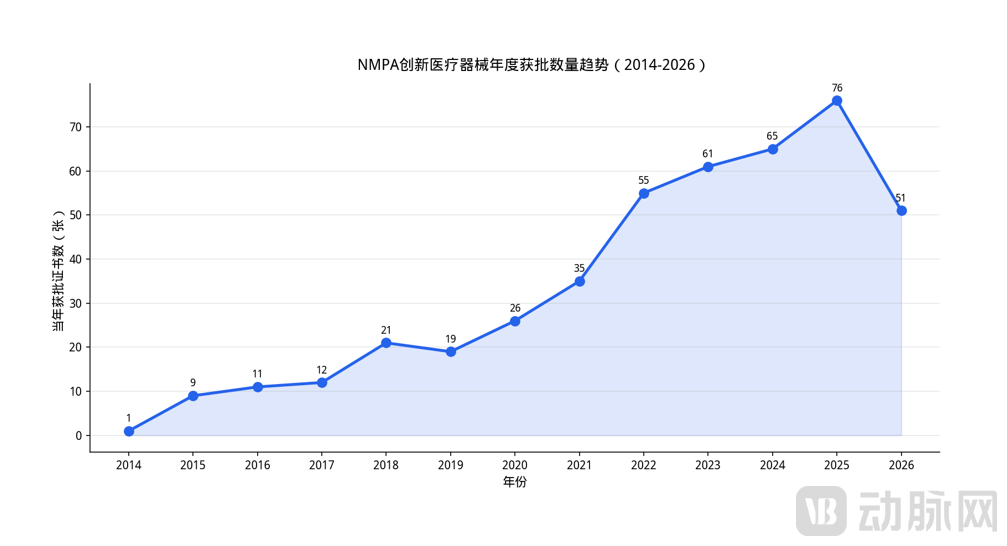
Data as of August 2026
By track, cardiovascular/interventional devices rank first with 105 approved innovative medical devices. Vascular intervention is a mature track for domestic medical device innovation, where expansion into multiple subfields and continuous iteration of approved products are driving the innovation boom.
Radiotherapy/oncology (71) and imaging devices (64) rank second and third. Innovation in these two fields is driven by the wave of import substitution, the expansion of large medical equipment deployment plans, and the launch of new-generation products such as proton therapy systems, photon-counting CT, and 7T high-field MRI systems.
Surgical robots/navigation rank fifth with 19 products (4.3%). This track is at an inflection point from concept validation to a product explosion, with clinical penetration accelerating. Approvals over the past three years have accelerated, with multiple product lines — laparoscopy, orthopedics, and vascular intervention — flourishing in parallel.
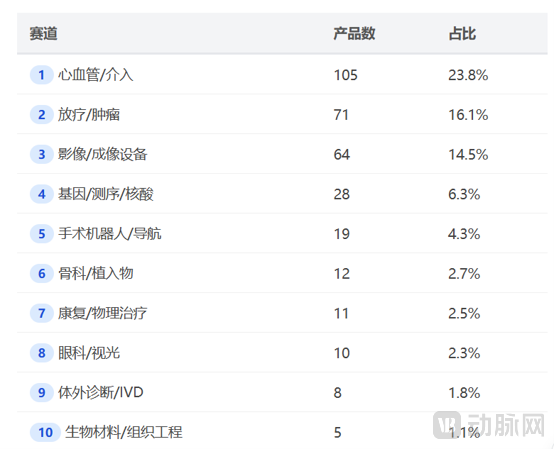
Segment distribution of approved innovative medical devices in China
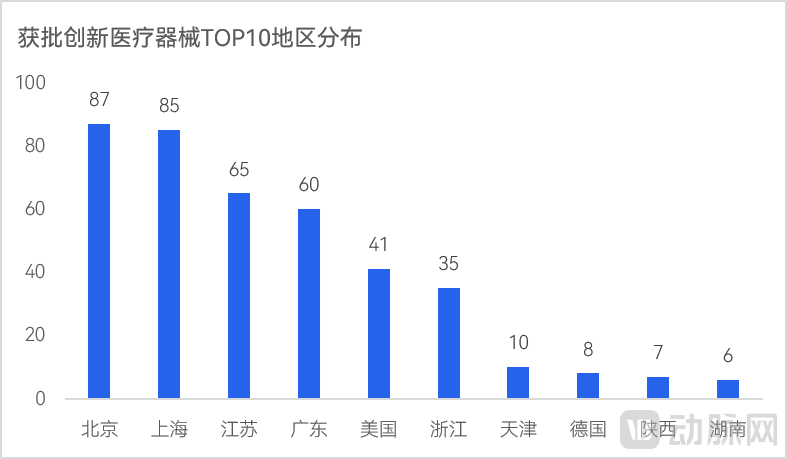
By geography, Beijing has 87 approved products, Shanghai 85, Jiangsu 65, Guangdong 60, and Zhejiang 35 — together accounting for about 75.1% of all approved innovative medical devices. Beijing leans toward neuromodulation and vascular intervention (PINS Medical alone holds 19 certificates), Shanghai toward minimally invasive devices and imaging, Jiangsu toward the Suzhou Industrial Park device cluster, and Guangdong toward Shenzhen's implantable/interventional and IVD segments.
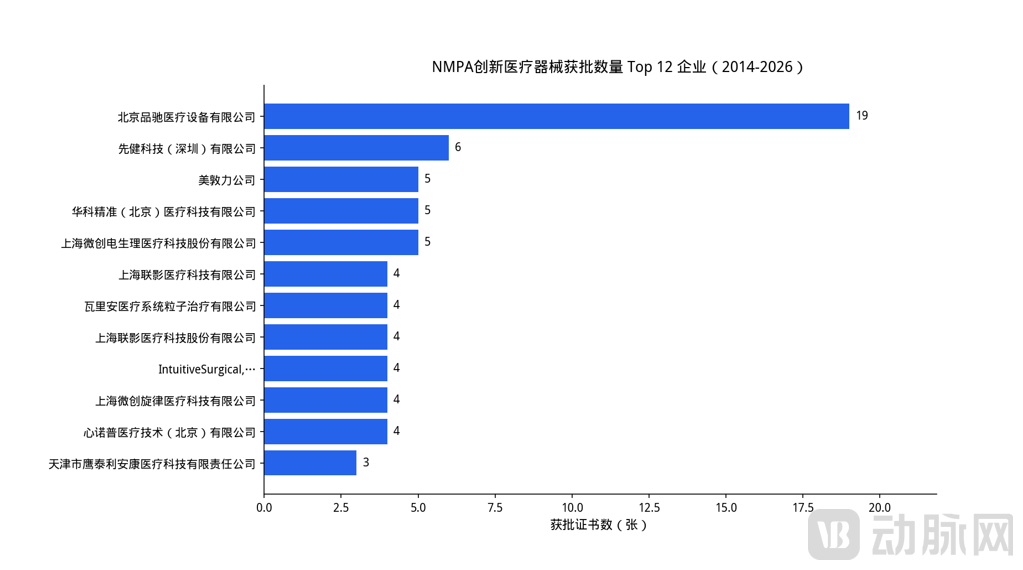
By company, PINS Medical tops the list among domestic approved innovative medical devices with 19 certificates, dominating the neuromodulation field (deep brain stimulation/spinal cord/sacral nerve). Platform-type leaders have an advantage in holding innovative medical device certificates: United Imaging, MicroPort EP MedTech, Lifetech Scientific, Medtronic, and other leading companies have brought innovative medical device products across multiple fields.
If the valley of death for innovative drugs lies in the R&D stage, then the valley of death for innovative medical devices lies in the commercialization stage.
Approval is only an admission ticket. Between a registration certificate and real revenue lies a bumpy commercialization road.
VCBeat (WeChat: vcbeat) has reviewed the commercialization of innovative medical devices with publicly disclosed sales in the past five years, seeking to answer from approved data how long it takes an innovative medical device to go from approval to RMB 100 million in sales.
Among the 343 innovative medical device products approved in the past five years, 19 have disclosed sales or installations after launch, and 10 of them have exceeded RMB 100 million in sales. Limited by corporate disclosure, the sample with public sales data is small (19/343); the following analysis is more applicable to products that have already crossed the commercialization threshold.
Some tracks have inherent advantages in commercialization. In the consumables field, innovative medical devices including TAVR (transcatheter aortic valve replacement), CGM (continuous glucose monitoring), flow diverter stents, IVUS (intravascular ultrasound), and intracranial drug-eluting stent systems have exceeded RMB 100 million in sales within two years of approval.
Large medical equipment has also produced standout products. Based on products with disclosed sales data, proton therapy systems and laparoscopic surgical robots have exceeded RMB 100 million in sales within two years of approval, thanks to their high value and high installation volumes.
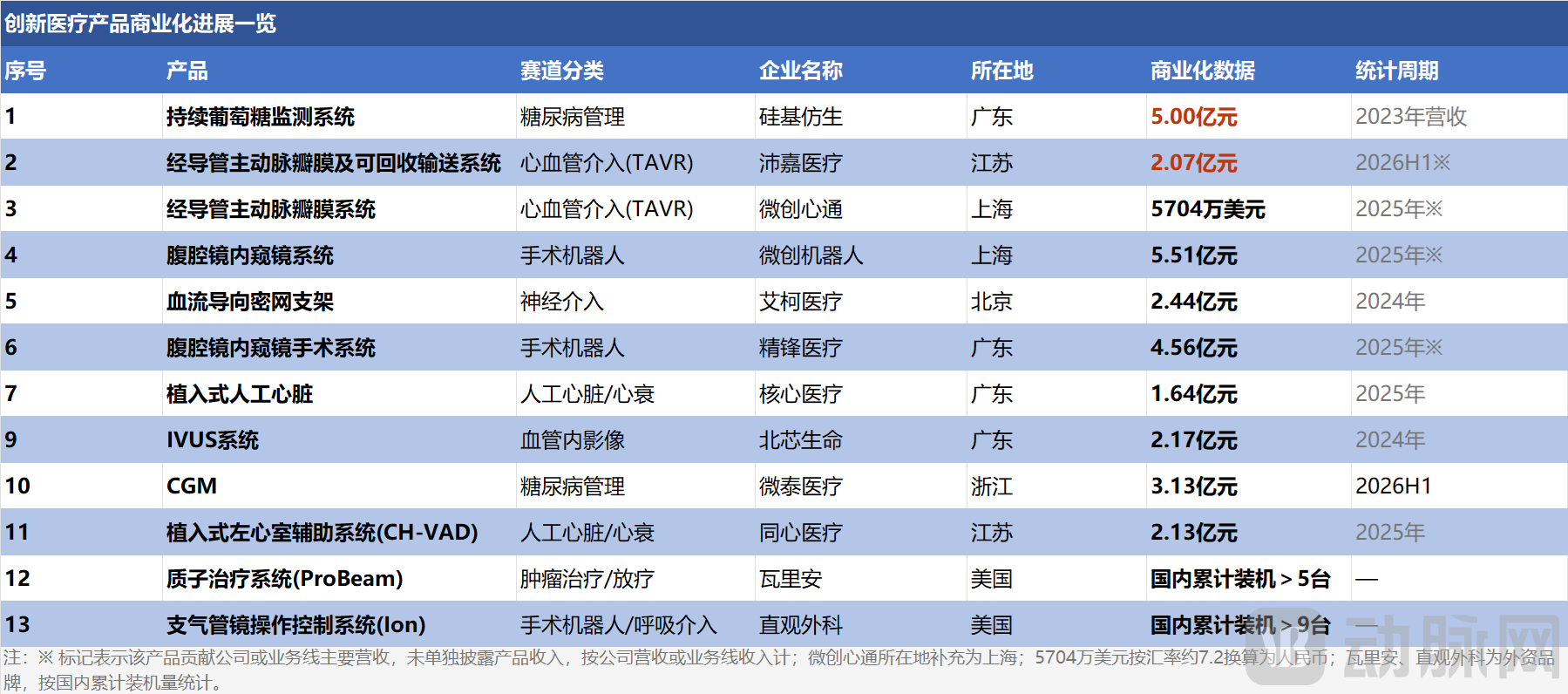
Reviewing the high-value consumables that broke RMB 100 million in sales in the past one to two years — TAVR, flow diverter stents, CGM, IVUS, and others — their commercial success is not a single-point breakthrough but the satisfaction of multi-dimensional conditions. We summarize these into five core dimensions:
1. Choose a Track in a Phase of Rapidly Rising Penetration
Successful innovative devices often enter a track where existing clinical approaches have clear bottlenecks and new technologies have just been approved. TAVR versus open-heart surgical valve replacement, CGM versus fingertip blood sampling, and PFA versus traditional radiofrequency ablation all fit this pattern.
From a market capacity perspective, the ceiling is set by the track, not by ranking. In a large-market track, even the third-ranked product can achieve RMB 100 million in sales; in a niche track, even absolute dominance leaves a limited commercialization ceiling. Therefore, the size of the addressable patient population and the slope of penetration growth are the primary variables determining the speed of commercialization.
2. Continuous Iteration to Achieve Performance Leadership
Approval only earns an admission ticket. Review shows that products with strong commercial performance generally enter rapid iteration cycles after launch, evolving from early import substitution to performance surpassing imported products. Products lacking continuous iteration are typically caught up by later entrants within two to three years, losing their first-mover dividend.
Take Sino Medical Sciences Technology's intracranial drug-eluting stent as an example: after its first NOVA series was approved, the company continued to launch iterative products such as self-expanding intracranial drug-eluting stents, building competitive barriers and consolidating market share through a product matrix strategy rather than dependence on a single product.
3. First-Mover Advantage: Turning the Time Window into a Strategic Asset
"First approval" or "exclusive indication" has significant leverage in early commercialization. Cases such as NOVA, the world's first drug-eluting stent dedicated to intracranial stenosis, and China's first TAVR product show that first-launched products can quickly seize the voice in clinical education, lay channels ahead of competitors, and hold pricing initiative. The brand recognition and clinical data accumulated by first movers in this period form a moat that latecomers find hard to cross.
4. Global Expansion: Building a Second Growth Curve and Brand Endorsement
Overseas markets have become a must and a source of incremental growth for domestic companies. Venturing abroad brings not only revenue — more importantly, overseas commercialization not only contributes income but also, through international brand endorsement, feeds back into domestic market access and clinical trust.
A counterintuitive fact is that China's sophisticated medical equipment is rapidly opening overseas channels. In surgical robots, for example, Edge Medical had 119 cumulative global orders in 2025, with 54 overseas installations accounting for more than half; MicroPort Surgical's Toumai has exceeded 220 global commercial orders.
The artificial heart, another product only a few companies in the world can develop, has also gone overseas in its domestic form. CH Biomedical posted revenue of RMB 213 million in 2025, of which BrioVAD, the upgraded version for global markets, and its accessories contributed RMB 107 million in 2025 — up 10-fold from 2024 — accounting for 50.51% of the company's total revenue.
5. Mastering Volume-Based Procurement: The Capability to Play the Price-for-Volume Scale Game
Volume-based procurement can also dramatically raise product penetration. Domestic products such as flow diverter stents and IVUS quickly leveraged procurement after approval to leapfrog in domestic share. Procurement can help new entrants rapidly expand market share, but behind this, companies need strong quality control, cost management capability, a rich product matrix, and a deep understanding of procurement rules — only then can they truly trade price for volume.
These five dimensions do not exist in isolation but form an organic whole that reinforces each other: track determines the ceiling, iteration determines vitality, first-mover advantage determines the window, going global determines the margin of safety, and procurement determines the speed of scaling. The more conditions a product satisfies, the higher its probability of converting from approval to RMB 100 million in sales. For innovative medical device companies, leadership in a single dimension is not enough to guarantee commercial success; only by building systematic capabilities across multiple dimensions can they stand out in fierce industry competition.
In sharp contrast to products such as TAVR and CGM that broke RMB 100 million in sales within one to two years, the commercialization cycle in some innovative device tracks is significantly prolonged, taking an average of more than four years to achieve a RMB 100 million sales breakthrough. Such tracks typically share three common features: high unit prices, steep physician learning curves, and lagging medical insurance coverage. The root causes of their commercialization difficulties can be reduced to the following three bottlenecks:
1. Missing Payer Support: Clinical Value Cannot Complete the Commercial Loop
The absence of a standalone medical service price item and medical insurance payment code is the primary blockage in innovative device commercialization. Even when hospitals recognize the clinical value of a technology, the lack of a billing basis and reimbursement channel weakens their incentive to purchase. At that point, no amount of clinical evidence can easily translate into sustainable commercial returns. This is particularly evident in intelligent assisted imaging software products.
2. Lack of Resource Investment: Approved, Then Delisted
Commercialization is a long race requiring continuous resource investment, not a finish line at approval. The case of Siemens Healthineers' CorPath GRX vascular interventional robot is a warning: the product had just received approval for its coronary indication in China in June 2023 when it was strategically abandoned by the group, exiting the Chinese coronary market. The resource reshuffling of a global giant is a profound reminder to the industry: product approval is only a necessary condition for commercialization, never a sufficient one. When a company's strategic focus shifts or resources are reallocated, even approved innovative products may face marginalization upon launch.
3. The Dual Test of Market Cultivation and Channel Capability
Some emerging categories face the combined constraint of a low single-product ceiling and insufficient channel capability. While clinical awareness is still being cultivated and market capacity is limited, the scarcity of players ironically forces first movers to bear high market education costs alone. Without mature channel networks and scaled promotion capability, even technologically leading products struggle to open the market quickly.
Approval is the starting point of innovation, not the end point of commercialization. Track selection determines the ceiling, continuous iteration determines vitality, and globalization and volume-based procurement capabilities determine the speed of scaling. For innovative medical device companies, a registration certificate is only the first ticket; converting clinical value into sustainable commercial value is the real endgame test.