

Regeneron's $200M+ Acquired Dual-AAV Gene Therapy DB-OTO Meets Primary Endpoint in Pivotal CHORD Trial

Regeneron
Biopharmaceutical Manufacturer

▲November 6-7The 10th Guangzhou (Greater Bay Area) BiomedicalInnovators Summit Scan to register
Disclaimer: Due to limited expertise, errors are inevitable, and some information may not be the most up-to-date. Comments pointing out any issues are welcome. This article is only an introduction to medical and health-related drugs, not a recommendation of treatment plans (if involved); this article does not constitute any investment advice.
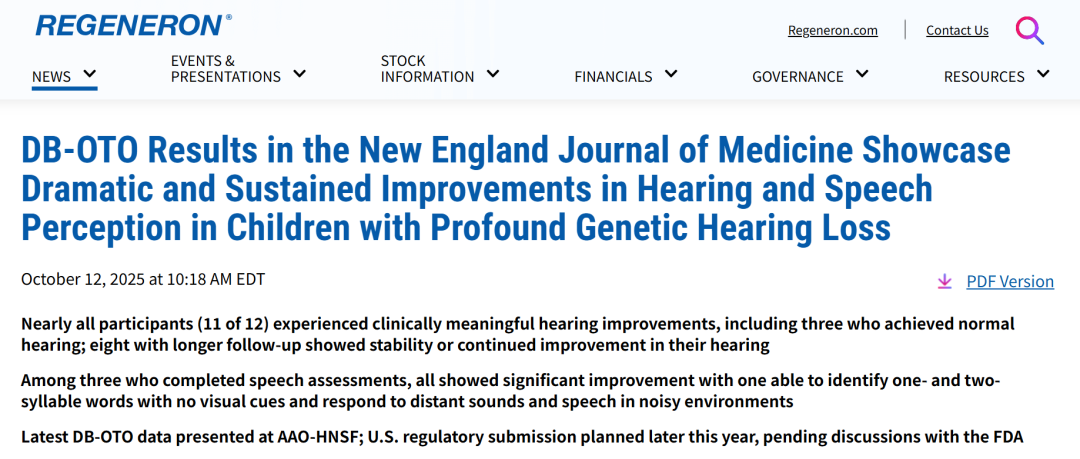
On October 12, 2025, Regeneron announced that the latest data on its investigational gene therapy DB-OTO had been published in the journal *The New England Journal of Medicine (NEJM)* and presented at the American Academy of Otolaryngology–Head and Neck Surgery Foundation (AAO-HNSF) Annual Meeting.Latest results from the pivotal CHORD trial show: 11 out of 12 participants experienced clinically meaningful hearing improvement., three of whom reached normal hearing levels. Additionally, among the eight participants who underwent long-term follow-up, their hearing performance remained stable or continued to improve, and all three participants who completed speech assessments showed significant improvement.
Regeneron stated that it plans to submit the U.S. regulatory application for DB-OTO later this year, pending discussions with the U.S. FDA. The therapy has received multiple designations from the FDA, including Orphan Drug, Rare Pediatric Disease, Fast Track, and Regenerative Medicine Advanced Therapy designations. The European Medicines Agency has also granted DB-OTO Orphan Drug designation.
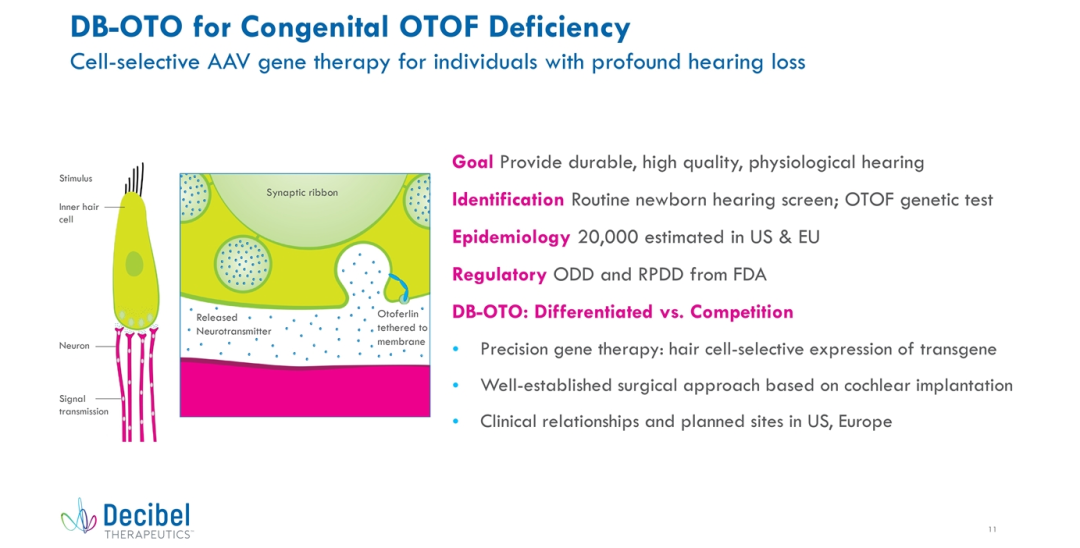
DB-OTO was acquired by Regeneron in 2023 for an upfront payment of $109 million and milestone payments of $104 million through the acquisition of Decibel Therapeutics, a Nasdaq-listed company.DB-OTO is an investigational cell-selective, dual adeno-associated virus (AAV) vector gene therapy designed to provide lasting and physiologically functional hearing for individuals with severe congenital hearing loss caused by OTOF gene mutations. The therapy involves infusing a modified, non-pathogenic virus into the cochlea under general anesthesia (similar to the procedure used in cochlear implant surgery) to deliver a functional OTOF gene, replacing the non-functional otoferlin protein.
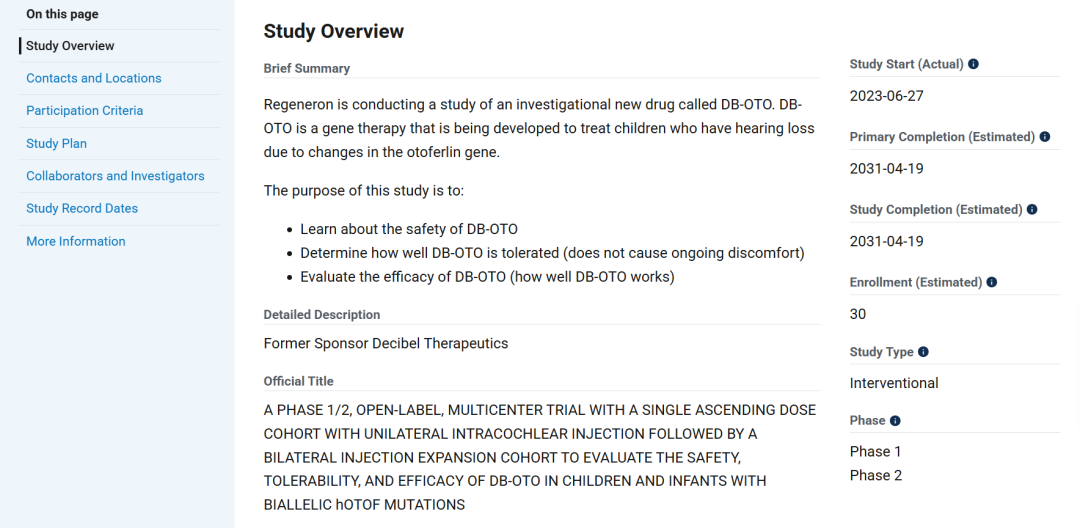
The CHORD trial is a registrational Phase 1/2 multicenter open-label trial designed to evaluate the safety, tolerability, and efficacy of DB-OTO in infants, children, and adolescents with OTOF-related hearing loss.The CHORD study was conducted in two parts:In the initial dose-escalation cohort (Part A), participants received a single intracochlear infusion of DB-OTO in one ear. In the expansion cohort (Part B), participants received the selected dose of DB-OTO from Part A in both ears.
Almost all subjects (11 of 12 individuals; 14 of 15 treated ears) experienced hearing improvement within weeks after treatment.The published and announced results show that the trial met the primary endpoint:In the 24-week pure-tone audiometry (PTA) assessment, the hearing of 9 subjects improved to ≤70 dB HL, a threshold corresponding to the clinical standard that typically does not require cochlear implantation, allowing for the preservation of natural acoustic hearing. Notably, 6 of them could hear soft speech without hearing aids, and 3 were even able to detect whispers (reaching normal hearing sensitivity). One subject who did not meet the primary PTA endpoint at 24 weeks further improved to "near-normal" hearing sensitivity at 48 weeks. Additionally,Achieve Key Secondary Endpoints of the Trial:Nine subjects had auditory brainstem response (ABR) thresholds ≤90 dB nHL.
Reference: Company Announcement

Mastering CAR-T Therapy, Stem Cell Therapy, Gene
Therapy,Comprehensive Information on Oncolytic Viruses and Nucleic Acid Drugs