

RMB 790 Million Raised, RMB 3.33 Million in Revenue: A Suzhou Biotech Sprints Toward IPO on a Global First-in-Class Drug

ProteLight Pharma
Developer of Innovative Antimicrobial Peptide (AMP) Therapeutics
On the last day of August 2026, ProteLight Pharmaceuticals submitted its Chapter 18A prospectus to the Hong Kong Stock Exchange.
Just two months ago, the Class 1 innovative drug Peceleganan Spray, branded Puyike (code PL-5) and independently developed by ProteLight, received approval for marketing from the National Medical Products Administration. This is the world's first approved first-in-class (FIC) "-ganan-class" anti-infective, indicated for secondary infections of first-degree or superficial second-degree burn and scald wounds caused by Staphylococcus epidermidis, Staphylococcus haemolyticus, or Acinetobacter baumannii.
The World Health Organization lists antimicrobial resistance among the top ten public health threats facing humanity. At least 700,000 people worldwide die each year from drug-resistant infections. To put it more directly, one lower-limb amputation due to diabetic foot infection occurs every 20 seconds globally.
When the antibiotics doctors prescribe have already been tolerated by bacteria, they need new weapons.
Antimicrobial peptides are one of the most promising candidates. But very few have actually been turned into drugs. In nearly 25 years, the US FDA has approved only five new peptide anti-infectives; in China, only seven similar drugs have been approved.
In such a niche track, ProteLight has completed six financing rounds, raising approximately RMB 790 million in total, at a post-money valuation of RMB 2.5 billion. Participating institutions include the PICC Sci-Tech Innovation Fund and Yifeng Runjun. What moved these institutions to put up real money was founder Dr. Chen Yuxin, who has been deeply engaged in this track for nearly 20 years.
ProteLight's starting point was a scientific idea in the laboratory.
While doing postdoctoral research in a laboratory at the University of Colorado, founder Chen Yuxin and his mentor Robert Hodges pondered a question: why can antimicrobial peptides kill bacteria without harming human cells? They eventually proposed a theory called the membrane discrimination mechanism.
In simple terms, the charge properties of bacterial cell membranes differ from those of human cell membranes. An antimicrobial peptide is like a magnetized fragment: it is attracted to the bacterial membrane, sticks to it, then inserts, flips, and destroys it. Human cell membranes, because of their different charge properties, are not stuck to — or if they are, the peptide does not destroy them.
The theory was published in 2006. Three years later, Chen Yuxin returned to China and founded ProteLight in Jiangyin, Jiangsu.
From the company's founding to the approval of its core product, he walked 17 years.
Puyike, an antimicrobial peptide spray designed on the basis of the membrane discrimination mechanism, received marketing approval from the NMPA on June 17, 2026. It is the world's first approved drug of its kind — a first-in-class product specifically for secondary infections of burn and scald wounds caused by Staphylococcus epidermidis, Staphylococcus haemolyticus, or Acinetobacter baumannii.
These bacterial names are tongue-twisters, but they share one common trait: many of their strains have already developed resistance to conventional antibiotics.
Most traditional antibiotics kill bacteria by interfering with internal metabolic pathways. Bacteria can easily mutate and alter target structures, rendering drugs ineffective. Puyike's antimicrobial peptide molecules selectively attack bacterial cell membranes, and even if the pathogen partially mutates, a certain killing effect is maintained.
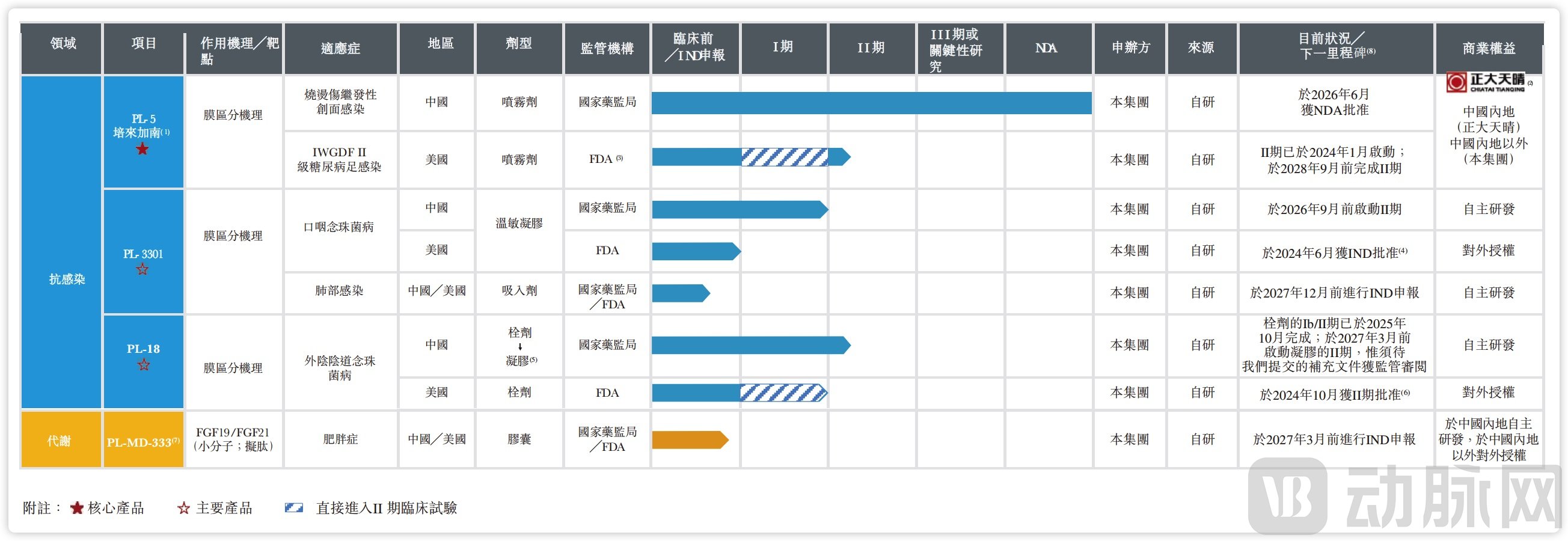
Pipeline layout. Source: prospectus
Beyond the approved Puyike, ProteLight has three other products at different stages.
PL-3301 is a thermosensitive gel for the treatment of oropharyngeal candidiasis. This disease commonly affects immunocompromised populations, such as HIV patients, cancer patients after chemotherapy, and elderly people on long-term steroids. Current treatments rely mainly on azole antifungals, but resistance is likewise a problem.
PL-3301 is designed for local administration: it forms a thin film at body temperature and continuously releases the antimicrobial peptide. This keeps the drug concentration at the infection site, minimizes systemic exposure, and reduces side effects. Phase 1a and Phase 1b clinical trials in China have been completed, with Phase 2 expected to start in September 2026. In the US, it received FDA approval for Phase 1 clinical trials in June 2024.
PL-18, meanwhile, is a suppository and gel targeting vulvovaginal candidiasis. About 470 million women worldwide suffer from this disease, with tens of millions of new cases each year. Current treatments rely mainly on oral drugs such as fluconazole and topical agents such as clotrimazole, but recurrence rates are high and some strains have developed resistance.
PL-18's Phase 1b/2 clinical trials in China have been completed, and the US FDA approved its Phase 2 clinical trial in October 2024. The prospectus notes that this drug may cover a broader gynecological infection market in the future.
Beyond topical products, there is also an oral small-molecule drug, PL-MD-333. It targets the FGF19/FGF21 pathway for obesity treatment. In preclinical studies, PL-MD-333 showed synergistic effects when combined with semaglutide. If PL-MD-333 can truly add synergy in combination, its potential will far exceed the anti-infective field.
ProteLight's pipeline reflects a clear logic: identify structural deficiencies in existing therapies and fill them with new molecular designs.
Academic research on antimicrobial peptides dates back to the 1980s, but turning them into drugs is not easy.
At the market level, the anti-infective drug market as a whole is already a red ocean. The global anti-infective drug market was about USD 137.2 billion in 2025, but is expected to show almost no growth over the next five years, with a CAGR of only 0.1%. In China, the market was USD 25.6 billion in 2025 and is projected to be only USD 25.4 billion by 2030 — declining rather than growing.
Within this red ocean, a small corner is quietly changing. Peptide anti-infective drugs — this segment had a global market of about USD 2 billion in 2025, projected to grow to USD 3.5 billion by 2030, a CAGR of 11.8%. China's growth rate also stays around 11.3%.
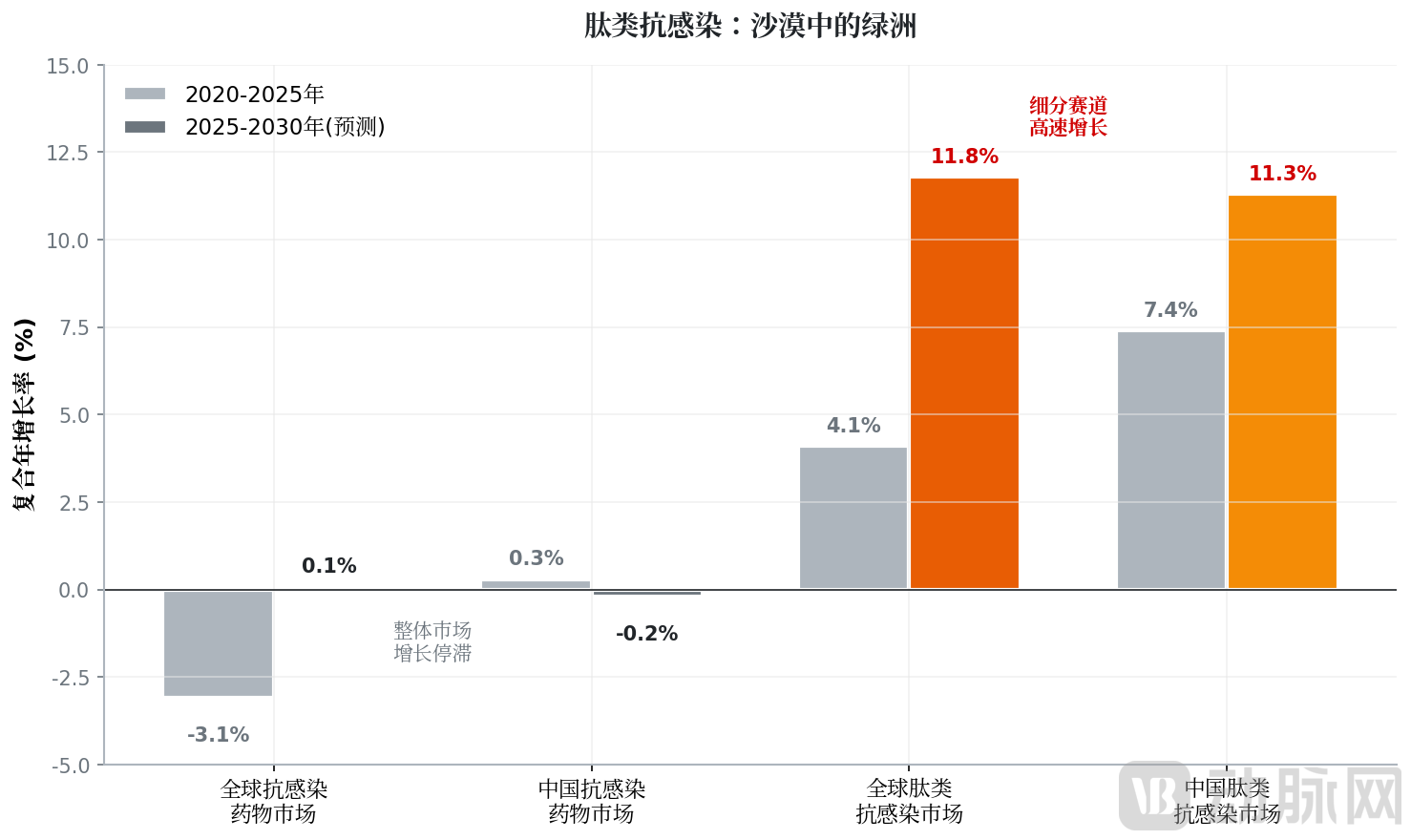
Peptide anti-infective drug market forecast. Source: compiled from prospectus data
Relying on their unique mechanism, antimicrobial peptides have become a new weapon when traditional antibiotics fail. In nearly 25 years, the FDA has approved only five new peptide anti-infectives worldwide; in China, only seven similar drugs have been approved by the NMPA. The track is relatively quiet, with few competitors.
On the other hand, ProteLight is also actively expanding Puyike's indications, and diabetic foot infection is a typical application scenario it is targeting.
The global diabetic foot infection drug market was about USD 3.1 billion in 2025, with about 32.5 million patients. Existing treatment relies mainly on systemic antibiotics, but many diabetic patients have poor blood circulation in the feet, making it hard for drugs to reach the infection site. Worse, diabetic foot infections often involve mixed infections of multiple bacteria, many of which are drug-resistant.
As a topical spray, Puyike can be applied directly to the wound, forming a high concentration at the infection site while reducing systemic exposure. This route of administration is especially advantageous for ischemic wounds.
Globally, only two drugs are currently in clinical development for diabetic foot infection — Puyike is one of them, and both are in Phase 2 clinical trials. ProteLight sits in the leading tier for this indication.
Puyike is already approved. But from approval to generating meaningful sales revenue, there remain many steps: reimbursement listing, hospital procurement, physician education, and patient awareness.
As early as December 2022, ProteLight signed an exclusive commercial cooperation agreement with Chia Tai Tianqing, which is responsible for Puyike's market promotion, channel strategy, tendering, and National Reimbursement Drug List inclusion in mainland China. ProteLight itself is responsible for manufacturing and supply.
Chia Tai Tianqing is a leading company in China's liver disease and anti-infective fields, with mature hospital channels and a sales team. For a biotech without large-scale commercialization experience, commercializing through a partner is a pragmatic choice.
The financial data reveal the urgency of the company's listing.
In recent years, ProteLight has generated modest revenue from daily-care products: RMB 3.332 million in 2025 and RMB 2.192 million in H1 2026. With continued R&D investment, the company remains loss-making.
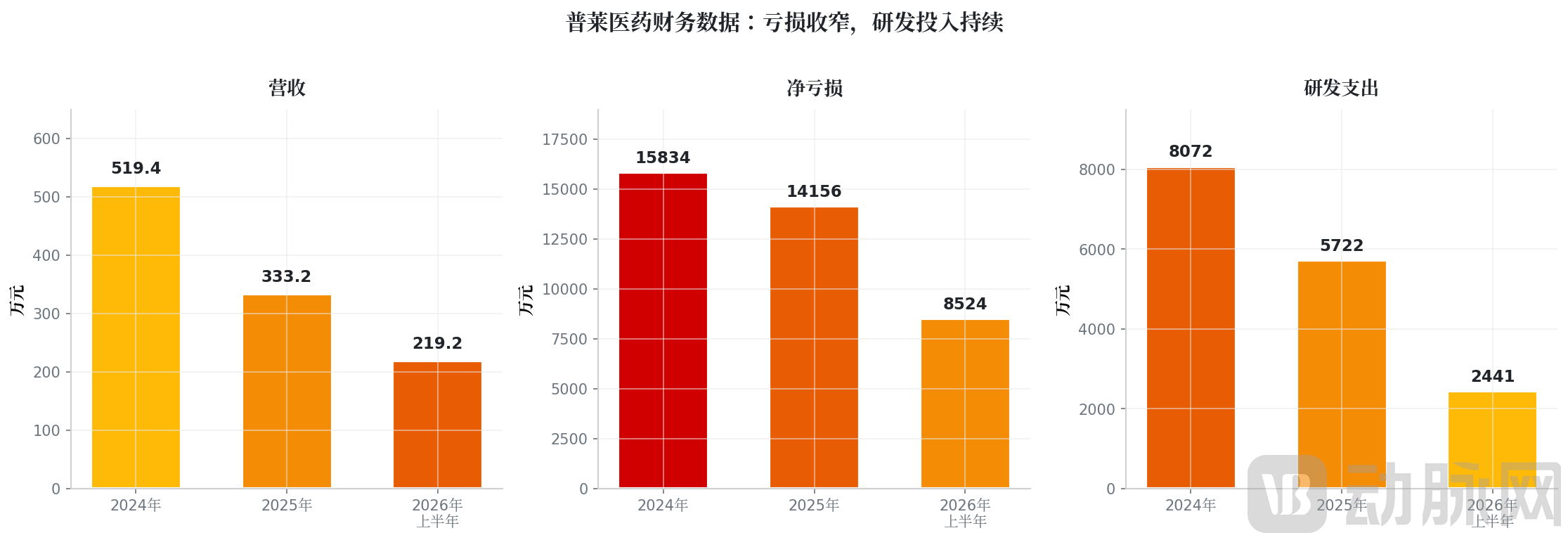
Financial position. Source: compiled from prospectus data
According to the prospectus, assuming the future consumption rate increases to 2.4 times the current level, existing funds (including bank financing) can sustain the company for 25 months; including IPO proceeds, 59 months.
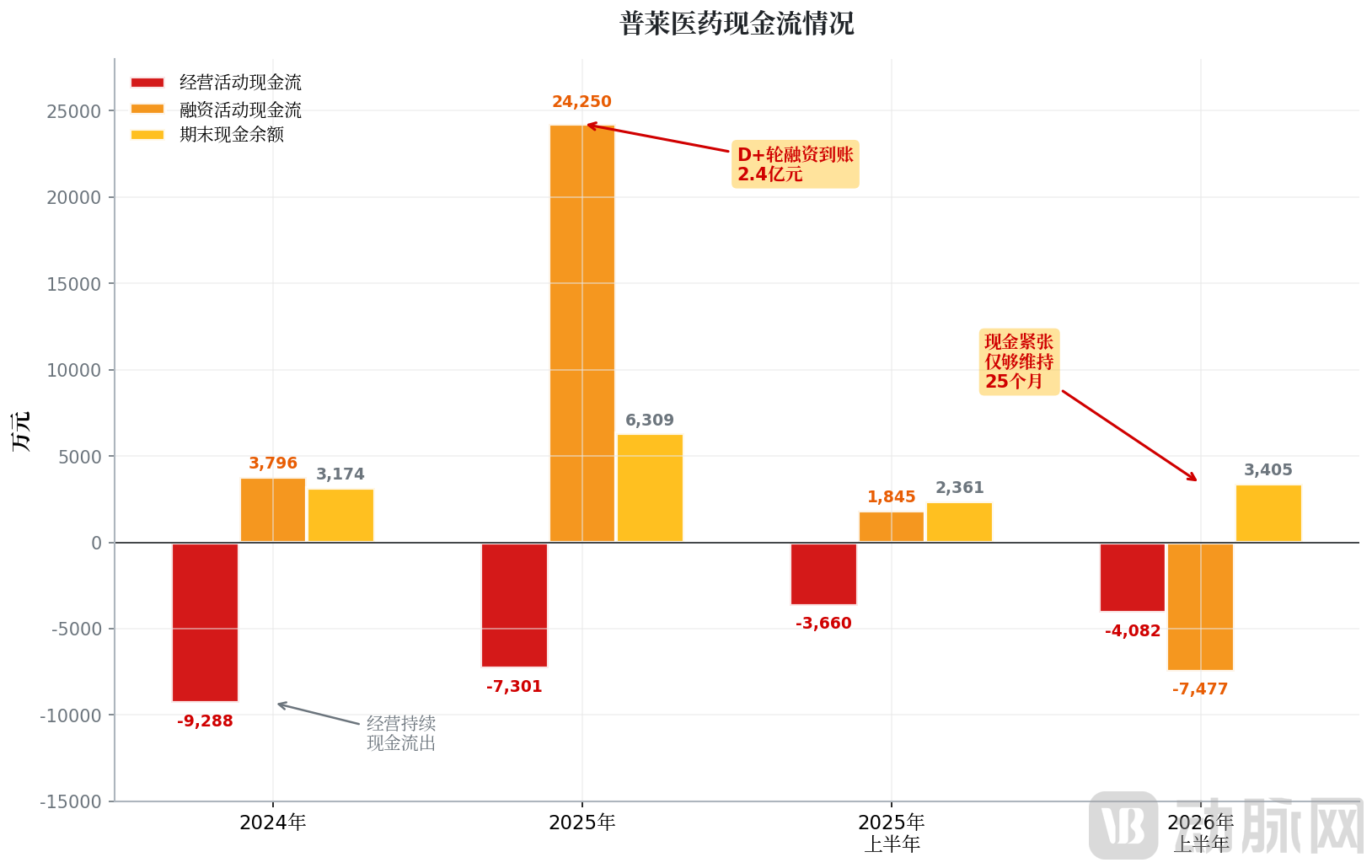
Cash flow position. Source: compiled from prospectus data
Pursuing a listing is both about replenishing ammunition and accelerating commercialization.
The allocation of proceeds confirms this: continued development of the core product Puyike, including clinical studies for diabetic foot infection in the US and post-marketing clinical evaluations in China, as well as planned subsequent clinical trials for PL-3301 and PL-18.