

USD 30 Million in the Bag! A Chinese Bispecific ADC Heads Overseas into Seven Markets in India and Africa

CHIATAI TIANQING
High-quality pharmaceuticals research, production, and sales provider

Cipla
Pharmaceutical Manufacturer

Sino Biopharm
Pharmaceutical R&D Developer
On September 1, Chia Tai Tianqing announced that its self-developed potential best-in-class (BIC) HER2 bispecific antibody-drug conjugate (ADC) TQB2102 (rolditamig deuderuxtecan) succeeded in a Phase III clinical study in HER2-low relapsed/metastatic breast cancer, meeting the prespecified primary and key secondary endpoints. This makes it the first Phase III study worldwide in which a HER2 bispecific ADC achieved success in HER2-low breast cancer. It is understood that Chia Tai Tianqing has received written consent from the CDE and will submit a marketing application for this indication in the near future.
Just the day before, on August 31, Sino Biopharmaceutical (01177) announced that its subsidiary Chia Tai Tianqing had signed an exclusive licensing and supply agreement with Cipla, India's third-largest pharmaceutical company, for TQB2102.
Under the agreement, Chia Tai Tianqing grants Cipla an exclusive license to develop and commercialize TQB2102 in India, South Africa, and five other emerging markets — seven high-growth international markets in total. Chia Tai Tianqing is entitled to an upfront payment and potential development, regulatory, and sales milestone payments of up to USD 123 million, plus double-digit royalties based on TQB2102's annual net sales.
This is the second regional licensing collaboration for TQB2102. To date, the two collaborations have cumulatively brought approximately USD 30 million in upfront and milestone payments.
Sino Biopharmaceutical told reporters from National Business Daily that the first licensed region for TQB2102 is also a vast non-US, non-European market.
As Xie Xin, executive director and senior vice president of Sino Biopharmaceutical, said in an interview with VCBeat, "BD is not about buying, buying, buying — self-development is the foundation." "Many times we don't need to 'knock on doors' proactively; we just need to let the right people know which tracks we are committed to, and high-quality projects will naturally come to us at the right time."
Going overseas, sailing toward the broader world beyond the US and Europe.
1Localization First: Filling the Demand Gap in Emerging Markets
Between 2024 and 2030, the global innovative drug market is expected to grow from approximately USD 1.08 trillion to USD 1.5 trillion, with emerging markets' contribution rate expected to exceed 35%. Sino Biopharmaceutical said that high-growth emerging market regions, with their large population bases, rapidly growing medical demand, and continuously improving regulatory and payment systems, are expected to add new momentum to the group's innovative drug revenue growth.
At a fundamental level, the cancer burden in emerging markets is equally heavy, and most regions have long been trapped in a development dilemma of "a market with demand, no products, and no guidelines." From a supply-demand perspective, vast population bases generate enormous medication demand, yet access to innovative therapies and cutting-edge drugs lags far behind the US and Europe.
Sino Biopharmaceutical said its globalization strategy will adhere to refined BD operations and a parallel route of "high globalization, high localization," laying out broad markets in Southeast Asia, South Asia, the Middle East, and beyond, and partnering with deeply rooted collaborators who know their markets, bringing internationally advanced treatment concepts, diagnostic and therapeutic solutions, and innovative products to local markets to benefit more patients.
Following this route, Cipla will be responsible for local clinical development, regulatory filings, and commercialization in the licensed region, while Chia Tai Tianqing will continue to be responsible for the manufacturing and supply of TQB2102.
As India's third-largest pharmaceutical company (IQVIA MAT June 2026), the second-largest company in South Africa's prescription drug market (IQVIA MAT May 2026), and the No. 2 player by prescription volume in the US generic inhalation and metered-dose inhaler market (IQVIA MAT June 2026), Cipla has long been deeply rooted in India, South Africa, North America, and other emerging markets. It has established mature regulatory, medical, market access, and commercialization systems in many countries covered by the agreement, and has built an extensive network with local healthcare professionals and institutions.
Its core advantage is outstanding local capability — particularly market access strengths — which will directly accelerate the clinical development, registration, and commercialization of TQB2102 in the licensed region.
This means one collaboration radiating across many countries.
In the South Asian market, India can serve as the hub and starting point for market expansion. India's drug approval outcomes carry high recognition and strong mutual-recognition effect in neighboring countries such as Sri Lanka, Nepal, and Pakistan, allowing registration resources to spill over quickly and radiate across surrounding regional markets. Similarly, in the African market, South Africa produces about 40% of Africa's medicines and is the only country in the Southern African Development Community (SADC) that broadly complies with WHO-GMP standards.
This also represents a new approach for Chinese innovative drugs going global: taking the high-value "FDA/EMA approval" path in the US and Europe, and the cost-effective "leveraging regional hubs" path in emerging markets.
2Innovative Drugs and Out-Licensing on the Rise: A Pharmaceutical Leader with Dual Engines
As a long-established pharmaceutical company, Chia Tai Tianqing started with generics and became one of the first Chinese companies to transition to innovative drugs. In 2018, its self-developed Class 1 innovative drug anlotinib hydrochloride capsules hit the market and has since been approved for 11 indications. As of the end of March, Chia Tai Tianqing had nearly 20 innovative products approved for marketing, including 11 Class 1 innovative drugs.
On the self-development front, the company has maintained R&D investment above 20% of total revenue for four consecutive years, with more than 130 programs in the pipeline, including over 100 innovative drugs — among the highest in the industry — forming a sound pattern of "one generation launched, one generation in reserve, one generation under development." On the BD front, it has successively acquired star domestic biotech companies LaNova Medicines and Hygieia.
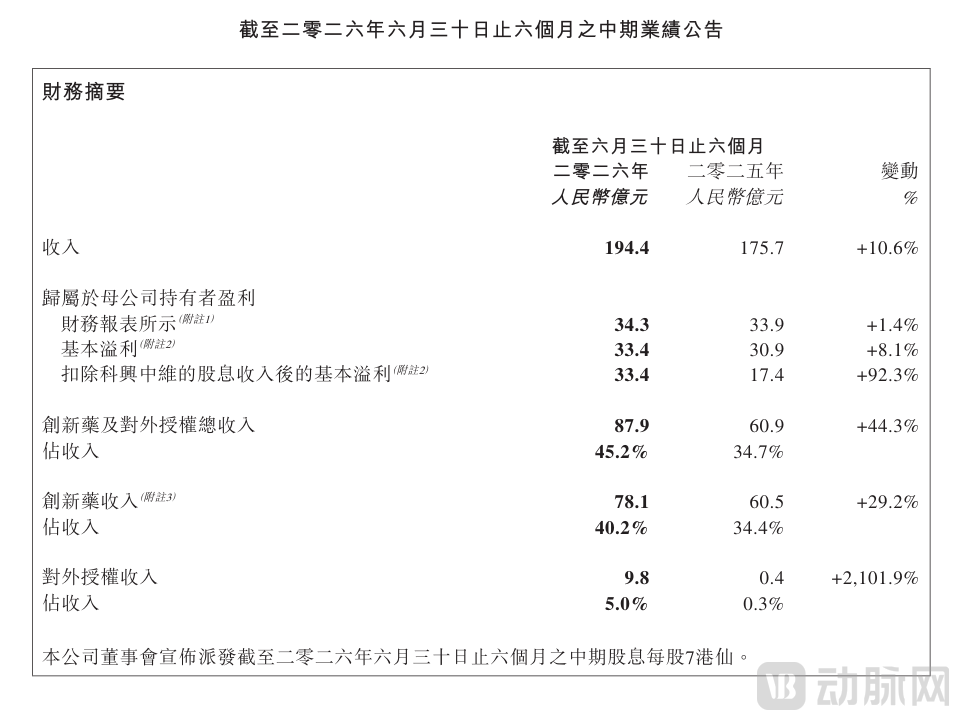
In fact, out-licensing has become an important growth engine for Sino Biopharmaceutical — in the first six months of 2026, out-licensing revenue reached RMB 980 million, up 2101.9% year over year.
According to its 2026 interim results announcement, for the six months ended June 30, Sino Biopharmaceutical recorded revenue of approximately RMB 19.44436 billion, up about 10.6% from the same period last year. Innovative drugs and out-licensing were the main drivers of growth — revenue from innovative drugs and out-licensing was approximately RMB 8.78940 billion, accounting for about 45.2% of the group's revenue, up about 44.3% year over year.
During the year, Sino Biopharmaceutical reached a USD 1.53 billion collaboration with Sanofi over rovadicitinib, a first-in-class JAK/ROCK inhibitor, and later licensed its self-developed COPD innovative drug TQC3721 to AstraZeneca for up to USD 1.9 billion, setting the highest single-product transaction record in the respiratory field in recent years.
3The World's No. 1 Cancer and Its Broad Unmet Market
Founded in 1935, Cipla focuses on complex generics, operates 48 production sites globally, and produces more than 50 dosage forms and 1,500 products across advanced technology platforms. It is highly regarded in therapeutic areas including respiratory, antiretrovirals, urology, cardiovascular, anti-infectives, and central nervous system, with business covering more than 70 markets worldwide. For ninety years, Cipla's mission has been to change patients' lives. In 2001, Cipla pioneered a triple antiretroviral therapy for HIV/AIDS in Africa, cutting the daily treatment cost to below USD 1.
In oncology, Cipla was the first company in India to launch the commonly used cancer chemotherapy drugs Vinblastine and Vincristin (1984), and today holds more than 32 drugs (57 SKUs) for treating various cancers. It also operates India's first FDA-approved oncology product manufacturing facility.
For Cipla, it inherently understands how innovative assets can scale in markets with weak payment capacity and high demand.
Last October, Cipla reached an agreement with Eli Lilly to obtain distribution rights in India for the blockbuster weight-loss drug Mounjaro (tirzepatide), relaunching it under the second brand Yurpeak. Under this collaboration model, Eli Lilly will manufacture and supply Yurpeak for Cipla, priced the same as Mounjaro.
One difference here is that TQB2102 has not yet been approved for marketing anywhere in the world. The USD 123 million total deal value speaks to Cipla's confidence in its commercialization.
TQB2102 is a next-generation HER2 bispecific ADC that simultaneously targets the ECD II and ECD IV domains of HER2, employing a cleavable linker and a topoisomerase I inhibitor payload. Based on its differentiated design, TQB2102 overcomes the limitations of traditional HER2 monoclonal antibodies or single-target ADCs: the bispecific binding mode enhances receptor cross-linking and internalization efficiency, offering clear differentiation in treating HER2-low patients.
TQB2102 has received three breakthrough therapy designations from the CDE (neoadjuvant treatment of HER2-positive early or locally advanced breast cancer; HER2 IHC 3+ advanced colorectal cancer after failure of oxaliplatin-, irinotecan-, and fluoropyrimidine-based regimens; and unresectable or metastatic HER2-low breast cancer without prior chemotherapy), and multiple Phase III studies are ongoing across HER2-low breast cancer, HER2-positive breast cancer, colorectal cancer, biliary tract cancer, and other tumor types.
At the 2025 American Society of Clinical Oncology (ASCO) Annual Meeting, Sino Biopharmaceutical presented results from the Phase Ib study of TQB2102 in HER2-low advanced breast cancer. In patients who had received multiple prior lines of therapy, the overall response rate (ORR) was 53.4% (39/73). Even among patients who had progressed after prior ADC therapy, 44.4% still achieved a response after TQB2102 treatment. In terms of safety, only one case of interstitial lung disease (ILD) occurred (Grade 2), an incidence of 0.55% — far lower than comparable HER2 ADCs.
The multicenter Phase III study announced today enrolled 543 patients with HER2-low breast cancer, with progression-free survival (PFS) assessed by an independent review committee (IRC) as the primary endpoint. Interim analysis showed that compared with investigator's choice chemotherapy, the TQB2102 arm significantly reduced the risk of disease progression or death in HER2-low breast cancer, with PFS improvement reaching statistical and clinical significance. The study successfully met its prespecified primary and key secondary endpoints.
Another source of confidence lies in the broad unmet treatment market.
According to the latest global cancer burden data for 2020 released by the WHO International Agency for Research on Cancer (IARC), new breast cancer cases worldwide reached 2.26 million in 2020, making breast cancer the world's No. 1 cancer for the first time, accounting for about 12% of annual new cancer cases globally.
In 2022, China recorded approximately 357,000 new breast cancer cases and about 75,000 deaths, posing a serious threat to women's health. About 45%–55% of breast cancers exhibit HER2-low status (HER2 IHC 1+ or 2+/FISH-). These patients form a new, heterogeneous group urgently in need of improved prognosis; current palliative chemotherapy offers limited clinical benefit with considerable toxicity, and new treatment options are urgently needed to improve outcomes.
A Nature Medicine paper on "patterns and trends in breast cancer incidence and mortality across 185 countries" shows that incidence is highest in Australia and New Zealand, followed by North America and Northern Europe, and lowest in South Asia, Central Africa, and Eastern Africa. Mortality is highest in Melanesia, with an age-standardized mortality rate (ASMR) of 26.8 per 100,000, followed by West Africa, while East Asia has the lowest mortality (6.5 per 100,000). This reflects disparities in diagnosis and treatment across regions — the highest lifetime risk of dying from breast cancer is in Fiji (1 in 24) and Africa (1 in 47).
However, the mortality-to-incidence ratio (M:I) is as high as 56% in countries with a low Human Development Index (HDI), compared with only 17% in countries with a very high HDI, again reflecting disparities in diagnosis and treatment between regions. The study notes that in low-HDI countries, breast cancer incidence is low but mortality is high, attributable to delayed diagnosis (resulting in more advanced cases) and poor treatment access (scarce medical resources).
The study projects that by 2050, new breast cancer cases will increase by 38% and deaths by 68%, with the fastest growth in low- and middle-income countries.
References:
National Business Daily, "'A Market with Demand, No Products, and No Guidelines!' Sino Biopharmaceutical on Why It Chose Cipla to Sell Oncology Drugs in Seven Emerging Markets Including India and South Africa"
VBInsight "Exclusive Interview with Sino Biopharm: Deconstructing the BD Logic of Big Pharma — Behind the Acquisitions, In-House R&D Capability Is the Foundation"