

First Chinese Original Medical Device to Appear in NEJM, Pulnovo Medical Fills the Billion-Dollar Gap in Heart Failure Treatment

Pulnovo Medical
Developer of Medical Devices in the Field of Pulmonary Hypertension Treatment
The European Society of Cardiology Congress (ESC 2026) was held in Munich, Germany, from August 28 to 31. As the global bellwether in the cardiovascular field, ESC provides a platform only for research substantial enough to rewrite guidelines and alter clinical pathways. Historically, very few Chinese enterprises have had the opportunity to present on this stage.
But at this year’s ESC Hot Line session, the most prestigious platform for clinical trial presentations at the conference, The results of the PADN-HF-PH study, which was co-led by Academician Han Yaling from the General Hospital of the Northern Theater Command and Professor Chen Shaojun from Nanjing First Hospital, were selected for presentation in the Hot Line session. This study, based on Pulmonary Artery Denervation (PADN), an original technology from Pulnovo Medical, was simultaneously published in the prestigious medical journal The New England Journal of Medicine (NEJM).
PADN thus became the first original Asian and Chinese cardiovascular technology to be published in the NEJM, marking a milestone for China’s medical device industry and sending shockwaves through the global cardiovascular community, which had been dominated by European and American technologies for a century.
In the field of cardiovascular medicine, NEJM and the ESC Hot Line are far more than mere academic publication channels—they are the world’s most authoritative platforms for disseminating clinical trial results. A study that is simultaneously published in NEJM and selected for presentation in the ESC Hot Line demonstrates the potential to reshape standards of clinical practice, with its data serving as a core source of evidence for future guideline updates.
In the most rigorous global cardiovascular testing arena, PADN-HF-PH further validated the clinical benefits of PADN with a larger sample size and more comprehensive hard composite endpoints, extending the evidence to a broader population of patients with pulmonary hypertension associated with left heart disease. The data from the PADN-HF-PH study are encouraging: Compared with pharmacological therapy alone, combined pulmonary artery denervation can significantly reduce the risk of clinical worsening in patients with pulmonary hypertension due to left heart disease (PH-LHD), preserve exercise capacity, decrease the annualized recurrence of clinical worsening events, and effectively alleviate long-term disease burden.
Professor Chen Shaojun presented the results of the PADN-HF-PH randomized controlled trial at the ESC 2026 (Munich) Hot Line session: Pulmonary artery denervation combined with GDMT significantly reduces the risk of clinical worsening in patients with pulmonary hypertension associated with left heart failure.
Heart failure once again took center stage at the 2026 ESC Congress. The congress featured the highly anticipated release of the updated Guidelines for the Management of Heart Failure. In the newly released 2026 ESC Heart Failure Management Guidelines, heart failure therapy is evolving from the previous singular framework of guideline-directed medical therapy to an integrated “pharmacological-device” comprehensive treatment paradigm.
The guidelines expand the traditional Guideline-Directed Medical Therapy (GDMT) framework into a new integrated therapeutic paradigm encompassing Foundational Medical Therapy (FMT), Add-on Medical Therapy (AMT), and Guideline-Directed Interventional and Device Therapy (GDIT). For the first time, devices and interventional procedures are incorporated into an evidence-based management logic equivalent to that of pharmacological therapies.
The publication of the PADN-HF-PH research findings aligns precisely with this paradigm shift in treatment. The new guidelines establish, for the first time, an independent hierarchy of evidence-based recommendations for interventional therapies. PADN-HF-PH is the first randomized controlled trial of a medical device to demonstrate positive results on primary endpoints in the field of pulmonary hypertension secondary to left heart disease, signaling that pulmonary artery denervation (PADN) holds promise for ending the long-standing lack of specific therapeutic interventions for this subtype.
Within the complex landscape of heart failure, pulmonary hypertension due to left heart disease (PH-LHD) represents a long-neglected and challenging issue. Group 1 pulmonary hypertension (PAH) refers to primary pulmonary hypertension caused by intrinsic pulmonary vascular pathology or congenital heart disease; Group 2 pulmonary hypertension (PH-LHD) is secondary to left heart disease, resulting from conditions such as heart failure and mitral stenosis. PH-LHD accounts for 65% to 80% of all pulmonary hypertension cases. Furthermore, 62%–73% of patients with heart failure with reduced ejection fraction (HFrEF) and 46%–83% of patients with heart failure with preserved ejection fraction (HFpEF) have comorbid pulmonary hypertension. Group 2 pulmonary hypertension is the most common type of pulmonary hypertension, However, it has long been trapped in a predicament of scarce treatment options. The benefits of traditional targeted drugs for pulmonary hypertension in patients with PH-LHD remain unclear. Clinical guidelines recommend only the treatment of underlying left heart disease for PH-LHD, lacking effective interventions specifically targeting pulmonary hypertension itself.
Pulnovo Medical's PADN brings new hope to this dilemma. This original Chinese, globally pioneering minimally invasive interventional therapy opens up a novel interventional treatment pathway for patients with PH-LHD by targeting pulmonary vascular remodeling through radiofrequency ablation of the sympathetic nerve plexus at the pulmonary artery bifurcation, thereby providing intervention at the level of neuromodulation.
Previously, PADN has been confirmed in multiple studies to improve hemodynamic parameters (such as decreased PAWP and PVR). The PADN-HF-PH study is the first large-scale RCT to demonstrate significant benefits of PADN on hard clinical endpoints, making this study worthy of detailed interpretation.
The PADN-HF-PH study design itself is highly rigorous, involving 264 patients in a randomized controlled trial (RCT) across 25 centers. The primary endpoint is a composite clinical worsening event, covering events such as all-cause mortality, heart or lung transplantation, hospitalization for heart failure, worsening heart failure requiring intravenous medication, and a significant decline in the six-minute walk distance.
Rather than selecting surrogate endpoints that are more likely to yield positive results, the investigators incorporated outcomes such as death, hospitalization, and loss of exercise capacity—reflecting the most authentic trajectories of patient deterioration. This approach more closely aligns with the real-world disease course of PH-LHD, characterized by recurrent exacerbations and progressive worsening, thereby allowing the composite clinical endpoint to more comprehensively capture the true impact of treatment on clinical outcomes.
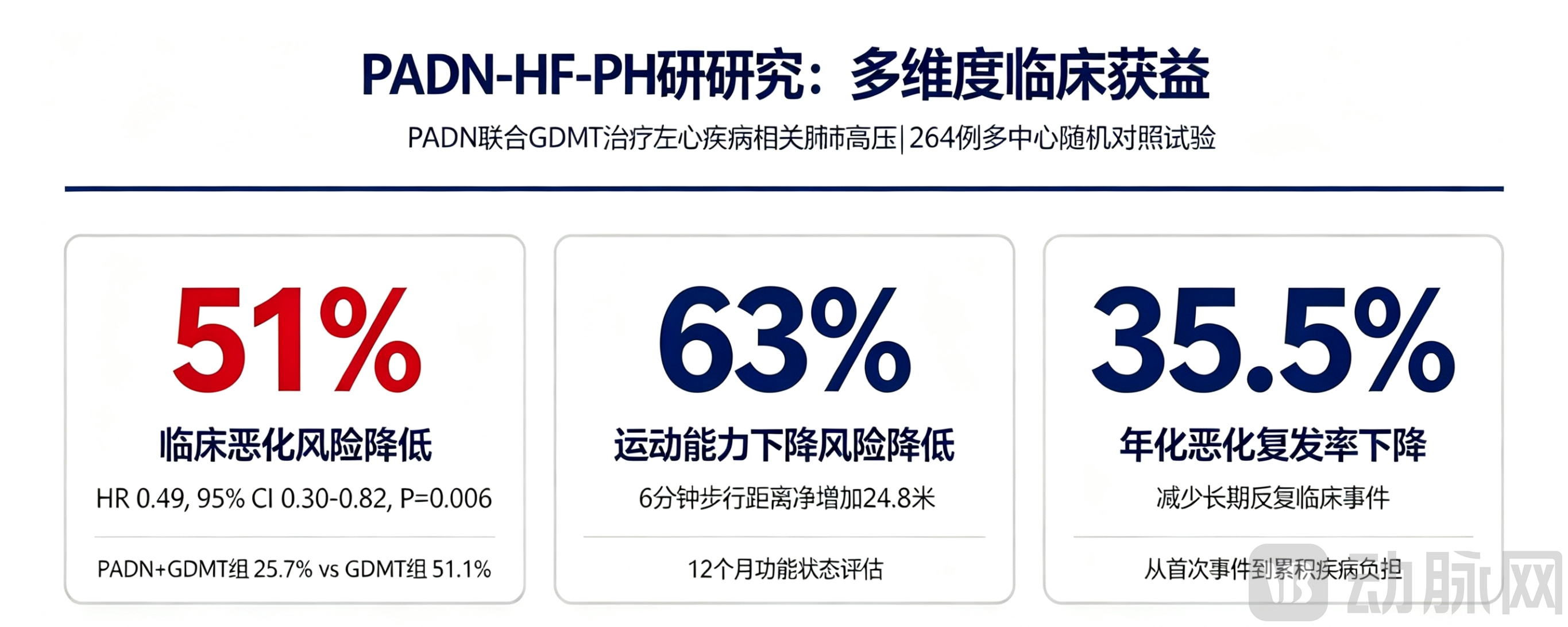
The positive results of PADN-HF-PH did not disappoint. After a median follow-up of 338 days, Kaplan-Meier estimates at two years demonstrated that PADN combined with guideline-directed medical therapy (GDMT) significantly reduced the risk of clinical worsening by 51% (HR 0.49, 95% CI 0.30–0.82; P=0.006), thereby significantly improving mid- to long-term therapeutic outcomes in patients.
More importantly, this benefit is not short-term. PADN-HF-PH data show that PADN combined with GDMT reduced the annualized rate of clinical worsening recurrence by 35.5%. For patients with heart failure, the disease burden posed by repeated hospitalizations is often heavier than that of a single event; the significant reduction in recurrence rates indicates that PADN exerts a sustained intervention on the disease progression.
In terms of functional protection, PADN also demonstrates differentiated value. Studies have shown that PADN combined with GDMT reduces the risk of declining exercise capacity by 63%, achieving a net improvement of 24.8 meters in the six-minute walk distance (6MWD). In the field of pulmonary hypertension, an improvement in 6MWD of ≥15 meters is considered clinically significant, and the 24.8-meter advantage far exceeds this threshold. In other words, PADN prevents the progressive deterioration of patients' functional status, which is highly significant for chronic progressive diseases such as PH-LHD.
From the improvement of hemodynamic parameters to the reduction in the risk of hard endpoints, and further to the alleviation of long-term disease burden, the PADN-HF-PH study has achieved a critical leap through multi-dimensional, large-scale data. This signifies that PADN not only improves physiological indicators but also delivers tangible clinical benefits to patients.
For cardiologists worldwide, the PADN-HF-PH data are reshaping the treatment decision-making framework for PH-LHD, serving as a critical foundation for global clinical adoption and marking the transition of PADN’s role from experimental exploration to a candidate for standard therapy.
Looking back from the pinnacle of global cardiovascular academic conferences, the previous milestones of Pama Medical's PADN technology clearly outline a path for a Chinese original technology to ascend to the peak of global cardiovascular innovation.
To understand why PADN was published in a top-tier journal, we must return to the origin of clinical needs. For a long time, heart failure-associated pulmonary hypertension has lacked effective interventions, with existing medications often failing to address all aspects comprehensively. PADN breaks away from the traditional biochemical drug pathway by inhibiting excessive sympathetic nerve activation in the pulmonary arteries through a single surgical procedure, simultaneously improving pulmonary vascular resistance and pulmonary artery wedge pressure—this is currently the only interventional approach proven to concurrently improve these two core hemodynamic parameters.
From a clinical value perspective, PADN offers patients a novel therapeutic option; from a commercial logic standpoint, its position as the world’s first-in-class therapy means it will not face direct substitution competition during the initial commercialization phase, thereby enjoying a longer window for market education and greater pricing flexibility.
Certainly, focusing on high-risk populations and refractory diseases where existing treatments are inadequate inevitably entails greater uncertainty in the development of original technologies.
Pulnovo Medical chooses to face the challenges head-on, Accumulating clinical evidence through a globalization strategy that combines original technology with globally synchronized, evidence-based practices. Pulnovo Medical’s academic publications have consistently targeted top-tier global platforms, progressively resolving uncertainties through a stepwise evidence-based research approach. From PADN-5 to PADN-Columbus, and further to PADN-HF-PH, multiple multicenter, randomized, sham-controlled clinical trials have established a comprehensive evidence system supported by long-term follow-up data.
In 2013, the PADN-1 Phase I pilot study on Pulmonary Artery Denervation (PADN) was published in JACC, marking the first international demonstration of the safety and efficacy of the PADN procedure and addressing the question of its technical feasibility.
In 2018, the primary results of the PADN-5 trial were presented at the TCT conference and simultaneously published in JACC: Cardiovascular Interventions, providing the first confirmation of the clinical benefits of PADN in patients with combined post-capillary and pre-capillary pulmonary hypertension (Cpc-PH) secondary to left heart failure.
In 2023, the three-year follow-up results of PADN-5 were published in JACC: Heart Failure, further validating the long-term safety and efficacy of PADN therapy. PADN treatment can significantly reduce the incidence of clinical worsening in patients with cpc-PH.
Data published earlier on leading academic platforms have thoroughly validated the feasibility of PADN technology; however, Pulnovo Medical did not remain at the stage of exploratory research but has continued to verify its value in reshaping clinical practice through large-scale, global multicenter clinical trials.
The PADN-Columbus international multicenter study was first presented at EuroPCR, demonstrating the reproducibility of the technique across different healthcare systems and among various operators. This indicates that PADN has a solid foundation for standardized promotion.
The PADN-HF-PH study, a multicenter randomized controlled trial (RCT) involving 264 patients across 25 centers, was featured as an ESC Hot Line presentation and simultaneously published in the New England Journal of Medicine (NEJM). This study provided the highest level of clinical evidence, demonstrating that this technology can significantly alter clinical outcomes with statistical significance and improve patient functional status in real-world clinical settings.
The clinical results of PADN, ranging from proof-of-concept to validation of efficacy and safety, have been successively published in top-tier global academic conferences and journals, which itself constitutes an authoritative endorsement of the study design, execution quality, and scientific value.
This technology is also accelerating its industrial translation. PADN has been cited in seven domestic and international clinical guidelines, marking a transition from expert consensus to standard treatment recommendations.
PADN therapy for Group 1 pulmonary hypertension has received regulatory approval in 12 countries and regions. For Group 2 pulmonary hypertension (PH-LHD), PADN is accelerating its entry into global regulatory systems, with the PADN-HF-PH study laying the foundation for its approval in the treatment of Group 2 pulmonary hypertension.
Currently, the PULSE-LHD clinical study, an Investigator-Initiated Clinical Trial (IDE) targeting Group 2 pulmonary hypertension, has been fully launched. Clinical trials have commenced at more than a dozen top-tier medical centers worldwide, including Cleveland Clinic, Mayo Clinic, Mount Sinai Hospital, Yale School of Medicine, and Weill Cornell Medicine. The enrollment of the first cohort of patients in the United States was recently completed.
From an industry perspective, PADN has established a high-quality clinical evidence-based system with comprehensive evidence and robust data in the field of interventional therapy for pulmonary hypertension and heart failure, demonstrating a strong exemplary effect.
These robust clinical data not only demonstrate that China’s original technologies are fully capable of producing world-class academic achievements, but also secure top-tier strategic endorsements from the global industry through their foundational innovative strength. Pulnovo Medical has attracted significant support from leading institutions, including Medtronic, a global giant in the medical device sector. The deep endorsement by Medtronic signifies high recognition of PADN’s solid evidence-based foundation and substantial value in clinical translation, marking the successful completion of the critical loop from cutting-edge academic exploration to global industrial commercialization for PADN.
The PADN-HF-PH study provides top-tier, NEJM-level evidence-based medicine, offering a new therapeutic pathway for patients with pulmonary hypertension associated with left heart disease, a common form of pulmonary hypertension. The value of the PADN-HF-PH study extends far beyond the success of a single randomized controlled trial (RCT). It is pivotal in driving the evolution of heart failure treatment from pharmacological monotherapy toward a synergistic approach combining drugs and medical devices. Under this new therapeutic paradigm, PADN, supported by robust evidence and regulatory approvals in multiple countries, is transforming a Chinese innovation into a global standard. This represents not only a reshaping of the treatment landscape but also a profound shift in the global discourse power within the cardiovascular intervention industry, signifying that Chinese technology has begun to provide solutions to world-class clinical challenges.